
The way most applicants write CV descriptions is lazy, vague, and leaves points on the table.
You see it every year: brilliant students with strong achievements hiding behind fuzzy verbs and sterile bullet points. Then they are shocked when “we thought you would have interviewed better based on your file” quietly translates to “your application did not look as good as you thought.”
Let me be direct. If you do not understand how to handle quantitative vs qualitative achievements in your CV descriptions, you will undersell yourself. Especially in a residency application environment where reviewers skim, not study.
Time to fix that.
The Core Problem: You Are Either a “Number Dumper” or a “Poet”
Most residency applicants fall hard into one of two camps.
The number dumper
Every bullet: “X publications, Y presentations, Z hours.” Everything is metric. Nothing is meaningful. Reads like a budget spreadsheet.The poet
Every bullet: “Passionate about teaching and committed to compassionate patient care in underserved communities.” Zero numbers. Zero specifics. Just vibes.
Both are wrong.
Program directors and selection committee members want two things at once:
- A quick, objective sense of scale and impact (quantitative).
- A concise, credible sense of quality and context (qualitative).
You need both. In the right proportion. In the right places.
What Quantitative vs Qualitative Actually Means on a Residency CV
Let me break this down with surgical precision.
Quantitative elements = Anything you can count, rank, or measure.
Publications, presentations, number of sessions taught, clinic volume, Step scores (not on CV usually), budgets, hours, percent improvement, ranks, match rate of mentees, etc.Qualitative elements = Anything that speaks to quality, complexity, uniqueness, or reputation that is not a number.
“Selective rotation,” “competitive national program,” “invited grand rounds,” “first author on guideline,” “senior resident chosen by chair,” “new clinic workflow adopted across department.”
Most applicants think “quantitative = impressive” and “qualitative = fluff.” That is wrong. A bullet with pure numbers but no qualitative frame often reads bland and small.
Think about it:
- “Conducted 300 patient encounters”
vs - “Managed a high-acuity inpatient panel with progressive autonomy, including night float cross-cover for 60–80 patients per shift”
Now combine both:
- “Independently managed 300+ inpatient encounters over 8 weeks on a high-acuity medicine service, including night float cross-cover for 60–80 patients per shift.”
That is how you anchor numbers in real clinical substance.
Where Each Type Belongs on the CV
Different sections tolerate different ratios of quantitative vs qualitative content. If you mix them wrong, reviewers get annoyed or confused.
| CV Section | Emphasis |
|---|---|
| Education | Mostly quantitative |
| USMLE/COMLEX (if listed) | Purely quantitative |
| Research Experience | Balanced |
| Publications/Presentations | Mostly quantitative |
| Leadership/Service | Balanced |
| Teaching | Balanced |
| Honors/Awards | Qualitative-first |
| Clinical Experience | Qualitative + scale |
Education
You do not need flowery writing here.
- Medical school, institution, degree, dates.
- Class rank or quartile if strong and provided by the school.
- Maybe a very short phrase if the program is unusual (e.g., “6-year BS/MD track”).
Example (correct):
- Doctor of Medicine, University of Michigan Medical School, 2020–2024
- Graduated with Distinction; Top 10% of class
No extra flavor text. No “completed rigorous curriculum.” Everyone did.
Research Experience
Here you need both.
Bad patterns I see all the time:
- Over-quantified: “Completed 3 projects, 2 abstracts, 1 poster.”
- Over-qualitative: “Worked in a busy translational oncology lab studying novel biomarkers.”
Better pattern:
- Role and area (brief).
- Your specific contribution.
- One or two concrete outputs (quantified).
- One qualitative marker of impact or complexity.
Example:
- Clinical Research Fellow, Advanced Heart Failure, Brigham and Women’s Hospital
Designed and coordinated a prospective registry of patients receiving LVAD therapy; led data collection for 120+ patients, performed multivariable analysis in R, and presented preliminary outcomes at the 2024 ACC Annual Scientific Session.
Notice:
- Numbers: 120+ patients, 2024 ACC
- Qualitative: prospective registry, advanced heart failure, ACC (big meeting)
No fluff words like “novel” or “cutting-edge” needed; the context does the work.
Publications / Presentations
This section is naturally quantitative. But people still mess it up.
Reality: The main qualitative signal here is authorship position and venue.
Compare:
- “Smith J, You A, et al. Journal of Surgical Case Reports.”
vs - “You A, Smith J, et al. Annals of Surgery.”
Second one hits harder. Immediately.
Structure it clearly; then, if you want, pull out the most impactful ones and highlight them in a “Selected Works” subsection with one-line qualitative descriptors.
Example (for a selected item):
- You A, Patel R, et al. “Early Mobilization after Whipple Procedure Is Associated with Reduced LOS.” Ann Surg. 2024 (accepted, in press).
First-author original study; oral plenary presentation at ACS Clinical Congress 2023.
You did:
- Quantitative: first-author, 2023, LOS (implied measurable), plenary (selective)
- Qualitative: “plenary” and “Ann Surg” do heavy lifting.
Do not write: “High impact journal” or “prestigious national conference.” That screams insecure.
Leadership / Service / Committees
This is where applicants swing too far into qualitative fluff.
Bad example:
- “Demonstrated strong leadership as class representative, advocating for peers and ensuring effective communication between students and faculty.”
That tells me nothing.
Better:
- Elected Class Representative, M3, University of Colorado SOM
Served as primary liaison for 160+ classmates, organized quarterly town halls with the dean’s office, and successfully proposed schedule adjustments that reduced overnight call frequency on required rotations.
Here you have:
- Quantitative: 160+ classmates, quarterly town halls, specific target (overnight call)
- Qualitative: “elected,” “primary liaison,” clear institutional impact
The Most Common CV Description Mistakes (And How to Fix Them)
Let me walk through the mistakes I see repeatedly in ERAS CV descriptions, especially when I review preliminary drafts before September.
1. Using Numbers with No Context
“Completed 250+ hours of community service.”
Compared to what? Over how long? Doing what? With what level of responsibility?
Fix the structure:
- Define setting or population.
- State your role.
- Then drop the number as a way of showing scale, not as the star of the show.
Example transformation:
- Before: “Completed over 250 hours of community service.”
- After: “Coordinated a weekly free clinic for uninsured patients in West Baltimore, providing 250+ hours of direct patient navigation, medication assistance, and follow-up coordination across 18 months.”
Now the 250 means something. It attaches to real work.
2. Purely Qualitative Descriptions That Sound Like Brochure Copy
“Actively participated in cutting-edge spine surgery research to improve patient outcomes.”
This sort of sentence lives everywhere. It says nothing about you.
Fix: Ask 3 blunt questions about each bullet.
- What did you actually do with your own hands or brain?
- Who or what changed because you were there?
- Can you quantify any part of that change or scope?
Example change:
- Before: “Actively participated in cutting-edge spine surgery research to improve patient outcomes.”
- After: “Abstracted perioperative data for 210 lumbar fusion cases, built a REDCap database, and co-authored an analysis showing a 15% reduction in LOS after implementation of an ERAS pathway.”
Now we have a real person doing real things. With numbers that attach to a concretely described intervention.
3. Converting Everything into Fake Metrics
On the flip side, some applicants manufacture numbers for everything. “Impacted 1,000+ community members.” “Reached 500+ learners.” Often clearly made up.
Program directors can smell fake numbers. It looks desperate.
Only quantify when:
- You actually tracked it.
- You can reasonably estimate it (and you would say the same number in an interview without blinking).
- The number adds clarity, not noise.
If you ran a longitudinal mentorship group with 6 M1s, just say “6 mentees,” not “impacted over 6 learners annually.” You are not marketing software.
How to Combine Quantitative and Qualitative in One Strong Bullet
There is a simple template that works across 80–90% of residency CV entries.
Action + Scope + Method/Responsibility + Outcome (preferably quantified)
Example for teaching:
- “Led weekly small-group EKG interpretation sessions for 12 second-year medical students, creating case-based materials and practice quizzes that were later adopted by the course director for use across the entire class.”
Quantitative:
- Weekly, 12 students, “entire class”
Qualitative:
- “Led,” “case-based,” “adopted by course director”
Notice how none of this is “passionate about medical education.” You show it instead of declaring it.
Another for QI:
- “Co-led a multidisciplinary QI project to reduce unnecessary daily labs on the inpatient medicine service, developing a decision-support checklist that decreased CBC orders by 22% over 3 months without any increase in rapid response calls.”
Numbers: 22%, 3 months
Quality: multidisciplinary, decision-support checklist, maintained safety
This is the level of precision that makes PDs stop skimming and actually read.
The Special Case: Subjective Achievements With No Clean Metric
Some of your best accomplishments will not have easy numbers.
- A patient’s family writing a letter naming you specifically
- The chair pulling you aside and saying, “You handled that code better than some of our incoming interns”
- Getting selected informally to present your case to visiting faculty
These are qualitative gold if you use them correctly and very sparingly.
Do not write:
- “Frequently praised for excellent bedside manner.”
- “Recognized as one of the strongest students by attendings.”
That reads as insecure and unverifiable.
Better strategies:
Tie it to a formal structure.
- “Rated ‘Outstanding’ in all 10 evaluation domains during M4 ICU sub-internship, with specific attending comments highlighting calm leadership during codes and effective family communication.”
Use one vivid, non-dramatic detail.
- “Selected by clerkship director to deliver a case-based teaching session to incoming M3s after strong evaluations on the medicine rotation.”
No adjectives like “amazing,” “exceptional,” “outstanding” unless they appear verbatim in official language (e.g., your school uses “Outstanding” as a top rating).
How PDs Actually Read Your Descriptions
Let me give you the real view from the other side of the table.
Most reviewers:
- Spend maybe 15–45 seconds on your CV section the first pass.
- Are scanning rapidly for:
- Evidence of reliability and work ethic.
- Signal of genuine scholarly engagement (not just checkbox research).
- Examples of initiative and leadership.
- Anything that screams “red flag” or “exaggeration.”
Your goal with quantitative vs qualitative content:
Numbers help them quickly scale you against other applicants:
How many projects, what kind of conferences, obvious productivity.Qualitative snippets give them hooks for interview questions:
“Tell me about that QI project with 22% reduction in labs.”
“How did you end up running small groups for the entire class?”
Where you lose points:
- Ten bullets in a row with no action verbs and pure description of settings.
- Over-justifying or over-selling small roles with grand language.
- Messy, inconsistent formatting that hides key numbers or names.
Formatting Choices That Quietly Signal Maturity
How you present numbers and descriptors visually matters. A few rules that separate polished from amateur.
Consistency in Numbers
Pick a style and stick with it:
- “10” vs “ten” — in a CV, default to numerals for anything measurable.
- “3–4” vs “3-4” — use a proper en dash (if your system handles it) or just “3–4” consistently.
- Use “+” only when it is honest and not obviously manipulative (“200+” is fine; “5+” is silly).
Order Within Bullets
Always lead with the strongest differentiator.
Bad:
- “Helped with data entry and literature review on an oncology outcomes project that included over 1,200 patients at a major academic center.”
Better:
- “Contributed to a 1,200-patient oncology outcomes study at a tertiary academic cancer center, performing data abstraction and literature review for analyses of survival predictors.”
You frontload scale and setting, then describe the grunt work.
Use of Institution Names as Qualitative Signal
You do not need to say “prestigious.”
You can simply write:
- “Summer Research Fellow, Memorial Sloan Kettering Cancer Center – Thoracic Oncology Service.”
Institution name already implies the weight. Let the reader think it without you declaring it.
Specialty-Specific Nuances in Quantitative vs Qualitative Emphasis
Not every specialty cares about the same balance. Some patterns I have seen:
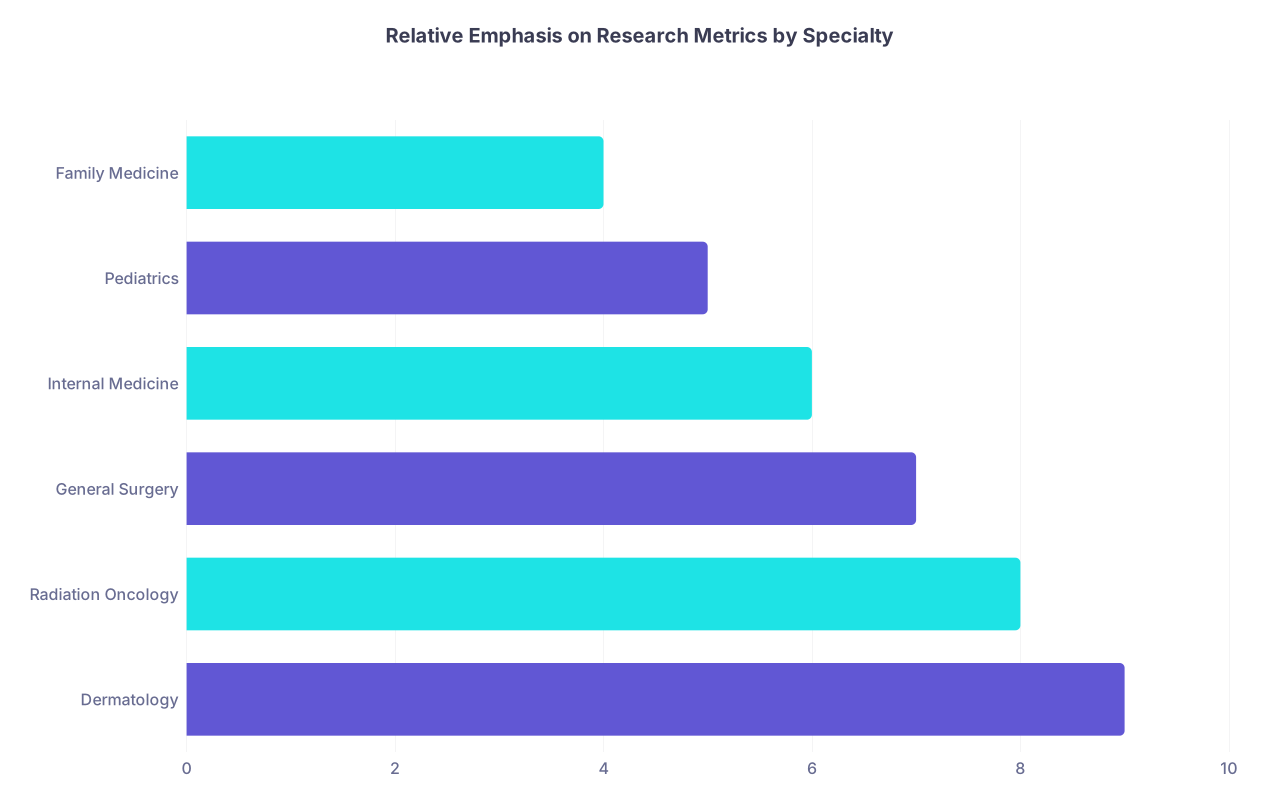
| Category | Value |
|---|---|
| Dermatology | 9 |
| Radiation Oncology | 8 |
| General Surgery | 7 |
| Internal Medicine | 6 |
| Pediatrics | 5 |
| Family Medicine | 4 |
Interpret this as: your CV for derm better show clearer, stronger, cleaner research numbers than a typical FM application, where longitudinal community engagement and teaching might carry more narrative weight.
Research-heavy specialties (Derm, Rad Onc, some IM subspecialty tracks)
- You need quantitatively clear evidence of productivity:
- Publications, abstracts, posters, years in lab, major grants.
- But the differentiator is usually the qualitative description of your actual role.
PDs can distinguish “data monkey on 7 papers” from “drove one solid first-author publication.”
Example for derm:
- “Completed a dedicated research year in cutaneous lymphoma at MD Anderson, leading a retrospective cohort study (n=180) on treatment patterns, serving as first author on a manuscript under revision for J Am Acad Dermatol, and presenting two abstracts at SID 2024.”
Clinically heavy, community-facing specialties (FM, Psych, Peds)
- Your quantitative data will lean more on:
- Continuity clinic volume.
- Community service hours.
- Number of teaching sessions or curricula.
But the real strength is in:
- Longitudinal relationships.
- Specific patient populations.
- Concrete program building.
Example for family medicine:
- “Co-founded a longitudinal diabetes group visit program at a federally qualified health center, coordinating monthly sessions for 10–15 Spanish-speaking patients, integrating nutrition counseling and medication reconciliation, and achieving an average A1C reduction of 0.8 points over 6 months among consistent attendees.”
Red Flags: Where Quantitative and Qualitative Clash
There are a few patterns that quietly raise eyebrows on selection committees.
1. Big Numbers, Tiny Titles
If you claim enormous scope with a junior title, it looks off.
- “As an M1 volunteer, led QI restructuring of the hospital’s ED triage system affecting 50,000+ annual visits.”
Really? An M1 led major ED triage restructuring? Doubtful.
Safer, more believable phrasing:
- “As an M1 volunteer, contributed to a resident-led QI project to streamline ED triage documentation, piloted in a high-volume academic ED (50,000+ annual visits).”
Now you are part of the team, not single-handed savior of the system.
2. Glowing Qualitative Claims with No Hard Evidence
Bullets like:
- “Consistently recognized as a top student on all rotations.”
If that is true, you better have Honors in everything and a strong MSPE to back it up.
Better:
- “Received Honors in 7 of 8 core clerkships, with narrative evaluations highlighting teamwork, organization, and patient communication.”
You just let the numbers and structure imply “top student.”
3. Overcompensation in Weak Areas
Applicants sometimes try to “talk around” weak metrics (e.g., no publications, limited research) with flowery qualitative language.
- “Engaged deeply with cutting-edge cardiology research to expand my understanding, even when projects did not progress to publication.”
That is not helping you.
Own your role and scope without apologizing or inflating:
- “Assisted with chart review and data collection for two cardiology outcomes projects; although neither progressed to publication during my involvement, the experience strengthened my skills in database management and critical appraisal of clinical literature.”
That is honest. Mature. And it will not trigger skepticism.
A Concrete Rewrite Example: Before and After
Let me show you how this actually looks when we fix a few entries.
Original CV excerpt (typical draft)
Research Assistant, GI Lab
Helped with data collection and analysis for several projects. Presented findings and participated in meetings.Volunteer, Student-Run Free Clinic
Completed 150+ hours providing care to underserved patients. Interpreted and helped with triage as needed.Teaching Assistant, Anatomy
Worked with M1s during anatomy lab and helped them understand structures.
Rewritten with proper quantitative + qualitative balance
Research Assistant, Gastroenterology Outcomes Lab, University Hospital
Abstracted clinical data for 320 patients undergoing colonoscopy for colorectal cancer screening, assisted with multivariate logistic regression in STATA for a study on adenoma detection rates, and co-authored one abstract presented at DDW 2023.Spanish Interpreter and Clinical Volunteer, Student-Run Free Clinic
Provided 150+ hours of in-person Spanish interpretation and basic triage support for uninsured adults, collaborating with attending physicians and social work to coordinate follow-up for patients with new diagnoses of hypertension and diabetes.Anatomy Small Group Facilitator, M1 Gross Anatomy Course
Led twice-weekly dissection sessions for a group of 8 first-year students, clarified anatomical relationships during lab, and created a set of 30 practice identification questions that the course director later shared with the entire class.
Notice:
- Same underlying experiences.
- Far more precise, grounded, and “real.”
- Numbers support the story instead of pretending to be the story.
How to Audit Your Current CV in 30 Minutes
You can fix a lot in one sitting if you approach it methodically.

| Step | Description |
|---|---|
| Step 1 | Open Existing CV |
| Step 2 | Highlight all numbers |
| Step 3 | Highlight all adjectives |
| Step 4 | Add role/scope/details |
| Step 5 | Keep as is |
| Step 6 | Replace w/ specifics or delete |
| Step 7 | Keep sparingly |
| Step 8 | Re-read section |
| Step 9 | Condense and sharpen |
| Step 10 | Move to next section |
| Step 11 | Section by Section |
| Step 12 | Numbers w/out context? |
| Step 13 | Adjectives w/out evidence? |
| Step 14 | Any bullet 2+ lines of fluff? |
What you are looking for:
- Bullets with only adjectives, no numbers, no concrete actions → rewrite.
- Bullets with only numbers and no sense of what you actually did → add verbs and context.
- Any sentence you could copy-paste into 20 other CVs without changing a word → fix it.
Where This All Fits in Your Overall Application Strategy
Your CV is not the personal statement. It is not the MSPE. It is the toolbox inventory.
Handled well, your quantitative and qualitative achievements in the CV:
- Give PDs an at-a-glance map of what you have actually done.
- Provide hooks for strong letters to echo and reinforce.
- Set up your personal statement to focus on narrative and reflection instead of rehashing vague descriptions.
Handled poorly, you force reviewers to guess what was real and what was inflated. Most will not bother guessing. They will assume the middle of the road and move on to the next file.
You do not need flowery prose. You do not need page-long descriptions. You need:
- Precise verbs.
- Honest, meaningful numbers.
- Selective, concrete qualitative details.
Get that right, and the rest of your application has room to breathe.
With your CV descriptions sharpened, you are finally giving programs something solid to work with. The next step is learning how to align those same achievements with your personal statement and interview stories so everything feels coherent and intentional. That alignment is what turns a “good file” into an easy “yes” at rank list time—but that is a discussion for another day.