
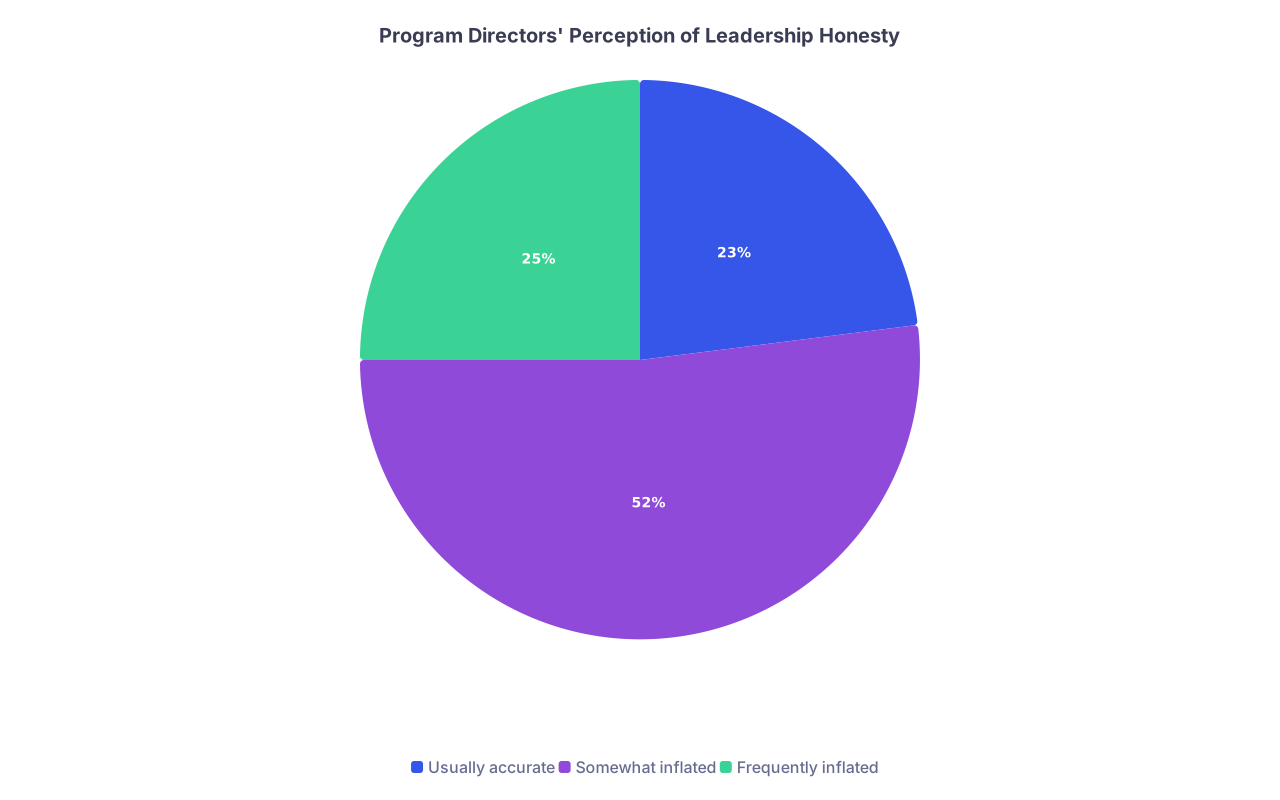
Only 23% of program directors believe applicants “usually” describe leadership roles accurately on ERAS.
The other 77% think you are stretching, relabeling, or outright inflating what you actually did.
Let me be blunt: “Leadership inflation” is one of the fastest ways to make your ERAS look fake, generic, and forgettable. And it is everywhere—especially among otherwise strong applicants who think they need to “pad” their leadership to look competitive.
You do not need more leadership on paper. You need your existing roles calibrated correctly, described precisely, and matched to what residency programs actually value.
Let’s break this down.
What “Leadership Inflation” Actually Looks Like
Leadership inflation is not just lying. Most people are not fabricating positions. They are doing something more subtle and, in some ways, more damaging:
- Up-titling minor participation into “executive” roles
- Calling routine tasks “strategic leadership”
- Turning one-off efforts into “programs” or “initiatives”
- Using vague, grandiose language that hides the actual work
| Category | Value |
|---|---|
| Usually accurate | 23 |
| Somewhat inflated | 52 |
| Frequently inflated | 25 |
Here is what I see repeatedly on ERAS drafts:
“Founder and CEO, Student Wellness Organization”
Reality: You started a WhatsApp group and hosted two peer debriefs.“Director of Clinical Operations, Free Clinic”
Reality: You managed the scribes’ schedule twice a month.“Chief Research Coordinator”
Reality: You consented patients and entered REDCap data.
The problem is not that these are worthless. They are not. The problem is that the titles and descriptions do not match the scope, scale, or complexity of what you actually did. Program directors notice that mismatch instantly.
And once they suspect you are inflating one thing, they start doubting everything.
How Programs Actually Evaluate “Leadership”
Most applicants assume “leadership” means “big title.” Chief. President. Director. Founder.
Residency programs are not that naive.
They care about three things:
- Responsibility – What were you actually accountable for?
- Impact – Did anything meaningful change because of you?
- Durability – Was this sustained over time, or a 2-week burst?
I have heard variations of this from PDs in IM, EM, and surgery:
“I don’t care if they were ‘President’ of something if it met twice and did nothing.”
“Show me where they took ownership when something could have failed.”
So when they read your ERAS, they are mentally stripping away your title and asking:
- What decisions did you make that affected other people?
- What would have fallen apart if you stopped showing up?
- Did you build, fix, or improve anything that outlived your immediate involvement?
That is leadership.
Not the word “president.” Not “chair.” Not “founder.”
Calibrating Titles: What’s Reasonable, What’s Ridiculous
Let’s be concrete. Here is where most applicants get into trouble: they over-upgrade ordinary roles into “executive” sounding titles.
Use realistic, widely understood titles. Reserve “director,” “founder,” “executive,” “chief,” or “coordinator” for roles that actually involved organization-wide responsibility.
| Actual Role | Reasonable Title | Inflated / Misleading Title |
|---|---|---|
| Scheduled volunteers for student clinic | Clinic Scheduling Lead | Director of Clinical Operations |
| Ran 3 workshops for M1s | Peer Teaching Coordinator | Director of Undergraduate Medical Ed |
| Started small peer support group | Organizer, Peer Support Group | Founder & CEO, Wellness Organization |
| Managed one project in QI lab | Project Lead, QI Initiative | Program Director, Quality Improvement |
Here is the calibration rule I use when editing ERAS:
- If you were one of many similar-level students doing roughly the same thing → avoid “director,” “executive,” “chief.”
- If you reported to a faculty or admin who made the main decisions → use “coordinator,” “lead,” or “representative” instead of “director.”
- If there was no formal structure, no formal membership, no budget, no reporting lines → be extremely cautious using “founder.”
When “Founder” Is Legitimate
You can call yourself a founder when:
- You identified a gap and created a new, structured program or organization
- It had recurring activities, not a one-off event
- Others besides you participated, and it persisted beyond your direct daily involvement
- There is documentation: website, flyers, emails, official recognition, or budget
“Founder, Near-Peer Anatomy Tutoring Program” can be entirely reasonable if you:
- Pitched the idea to the course director
- Recruited and trained tutors
- Built the schedule and feedback process
- Ran it for a year and handed it off to successors
Calling yourself “Founder” because you created a shared Google Drive or a Slack workspace is ridiculous. That is how you lose credibility.
Describing Roles: Translate Tasks into Real Responsibility
You can have a modest title and still demonstrate powerful leadership—if you describe the role properly.
Where applicants mess up is either:
- Inflating with vague, MBA-word-soup language, or
- Underselling with a bland bullet list of tasks
You want something in the middle:
- Concrete enough to be believable
- Scoped enough to show what you owned
- Focused enough to show change or outcome
Structure your experience descriptions like this:
- Scope – Whom or what did you oversee?
- Action – What did you actually do?
- Impact – What changed, improved, or scaled as a result?
Bad:
“Led quality improvement initiative to improve patient care and enhance workflow efficiency.”
Better:
“Co-led a team of 4 students and 2 nurses to redesign medication reconciliation workflow for a 20-bed internal medicine ward, reducing average reconciliation time from 18 to 11 minutes over 3 months.”
The second version does not need the word “leader” anywhere. The leadership is obvious from the content.
Common Leadership Inflation Patterns on ERAS
Let me point out the three most common patterns I see when I review CVs and ERAS applications.
1. Committee Member → “Board” or “Executive Council”
Scenario: You were one of 12 people on a student interest group steering committee. You attended meetings, maybe volunteered for one project.
What I see on ERAS:
“Board Member, Executive Council, Internal Medicine Interest Group”
“Responsible for strategic direction and oversight of all group operations.”
Reality: You mostly approved event dates and attended lunch talks.
Fix:
“Steering Committee Member, Internal Medicine Interest Group”
“Helped plan and execute 6 career and skills workshops annually; personally organized a 40-attendee EKG interpretation session with faculty.”
You did not lose anything by stripping the grandiosity. You gained credibility.
2. Routine Work → “Program Management”
Scenario: You were a volunteer physician navigator or clinic volunteer who came regularly and became “the reliable one.”
What appears on ERAS:
“Program Manager, Student-Run Free Clinic”
“Oversaw operations and coordinated patient flow to optimize services.”
Reality: You checked patients in, roomed them, occasionally helped clarify which forms to use, and maybe trained one new volunteer.
Fix:
“Senior Volunteer, Student-Run Free Clinic”
“Completed >120 volunteer hours; served as informal point-person for onboarding new volunteers and troubleshooting clinic workflow on busy nights.”
That is leadership through reliability and informal influence. No invented title required.
3. One Event → “Longitudinal Initiative”
Scenario: You co-organized a single conference, health fair, or one-day workshop.
What gets written:
“Director, Community Health Outreach Initiative”
“Led multi-faceted outreach program improving access to care in underserved population.”
Reality: You rented a space, coordinated 10 volunteers, ran one blood pressure and glucose screening day.
Fix:
“Co-organizer, Community Health Screening Event”
“Coordinated 10 volunteers and 3 community partners to provide BP and glucose screenings for 85 participants; implemented simple referral protocol for patients with elevated readings.”
That is still good. And much more believable.
How Program Directors Sniff Out Inflated Leadership
You might think you are being clever. You are not.
Experienced interviewers pick up inflated leadership in three places:
Inconsistency across application components
- ERAS says “Director of Research Operations.”
- LOR from the same lab calls you “a reliable study assistant.”
- That mismatch is fatal.
Lack of detail in interviews
They ask very simple questions:- “What was the hardest decision you had to make in that role?”
- “Walk me through a typical week in that position.”
- “How did you measure whether your ‘initiative’ was successful?”
If you cannot answer with specifics—numbers, names, stories—they know you have inflated.
Language shift
Applicants with real leadership:- Use concrete details: attendance, frequency, specific problems they solved
- Mention people: “our M1 class,” “the clinic nurses,” “the Dean of Students”
- Talk about failure or resistance and how they adapted
Applicants with inflated leadership:
- Hide behind vague phrases: “strategic planning,” “oversight,” “facilitated improvements”
- Never mention numbers or scale
- Cannot describe a single difficult conversation they had to navigate
I have sat in rank meetings where someone literally says, “I don’t believe half of this,” and the table nods. That applicant never stands a chance, even with strong scores.
Calibrating Roles Without Underselling Yourself
The solution is not to swing to the other extreme and downplay everything.
You do not need to apologize for leading something that was small. You just need to define the scope clearly so expectations are calibrated.
Use scale indicators
Whenever possible, anchor your role with:
- Number of people impacted: “class of 180,” “team of 6,” “clinic serving ~40 patients per night”
- Time span: “over 12 months,” “for 3 consecutive semesters”
- Frequency: “monthly,” “weekly,” “twice per term”
Example:
“Co-leader, M2 Peer Tutoring Group
Co-led weekly review sessions for groups of 10–15 M1s during the renal and cardio blocks over 5 months; created problem sets now used by subsequent student leaders.”
Small scale. Clear. Real leadership.
Name your actual authority
Do not pretend you had more authority than you did. But do state what you were actually allowed to decide.
- “Had final say on speaker selection.”
- “Created and implemented a standardized orientation process.”
- “Redesigned the call schedule template to balance coverage and wellness.”
If you never had to make a decision others depended on, that was not really leadership. That was participation. There is a difference.
How to Clean Up an Already-Inflated CV Before ERAS
If you are looking at your CV right now and cringing: good. That means you can still fix it.
Here is the process I use when I work through applicants’ existing documents.

| Step | Description |
|---|---|
| Step 1 | List all leadership roles |
| Step 2 | Strip titles to neutral labels |
| Step 3 | Write 2-3 sentences of what you actually did |
| Step 4 | Choose calibrated title: lead, coordinator, rep |
| Step 5 | Reclassify as participation or service |
| Step 6 | Quantify scope and impact |
| Step 7 | Align ERAS, CV, and LOR language |
| Step 8 | Did you make decisions others depended on? |
Step by step:
- List each role on a blank sheet without titles. Just: “free clinic,” “interest group,” “research project,” “mentoring.”
- Under each, write what you actually did in plain language, as if you were explaining it to a classmate. No buzzwords.
- Ask: “Would anything have fallen apart if I stopped doing this?”
- If yes → some degree of leadership.
- If no → service, volunteering, participation.
- Pick titles that reflect that answer:
- Real authority over people or processes → “lead,” “co-lead,” “coordinator,” “editor,” “chair” (if that was the program’s term).
- No real authority, but consistent involvement → “member,” “volunteer,” “participant,” “contributor.”
- Re-align everything:
- ERAS entries
- CV
- Personal statement (if mentioned)
- Ask LOR writers to use similar language (you can suggest phrasing in a letter “brag sheet”).
Consistency is non-negotiable. If your CV says “Director” and your letter says “student volunteer,” you look either dishonest or sloppy. Both are bad.
What Actually Impresses Programs More Than Fancy Titles
Here is the part most applicants do not believe until they see it on interview day.
Program directors are often more impressed by:
- A small, well-run, clearly described leadership role
- A tough problem you owned and pushed through
- Evidence that other people trusted you to handle things when they were not around
than by:
- A bloated, buzzword-heavy “President/Director/Founder” entry that falls apart under basic questioning.
So aim to show:
- Ownership over pieces of complex systems (clinic flow, course review, mentoring structure)
- Initiative in fixing something broken, not just maintaining the status quo
- The ability to work through conflict and logistics with adults (faculty, admin, staff), not just your peers
Example that reads extremely well:
“Co-coordinator, Senior-Junion Mentorship Program
Identified inconsistent mentorship for rising M3s; proposed a structured mentor-mentee pairing system to the Office of Student Affairs. Recruited 22 M4 mentors, matched them with 46 M3s, and developed a 3-session small-group curriculum on clinical expectations. Post-year survey: 87% of mentees reported feeling ‘better prepared’ for clerkships.”
No need for “director.” This is mature, believable, consequential leadership.
Quick Self-Check: Are You Inflating?
If you are not sure whether something crosses the line, ask yourself:
- Would a neutral third party who also worked there agree with this title?
- If the PD called my supervisor and read this line aloud, would they nod or raise an eyebrow?
- Could I talk about this role for five full minutes in an interview with concrete examples?
- Do I have at least one specific story that shows challenge, decision-making, and outcome from this role?
If you answer “no” to any of those, scale it back.
You will not lose points for modest, accurate descriptions. You will absolutely lose points for puffed-up nonsense.
Final Calibration Examples (Before & After)
Let me show you three quick rewrites that I have actually done with applicants.
Example 1 – Student Group
Before:
“President, Surgery Interest Group
Directed all operations and coordinated events to improve medical student exposure to surgical careers.”
After:
“Co-president, Surgery Interest Group
Co-led a 6-student board to organize 8 events annually, including skills workshops and career panels for ~60 pre-clinical students; initiated a new resident-student suture lab that is now held each semester.”
Why this is better: Title aligned to actual shared leadership. Specific numbers. Clear initiative.
Example 2 – Research
Before:
“Chief Coordinator, Cardiology Outcomes Lab
Managed all aspects of research operations and coordinated multi-center collaboration efforts.”
After:
“Student Research Coordinator, Cardiology Outcomes Lab
Coordinated data collection for a retrospective outcomes study across 2 hospital sites; created a REDCap data dictionary, trained 3 new student volunteers, and monitored data quality for 420 patient entries.”
Why this is better: Strips away fake “chief,” clarifies scope. Very believable.
Example 3 – Community Outreach
Before:
“Founder & Director, Community Health Initiative
Led comprehensive outreach program to enhance preventive care access for underserved communities.”
After:
“Organizer, Community Blood Pressure Screening Event
Initiated and organized a one-time screening event in partnership with a local church; recruited 5 student volunteers and 2 attending physicians, screened 73 adults, and provided written referrals for 19 with markedly elevated readings.”
Why this is better: Calls it what it is. A good, meaningful, one-time event. That is enough.
FAQs
1. If my school officially called the position “Director,” can I still use that title?
Yes, but calibrate in the description. If your school uses inflated titles (many do), you can keep the official one and immediately clarify scope:
“Student Director (equivalent to co-lead), Student-Run Free Clinic — co-managed weekly schedules for 25 student volunteers and served as the main student contact for faculty preceptors.”
You are signaling honesty by contextualizing the title.
2. How many leadership roles do I need to look competitive?
You do not need a long list. One to three substantial, clearly described leadership roles are more valuable than eight flimsy ones. Programs are looking for evidence that you can take ownership and work with others, not that you collected titles.
3. Should I include leadership from before medical school?
Include pre-med leadership if:
- It was sustained (≥1 year),
- Substantial (real responsibility over people, projects, or budgets), and
- Relevant to residency (teaching, health-related, organizational, advocacy, etc.).
Do not clutter ERAS with every college club you once touched. Pick 1–2 that still speak to who you are now.
4. What if my only leadership is informal (e.g., being the “go-to” person on a team)?
You can absolutely frame informal leadership, as long as you are honest:
“Informal team lead among 4 M3s on our surgery service; coordinated shared patient lists, divided pre-rounding tasks, and served as primary contact for our resident regarding student responsibilities.”
Again: no fake title, but the leadership is clear.
5. Will down-titling my roles hurt me compared to applicants who inflate?
No. The opposite. Programs see thousands of applications and are tired of inflated leadership. You will stand out as more credible, more mature, and easier to trust. That matters more than squeezing “director” or “founder” into a line.
Key points to walk away with:
- Programs care far more about what you owned and improved than the title you gave yourself.
- Overstated leadership is easy for experienced readers to spot and can quietly tank your application.
- Accurate, scoped, specific descriptions of real responsibility—no matter how small—are what actually make you look like someone they want on their team.