
The way most applicants describe research on ERAS is sloppy, repetitive, and quietly killing strong applications.
Let me be blunt: weak research entries are one of the fastest ways for an otherwise solid applicant to look generic. Not because you did bad research. Because you told the story badly.
You are not being judged only on what you did. You are being judged on:
- How you communicate complex work.
- Whether you understand methods and impact.
- Whether you can think like a future academic clinician, not a lab assistant.
Let me break down the most common pitfalls I see every year in ERAS research descriptions—and exactly how to fix each one with concrete structure, phrasing, and strategy.
The Big Picture: What Program Directors Actually Want From Research Entries
Before we dissect mistakes, you need to know the grading rubric in most faculty minds. When they scan your ERAS research section, they are subconsciously asking:
- Did this person do more than grunt work?
- Do they understand the question, methods, and limitations?
- Can they communicate research concisely and clearly?
- Is there a progression or pattern (responsibility, depth, independence)?
- Is there any evidence they finish what they start (presentations, pubs, abstracts)?
They are not reading it like a CV builder. They are reading it like a screening exam in “Can I trust this person with my data, patients, and time?”
Your descriptions either signal “serious, thoughtful, reliable” or “fluffy, superficial, inflating.”
Pitfall #1: Using Vague, Fluffy, Non-Specific Language
This is the single most common problem. Entries that sound like this:
- “Assisted with various tasks in a clinical research lab.”
- “Worked on improving patient outcomes using innovative techniques.”
- “Helped with a project on quality improvement for patient safety.”
This tells the reader nothing. It sounds like filler. It smells like you do not really understand the project.
You need to move from vague → specific, from “helped with research” to “studied X in Y population using Z method, with Q outcome.”
How to Fix It
Use a tight, repeatable structure for each entry:
- One-line project summary (research question + population + method).
- Your specific role and skills.
- Concrete outputs (abstracts, posters, manuscripts, data collection milestones).
- If no output yet, current status + what you are actively doing.
Example of a bad vs good transformation:
Bad:
“Worked on a project studying outcomes of stroke patients in the ICU. Helped with data collection and analysis.”
Good:
“Retrospective cohort study of 320 ICU patients with ischemic stroke to identify predictors of 30‑day mortality. Extracted clinical variables from EHR, built REDCap database, and conducted multivariable logistic regression in STATA under faculty supervision. First author abstract accepted to SCCM 2024; manuscript in revision for Critical Care Medicine.”
Notice what changed:
- Specific design: retrospective cohort.
- Clear sample size and population.
- Named tool: REDCap, STATA.
- Defined outcome: 30‑day mortality.
- Actual deliverable: abstract, manuscript status.
If a faculty member from that field reads your entry, they should be able to guess what your methods section might look like. If they cannot, it is still too vague.
Pitfall #2: Writing Like a Job Description Instead of a Research Story
Many applicants just rattle off tasks:
“Responsibilities included: data collection, chart review, entering data, attending meetings, and assisting with manuscript preparation.”
That is basically a glorified bullet list from a part-time job. It hides the “why” behind the project and says nothing about your intellectual engagement.
Faculty do not want to see “task-doer.” They want to see “junior colleague who gets the big picture.”
How to Fix It
Frame each project around the research question first, then your role within that context.
Template you can reuse:
- “Prospective/retrospective/cross-sectional/experimental study examining [primary question] in [population/setting] using [key method/tools].”
- “My role: [X–Y responsibilities], including [at least one intellectual contribution, not just manual work].”
- “Outcome: [submitted/accepted/presented/in progress].”
Concrete example:
Weak:
“Assisted with QI project in the ED doing data collection and analysis.”
Strong:
“Quality improvement initiative reducing door-to-antibiotic time in septic ED patients. Audited baseline performance across 2,500 visits, identified delays in triage antibiotic ordering, and helped design an EMR order set modification. Created run charts in Excel to track median time before and after intervention; contributed to PDSA cycle design and data interpretation. Poster presented at ACEP regional meeting.”
Notice the flow: question → intervention → your contribution → outcome.
Pitfall #3: Overstating Your Role (Borderline Dishonesty)
This one gets you in real trouble in interviews.
I have seen ERAS entries where a student writes “Designed a randomized controlled trial” when in reality they sat in a meeting, nodded, and then consented patients according to a protocol someone else wrote. Or they list themselves as “primary author” on a manuscript that only exists as a rough draft Google Doc no journal has ever seen.
Program directors, especially research-heavy ones, are very good at sniffing out exaggeration. They also share information. If one interviewer thinks your entry is inflated, they will often ask more pointed questions. That is how your day goes sideways.
Red Flags That You Are Overstating
- Using “first author manuscript” when it is not submitted anywhere.
- Saying “designed study” when you mean “contributed ideas in meetings.”
- Claiming “performed statistical analysis” when you only clicked run on a pre-built R script.
- Presenting “under review at NEJM” for something that has only been submitted there. (Yes, people do this.)
How to Fix It (Without Underselling Yourself)
Use precise phrases that reflect reality but still show contribution:
Instead of “designed study”
Use: “Contributed to study design discussions regarding inclusion criteria and outcome selection.”
Instead of “performed statistical analysis”
Use: “Performed preliminary univariate analyses in R under supervision; assisted with data cleaning and variable coding.”
Instead of “first author paper under review at JAMA” when it is only drafted
Use: “Drafted first-author manuscript; preparing for submission to a peer-reviewed journal.”
If it is actually under review, say so clearly:
“First author manuscript under review at Journal of Hospital Medicine (submitted July 2025).”
Honest, specific, and defensible in an interview.
Pitfall #4: Ignoring the Status and Outcome of Your Work
Half-finished stories are a huge missed opportunity. Faculty look for one thing relentlessly: completion.
Many ERAS entries just say what you did, not what came out of it:
“Worked on a project examining predictors of readmission in heart failure patients.”
And then… nothing. No abstract. No presentation. No status.
This leaves the impression that either:
- The project went nowhere, or
- You do not follow projects through the final steps.
How to Fix It
Every research entry should end with a clear status line. Use one of these categories:
- Completed and published/presented
- Completed and submitted
- Completed analysis, manuscript in preparation
- Ongoing data collection
- Project conceptual stage
You can even explicitly mark this as “Status:” at the end to make it visually obvious in ERAS.
Example statuses that work:
- “Status: Third author paper published in Journal of Neurosurgery (2024).”
- “Status: First author abstract accepted to AHA Scientific Sessions; presenting November 2025.”
- “Status: Data collection complete; performing multivariable analyses and drafting manuscript.”
- “Status: Project on hold due to COVID-19–related recruitment suspension; completed partial dataset analysis for internal report.”
That last one signals something crucial: you stayed engaged even when things stalled.
Pitfall #5: Writing Walls of Text That No One Wants to Read
ERAS text fields tempt people into writing paragraph monsters with no structure, history of the lab, details about the PI’s career, and narrative fluff.
Remember: reviewers are skimming. On a laptop. Often at 11:30 pm. With 60 applications left in the stack.
They are not reading your micro-essay. They are hunting for key data points:
- Topic / question
- Design / methods
- Role / responsibility
- Outcome / status
How to Fix It
You do not need bullets, but you do need structure and economy.
Try a 3–4 sentence maximum rule:
- One sentence: project question + design + population.
- One sentence: your role, including at least one higher-level responsibility.
- One sentence: tools/skills and outcomes.
- Optional sentence: status or unique impact.
Example:
“Prospective cohort study assessing the relationship between frailty index and 90-day readmission in older adults hospitalized for heart failure. Screened and consented eligible patients, administered frailty assessments, and entered data into REDCap; participated in weekly analytic meetings and drafted background and methods sections for manuscript. Learned basic survival analysis in STATA to assist with Kaplan–Meier curves and Cox models. Status: Second author manuscript submitted to JGIM (August 2025).”
Clean. Dense. Very readable.
Pitfall #6: Failing to Connect Multiple Projects into a Coherent Story
Another subtle but costly mistake: your 6–10 research entries look like a random word cloud.
- One dermatology chart review.
- One basic science mouse project.
- One health literacy survey in Spanish-speaking patients.
- One QI project on sepsis alerts.
But in ERAS they just sit there, unconnected. The reader has to work to see any pattern.
Faculty like trajectories. They like to see evolution:
- From grunt work → ownership.
- From simple projects → more complex ones.
- From loosely related → focused interest.
How to Fix It
You are not going to rewrite ERAS into a narrative, but you can design your descriptions to quietly show progression.
Tactics:
- Order matters. Put the most relevant or most “mature” work highest in the research section.
- Recycle language across related projects to signal theme (“perioperative outcomes,” “health disparities,” “neuroimaging biomarkers”).
- Highlight advancement in role: “Initially responsible for data entry… later led data cleaning and analysis for subsequent project.”
Example of showing progression within entries:
Early project:
“Retrospective chart review of 450 patients with spontaneous intracerebral hemorrhage to describe baseline characteristics and in-hospital mortality. Assisted with data abstraction from EHR and reconciled discrepancies with senior residents. Status: Internal departmental presentation; no publication planned.”
Later project (same PI):
“Case-control study investigating radiographic predictors of hematoma expansion in spontaneous intracerebral hemorrhage. Designed REDCap data collection instrument, led data abstraction, and performed inter-rater reliability testing (Cohen’s kappa). Contributed to variable selection for multivariable model. Status: First author abstract accepted to AAN 2025; manuscript in preparation.”
Same disease space, more responsibility. That is what you want them to see.
Pitfall #7: Omitting Technical and Analytical Skills
Many students undersell the concrete tools they actually used. Or they list them separately in the “Experience” or “Other” section and never connect them to actual work.
Program directors want to know: what can you actually do?
Not “familiar with SPSS.” That is meaningless. Can you wrangle a messy dataset, code variables, generate a logistic regression, interpret an odds ratio?
How to Fix It
Embed technical skills naturally inside the project description. Not as a random list.
Name:
- Software: R, STATA, SPSS, SAS, Python, MATLAB.
- Platforms: REDCap, Qualtrics, EPIC reporting tools.
- Techniques: multivariable regression, Kaplan–Meier survival curves, Cox proportional hazards, propensity score matching, thematic analysis for qualitative work.
Example:
Weak:
“Familiar with REDCap and SPSS.”
Strong:
“Built REDCap database with 75 variables; created data quality rules and export templates. Performed descriptive statistics and multivariable linear regression in SPSS to examine associations between BMI and hospital length of stay.”
That tells a PD: this student has actually touched real data.
Pitfall #8: Treating QI and Education Projects as “Lesser” Research
Another epidemic: students label anything not randomized or hypothesis-driven as “just QI” or “just an educational project” and then describe it in two sad lines.
That is a mistake. Many programs care a lot about:
- QI
- Patient safety
- Medical education
These are extremely relevant to your future residency.
How to Fix It
Treat QI and education projects with the same basic research structure:
- Problem or gap.
- Intervention or tool.
- Assessment method.
- Outcome.
Example QI entry:
“Plan–Do–Study–Act (PDSA) QI project to reduce unnecessary telemetry use on a general medicine ward. Identified baseline telemetry utilization and appropriateness using 2017 AHA guidelines across 300 admissions. Developed and implemented an EMR best-practice advisory and resident education module. Monitored monthly telemetry-days per 1,000 patient-days and inappropriate use proportion for 6 months post-intervention, achieving a 25% reduction in inappropriate telemetry orders. Status: Poster presented at SGIM regional conference.”
Example education research entry:
“Curriculum development project creating a simulation-based sepsis recognition module for third-year medical students. Designed case scenarios and checklists, facilitated small-group sessions, and collected pre-/post-session confidence and knowledge assessments. Performed paired t-test analysis showing significant improvement in mean test scores (62% to 84%, p<0.001). Status: Abstract accepted to Clerkship Directors in Internal Medicine (CDIM) meeting.”
That is real, meaningful work. Present it that way.
Pitfall #9: Mislabeling Abstracts, Posters, and Publications
ERAS has separate spaces for:
- Peer-reviewed journal articles/abstracts
- Posters/presentations
- Other research projects
Students often duplicate or misfile things:
- Same abstract listed as “publication” and “poster.”
- Unsubmitted manuscript treated like a publication.
- Internal departmental talk listed as a “national presentation.”
Program directors notice. And they do not like it.
How to Fix It
Be very literal with classifications. If it is not accepted or published, it does not belong in the “Publications” section. Period.
Use the research description to explain where things stand.
| Output Type | Where It Belongs |
|---|---|
| Published journal article | Peer-Reviewed Publications |
| Accepted abstract, national mtg | Peer-Reviewed Abstracts |
| Poster presented at conference | Presentations/Posters |
| Internal departmental talk | Presentations (Internal) |
| Manuscript not yet submitted | Research description only |
If you are not sure whether something “counts,” err on the conservative side and contextualize it in the project description rather than inflate the academic section.
Example clarification in description:
“Presented findings at departmental grand rounds (internal presentation; not peer-reviewed).”
Crystal clear and honest.
Pitfall #10: Failing the “Can I Talk About This for 10 Minutes?” Test
This is where inflated or poorly understood entries blow up during interviews.
Classic scenario:
- You list 8 research projects.
- An interviewer says, “Tell me more about this one,” and points randomly.
- You vaguely remember doing chart review in MS2 and do not recall the main outcome, the sample size, or the key result.
Now you look like a passenger on your own CV.
How to Fix It
Before you submit ERAS, run every research entry through this filter:
“Could I comfortably discuss this project for 5–10 minutes without notes, including:
- The main research question.
- Basic design and population.
- One or two key findings (or expected findings).
- One limitation.
- My personal contribution.
- What I learned or how it shaped my interests?”
If the answer is no, you either:
- Need to refresh your memory and understanding, or
- Need to trim the description so it does not imply more depth than you actually have.
Create a one-page “cheat sheet” for yourself you can review before interviews:
- Bullet per project: question, design, N, main outcome, your role, key result, one limitation.
This is not for ERAS. This is for your brain.
Putting It Together: Example Rewrites
Let us look at a few “before and after” examples.
Example 1: Clinical Research
Before:
“Worked on a study of COPD readmissions. Helped with data collection and entering data into Excel. We are working on a paper.”
After:
“Retrospective cohort study of 520 patients hospitalized with COPD exacerbations to identify predictors of 30-day readmission. Extracted clinical and demographic variables from EPIC into Excel, cleaned and merged datasets, and generated descriptive statistics and univariate analyses in SPSS. Participated in model-building discussions for multivariable logistic regression. Status: Second author abstract accepted to ATS 2025; manuscript in preparation.”
Example 2: Basic Science
Before:
“Assisted in a cardiology lab studying heart failure. Performed Western blots and PCR. Helped with experiments.”
After:
“Bench research in a cardiology lab investigating the role of protein X in murine models of heart failure. Performed Western blotting and qPCR to quantify protein and mRNA expression in treated vs control mice; maintained detailed lab notebook and optimized antibody concentrations for reliable signal. Summarized results for internal lab presentations and contributed figures to a senior postdoc’s manuscript. Status: Anticipated middle-author paper; not yet submitted.”
Example 3: Education Project
Before:
“Helped create an OSCE for medical students and evaluated their performance.”
After:
“Medical education project designing a standardized patient OSCE station on delivering bad news for third-year students. Co-developed case script and assessment checklist, trained standardized patients, and facilitated debriefing sessions. Collected pre- and post-session self-efficacy ratings and narrative feedback, performing thematic analysis to identify common communication challenges. Status: Presented at school-wide education day; drafting manuscript for MedEdPORTAL.”
Visual: How Research Value Accumulates
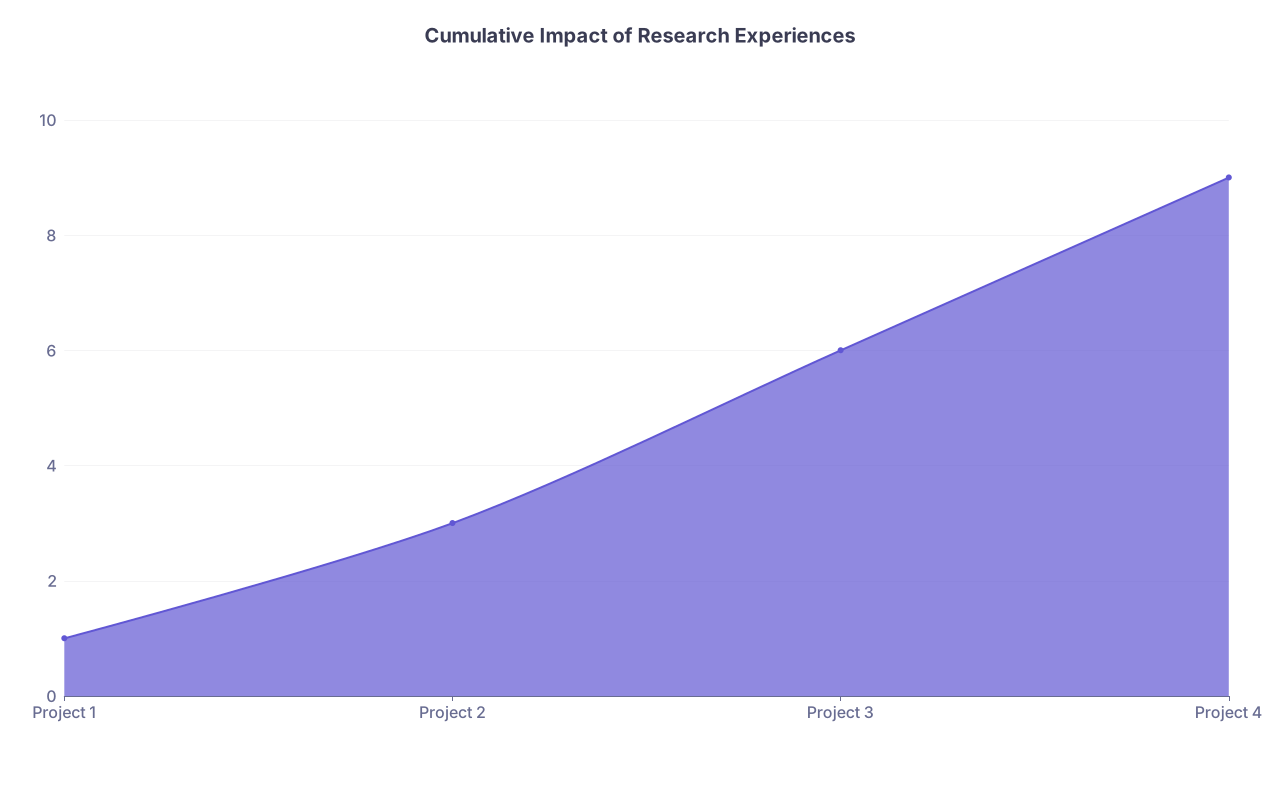
| Category | Value |
|---|---|
| Project 1 | 1 |
| Project 2 | 3 |
| Project 3 | 6 |
| Project 4 | 9 |
Each successive, well-described project should add:
- More responsibility.
- More skills.
- More concrete outcomes.
If you describe them correctly, the curve looks like growth, not noise.
Process: How to Systematically Fix Your ERAS Research Section
Here is how I would do it if I sat down with you and your ERAS draft.

| Step | Description |
|---|---|
| Step 1 | List all projects |
| Step 2 | Identify most important 4-6 |
| Step 3 | For each, write question-design-population sentence |
| Step 4 | Add clear role + skills sentence |
| Step 5 | Add outcomes + status sentence |
| Step 6 | Scan for vagueness or exaggeration |
| Step 7 | Check 10-minute talk test |
| Step 8 | Finalize order and submit |
Do this ruthlessly. Delete fluff. Replace vague verbs with concrete ones. Align everything with what you can actually defend in an interview.
A Quick Word About Formatting and Style
A few style rules that make a difference:
- Use past tense for completed work, present tense for ongoing roles.
“Collected data” vs “Collect data and attend weekly meetings.” - Avoid first person pronouns in the description. You do not need “I.” It is assumed.
- Do not waste space with “I gained valuable experience in…” at the end. Let the substance imply that.
- Spell out unfamiliar acronyms once, especially for niche tools.
And stop trying to make it literary. This is not your personal statement. This is a technical section. Treat it like one.
How Programs Really Read This Section

Most faculty do not read every word. They skim:
- First line: topic and design.
- Last line: publication/presentation status.
- Middle: keywords for methods and role.
They are triaging: is this “serious,” “moderate,” or “lightweight” research?
If you structure your entries the way I laid out, it becomes very easy for them to put you in the “serious and honest” bucket. That is where you want to live.
FAQ (Exactly 4 Questions)
1. How many research entries are “enough” for ERAS?
There is no magic number. I care more about depth and clarity than volume. Three to five substantial, well-described projects with clear roles and outcomes look better than ten thin, vague ones. If you have many small contributions, you can consolidate related minor projects under one entry and briefly list them, instead of bloating the section with near-duplicates.
2. Should I include projects that never led to a poster or publication?
Yes, if you contributed meaningfully and can explain what you did and what you learned. The key is to be honest about the status: “Internal analysis only; no abstract submitted” is perfectly acceptable. Many real research projects die before publication. That is normal. Hiding them is worse than acknowledging that reality.
3. How do I handle being one of many students on a large project?
Be explicit about your slice of the pie. State the overall project question briefly, then zoom in on your part: which patient subset, which data fields, which analyses, which figure, which section of the manuscript. Do not pretend you ran the whole thing. Program directors know big projects involve big teams. They just want to know where you fit in that ecosystem.
4. What if my only “research” is QI or small school-based projects?
Then you describe them extremely well and stop apologizing for them. If you can show you identified a problem, implemented an intervention, measured outcomes, and reflected on the process, that is valuable. Especially for fields like internal medicine, pediatrics, EM, and surgery. Strong, rigorous QI often impresses more than a token basic science stint you barely remember.
You have one shot per application cycle to show programs that you are more than “did some research.” If you fix these pitfalls, your ERAS research section stops looking like a checklist and starts looking like the early profile of the physician-scientist, clinician-educator, or QI leader you are trying to become.
Get that foundation right, and when interview season rolls around, you are not just ready to answer “Tell me about your research”—you are ready to own that entire conversation. What you do with that in the interview room, though, is a different strategy altogether.