The blunt truth: Most applicants either email program directors way too quickly or not at all. Both are mistakes.
If you made an error in your residency application, emailing the PD might be the right move—but only in specific situations. The rest of the time, you fix it quietly and move on.
Here’s how to decide, without guessing.
The Core Rule: Only Email When the Stakes Are Truly High
You do not email a PD for every typo, preference change, or minor oversight. You email when:
- The error could materially change how you’re evaluated
- The program actually needs the corrected information to consider you fairly
- You cannot correct it through ERAS or another normal channel
If all three aren’t clearly true, you probably should not email.
Let’s get concrete.
When You Should Email a PD (or Coordinator)
These are the scenarios where I’ve seen emails help or at least be completely appropriate.
1. You Mis-represented a Major Fact (Even If By Accident)
Examples:
- You listed the wrong USMLE/COMLEX score (e.g., 259 instead of 229, or vice versa)
- You marked a passed exam as failed or vice versa
- You put the wrong graduation year (suggesting you’re still a student when you’re actually a graduate)
- You said you’re ECFMG certified when you’re not, or left off that you are certified
Here, the integrity issue matters more than the embarrassment.
If a program invites you based on incorrect data and discovers the discrepancy later (through official score reports, MSPE, or background checks), that’s far worse than a brief, honest correction email now.
What to do:
– Email the program coordinator first, not always directly the PD
– Be concise, own the mistake, correct the fact, and reassure that ERAS data (or official score reports) are accurate where relevant
2. You Uploaded the Wrong Document to That Program
Examples:
- You attached a personal statement for another specialty or program (e.g., “I’m thrilled at the opportunity to train in neurology” for a medicine program)
- You uploaded the wrong customized personal statement clearly addressed to another institution
- You attached a different program’s name or city multiple times in your PS
This can be fatal if they actually read it before you fix it. But programs are used to seeing occasional mix-ups.
Email is appropriate when:
- The document clearly references another specialty or program by name
- The wrong file significantly changes how you’ll be perceived (e.g., psychiatry PS to surgery program)
What you do:
- Fix the document in ERAS if possible (upload and assign the correct one)
- Then email the coordinator explaining briefly that the wrong version was initially assigned and has now been corrected
- Apologize once. Don’t over-explain.
If you just have a generic PS with no program name but it’s not perfectly tailored? Do not email. That’s not an “error”; it’s just not ideal.
3. You Omitted Truly Critical, Time-Sensitive Information
Examples:
- You just received Step 2 or COMLEX Level 2 scores that are much stronger than Step 1 and that you know programs are waiting on
- You updated ECFMG certification or visa status after application submission
- You had a name change or identity-related change that could affect document matching or communication
- You had a significant status change: graduation date updated, cleared a prior degree issue, resolved a leave that was “pending” in your MSPE
In these cases, programs might filter you out based on old info. Updating them can legitimately change your chances.
Key point: Programs are used to receiving score updates and certification updates. These are routine and acceptable reasons to reach out.
Who to email:
Always start with the program coordinator unless the website explicitly says otherwise. Many PDs prefer that all administrative updates go through the coordinator.
4. You Made a Serious Ethical Error That Needs Clarifying
Rare, but it happens.
Examples:
- You misstated your role in a research project or publication in a way that could look like dishonesty once verified
- You realized a LOR description or title is misleading (e.g., calling someone “Program Director” who’s actually an associate or faculty)
- You mistakenly duplicated the same activity and inflated hours significantly
If there’s a realistic chance the program will view this later as fraud or misrepresentation, you correct it.
Yes, it’s uncomfortable. Yes, it’s still better than them catching it without your explanation.
Here, an email that says essentially, “I realized I wrote X, the accurate description is Y; this wasn’t intentional inflation and I want to be transparent,” is your best option.
When You Should Not Email a PD
This is where most applicants go wrong. They over-contact.
You generally do not email a PD for:
- Typographical errors in your ERAS application
- Small grammar mistakes in your personal statement
- Slightly off activity dates (month vs month +1) that don’t change the story
- Wanting to say “I’m really interested in your program” after submitting, just to “stay on their radar”
- Clarifying something trivial that no one will care about
- Anxiety-driven requests: “Just wanted to check you got my application” (they did)
These emails waste staff time and do not help you. At worst, they mark you as someone who requires a lot of hand-holding.
If you’re asking, “Would I look obsessive if I send this?” the answer is probably yes.
Step-by-Step: A Simple Decision Framework
Use this mini flowchart in your head before emailing.

| Step | Description |
|---|---|
| Step 1 | Notice an application mistake |
| Step 2 | Do NOT email. Fix silently if possible. |
| Step 3 | Fix in ERAS/ECFMG/etc. No email needed. |
| Step 4 | Email program coordinator with brief correction |
| Step 5 | Only loop back if a major new update arises |
| Step 6 | Does it significantly affect evaluation? |
| Step 7 | Can it be fixed directly in ERAS or official systems? |
| Step 8 | Is it about scores, certification, wrong document, or serious misrepresentation? |
If at any point the answer is “no, this doesn’t really affect how they see me,” stop. Do not email.
Who To Email and What To Say (Script Included)
PD vs Program Coordinator vs Generic Address
General rule:
- Program coordinator: first choice for administrative or document-related issues
- Generic program email (like [email protected]): also acceptable
- Program Director directly: reserve for very serious issues, or when the website clearly says PD is the point of contact
If in doubt, default to the coordinator. They manage most communication and will loop in the PD if needed.
How to Structure the Email
You want:
- Subject line that is clear
- One or two short paragraphs
- No drama, no oversharing, no anxiety dumping
Example email for a wrong personal statement:
Subject: Application Update – Corrected Personal Statement
Dear [Program Coordinator Name],
I am an applicant to your [Specialty] residency program for the [20XX] Match (AAMC ID: [ID]). I realized that I initially assigned the wrong version of my personal statement to your program. I have now uploaded and assigned the correct version in ERAS.
I apologize for the confusion and appreciate your understanding.
Sincerely,
[Full Name]
[AAMC ID]
Example for incorrect score reporting:
Subject: Correction to ERAS Application Information
Dear [Coordinator/Dr. Last Name],
I am an applicant to the [Program Name] [Specialty] residency (AAMC ID: [ID]). I noticed that I made an error in my ERAS application regarding my USMLE Step [X] score. I mistakenly entered [incorrect value]; the correct score is [correct value], which is consistent with the official score report transmitted to ERAS.
I wanted to correct this promptly so that my application reflects accurate information. I apologize for the oversight.
Sincerely,
[Full Name]
[AAMC ID]
Doesn’t need to be more complicated than that.
What Programs Actually Care About (Versus What You’re Spiraling About)
You think they care deeply about:
- Two typos in your third activity entry
- One extra “very” in your personal statement
- Your CV being formatted in 11 vs 12-point font
They don’t.
Programs mostly care about:
- Board scores and whether they match the transmitted reports
- Graduating status, visa status, and eligibility
- Major professionalism issues or honesty
- Clear, coherent descriptions of your background
- Whether you look like someone they can trust and teach
Here’s a quick sanity check table.
| Situation | Email? |
|---|---|
| Wrong specialty named in PS for that program | Yes |
| One or two typos in application or PS | No |
| Incorrect Step/COMLEX score entered | Yes |
| Slightly off start/end dates of activities | No |
| New Step 2 score that’s much higher | Yes (update) |
| Generic “I’m very interested” message | No |
If the issue doesn’t land on the “Yes” side of a chart like this, don’t touch it.
How Timing Changes the Decision
Your strategy depends on when you notice the mistake.
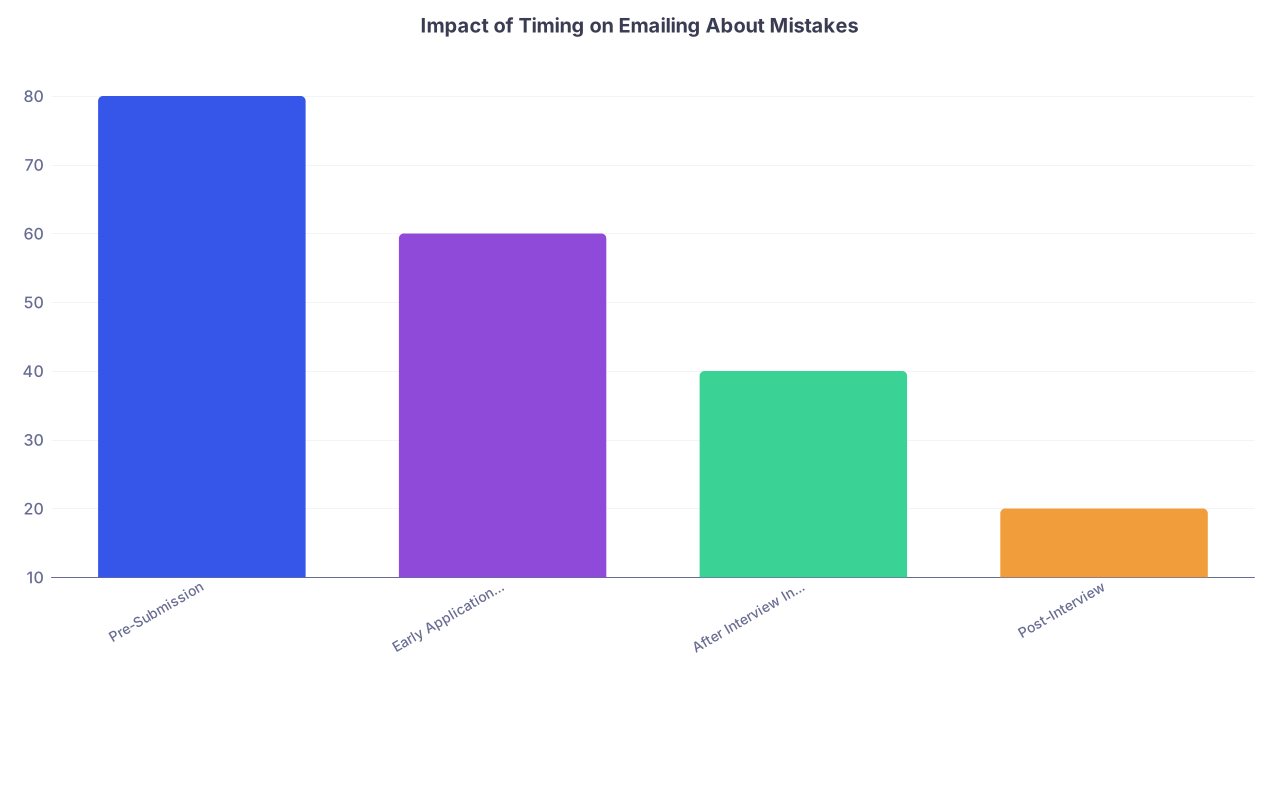
| Category | Value |
|---|---|
| Pre-Submission | 80 |
| Early Application Season | 60 |
| After Interview Invite | 40 |
| Post-Interview | 20 |
Interpretation (rough, but directionally true):
- Pre-submission: 80% of issues can be fixed quietly in ERAS. No email.
- Early season (September–October): Some updates/major fixes are reasonable to email.
- After interview invite: Only major factual or ethical issues warrant an email. Minor items? Let it go.
- Post-interview: Extremely rarely should you email to correct something, unless it’s a serious misrepresentation that could blow up later.
Once you’ve interviewed, every email has disproportionately higher weight. It will be remembered. Use that channel carefully.
Red Flags: Emails That Hurt You
Here are patterns that absolutely work against applicants:
- Multiple emails to the same program about small issues (“one more thing I forgot…”)
- Emotional oversharing: “I’ve been so stressed, I can’t sleep thinking about this typo”
- Asking for reassurance: “Will this affect my chances?”
- Blaming others: “My school/ERAS/my advisor made me do this wrong”
- Long paragraphs with your entire life story attached to a tiny correction
Write like a colleague talking to another professional. Calm. Direct. Brief.
Think: “I’m updating you so you can do your job accurately,” not “Please validate me.”
How to Prevent Needing These Emails Next Time
You might be reading this before applying or early in the process. Good. Here’s how to avoid the whole situation.

| Step | Description |
|---|---|
| Step 1 | Draft ERAS and PS |
| Step 2 | Print to PDF |
| Step 3 | Read out loud once |
| Step 4 | Have 1-2 trusted people review |
| Step 5 | Check numbers vs official docs |
| Step 6 | Verify each programs assigned PS |
| Step 7 | Take 24 hours before submission |
Cheap but effective safeguards:
- Print your ERAS application to PDF and read it out loud once
- Have one or two trusted people scan for obvious factual errors
- Double-check every assigned personal statement file by program
- Compare scores, dates, and certification status to your official docs
- Sleep on it one night before final submission
None of this is glamorous. All of it prevents those “should I email the PD?” spirals later.
FAQ: Emailing PDs About Residency Application Mistakes
1. Will emailing a PD or coordinator about a mistake hurt my chances?
Usually not—if the email is for a legitimate, significant issue and is professional and brief. Programs expect occasional honest mistakes. What they dislike are frequent, unnecessary, or emotional emails. A single, calm correction about scores, documents, or status is rarely a deal-breaker and can actually build trust.
2. Should I email every program or just a few if the error was global (e.g., wrong score or wrong date)?
If the mistake materially affects your candidacy and appears in all applications, then yes—you correct it for all programs where it matters. But you can often fix global issues through ERAS (like uploading a corrected PS) without separate emails. Reserve program emails for things that cannot be quietly corrected in the system.
3. What if I realize a mistake after I’ve interviewed at a program?
Post-interview, the bar is higher. Only email if the mistake is significant enough that, if they discovered it on their own, it could damage your credibility (e.g., misreported score, misdescribed research role). For small things—minor date errors, a slightly inaccurate detail you said verbally—let it go. Do not flood them with “clarifications” after interviews.
4. Is it okay to email both the PD and coordinator, or is that overkill?
Pick one primary recipient. In most cases, that’s the program coordinator. If you email the PD, you do not need to CC the coordinator unless the website suggests both. The more people you CC, the more you risk looking like you’re broadcasting a minor issue. Keep the circle small unless the issue is truly serious.
5. Can I combine a correction email with an expression of interest (“Your program is my top choice”)?
Do not bundle these. A correction email should do one thing: correct the record. Tacking on interest language makes it feel opportunistic and muddy. If you later send a genuine interest or preference signal, that should be a separate, clearly intentional message—not stapled to an administrative fix.
6. How long should I wait after noticing a mistake before emailing?
If you’ve decided it’s significant enough to email about, do it within 24–72 hours. Sooner shows responsibility, but waiting a day lets you calm down and write a clean, concise message. Don’t let it fester for weeks and then blast programs right in the peak of interview season unless absolutely necessary.
7. I’m still not sure if my situation is “big enough” to email about. What’s the tie-breaker?
Ask yourself two questions:
- “Would a reasonable PD say this changes how they evaluate me?”
- “If this came out later without my explanation, could it look dishonest?”
If the answer to both is no, don’t email. If the answer to either is a clear yes, write a short correction to the coordinator. If you’re truly stuck, draft the email, sleep on it, and re-read it the next day. If it feels overly dramatic or trivial on second read, delete it.
Open your ERAS PDF right now and scan it like you’re a PD skimming a stranger’s file. Circle anything that would genuinely change how you see that applicant. Only those circled items deserve an email. The rest? Fix what you can in the system—and move on.