
The most damaging problems in residency applications are not found in October. They are quietly hiding in August and September while you assume “the school is handling it.”
If you wait until ERAS opens to discover your letters are missing, your MSPE has landmines, or your advisor is on vacation until October, you are already behind. At that point, you are not “fixing” things. You are doing damage control.
Here is the exact August–September timeline you should follow to catch (and fix) LoR and MSPE problems before they cost you interviews.
Early August (Aug 1–14): Force the Problems Out of Hiding
At this point you should stop assuming anything is “probably fine.” You are moving from trust to verification.
Week 1 of August: Audit Your Letters of Recommendation
In the first 7–10 days of August, you should:
-
- For each planned letter:
- Writer’s name and title
- Specialty
- Date requested
- Date they verbally agreed
- Target programs that letter is for (e.g., EM SLOR vs generic IM letter)
If this list only exists in your head, that is your first mistake. Put it in a spreadsheet today.
- For each planned letter:
Sort your letters into these buckets
| Status Category | Definition |
|---|---|
| Secure & Uploaded | Writer confirmed, letter in ERAS |
| Secure but Not Uploaded | Writer confirmed, not yet uploaded |
| Verbally Promised Only | Said yes, but no confirmation / date |
| High Risk | Poor communication or vague response |
You want at least 3 letters already written or clearly on track by mid-August for most core specialties, more for competitive ones (e.g., 4 LoRs with at least 2 specialty-specific for derm, ortho, ENT, etc.).
- Send precise, time-bound follow-ups
For every letter that is not already in ERAS or your school’s system, you should send an email like this now, not “later this month”:
“Dear Dr. Smith,
Thank you again for agreeing to write a letter of recommendation for my Internal Medicine residency applications.
My goal is to have all letters uploaded by August 25 so programs can see a complete file early.
The LoR portal link from ERAS should be in your email from [school/ERAS system] with my AAMC ID: [XXXX].
Please let me know if you have any questions or if I can provide an updated CV or personal statement.
Best,
[Your Name]”
If you are still using vague lines like “whenever you have time,” you are setting yourself up for late or missing letters.
- Identify and replace high-risk letter writers
At this point you should be brutally honest:
- If you have:
- An attending who never responds to emails
- A preceptor who barely remembers you
- A PD who says, “Sure, just remind me later”
You should immediately:
- Add a backup letter writer from:
- A recent sub-I where you worked closely with an attending
- A research mentor who knows you well (even if not in your exact specialty)
- A clerkship director who can speak to your clinical performance
You do not drop the original writer. You just stop betting your entire application on them.
Week 2 of August: MSPE Reality Check
At this point you should stop pretending the MSPE is a one-page fluff letter. Programs read it carefully. PDs sit in conference rooms and say things like, “Look at this professionalism comment from third year.”
Your job this week: surface every possible problem.
- Get your MSPE draft or component evaluations
Depending on your school, by early–mid August you may have:
- A draft MSPE to review
- Or at least the raw clerkship comments and narratives that will feed into it
If you have seen nothing, email your dean’s office or student affairs with a specific, time-limited question:
“Hello [Name],
I am confirming the timeline for MSPE review.
- When will students be able to see either the draft MSPE or the narrative comments that will be included?
- Will there be any opportunity for factual corrections before October 1?
Thank you for clarifying,
[Your Name]”
Vague “we’ll send it out later this fall” with no details is a red flag. Push for dates.
When you get access to comments / draft MSPE, read them like a PD who has 90 seconds per applicant:
You are scanning for:
- Unbalanced narratives
- Example: “Struggled early in the rotation with time management” with no follow-up about improvement
- Loaded phrases
- “Needed more supervision than expected for level”
- “Improved after coaching”
- “With additional experience, could become a strong resident”
- Professionalism hints
- Any mention of:
- Tardiness
- Documentation issues
- Communication problems
- “Boundary” or “behavior” concerns
- Any mention of:
- Unexplained grade patterns
- One low clerkship in your desired specialty with a neutral or slightly negative comment
- A remediation note with no context
Flag each issue in a document. You will not fight every phrase. You will focus on:
- Factual errors
- Unbalanced or misleading wording
- Omissions of documented improvement
- Schedule a meeting, do not just send edits
At this point you should get on a dean/faculty member’s calendar. Not trade emails.
Your email:
“I have reviewed my clerkship comments / draft MSPE and identified a few factual issues and context points that may need clarification.
Could we schedule a brief meeting this week or next to review them together? I want to ensure the MSPE accurately reflects my performance before October 1.”
Bring:
- A printed copy of concerning lines
- Brief bullet points:
- What happened
- What has changed
- What is factually incorrect
You are not asking them to make you look perfect. You are asking them to avoid misleading or incomplete portrayals.
Mid–Late August (Aug 15–31): Lock Down LoRs and Plan MSPE Damage Control
By the second half of August, your mindset changes from “find problems” to “stabilize the situation.”
Aug 15–21: Confirm LoR Logistics and Redundancy
At this point you should have:
- At least:
- 3–4 letters requested
- 2 letters already uploaded or explicitly confirmed with a date
- For competitive specialties: ideally 4 letters with at least 2–3 specialty-specific
- Verify ERAS linkage for each letter
Common, costly mistake: the letter exists, but:
- It is assigned the wrong specialty
- It has a generic title when it should be specialty-specific
- It is not assigned to any programs
Open ERAS and check:
- Letter titles (e.g., “Internal Medicine Letter – Dr. X” not just “Letter 3”)
- Which programs each letter is assigned to
- Whether any program requires:
- A department chair letter
- A specific Standardized Letter (e.g., EM SLOE)
If your school uses a portal, confirm that:
- The writer received the correct ERAS Letter ID
- There is no “pending” or “incomplete” status on their side
- Create a “drop-dead date” and a backup plan
For each not-yet-uploaded letter, set:
- Soft deadline: ~Aug 25
- Absolute deadline: ~Sept 5
If by Sept 5:
- The letter is not uploaded
- The writer is not responding
You will:
- Pivot to backup letters
- Or re-request from another attending
Do not wait until September 20 to admit a letter is dead.
Aug 22–31: MSPE Strategy and Personal Statement Alignment
By the last week of August, you should know:
- What your MSPE will roughly say
- Where the landmines are
- Which narratives you need to counterbalance elsewhere
- Clarify what cannot be changed
Most schools will:
- Not remove negative comments
- Not erase professionalism flags
- Not alter actual clerkship grades
They may:
- Adjust wording that is factually off
- Add a follow-up sentence documenting improvement
- Remove clear factual errors
Your goal: extract every improvement or context sentence you can.
Example of a reasonable ask:
- Current: “Initially struggled with documentation and required close supervision.”
- Ask: Add “By the end of the rotation, documentation was timely and accurate, and supervision needs decreased appropriately.”
- Align your personal statement and ERAS experiences
You do not pretend the issues do not exist when they are in black-and-white on your MSPE.
At this point you should:
- Decide where you will address any significant concern:
- Meaningful clerkship grade drop in your chosen specialty
- Professionalism or remediation mention
- Extended leave or gap year not otherwise obvious
Options:
- Brief explanation in the personal statement (1–2 sentences, not a full confession)
- Or answer “Yes” to the ERAS red flag questions (e.g., professionalism, leaves of absence) and use that space to explain
What you do not do: let the PD’s first exposure be a vague negative MSPE line with no context from you.
- Coordinate with your advisor / specialty mentor
Late August is when your advisor should stop being “generically supportive” and become tactically helpful.
You should ask them directly:
- “Have you seen MSPE comments like mine before? How did programs interpret them?”
- “Which programs in [specialty] are more forgiving of this kind of issue?”
- “Do you recommend I address this explicitly in my personal statement, or only if asked in interviews?”
If your advisor is evasive or overly reassuring (“PDs do not really read all that”), treat that as noise. Ask someone who has recent PD connections or sits on a residency selection committee.
Early September (Sept 1–14): Final Checks Before Programs Start Screening
By early September, the clock is no longer theoretical. Programs will start pre-screening as soon as applications can be viewed. At this point you should be in verification mode.
Sept 1–7: ERAS Application and LoR Finalization
This week, do a full “live fire” rehearsal of your application.
- Open ERAS and check like you are a program
Look at your application from the program perspective:
Are all intended LoRs:
- Uploaded
- Assigned to your program list
- Clearly labeled (so PDs know which is which)?
Are there mismatches?
- Applying IM, but your first two letters are from preclinical research with no clinical content
- Only one letter in-target specialty for something competitive (e.g., ortho with a single ortho letter)
If there are gaps:
- Immediately email or call your highest-yield letter writers
- Explain that you are submitting ERAS on [date] and need the letter by [specific day]
Common mistake: sending every letter you have to every program.
At this point you should:
- Cap at the program maximum (usually 3–4 per program)
- Choose the strongest, most relevant letters for each specialty:
- For categorical IM: IM letters, sub-I attendings, strong medicine subspecialty mentors
- For EM: SLOEs first, then other clinical letters
- For surgery: surgery sub-I letters outrank generic medicine letters
If you have a lukewarm letter from a “big name” and a strong letter from a less famous attending who loved working with you, I will tell you bluntly: the strong letter wins.
Sept 8–14: MSPE Contingency and Communication Plan
MSPEs are not released to programs until October 1, but your strategy for handling any issues needs to be in place before interview invites start.
- Write your “MSPE issue” talking points now
Do not improvise in October when an interviewer asks, “Tell me about this comment on your surgery clerkship.”
Write 3–4 sentences covering:
- Very brief description of what happened
- What you learned
- What has changed since then
- How faculty have seen that change
Example:
“On my third-year surgery rotation, I initially struggled with time management and documentation, which is reflected in the comment you see in my MSPE. I received direct feedback early, adjusted my workflow, and by the end of the year my sub-I evaluations consistently mention organization and reliability as strengths. I am glad it happened when it did because it forced me to rebuild my system before residency rather than during it.”
You are not defending. You are demonstrating insight and growth.
- Confirm your dean’s letter / advisor advocacy plan
Some schools quietly advocate for specific students with borderline issues. Some do not. You should know which system you are in.
Ask directly:
- “For students with some concerns mentioned in the MSPE, is there any additional outreach or advocacy the dean’s office provides to help contextualize those issues for programs?”
If the answer is no, you lean harder on:
- Strong uptrending letters of recommendation
- Clear, concise explanations on ERAS where appropriate
- Personal statement that emphasizes growth, reliability, and current performance
Late September (Sept 15–30): Final Sweep and Program-Specific Adjustments
By the last half of September, the train is about to leave the station. You are not making big structural changes now. You are tightening bolts and checking the brakes.
Sept 15–22: Targeted Program Review
At this point you should look at your highest-priority programs and ask a blunt question:
“Given my LoRs and MSPE, what will make them hesitate on my file?”
- For each top-tier or dream program:
Check:
- Do they explicitly require:
- A chair letter?
- A SLOE or standardized letter?
- A minimum number of specialty letters?
If something is missing:
- You either:
- Accept that this program is a long shot this cycle
- Or you urgently try to obtain what is missing (chair letter, late SLOE, etc.), knowing it may not arrive day one
- Re-balance your letter assignments
Maybe you originally planned:
- 2 generic IM letters
- 1 research letter
- 1 sub-I letter
But now you know:
- Your best advocacy is in that sub-I letter
- Your research mentor barely mentioned clinical skills
So you adjust:
- High-priority IM programs get:
- 2 strongest IM / sub-I letters
- 1 research or broadly supportive letter
Second-tier programs might get a slightly weaker set. That is fine. You protect your best options first.
Sept 23–30: Lock Everything, Then Stop Tinkering
The danger at the end of September is endless fiddling. At this point you should be done “fixing” and start preparing for interviews.
Your final checklist this week:
All planned LoRs:
- Uploaded
- Correctly assigned
- Appropriately labeled
MSPE:
- You know what is in it
- You know what cannot be changed
- You have your explanation script ready
ERAS:
- Any places where you had to disclose issues (professionalism, leaves, etc.) are clear, factual, and concise
- Personal statement does not over-explain but also does not ignore major visible issues
Then stop making large changes. Programs will start reviewing files quickly once they can see them.
One Visual to Keep in Mind: When Problems Usually Show Up
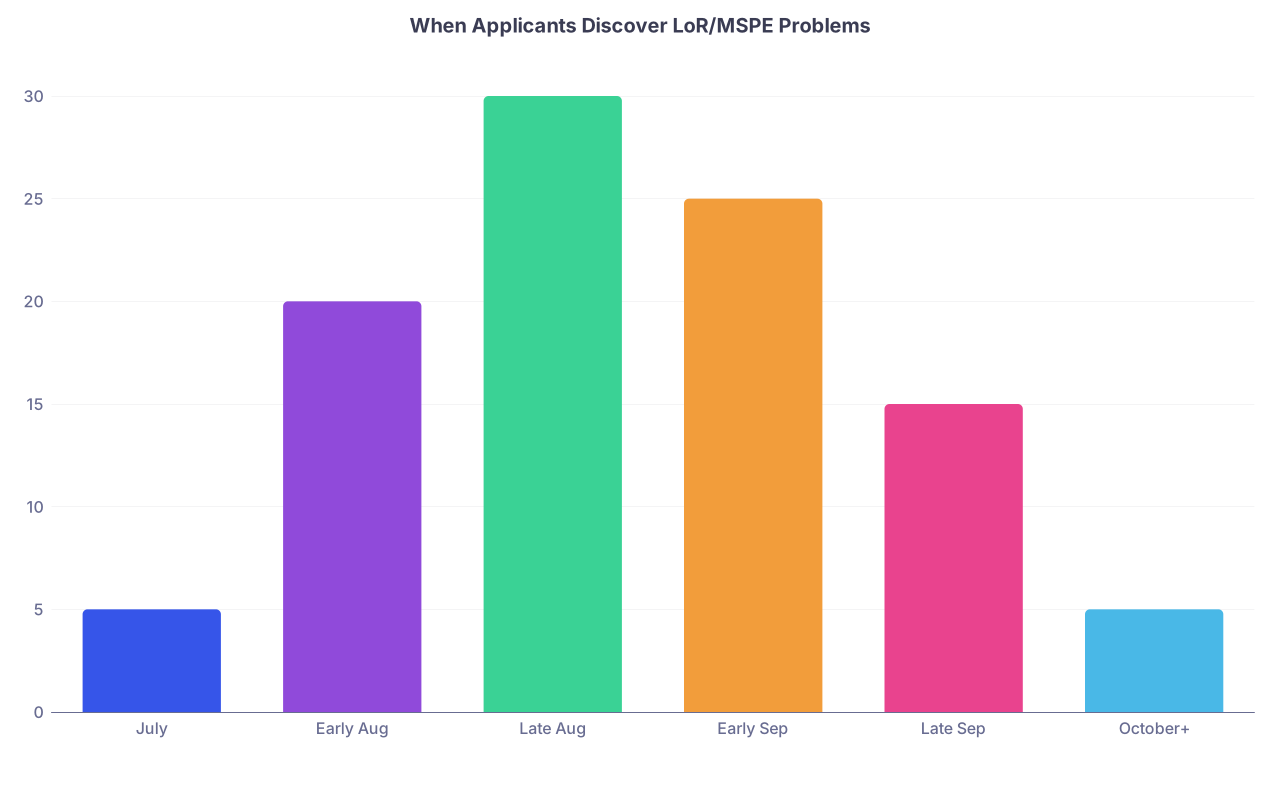
| Category | Value |
|---|---|
| July | 5 |
| Early Aug | 20 |
| Late Aug | 30 |
| Early Sep | 25 |
| Late Sep | 15 |
| October+ | 5 |
The spike in late August and early September is not an accident. That is when people finally start checking.
You are making that check earlier, more systematically, and with an actual plan.
Your Move Today
Do one concrete thing right now: open whatever system your school uses (or your own spreadsheet) and categorize every planned letter writer into the four status buckets above: Secure & Uploaded, Secure but Not Uploaded, Verbally Promised Only, High Risk.
Once you see who is actually a liability, you will know exactly where to push this week.