
It’s late March of MS3. You’ve just survived your heaviest clerkships, ERAS hasn’t opened yet, but everyone is suddenly talking about “updating your CV,” “getting your letters lined up,” and “being professional” like it’s some vague personality trait.
Here’s the truth: the bad habits you carry through this spring are exactly what will show up in your ERAS application, in your dean’s letter, and in the quiet conversations between PDs on rank day.
So we’re going to walk week-by-week through MS3 spring and early summer and fix the stuff that actually hurts you: sloppy CVs, vague experiences, weak narratives, and professionalism red flags that never quite make it into the official feedback but absolutely live in people’s heads.
Late March – Reality Check and CV Autopsy
At this point you should stop pretending “I’ll fix it when ERAS opens” is a plan.
Week 1: Pull Everything Into One Brutal Pile
Action for this week: collect, don’t edit.
You should sit down with:
- Every clerkship evaluation you can access
- Any professionalism notes, emails from staff, or “feedback chats” you had
- Your existing CV (even if it’s a mess)
- A blank ERAS-like document with the main experience categories
Now, at this point you should:
-
- Highlight: “professional,” “reliable,” “timely,” “communicates well,” “pleasant to work with.”
- Also highlight: “occasionally late,” “needs to improve organization,” “quiet on the team,” “seems disinterested at times.”
The first group is your brand. The second is your repair list for the next 4–5 months.
Print your CV and mark it up with a pen.
Circle what’s vague or embarrassing:- Bullet points like “Participated in research project”
- Activities with no dates
- “Leadership” entries where you attended three meetings and left
List your actual roles by bucket. Write them like ERAS sections:
- Research
- Leadership
- Teaching
- Service/volunteering
- Work
- Honors/awards (or lack thereof)
You’re not fixing yet. You’re defining the problem.
Early April – Structure the CV Before You Stuff More Into It
At this point you should be building the skeleton of your ERAS experiences, not just adding more lines.
Week 2: Convert Your CV to ERAS-Style Entries
Open a new doc and create sections that mirror ERAS. Start rebuilding from scratch.
For each experience, you should have:
- Title/role – concrete and honest (e.g., “Volunteer Tutor,” not “Educational Specialist”)
- Organization
- Location
- Start and end dates
- 1–3 concise bullets with outcomes
Better bullets are specific and active:
- Bad: “Helped with research on diabetes.”
- Better: “Abstracted chart data for 150+ patients with T2DM and contributed to preliminary analysis for QI project on A1c monitoring.”
If you can’t write at least one specific bullet, ask yourself: is this actually worth keeping?
Week 3: Reality Check on Gaps and Overreach
This week, you should evaluate where your CV is thin and where you’re overselling.
Look for:
- Empty leadership section – no titles, no roles.
- “Leadership” that’s just attendance – committee “member” in name only.
- Stacked but shallow stuff – five research projects, no poster, no abstract, no anything.
Now decide:
- What can still become a real, defensible accomplishment by August?
- What needs to quietly disappear from your ERAS entirely?
Here’s a simple filter:
| Situation | What You Should Do |
|---|---|
| 5+ meetings, no impact | Keep, but write a modest, accurate bullet |
| 1–2 meetings, never went back | Cut it. No one cares. |
| Research with pending abstract | Keep, label as “submitted” only if actually submitted |
| “Leadership” via group chat only | Cut, or recast as informal peer support if truly real |
If you feel a little exposed reading this, good. That “oh no” feeling right now is better than a PD rolling their eyes at your ERAS later.
Mid–Late April – Fix the Professionalism Narrative People Actually See
Now we deal with the stuff that doesn’t show up as a grade: reliability, communication, and how much people trust you.
At this point you should treat every remaining clerkship like an audition rotation.
Week 4: One Concrete Professionalism Upgrade Per Week
Pick one habit that has been mentioned or that you know is weak:
- Chronic “5 minutes late”
- Slow replying to emails
- Not pre-reading notes / showing up unprepared
- Disappearing on the wards without telling anyone
Then, for 7 days, overcorrect it.
Examples:
- If you’re “occasionally late” → be in the hospital 20 minutes earlier than needed. Every day.
- If staff said you’re “hard to find” → tell your senior where you’ll be when you step away and send a quick update if plans change.
- If feedback says “quiet member of the team” → commit to one concise patient update or question on rounds per patient.
You’re not trying to become a new person. You’re trying to generate clean, recent professionalism language for upcoming evaluations and for future letters.
Week 5: Clean Up Your Digital and Email Habits
You absolutely will be judged for this.
This week you should:
- Change your email signature to something simple and professional:
First Last, MS3 | [Med School Name] | Phone | [School email]
- Stop using non-school emails with dumb handles for anything residency-related.
- Standardize your email replies:
- Reply within 24 hours during the week (12 is better).
- Say “Thank you, I’ll do X by [day/time]” and then actually hit that time.
I’ve seen residents lose strong letters because an attending repeatedly had to chase them for a draft or form. Nobody writes “poor professionalism” in the letter. They just write a lukewarm, generic one.
Early May – Experience Descriptions and the ERAS Voice
At this point you should start writing like ERAS, not like a college resume.
Week 6: Rewrite Experience Bullets in ERAS Tone
Open your draft CV and convert college-style fluff into residency-appropriate language.
Common mistakes:
- Overstating scope: “Led a team of 20” when you sent 3 reminder emails a month.
- Buzzword salad: “Utilized interdisciplinary approaches to optimize patient-centered paradigms.”
- First person, emotional essays in experience descriptions.
Aim for:
- Concrete verbs: led, organized, implemented, created, analyzed, taught
- Measurable scope: “10 students,” “4 sessions,” “30 participants”
- Modest, accurate phrasing: “assisted with,” “contributed to”
Example transformation:
- Before: “Participated in leading student-run clinic by improving patient care and leadership skills.”
- After: “Coordinated scheduling for a weekly student-run clinic serving ~25 uninsured patients per month; organized volunteer coverage and tracked follow-up rates.”
Week 7: Identify “Gold” Experiences vs. Filler
Not every experience is equal. Some will matter a lot, others are just space.
Mark your entries:
- Gold – You can talk about it for 5 minutes without forcing it; clear impact; fits your specialty narrative.
- Silver – Real work, respectable, but not core to your story.
- Bronze – Fine, but generic or marginal.
Your goal: by ERAS opening, you should have:
- 3–5 Gold experiences
- 5–10 Silver
- As few Bronze as possible
Why this matters: Gold experiences you highlight in personal statements, interviews, and at the top of your ERAS experience list. Bronze is just… there.
Late May – Repairing Red Flags Before They Go on Paper
At this point you should deal with the awkward stuff: leaves, failures, professionalism “conversations,” weird clerkship narratives.
Week 8: Name and Contain Your Red Flags
List any potential issues:
- LOA, repeat year, failed Step or shelf, remediation
- Known professionalism incident (even if “resolved”)
- Major grade drop in one block for non-obvious reasons
- Strange pattern: 6 Honors → 1 Low Pass in a core rotation
For each one:
Write a 2–3 sentence neutral explanation.
- No drama. No blaming.
- Clear what happened, what you did, and what changed.
Decide where it lives:
- MSPE / dean’s letter only?
- Personal statement for that specialty?
- Separate communication if a PD asks?
Your goal is simple: by August, you should have one consistent story that you and your school both tell.
Early June – Final Clerkships as Reputation Builders
ERAS isn’t open yet. PDs are not reading anything. But attendings are collecting their mental headlines about you now.
At this point you should treat June as a letter-of-recommendation month, even if you’re not explicitly on an “away” or sub-I.
Week 9: Pick 1–2 People You Want Letters From
Look back: who has already seen you at your best or will see you in June?
- A clerkship director who knows your work
- An attending who gave you strong mid-rotation feedback
- A research mentor who actually remembers your contributions
Now, this month you should:
- Make sure they see you again, and see you better.
- Ask specific questions, show growth from earlier in MS3, and volunteer for one slightly annoying but visible task (organizing a small teaching session, QI form, etc.).
Letter writers remember the students who quietly cleaned up loose ends.
Week 10: Lock in Professional Habits You Can Sustain
Before you move into sub-Is and aways, establish this baseline:
Daily:
- Arrive early enough to never be the reason your team is late.
- Pre-chart at least key patients.
- Check in with your senior before leaving and ask: “Anything I can help with before I go?”
Weekly:
- Ask one person (resident/attending) for one specific area of improvement, not “any feedback?”
- Write it down and visibly work on it the next week.
This is how you convert “improving professionalism” from a vague phrase into repeated, documented behaviors that show up on evals.
Mid–Late June – Building Your ERAS Framework Before It Opens
Now we’re moving toward real application season. Time to create structure so ERAS isn’t a panic project.
Week 11: Build a Master Application Document
At this point you should create a single living document that will feed into ERAS later. Include:
- Working CV (ERAS-style)
- Draft list of:
- Programs you’re interested in
- Potential letter writers
- Key experiences to highlight for each specialty
Also create rough versions of:
- One “generic” bio paragraph about yourself (3–4 sentences max)
- A specialty-specific paragraph for your main target (e.g., Internal Medicine, EM, Psych)
These will become intros for emails, PS drafts, and sometimes even interview talking points.
Week 12: Sanity-Check Your Trajectory vs. Your Target Specialty
Face reality now, not in September.
Use something like this:
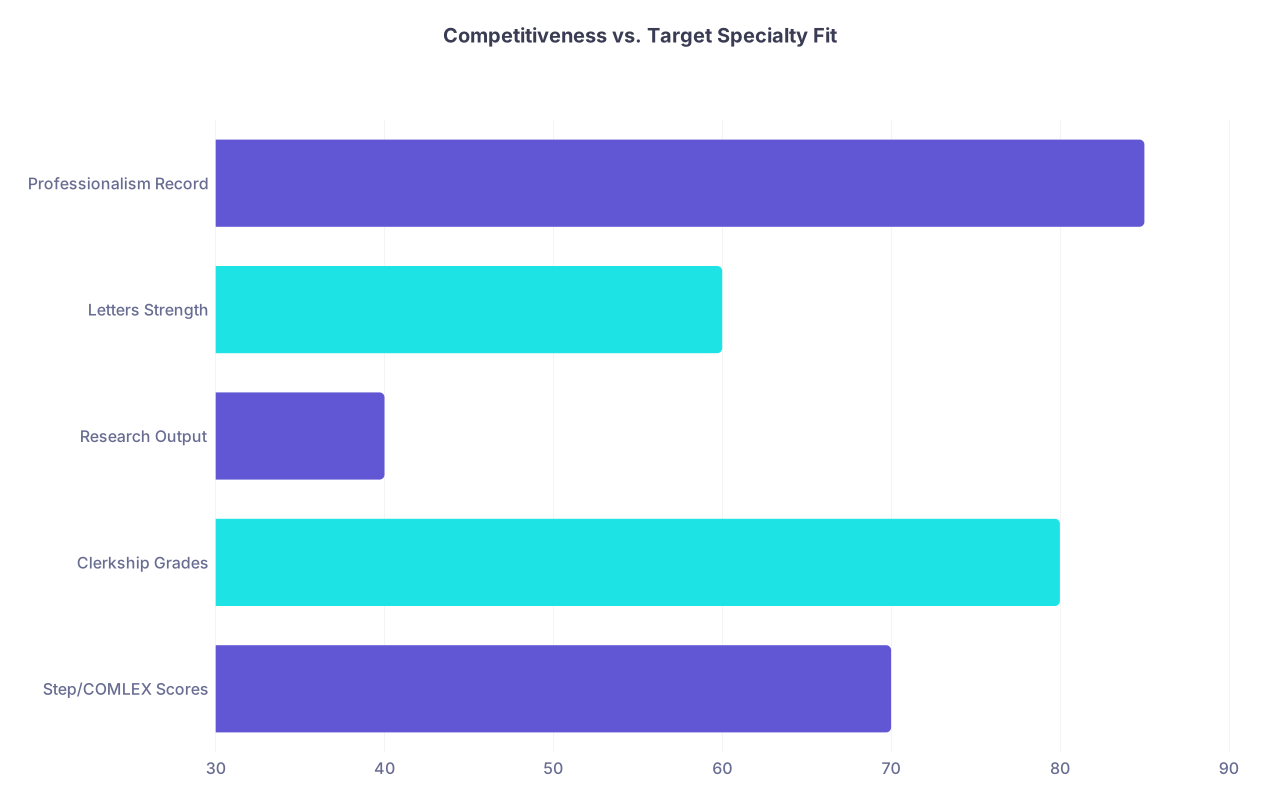
| Category | Value |
|---|---|
| Step/COMLEX Scores | 70 |
| Clerkship Grades | 80 |
| Research Output | 40 |
| Letters Strength | 60 |
| Professionalism Record | 85 |
Translate your own situation into a rough mental score out of 100 for each area. If you’re aiming for something competitive (Derm, Ortho, ENT, Plastics, NSG), the bar is higher. You should be brutally honest:
- If research is a 20/100 and you’re going into Dermatology, that’s a problem.
- If professionalism is an 80/100 but letters are 40/100, you can fix letters faster than professionalism.
Decide what can realistically be upgraded before ERAS submission and what just needs a smart explanation and strategy.
Early July – Last-Minute CV and Professionalism Tune-Up Before ERAS Opens
By July, you’re almost out of “prep” time. This is where details start to matter.
Week 13: Line Edit Your CV Like a PD Is Reading in a Hurry
You should now read through your entire experience list with a PD’s level of patience: almost none.
Fix:
- Repetition of the same verb every line (no more “Participated…” x10)
- Overlong descriptions (if it takes 7 lines, you’re hiding fluff)
- Inconsistent tenses (past work = past tense, ongoing = present)
- Typos, obviously, because yes, they notice
Ask yourself for each bullet: If this were read aloud in an interview, would I feel solid or slightly embarrassed?
If even slightly embarrassed, rewrite it or cut it.
Week 14: Professional Branding in the MSPE Era
You don’t control the MSPE format, but you do control the inputs people used to write it.
At this point you should:
- Make sure your most recent clerkship evals reflect the professionalism improvements you’ve been working on.
- Ask your dean’s office (politely) if there are any forms, updates, or professional development stuff you’re supposed to complete before MSPE drafting.
Bottom line: you want your “recent history” to be clean. If there was a rocky rotation early MS3, it helps a lot if the narrative since then is “consistently strong, reliable, and engaged.”
Common Early CV & Professionalism Mistakes You Should Stop This Spring
Let me be blunt. These are the repeat offenders I see year after year.

CV Mistakes
- Listing every shadowing hour from premed like it’s a major clinical experience
- “Leadership” roles that were one event you barely recall
- Inflating research you didn’t actually design, write, or analyze
- Writing emotionally instead of concretely: “I learned the importance of compassion…” as a bullet point
- Double-counting the same work under slightly different names
If you’re not sure whether something sounds inflated, assume an attending with 20 years’ experience can smell it instantly. Because they can.
Professionalism Mistakes
- Being “fine” on the wards but completely unreliable by email
- Only being pleasant upward (to attendings) and indifferent or rude to staff
- Leaving rotations early without clear sign-out because “there wasn’t much to do”
- Asking for letters late, with no materials, and forcing the writer to work from vague memory
- Social media that’s public and unprofessional while you’re applying
You don’t need to be perfect. You do need to be predictably solid.
Visual Timeline: What You Should Be Doing, Month by Month
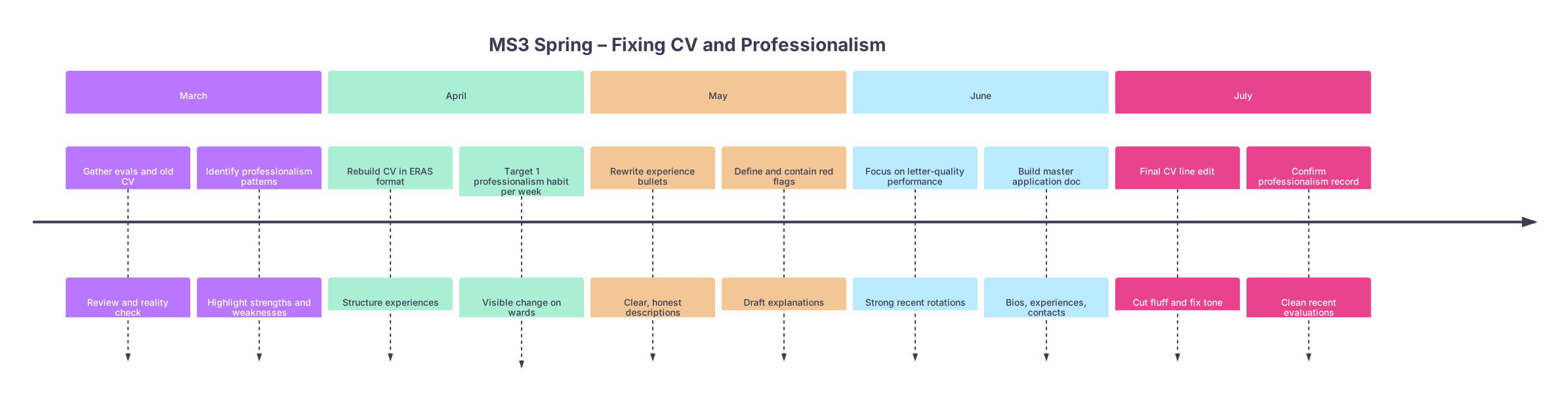
| Period | Event |
|---|---|
| March - Gather evals and old CV | Review and reality check |
| March - Identify professionalism patterns | Highlight strengths and weaknesses |
| April - Rebuild CV in ERAS format | Structure experiences |
| April - Target 1 professionalism habit per week | Visible change on wards |
| May - Rewrite experience bullets | Clear, honest descriptions |
| May - Define and contain red flags | Draft explanations |
| June - Focus on letter-quality performance | Strong recent rotations |
| June - Build master application doc | Bios, experiences, contacts |
| July - Final CV line edit | Cut fluff and fix tone |
| July - Confirm professionalism record | Clean recent evaluations |
Quick Comparison: Old Habits vs. Fixed Habits by ERAS Opening
| Area | Before (Now) | After (By ERAS Opening) |
|---|---|---|
| CV Structure | Mixed college + med format | Clean ERAS-style sections |
| Experience Bullets | Vague, fluffy, inflated | Specific, modest, outcome-focused |
| Professionalism | “Usually fine,” inconsistent | Predictable, reliable, documented |
| Feedback Approach | Avoids difficult feedback | Actively seeks and applies feedback |
| Red Flags | Unnamed, stressful | Contained, explained, consistent story |
FAQ (Exactly 4 Questions)
1. My CV feels empty. Is it better to add weak activities or leave it sparse?
Sparse and honest beats padded and fake every time. PDs would rather see 6–8 real, well-described experiences than 20 lines of “member,” “attended,” and “participated.” Focus this spring on turning 2–3 things into genuine Gold experiences by taking on real responsibility, finishing projects, or producing something concrete (poster, talk, workshop). You can absolutely match with a lean but solid CV.
2. I had a professionalism incident MS2/MS3. Should I address it in my personal statement?
Only if it’s serious enough that it’s guaranteed to appear in your MSPE or be known to programs (formal remediation, LOA, major incident). If so, use 2–3 sentences: clear, concise, no drama, with a focus on what changed. Do not write a full essay on it. If it’s a minor issue that’s been handled and is not highlighted in official documents, over-explaining can actually draw more attention than necessary.
3. How many “leadership” roles do programs expect to see?
There’s no magic number. One or two real, meaningful roles beats four or five titles where you did nothing. For a standard, non-ultra-competitive specialty, having a solid role in a student group, clinic, teaching, or QI project is usually enough. For more competitive fields, depth and impact matter more than raw count. By ERAS, you should be able to clearly describe what you actually did, not just the title.
4. How do I know if an attending will write me a strong letter vs. a lukewarm one?
Ask directly, and use the strong-letter question wording: “Do you feel you know me well enough to write a strong letter of recommendation for residency?” If they hesitate, hedge, or say something like “I can write you a letter” without the word “strong,” assume it will be generic and look elsewhere. That’s why what you do this spring and early summer matters—so someone can honestly say, “Yes, you’ve been excellent. I’d be happy to.”
Today’s next step: pull up your most recent clerkship evals and your current CV. Set a 30-minute timer and mark three things that need to be rewritten or fixed—one experience bullet, one professionalism habit, and one vague or inflated entry. Don’t overthink it. Just start the cleanup.