The last two weeks before ERAS submission are where strong applications quietly die. Not from weak scores or lack of research— from sloppy, preventable errors.
You do not need more “general advice” right now. You need a clock‑based, day‑by‑day error‑proofing plan so you are not still editing your personal statement at 11:47 p.m. on deadline night while ERAS freezes and your Wi‑Fi flickers.
Here’s exactly what to do, and when.
Big Picture: Your Two‑Week ERAS Error‑Proofing Timeline
Before we drop into day‑by‑day, you need the battlefield map.
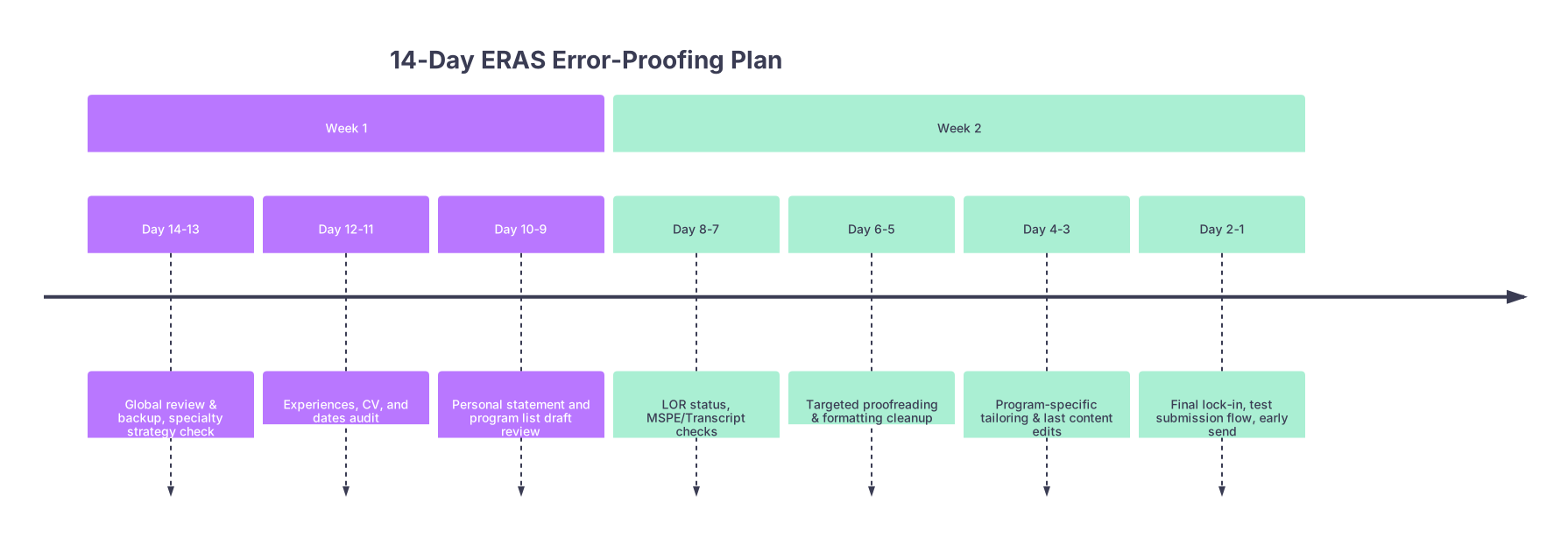
| Period | Event |
|---|---|
| Week 1 - Day 14-13 | Global review & backup, specialty strategy check |
| Week 1 - Day 12-11 | Experiences, CV, and dates audit |
| Week 1 - Day 10-9 | Personal statement and program list draft review |
| Week 2 - Day 8-7 | LOR status, MSPE/Transcript checks |
| Week 2 - Day 6-5 | Targeted proofreading & formatting cleanup |
| Week 2 - Day 4-3 | Program-specific tailoring & last content edits |
| Week 2 - Day 2-1 | Final lock-in, test submission flow, early send |
The theme: front‑load decisions, back‑load only mechanical checks. If you’re still deciding which specialty you’re applying to three days before submission, you’ve already lost ground.
Day‑by‑Day Plan: Two Weeks Before ERAS Submission
Day 14: Lock the Overall Strategy
At this point you should stop changing the fundamentals. Today is for big decisions only.
Decide and fix:
- Primary specialty (and backup if applicable)
- Academic vs community focus
- Geographic strategy (realistic, not fantasy)
Reality‑check your program numbers.
- Competitive specialty (ortho, derm, ENT, plastics, IR, etc.): you likely need 60–80+ programs.
- Mid‑range (IM, peds, EM, anesthesia): often 40–60.
- Less competitive or strong home support: sometimes 25–40 is reasonable.
If you have an advisor who says, “Apply to derm with a 215 Step 2 and 1 abstract, you’ll be fine,” ignore them. That’s negligent optimism.
- Create a master ERAS checklist file.
One document or note with:
- ERAS login + AAMC ID
- Target specialties
- Target number of programs
- LOR writers & status
- Personal statement versions (e.g., IM, IM with cards interest, prelim, TY)
- Key deadlines for your programs (特殊 ones like early offers)
This is your control center. From now on, you edit this and nothing gets tracked only “in your head.”
Day 13: Backup Everything & Freeze Structure
Today is insurance day. Systems, not content.
At this point you should make ERAS‑specific backups so a portal glitch or laptop failure doesn’t wreck you.
Export or copy:
- Your entire ERAS application section by section into a Word/Google doc or PDF.
- Current CV.
- Each version of your personal statements (clearly named).
- Program list (even if rough).
Save in at least two places:
- Local (laptop/desktop).
- Cloud (Google Drive, OneDrive, Dropbox, iCloud).
Name files like an adult who expects chaos:
ERAS_Master_Application_2026-09-01PS_InternalMed_Core_2026-09-01ProgramList_IM_Prelim_2026-09-01
Do not rely on “final_final_reallyfinal.docx”. You’ll hate yourself later.
Day 12: Experience Section – Structural Audit
This is where I see the most stupid, costly errors.
At this point you should check for structural problems, not adjectives.
Count your experiences.
- Clinical, research, leadership, teaching, volunteering, work.
- Do you have obvious gaps? Like zero continuity activities after M1? Fix with thoughtful framing, not lies.
Audit for redundancy.
- Three entries that all say “medical student volunteer, took vitals, helped patients”? Trim and consolidate.
- If you split a single role into 4 micro‑entries just to look busy, fix it. Programs are not fooled, they’re annoyed.
Check roles vs dates vs titles.
- Titles consistent with CV and letters: if your letter says “Chief Scribe,” don’t call yourself “Lead Physician Assistant.”
- Start/end dates match reality (and each other). Month/year accuracy is non‑negotiable.
- No overlapping full‑time commitments that are logistically impossible.
Tag top 3–5 experiences.
- These are your “anchor” activities. They should:
- Be clinically relevant.
- Have leadership/ownership elements.
- Ideally be recent (last 2–3 years).
- These are your “anchor” activities. They should:
Flag these in your doc. You’ll align your personal statement and interview stories with them.
Day 11: Experience Section – Content Cleanup
Yesterday was structure. Today is content.
At this point you should tighten language and fix cringe.
Pick one experience category at a time:
- Clinical
- Research
- Volunteering
- Teaching/leadership
- Work/other
For each entry:
- Replace vague fluff with specifics:
- Bad: “Responsible for patient care.”
- Better: “Pre‑rounded on 6–8 inpatients daily, updated sign‑out, and presented on rounds.”
- Remove passive bragging:
- Bad: “Honored to have the opportunity to…”
- Just describe what you did and what changed.
- Fix obviously fake heroic language:
- “Saved countless lives” becomes “Assisted resuscitations and followed outcomes longitudinally.”
Hard rule: no new experiences added after today unless something massive appears (new publication, huge leadership role, etc.). Late additions = formatting errors and date mistakes.
Day 10: Personal Statement – Content Check (Not Proofreading)
Personal statements die from being edited to death by 6 different people with 6 agendas.
At this point you should lock down the story, not the commas.
- Decide: how many versions do you actually need?
- One per specialty (IM, EM, Peds, etc.).
- Maybe one extra version for a specific niche (IM with cards interest vs IM with heme/onc).
- Transitional/Prelim year might need its own.
If you have 7 versions, you’ve already increased your odds of uploading the wrong one to the wrong program.
Run the “first page test.” Ask:
- Does the first paragraph clearly signal the specialty and your angle?
- Could this same paragraph work for 3 different specialties? Then it’s too generic.
Check for these common, fatal errors:
- Generic opening: “I have always been fascinated by the human body…” Cut it.
- Trauma dump with no reflection: patients’ suffering is not your entertainment.
- Name‑dropping programs (“I would be honored to train at [Program]”) in a generic PS. This guarantees mis‑matches.
Align PS with your experiences.
- If you talk about a transformative patient, that experience should be clearly findable in ERAS.
- If you emphasize research, make sure it’s not a one‑line “summer project” entry.
Day 9: Program List – First Pass Reality Check
This is where anxiety makes people either apply to 18 programs total or 120 they can’t afford.
At this point you should build a realistic, tiered program list. First draft, not final.
| Tier | # Programs | Type |
|---|---|---|
| A | 10–15 | Reach/aspirational |
| B | 20–30 | Solid target |
| C | 10–20 | Safety/backup |
Use filters:
- Regions you’d actually live in.
- Programs that traditionally interview IMGs/DOs if that’s you.
- Score cutoffs (even unofficial, via forums/advisors).
Color‑code or tag:
- Green = definitely.
- Yellow = maybe.
- Red = no (and then stop obsessing over them).
Do not finalize today. You just want something coherent enough to react to.
Day 8: Letters of Recommendation Status Audit
At this point you should stop assuming letters will magically appear.
Make a simple table (even in your notes):
- Dr. Smith – IM attending – Said yes? Y/N – Uploaded? Y/N
- Dr. Lee – Research mentor – Status
- Dr. Patel – Sub‑I – Status
Then:
Log into ERAS and check:
- Are all letter writers listed?
- Are letter slots correctly labeled by specialty?
- Are there any “pending” letters from people who are notoriously slow?
Send a polite, concrete reminder to anyone pending:
- Subject: “ERAS Letter (Due in 7–10 Days) – [Your Name]”
- Include:
- Your CV.
- PS draft if helpful.
- Deadline you’re targeting (I’d tell them you’re submitting 2–3 days before the real submission day).
Identify weak links.
- Anyone not responding to emails?
- Anyone you barely know who might write a bland or harmful letter?
- You still have time (barely) to pivot to a different writer if needed.
Day 7: Transcript & MSPE / Dean’s Letter Check
This day gets ignored until something explodes.
At this point you should confirm your school and ERAS are actually talking.
- Check with your registrar/Dean’s office:
- Has your transcript been sent or queued?
- When is the MSPE released? (Usually Oct 1, but double‑check.)
- Confirm:
- Your name is consistent across ERAS, school systems, and any test score reports.
- No middle‑name versus initial mess that could delay matching records.
This is boring admin work. It’s also the stuff that causes “we can’t see your transcript” emails in late October.
Day 6: Global Proofreading – Round 1
Today is your content‑level proofread of the entire application. Not yet microscopic; we’re looking for glaring issues.
At this point you should plan a 90–120 minute focused session.
Work section by section:
- Demographics & personal info:
- Name, contact, USMLE/COMLEX IDs.
- ECFMG status if IMG.
- Education:
- School names spelled correctly.
- Graduation months/years correct.
- Experiences:
- Scan for typos, tense mismatches, weird capitalization.
- Publications:
- Author order accurate.
- Journal names spelled right.
- “In press” vs “submitted” used correctly.
Then, if you can:
- Have one trusted person (faculty, advisor, detail‑oriented friend) read the ERAS PDF or screenshots for red flags.
- Give them a very specific ask: “I’m not changing content now, only want to know if something looks wrong or confusing.”
Day 5: Personal Statement – Final Content & Tone Edit
By now, structure is set. Today is about tightening and sanity‑checking tone.
At this point you should:
Read each PS out loud slowly.
- Anywhere you stumble? Rewrite.
- Any sentence longer than 3 lines? Probably needs to be split.
Remove:
- Clichés (“multidisciplinary,” “lifelong learner,” “always wanted to be a doctor”) unless they’re supported by concrete examples.
- Forced trauma narratives that center you rather than the patient or your growth.
- Excessive negativity about other specialties, systems, or people.
Confirm:
- Each version mentions the correct specialty.
- No program names in generic versions.
- Tone matches the specialty. (Your EM PS can be more energetic; your IM PS can be a bit more reflective. But all should still sound like one person.)
After today: no major structural rewrites. Only micro edits.
Day 4: Program List – Finalize and Budget Check
At this point you should lock the program list. No more wishlist wandering through FREIDA at 2 a.m.
Re‑review your tiered list:
- Do you have:
- Enough realistic “safeties” for your metrics?
- Some reaches so you don’t regret under‑reaching?
- Any “because it’s famous” programs that don’t fit your profile? Be ruthless.
- Do you have:
Run a quick cost estimate. Use AAMC’s fee schedule and multiply. Check your actual bank account, not theoretical future money.
Trim or expand today, not the night before submission.
Last‑minute list changes are where application mis‑clicks blossom.
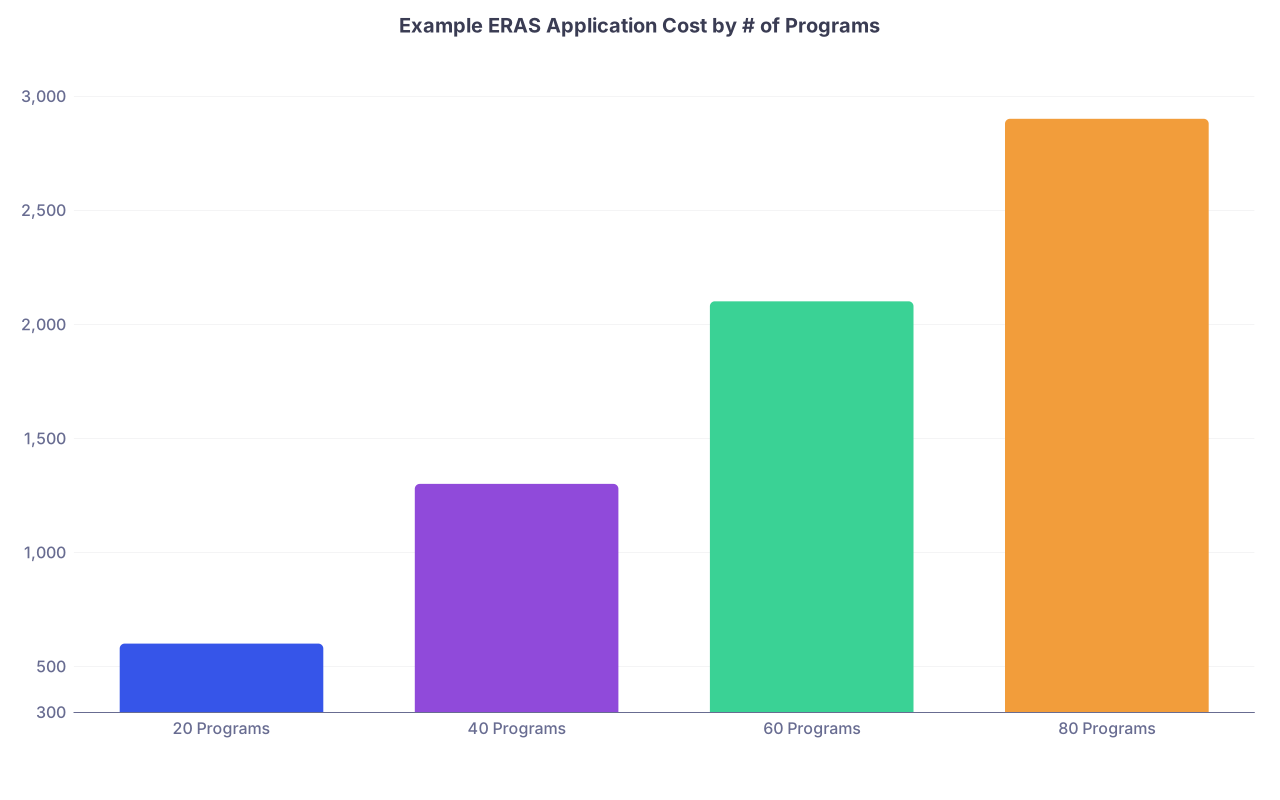
| Category | Value |
|---|---|
| 20 Programs | 600 |
| 40 Programs | 1300 |
| 60 Programs | 2100 |
| 80 Programs | 2900 |
(Values approximate. The point: it escalates fast.)
Day 3: Final Experience & Publication Polish
Now you’re at the fine‑tooth comb stage for content already in place.
At this point you should:
- Do a line‑by‑line read of:
- Experiences
- Publications
- Awards/honors
Look for:
- Repeated phrases (e.g., “I had the opportunity to…” five times).
- Awkward tense use: experiences should typically be past tense unless ongoing.
- Overuse of first‑person (“I,” “my,” “me”) in every sentence. Variety matters.
- Standardize formatting:
- Consistent bullet style (if applicable).
- Consistent journal title presentation.
- Consistent date formats (MM/YYYY vs Month YYYY—pick one and stick to it).
This is small stuff, but messy formatting screams “sloppy” to PDs skimming 400 applications.
Day 2: Technical Check & Submission Rehearsal
At this point you should treat ERAS like a glitch‑prone system, because sometimes it is.
Log in and go through every tab:
- Confirm no section has a red or yellow warning.
- Double‑check LOR assignments per program and per specialty.
- Confirm which PS is linked to which program group.
Do a “mock submission” mentally:
- Click up to the point before you pay.
- Make sure the right programs/specialties/PS/LOR combos are attached.
- Check your internet connection stability on the device you’ll actually use.
Decide your submission time window tomorrow.
- Aim for morning or early afternoon.
- Avoid the last 3–4 hours before the official “big” deadline. That’s when servers slow and people panic.
Day 1 (Submission Day): Final Pass & Early Send
This is not the day for creative work. It’s execution day.
At this point you should:
Do a 15–20 minute final review:
- Skim contact info.
- Skim one PS version (just for sanity; don’t re‑edit).
- Confirm LORs show as assigned and/or uploaded as planned.
Submit in batches, not all at once:
- Start with a small group of lower‑stakes programs (not your dream top‑3).
- Confirm submission confirmation emails/receipts look normal.
- Then submit the rest.
Immediately after:
- Save confirmation emails.
- Export or screenshot your final ERAS pages for your own records.
Do not keep opening and re‑opening the portal to obsessively reread what you already sent. That way madness lies.
Common Last‑Two‑Weeks ERAS Mistakes (And When to Avoid Them)
Here’s how the big errors line up with the timeline—and when you should have killed them.
| Mistake | When to Prevent It |
|---|---|
| Wrong PS attached to programs | Day 2–1 (tech check) |
| Contradictory dates/titles in CV | Day 12–11 (audit) |
| Over/under-applying drastically | Day 9–4 (list build) |
| Unsubmitted or missing LORs | Day 8 (LOR audit) |
| Last-minute major PS rewrites | Day 10–5 (content) |
You’ll notice none of these are about your board score. They’re about your process.
Visual: How Your Effort Should Shift Over the Two Weeks
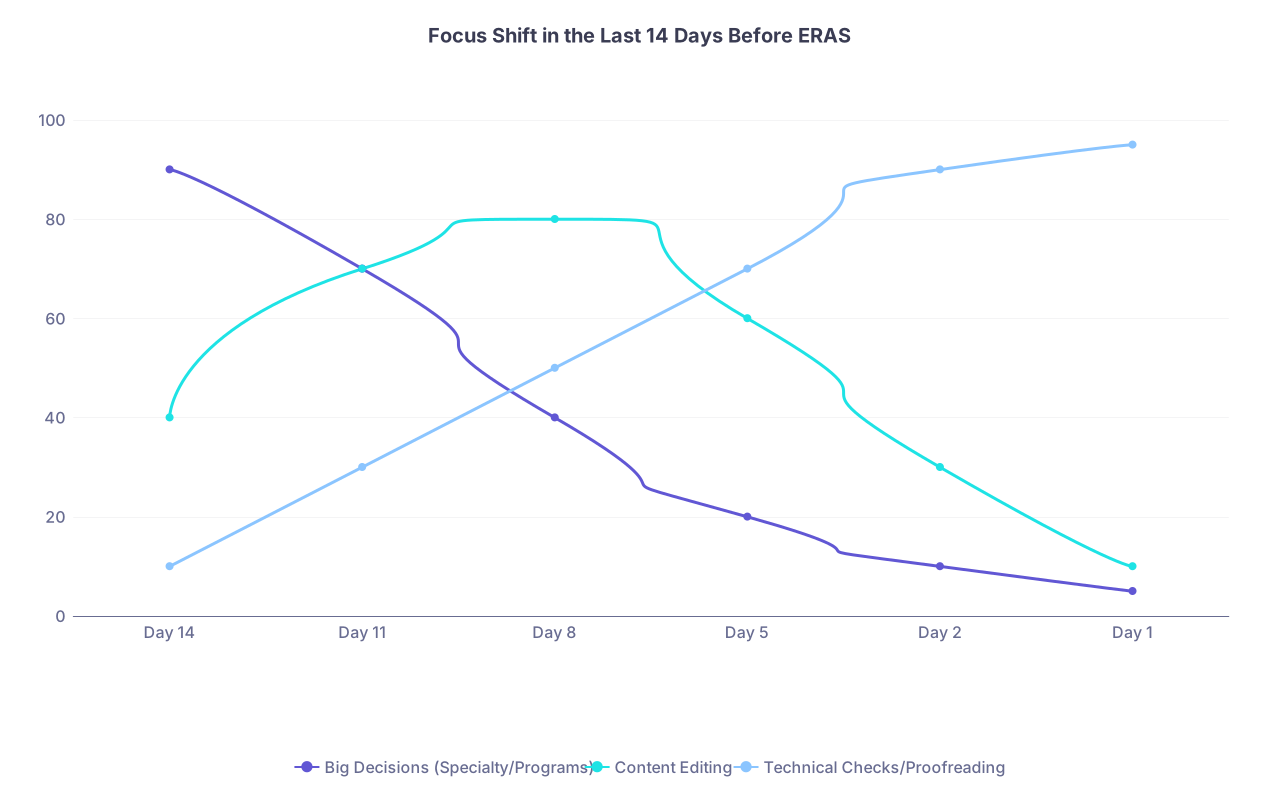
| Category | Big Decisions (Specialty/Programs) | Content Editing | Technical Checks/Proofreading |
|---|---|---|---|
| Day 14 | 90 | 40 | 10 |
| Day 11 | 70 | 70 | 30 |
| Day 8 | 40 | 80 | 50 |
| Day 5 | 20 | 60 | 70 |
| Day 2 | 10 | 30 | 90 |
| Day 1 | 5 | 10 | 95 |
The mistake most applicants make? They keep big decisions alive until the end and leave technical checks for the last night. Reverse that.
Quick Mental Checklist For Each Phase
To keep yourself honest, here’s a fast “at this point you should…” review:

| Step | Description |
|---|---|
| Step 1 | Day 14-11 |
| Step 2 | Strategy & Experience Audit |
| Step 3 | Day 10-7: PS & LOR Status |
| Step 4 | Day 6-3: Proof & Polish |
| Step 5 | Day 2-1: Tech Check & Submit |
By each phase:
Day 14–11
- Strategy fixed.
- Experiences structurally clean.
- Backups made.
Day 10–7
- PS versions finalized in content.
- LOR plan realistic and checked.
- Program list roughly built.
Day 6–3
- Global proofreading done.
- Formatting standardized.
- Program list finalized.
Day 2–1
- Technical checks complete.
- Submission rehearsed.
- Applications sent before the chaos spike.
Final Thoughts
Three things I want you to walk away with:
- Decisions first, proofreading last. If you’re still changing specialties four days before ERAS opens to programs, that’s the real error.
- Multiple small checks beat one big heroic all‑nighter. Ten 20‑minute passes over two weeks will catch more than one 6‑hour panic session.
- Treat ERAS like a fragile system, not a friendly website. Back up, double‑check attachments, and submit early. The boring stuff is what protects you from the dumbest, most painful mistakes.