
The worst thing you can do with a professionalism citation in residency applications is pretend it does not exist.
If you’re carrying a professionalism flag, notation, or “concern” into ERAS, you’re not ruined. But you are under a spotlight. Programs are asking themselves one question: “Can we trust this person at 3 a.m. with our patients and our team?” Your job is to make that answer a calm, confident yes.
Let’s walk through exactly how to do that—step by step, situation by situation.
1. First: Get Clinical-Grade Clarity On Your Citation
Before you write a single word on ERAS, you need to know exactly what’s on your record. Not what you “think” they said. What they actually documented.
Here’s what to do this week, not “later”:
Request your official record
Ask your Student Affairs / Dean’s Office directly:- “Is there any professionalism concern, citation, or flag in my file?”
- “How is it described in the MSPE?”
- “Is there any internal professionalism log that is not in the MSPE but might be shared if a program calls?”
Get the actual language
Ask for the exact wording that appears (or will appear) in:- Your MSPE narrative
- Any professionalism section or “adverse action” section
- Any remediation/completion notes
Do not rely on memory of meetings. I’ve seen students assume it was “minor conflict with resident,” then read: “Unprofessional communication with the team, required formal remediation.” Very different.
Clarify the status
You need to know:- Was this officially a professionalism citation or concern?
- Was it considered “resolved” or “remediated”?
- Is there any language like “no ongoing concerns” or “successfully completed remediation”?
Those phrases are gold when you’re explaining things.
Understand the category
Programs don’t see all professionalism issues the same. Roughly, they bucket it like this:How Programs Informally Categorize Professionalism Issues Category Program Reaction Level Minor admin / policy slip Low concern Communication / attitude Moderate concern Reliability / no-shows High concern Dishonesty / cheating Very high concern Figure out which bucket you’re in. It affects how hard you’ll have to work to restore trust.
2. Decide Where You Need To Disclose (And Where You Don’t)
You’re not writing a confessional novel. You’re answering what’s asked—fully, honestly, and efficiently.
Typical places professionalism issues come up:
- ERAS “Additional Questions” or “Adverse Actions” section
- Supplemental applications or program-specific questions
- MSPE narrative (which you can’t change, but you must work around)
- Interviews (“Tell me about this professionalism concern…”)
You do not need to:
- Put your professionalism issue in your personal statement headline
- Re-explain it in every single paragraph
- Volunteer extra unrelated dirt no one asked for
Your rule: Answer directly where asked, then use the rest of the application to show who you are now.
3. Use the Right Structure: Short, Clear, Grown-Up
Most people mess this up in one of three ways:
- They minimize: “There was a slight misunderstanding…”
- They over-explain every detail: “On October 3rd, at 8:17 am, I walked into the OR…”
- They self-flagellate: “I was a terrible person and didn’t deserve to be a doctor…”
All three read badly to program directors.
Your explanation needs four things, in this order:
- Brief context (1–2 sentences)
- Clear acknowledgment of your error (own your piece, not the entire universe)
- Concrete actions you took afterward
- Specific changes in behavior with evidence
Here’s a simple template you can adapt:
During my third-year [clerkship/rotation] in [specialty], I received a professionalism citation related to [very brief category: e.g., punctuality, communication with team, following documentation policy].
I take full responsibility for my part in this situation. I [brief, factual description of what you did wrong, without excuses].
In response, I [completed remediation / met regularly with ___ / participated in ___]. I also [implemented specific behavior changes: changed task system, sought feedback, adjusted communication style].
Since then, I have [evidence: no further concerns, strong evaluations in X, leadership roles, positive comments in MSPE or from attendings]. This experience pushed me to [1–2 sentences about growth, tied directly to residency-relevant skills like reliability, communication, accountability].
That’s it. No drama. No paragraphs of justification.
4. Calibrated Honesty: Own It Without Lighting Yourself On Fire
This part is tricky, and where people either look evasive or unstable.
Here’s what works:
You must:
- Use first person: “I did,” “I failed to,” “I did not follow.”
- Accept responsibility for your part, not blame others.
- Show insight about why it was a problem (“My late arrivals disrupted sign-out and added stress to the team.”)
You must not:
- Blame the system, the attending, the policy, or “communication issues” as the main story.
- Say “it was taken out of context” as your primary line. That reads as defensive in 99% of cases.
- Over-share emotional turmoil in a way that makes you sound fragile rather than solid.
Better:
“I was late multiple times to pre-rounding and initially underestimated the impact this had on my team. After my clerkship director addressed it, I realized I was relying on last-minute planning instead of consistent systems.”
Worse:
“The clerkship was notoriously disorganized and the residents frequently changed the expectations, which led to a misunderstanding that unfairly portrayed me as unprofessional.”
Programs do not have the time or context to adjudicate your side of a he-said-she-said story. They’re not investigating. They’re risk-assessing.
5. Tailoring By Type of Professionalism Issue
Not all issues are equal. You need to address the specific kind of concern.
A. Punctuality / Attendance / Missed Responsibilities
Programs worry this means: Can’t be relied on for call, will leave colleagues stranded.
Your focus:
- Systems you’ve put in place (calendar, reminders, check-ins, asking for help earlier)
- Concrete track record since the incident: no missed shifts, praise for reliability
Example framing:
Early in my third year, I received a professionalism citation for late arrivals to pre-rounding. I failed to build in adequate buffer time and overestimated how quickly I could complete pre-rounds, which left my team waiting.
After meeting with my clerkship director, I developed a new structure for my mornings, including earlier start times and a pre-round checklist. Since then, across [X] subsequent clerkships and [sub-I], I have had no further attendance concerns and have been consistently described as reliable and prepared in my evaluations.
B. Communication / “Unprofessional Behavior” / Attitude
Programs worry this means: Toxic on the team. Difficult to teach.
Your focus:
- Specific communication patterns you’ve changed (tone, feedback-seeking, asking for clarification)
- Evidence that you work well on teams now: leadership, peer evaluations, letters that praise collegiality
Example:
During my surgery clerkship, I received a professionalism concern related to how I expressed frustration during a busy call night. In a moment of stress, I spoke abruptly to a resident in front of the team.
After reflecting with my advisor, I recognized that my tone and timing were inappropriate, regardless of my intention. I completed a professionalism and communication workshop and began actively seeking feedback on my interactions. Since then, my evaluations consistently highlight my calmness under pressure and teamwork, particularly on my ICU and ED rotations.
C. Documentation / Policy / Confidentiality
Programs worry this means: Risk to patient privacy or medico-legal exposure.
Your focus:
- Your understanding of the policy now
- The systems you use to protect privacy and follow rules
- Clean behavior since then
Example:
I received a professionalism citation for inadvertently including identifiable patient information in a study document that was not properly de-identified. Although no data was shared outside our secure system, I had not followed protocol.
I completed additional HIPAA training, reviewed our IRB policies with my research mentor, and implemented a double-check system for all data handling. I have since continued in research roles without further issues, and this experience made me more meticulous about confidentiality and regulatory details.
D. Academic Dishonesty / Cheating / Falsification
This is the hardest category. Programs worry this means: fundamental integrity risk.
You cannot sugarcoat this. You must show radical honesty and sustained behavior change.
Your focus:
- Clear acknowledgment of wrongdoing (no euphemisms)
- Consequences you accepted
- Concrete changes: transparency, asking for help early, documented trust in later roles
- Strong backing from faculty who know the full story and still vouch for you
Your explanation must sound like someone who understands they broke trust and has worked to rebuild it.
6. Where Exactly To Address It In ERAS
Let’s be precise.
ERAS “Adverse Actions” / “Professionalism” Questions
Use the structured explanation here. Keep it tight. 1 short paragraph for context + 1 for actions and growth.
No bullet points. No multi-page essay. Just clear, direct prose.
Personal Statement
Should you mention it here? Depends.
Use the personal statement if:
- The professionalism issue is central to your growth story and you can discuss it maturely, and
- Your MSPE makes it prominent enough that it’ll be top of mind anyway.
Skip it if:
- The issue is relatively minor and already addressed cleanly in the designated section.
If you include it, do not let it hijack the essay. One short, focused paragraph is usually enough.
Structure:
- Brief mention of the incident
- Emphasis on what you learned and how it shapes the physician you’re becoming
- Transition into concrete examples of current behavior
Letters of Recommendation
You don’t write these, but you can choose writers strategically.
You want at least one letter from:
- Someone who knows about the professionalism issue
- Has seen your behavior after it
- Can credibly say: “I trust this person.”
Do not hide the issue from your letter writers. That’s how you get generic letters that contradict the MSPE tone.
7. During Interviews: Answering Without Spiraling
If you have a clear professionalism note, expect the question. If it doesn’t come up, fine. But be ready.
Here’s an interview script structure that works:
- One sentence context
- One sentence owning the mistake
- Two sentences on what you did about it
- One or two sentences on who you are now
Example:
“During my third-year medicine rotation, I received a professionalism citation for repeated lateness to pre-rounding. I hadn’t built adequate structure into my mornings, and my team paid the price for that.
After that, I worked with my advisor to redesign my schedule and time management, and I haven’t had any further issues. In fact, my sub-I evaluations highlight my reliability and preparation. The experience made me much more conscious of how my small choices affect the whole team, especially in residency-level environments.”
Say it. Then stop. Do not nervously keep talking.
If they push with follow-up questions, keep everything factual and non-defensive. You’re not trying to win a debate; you’re demonstrating stability and maturity.
8. Rebuilding Your Narrative Around Trust
A professionalism citation creates a “trust deficit.” You can’t erase it. You can outgrow it.
Your entire application, then, should highlight:
- Reliability: consistent work, responsibilities you’ve held, things you followed through on
- Humility: willingness to learn, accept feedback, and improve
- Team orientation: examples where you supported others, not just yourself
- Longitudinal improvement: a clear “before and after” pattern over time
You’re trying to make a PD think: “Yes, there was an issue. But this person did the hard, unglamorous work of changing. I can work with that.”
This is also where your rotation and sub-I choices matter. If you had a professionalism issue in medicine, doing a strong medicine sub-I with clean, glowing evaluations is not optional. It’s the rebuttal.
9. Common Mistakes People Make With Professionalism Citations
Let me be blunt about what does not work. I’ve seen all of these:
- Pretending it’s “minor” when the MSPE sounds serious. Programs will believe the dean’s office over your spin.
- Writing a three-page explanation full of emotional detail. Long explanations often look like you’re still stuck in it.
- Making the citation your whole personality. You’re not your worst day. Don’t center it at the expense of your strengths.
- Blaming stress, burnout, or personal issues without showing change. You can acknowledge context, but there has to be a clear “And here’s what I do differently now.”
- Ignoring it during interview prep. The first time you say this out loud should not be in front of a PD on Zoom.
If you’re not sure whether your explanation sounds defensive, read it to someone outside medicine. Ask them: “Does this sound like I’m making excuses, or like I’m owning what I did?” They’ll know.
10. When The Citation Is Severe: Adjusting Strategy
If you’re in the high-concern categories (major dishonesty, repeated violations, or professionalism probation), you may need more than just good wording.
Think about:
- Applying more broadly and to a wider tier of programs
- Strongly considering your home program and places where faculty know you personally
- Taking a research year or extra clinical work (if appropriate) to build a longer post-incident track record
- Having your dean or advisor proactively speak to selected PDs on your behalf (this actually happens more than you think)
Is it harder? Yes. Is it impossible? No. But you cannot approach it like someone with a clean record and one annoying line in their MSPE.
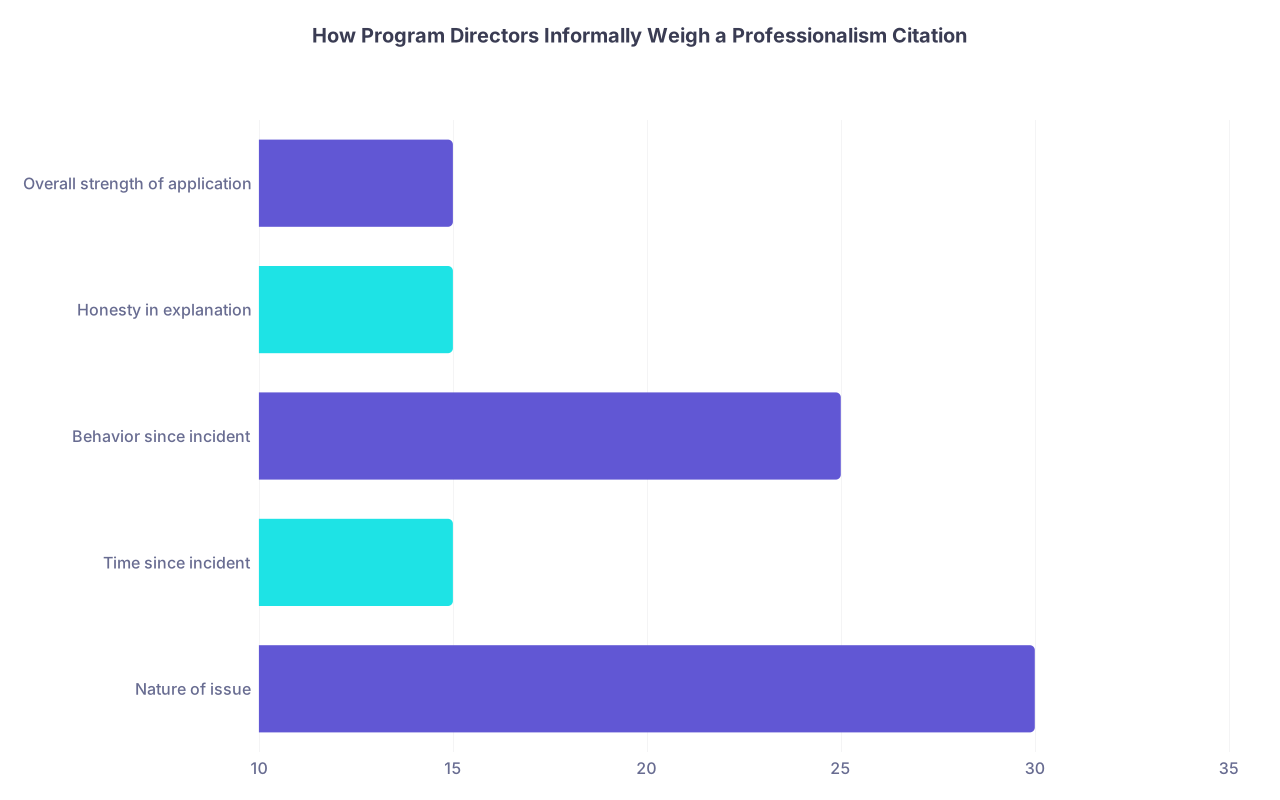
| Category | Value |
|---|---|
| Nature of issue | 30 |
| Time since incident | 15 |
| Behavior since incident | 25 |
| Honesty in explanation | 15 |
| Overall strength of application | 15 |

| Step | Description |
|---|---|
| Step 1 | Confirm exact citation language |
| Step 2 | Clarify status and resolution |
| Step 3 | Identify where ERAS asks about it |
| Step 4 | Draft concise written explanation |
| Step 5 | Review with advisor or dean |
| Step 6 | Select letter writers who know your growth |
| Step 7 | Integrate briefly into PS only if needed |
| Step 8 | Rehearse interview answer |

11. Concrete Example: From Raw Incident To Application-Ready
Let’s put this all together with a hypothetical.
Scenario:
You snapped at a nurse on your surgery rotation, got reported, and received a professionalism note for disrespectful communication. It’s in your MSPE.
Raw story (how students often tell it):
“The nurse paged me repeatedly while I was scrubbed in, then escalated to the attending and exaggerated how I spoke to her. I was stressed and said something back, and then suddenly I had a professionalism citation.”
Application-ready version:
“During my surgery rotation, I received a professionalism citation after speaking abruptly to a nurse who paged me while I was scrubbed in. I was frustrated and responded in a way that was dismissive and unprofessional.
My clerkship director met with me, and we discussed both my communication and strategies for managing pages while scrubbed. I apologized directly to the nurse, completed our professionalism workshop, and began actively soliciting feedback from nurses and residents on my communication. Since then, rotating through the ICU and ED, I have focused on clear, respectful communication under pressure. My recent evaluations specifically highlight my collaboration with nursing and ancillary staff, which I now see as a core part of my role.”
Same event. Very different signal.