
The worst residency application mistake is not a low score. It is an unforced error where you overshare personal issues and give programs a reason to doubt you.
If you already did it, you are not doomed. But you do need to handle it deliberately.
This is for you if you’re staring at your ERAS personal statement or supplemental responses thinking: “I said way too much about my depression/divorce/family trauma/leave of absence. Did I just tank my cycle?” And now you’re wondering: Do I clarify? How? With whom? Or do I shut up and hope it blows over?
Let’s walk through what actually works in this situation, step by step.
Step 1: Figure Out If You Actually Overdisclosed
Not every mention of hardship is “overdisclosure.” Sometimes applicants panic just because they were honest.
You probably overdisclosed if any of these sound uncomfortably familiar:
- You named specific diagnoses (e.g., “My bipolar disorder led to…”), especially multiple ones.
- You went into detail about suicidal thoughts, self‑harm, or hospitalization in a way that felt vivid rather than contained.
- You described active, recent chaos: ongoing custody battle, current financial crisis, ongoing conflict with your school, etc.
- You focused heavily on what happened to you, with very little on what you did, what changed, or how you’re stable now.
- You described leave of absence or academic issues with more drama than resolution.
Quick rule: If a program director could read your statement and reasonably ask, “Are they stable enough to do this job next July?”, you overdisclosed or under‑reassured.
Now separate this into buckets:
- What is written in ERAS (personal statement, experiences, “leave of absence / disruption” sections)?
- What went into supplemental program-specific questions?
- What you said in emails to programs (less common, but sometimes people panic and overshare there).
Why this matters: ERAS content is global and cannot be changed mid‑cycle. Supplemental and email content may be variable and sometimes requires targeted clarification.
Step 2: Decide Whether Clarification Is Necessary or Just Reassurance in the Interview
Clarifying is not always smart. Sometimes you turn a small concern into a huge one just by repeating it.
You clarify proactively when:
- You wrote something that is ambiguous and could easily be misread as:
- Ongoing functional impairment
- Risk to patient safety
- Likely to resign / repeat a year / not finish
- You misrepresented or misstated something factual (dates, leave type, boards timing) because of panic or poor wording.
- You implied active legal or professionalism issues (investigations, probations) that either:
- Aren’t active anymore, or
- You described imprecisely and now realize the wording was bad.
You do not send clarifications just because:
- You’re embarrassed you were emotionally honest.
- You mentioned therapy, counseling, or burnout recovery once, but you also clearly described recovery, boundaries, and support.
- You told a painful but contained story that ends in stability and growth.
If you’re unsure, ask: “If a PD had questions, could I reasonably fix this in a 2–3 minute, calm explanation at the interview?”
If yes → probably no mass email.
If no → you may need a targeted correction.
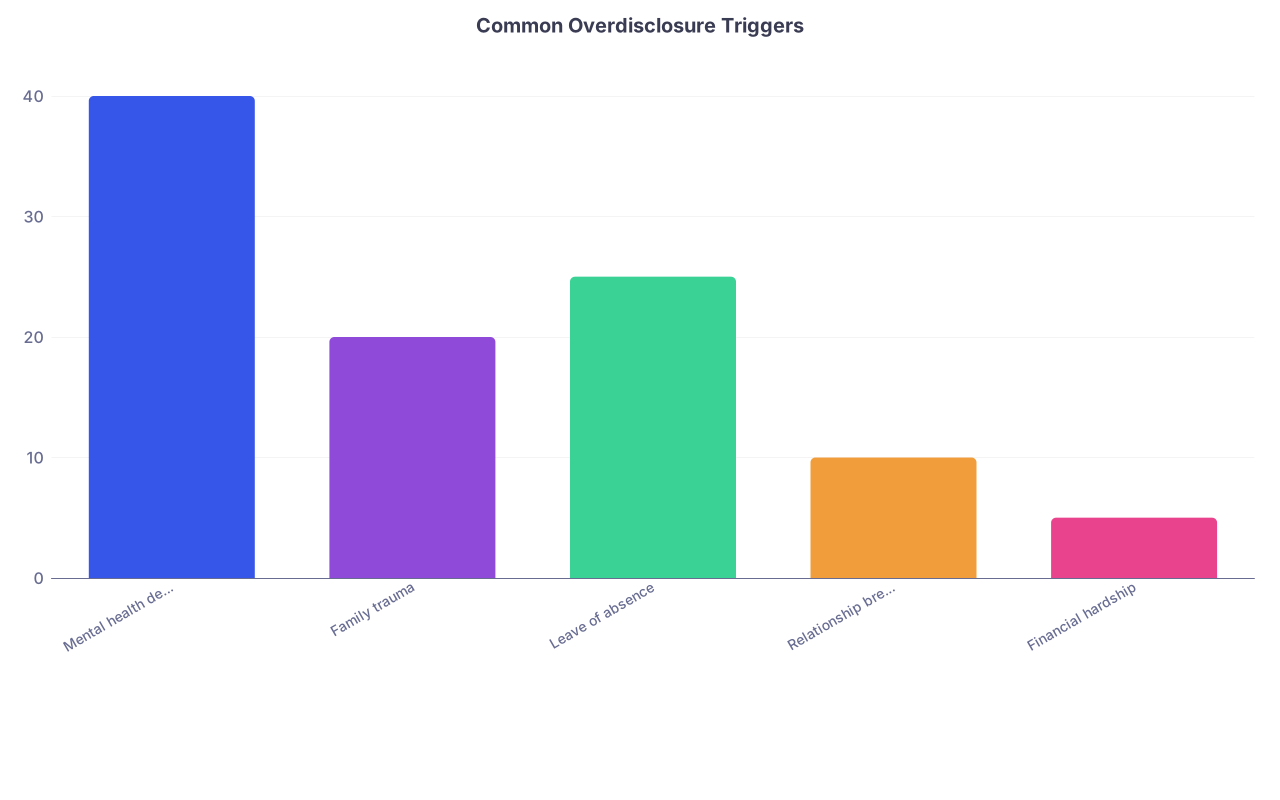
| Category | Value |
|---|---|
| Mental health details | 40 |
| Family trauma | 20 |
| Leave of absence | 25 |
| Relationship breakdown | 10 |
| Financial hardship | 5 |
Step 3: Get a Reality Check Before You Touch the “Send” Button
Do not do this part in your own head at 1 a.m. You’re not objective right now.
You need one or two of the following:
- A trusted faculty advisor (preferably someone who has sat on a residency selection committee).
- A dean or student affairs person who deals with struggling students.
- A PGY2+ resident in your target field who has actually seen or discussed applications.
- Worst case: a smart classmate who can be brutally honest.
Show them:
- The specific paragraph(s) you’re worried about.
- The specific question or prompt if it was a supplemental.
- Your draft of any clarification email / message (if you’re considering sending one).
Ask them very specific things:
- “If you were a PD, what concerns would you have after reading this?”
- “Does this sound like a current, unstable situation or a resolved challenge?”
- “Is clarifying this now going to make it better, or just amplify it?”
If your reviewer says, “Yikes, yeah, that’s a lot,” you likely need to think more actively about damage control.
If they say, “This is vulnerable but fine,” do not create drama where there is none. Accept the discomfort and move on.
Step 4: Choose Your Strategy: Silent, Tactical, or Direct
You have three realistic paths.
1. Silent Strategy: Do Nothing Now, Be Ready Later
Use this if:
- You did not misrepresent facts.
- The story is on the intense side but clearly ends in recovery, treatment, and stable functioning.
- Your advisor says, “Leave it alone. Just be prepared to talk about it.”
Your job in this lane:
- Build a clean, solid “here is where I am now” narrative for interviews.
- Have objective anchors: step scores, recent strong clerkship evals, sub‑I letters that show you functioning at a residency level.
- Practice a 60–90 second version of your story that:
- Acknowledges the event.
- Focuses on concrete changes.
- Emphasizes current stability and support.
Example interview framing:
“I went through a major depressive episode during my third year, which I referenced in my statement. I received treatment, including therapy and medication, and took a short leave with my school’s support. Since returning, I have completed all clerkships on time, have not needed further leave, and maintain regular care with my providers. The main impact on me now is that I’ve built much stronger boundaries and coping strategies, which helped me manage my sub‑I and night float without burning out.”
Short, specific, not melodramatic. That’s the tone you’re aiming for.

2. Tactical Clarification: Limited Emails to Specific Programs
Use this if:
- You clearly mis‑framed a leave, condition, or event.
- You recently got new stabilizing information that changes the risk calculation (e.g., you passed Step 2 after writing about academic struggles and left that hanging).
- You wrote something that, on re‑read, sounds like you’re still in the middle of the crisis when you’re actually on the other side.
You do not send:
- A mass, emotional essay about your life.
- Frequent follow‑ups.
You do send:
- A short, factual, calm message to the program coordinator or the “program email” listed in ERAS.
Basic structure:
- Subject line: “Update/clarification regarding ERAS application – [Your Name, AAMC#]”
- One line: Why you’re writing.
- 2–4 lines: The clarification.
- One line: Reassurance and thanks.
Example:
“Dear Dr. X and Residency Selection Committee,
I am writing to briefly clarify a part of my ERAS application. In my personal statement, I referred to a period of severe anxiety that impacted my academic performance and led to a short leave of absence. I realized on re‑reading that I did not clearly state that I have been back in full‑time clinical training for over a year, have completed all subsequent rotations without accommodations or additional leave, and remain in ongoing, effective treatment.
I wanted to ensure that my current level of functioning was accurately represented to your committee. Thank you for your time and consideration.
Sincerely, [Name] AAMC#: [number]”
Notice what this does:
- It doesn’t relitigate your trauma.
- It doesn’t apologize for existing.
- It closes the loop: identifies concern → states current status → stops.
You don’t need to send this to every single program. Prioritize:
- Programs where you have a real shot (geographically, stats‑wise, or with connections).
- Programs where you’ve already got interview invites (to shape how they see you before meeting).
3. Direct Re‑Framing: Handle It Head‑On in Interviews
This is the strategy for:
- Things you cannot fix in writing because ERAS is locked.
- Programs that do not like extra emails.
- Situations where the content is intense but not factually wrong.
This is you saying: “Yes, I went through that. Here is why it does not compromise my ability to be a safe, reliable resident now.”
Your frame needs three parts:
- Past (brief): One or two sentences describing the issue without graphic detail.
- Intervention: What was actually done. Treatment, leave, support, remediation.
- Current functioning: How long you’ve been stable, specific evidence you’re okay now.
Example for mental health:
“In my application I referenced a period of major depression during M3 that contributed to a leave of absence. I worked with my dean and a psychiatrist, started therapy and medication, and took one semester away from clinical duties. Since returning, I’ve completed two full years of clinical rotations including sub‑internship, with no further leave and strong evaluations. I still see my therapist regularly and have a good system in place that’s been working for over 18 months.”
Example for personal/relationship crisis:
“I mentioned a difficult divorce that overlapped with my third‑year clerkships. At that time I was dealing with housing and custody issues, which did affect my focus and led to one lower grade. That legal process concluded last year, and I now have a stable living situation, reliable childcare, and support from my family and school. My performance since then—including my medicine sub‑I and ICU rotation—reflects that stability.”
Do not overshare new painful details just because they ask “tell me more.” You can always say:
“I’m comfortable sharing the broad strokes as they relate to my training and functioning, but I’d prefer to keep the more personal details private.”
That’s a boundary. Programs actually respect that when stated calmly.

| Step | Description |
|---|---|
| Step 1 | Realize you may have overdisclosed |
| Step 2 | Seek advisor review |
| Step 3 | Prepare interview framing only |
| Step 4 | Send brief clarification email to selected programs |
| Step 5 | Practice concise, stability-focused explanation |
| Step 6 | Factual error or major ambiguity? |
| Step 7 | Advisor says clarify? |
Step 5: Adjust How You Answer Future Application Questions This Cycle
Even if ERAS is locked, you’ll still see:
- Supplemental questions for late‑applying programs (if any).
- Pre‑interview questionnaires.
- Open‑ended “anything else you want us to know?” prompts.
Do not repeat the overdisclosure mistake.
For the rest of this cycle:
- You are allowed to “zoom out” on the personal details.
- Focus on impact + resolution, not backstory.
Bad version:
“I grew up in a chaotic home with parents who abused substances, and this led to long‑term trauma and a diagnosis of PTSD, which I still struggle with when confronted with certain triggers in the hospital.”
Better version:
“I grew up in an unstable environment with significant family substance use and conflict. That experience shaped my interest in caring for vulnerable patients and also meant I needed time in medical school to address my own responses to stress. With therapy and support, I now have strong coping strategies and feel well‑equipped to handle the demands of residency.”
You are not obligated to give them your trauma file for them to judge you. You are obligated to be honest about anything that materially affects your training, licensing, or safety. That’s different.

Step 6: Protect Your Future Self (Next Cycle or Future Applications)
Some of you reading this will not match. Not always because of this disclosure issue—but it can contribute. If you end up in a reapplication situation, you need a reset.
For future cycles (or fellowship apps later):
- New personal statement. Completely rewrite. No recycling the overshared version with a few edits. Start clean.
- Aim for “acknowledge but not immerse.” One short paragraph on major issues is usually enough.
- Lead with strength, not crisis. Your story is not “I had depression.” Your story is “I became the kind of future intern who has already learned to manage real adversity.”
- Have someone on selection side read every high‑stakes paragraph. Not just your friends.
I’ve seen reapplicants go from “this is a liability” to “this is a believable story of resilience” in one year simply by changing tone, length, and focus.
Red Lines: What You Should Not Do
Let me be blunt about a few things that will make it worse:
- Do not send multiple long, emotional emails to the same program.
- Do not demand reassurance: “Did this affect my chances?” That puts them in an impossible spot.
- Do not suddenly claim a different version of events that contradicts your dean’s letter or transcript. You can clarify, but you cannot rewrite history.
- Do not talk about active legal battles against your school/program in interviews unless you absolutely must. That screams “future HR problem.”
- Do not name and blame individual people (“my PD was abusive,” “my dean was out to get me”) without extreme care. You may be right, but they will worry you’ll say that about them next.
Your guiding principle: calm, factual, forward‑looking.
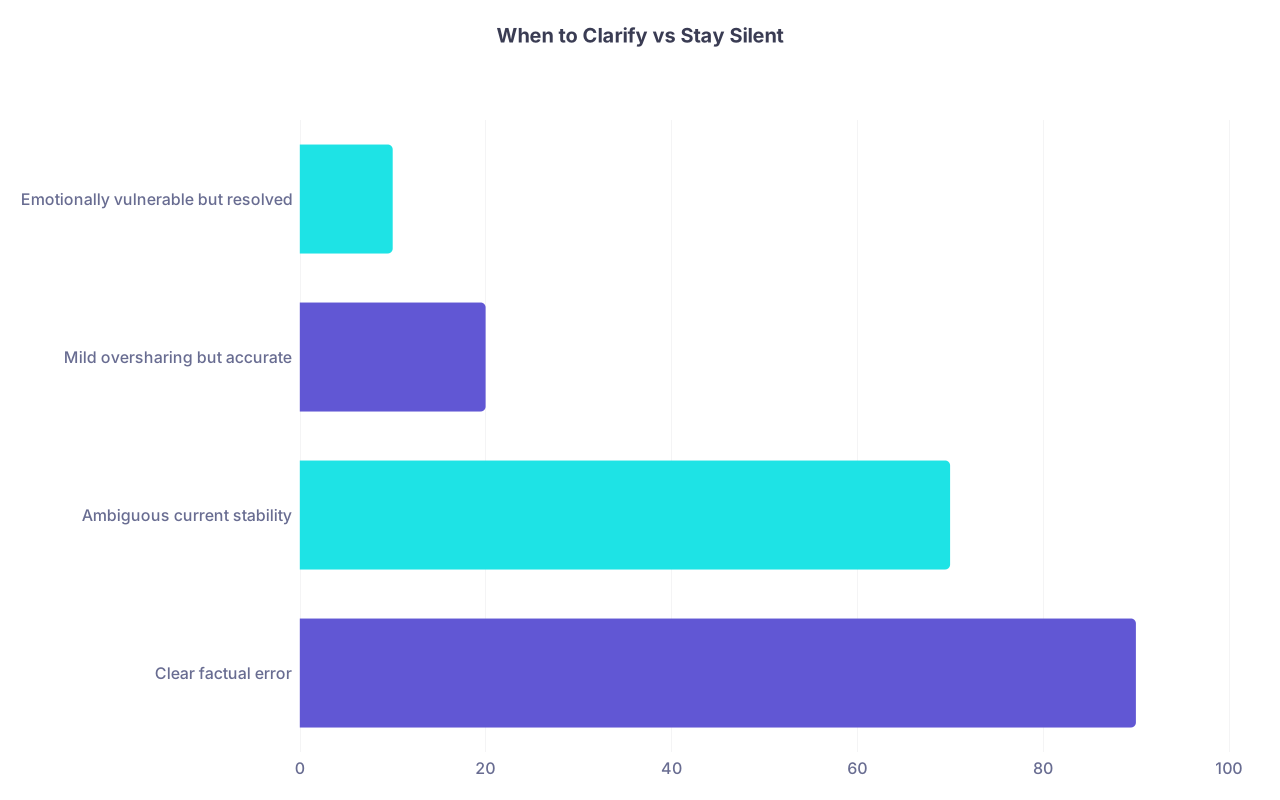
| Category | Value |
|---|---|
| Clear factual error | 90 |
| Ambiguous current stability | 70 |
| Mild oversharing but accurate | 20 |
| Emotionally vulnerable but resolved | 10 |
How Programs Actually Think About This Stuff
Programs do not reject you because you had depression. Or a divorce. Or a leave.
They reject you when they think:
- You’re likely to need unplanned extended leave.
- You’re likely to fail boards or rotations.
- You’re likely to create serious interpersonal or professionalism issues.
- You’re likely to be unsafe with patients.
Your job is to give them credible reasons to think:
- “That chapter is closed or well‑managed.”
- “This applicant knows their limits and uses help appropriately.”
- “I can picture them showing up every day at 5:30 a.m. and functioning.”
Proof matters more than words:
- Strong sub‑I comments.
- Letters that mention reliability and work ethic.
- A clean recent academic record.
- Evidence of follow‑through (research completed, QI projects finished, leadership roles sustained).
Your clarification—whether email or interview—should point indirectly to that proof.

Quick Script Library (Steal These Phrases)
Use these as building blocks, not copy‑paste robot text.
For emails:
- “I realized my wording may not have clearly conveyed my current level of stability and functioning.”
- “I have been in continuous, full‑time clinical training since [date] without further leave.”
- “I remain in ongoing, effective treatment and have a strong support system.”
For interviews:
- “That was a difficult period, but it is not my current reality.”
- “What I took from that experience is a much more realistic understanding of my limits and how to seek help early.”
- “Over the past [X] months, my performance has been consistently strong, which I see as the best reflection of where I am now.”
For boundaries:
- “I’m happy to share how it affected my training and how I addressed it, but I’d prefer to keep specific personal details private.”
| Scenario | Recommended Action |
|---|---|
| Named diagnosis + current severe symptoms implied | Tactical clarification email + strong interview framing |
| Leave of absence vaguely described, now fully resolved | Short clarification email for top programs |
| Emotional but accurate account of resolved issue | No email; tighten interview story |
| Factual error about dates/disciplinary status | Immediate correction email to all programs mentioned |
| Overshare in one program-specific essay only | Optional brief clarification to that single program |
FAQs
1. Could a clarification email actually hurt me more than help?
Yes, if it is long, emotional, or introduces new worries. A good clarification email is short, factual, and strictly reduces ambiguity. If your message is basically, “I’m so sorry, I overshared, please don’t hold it against me,” that will hurt you. If it calmly states, “Here is a concrete, stabilizing fact I didn’t make clear,” it can help or be neutral. When in doubt, get a faculty member to sign off on your draft.
2. Do I have to disclose my diagnosis at all, ever?
No, not the label. You must be honest about functional issues that affect your ability to complete training, patient safety, or licensure, and about formal leaves/disciplinary actions that appear in official documents. But you don’t owe anyone your DSM codes. You can say “a health issue,” “a mental health challenge,” or “a personal crisis” and then describe the impact and resolution. Programs care about whether you can do the job reliably, not about the ICD‑10 line item.
3. What if a program directly asks for more details than I’m comfortable sharing?
You hold the line politely. For example: “I’m comfortable describing how it impacted my training and how I addressed it, but I’d like to keep the more personal specifics private.” Then pivot back to functioning: “What I can say is that I’ve been fully stable for the past [X] months, in regular treatment, and have completed all recent rotations without issue.” If they push hard past that, take note—that’s data about their culture. You’re allowed to not rank them.
You cannot rewrite what you already submitted. But you can control what happens next: how you clarify, how you speak in interviews, and how convincingly you show that whatever you went through is now a source of maturity, not ongoing chaos.
Handle this chapter cleanly, and you’re still very much in the game. The rest of your story—from interview performance to how you show up intern year—is still unwritten.