
The obsession with being a “well‑rounded” residency applicant is hurting more people than it helps.
Programs are not begging for generalists who dabbled in everything and committed to nothing. They’re trying to identify people who look like future colleagues in their specialty. A bloated, unfocused CV doesn’t make you safe. It makes you forgettable.
Let’s dismantle the “well‑rounded” myth with what program directors actually say, what the data actually show, and what I’ve watched happen to applicants who tried to be everything at once.
The Myth of the “Well‑Rounded” Applicant
Somewhere between MS1 orientation and ERAS season, a dangerous idea takes root: the belief that you need to collect activities like Pokémon cards.
Shadowed orthopedics for a week? Add it. Briefly volunteered at a free clinic? Add it. Joined three interest groups, sat through three meetings, never went back? Somehow that ends up on the CV too.
The justification is always the same: “Programs want well‑rounded applicants.”
No, they don’t. Not like that.
When program directors talk about wanting “well‑rounded” residents, they mean:
- Someone who can function on a team without imploding.
- Someone who won’t crumble when on call.
- Someone whose identity isn’t so fragile that a bad eval ruins them.
- Someone with some dimension beyond test scores.
That is very different from a CV packed with 28 low‑impact activities with no coherent story.
Residency selection is not a liberal arts college brochure. You’re not being evaluated for “campus culture contribution.” You’re being evaluated for fit and trajectory in a specific field.
And here’s the part applicants hate to hear: too much breadth with shallow depth is a red flag, not a bonus.
What the Data Actually Show (Not Your Advisor’s Folklore)
Let’s stop guessing and look at the data.
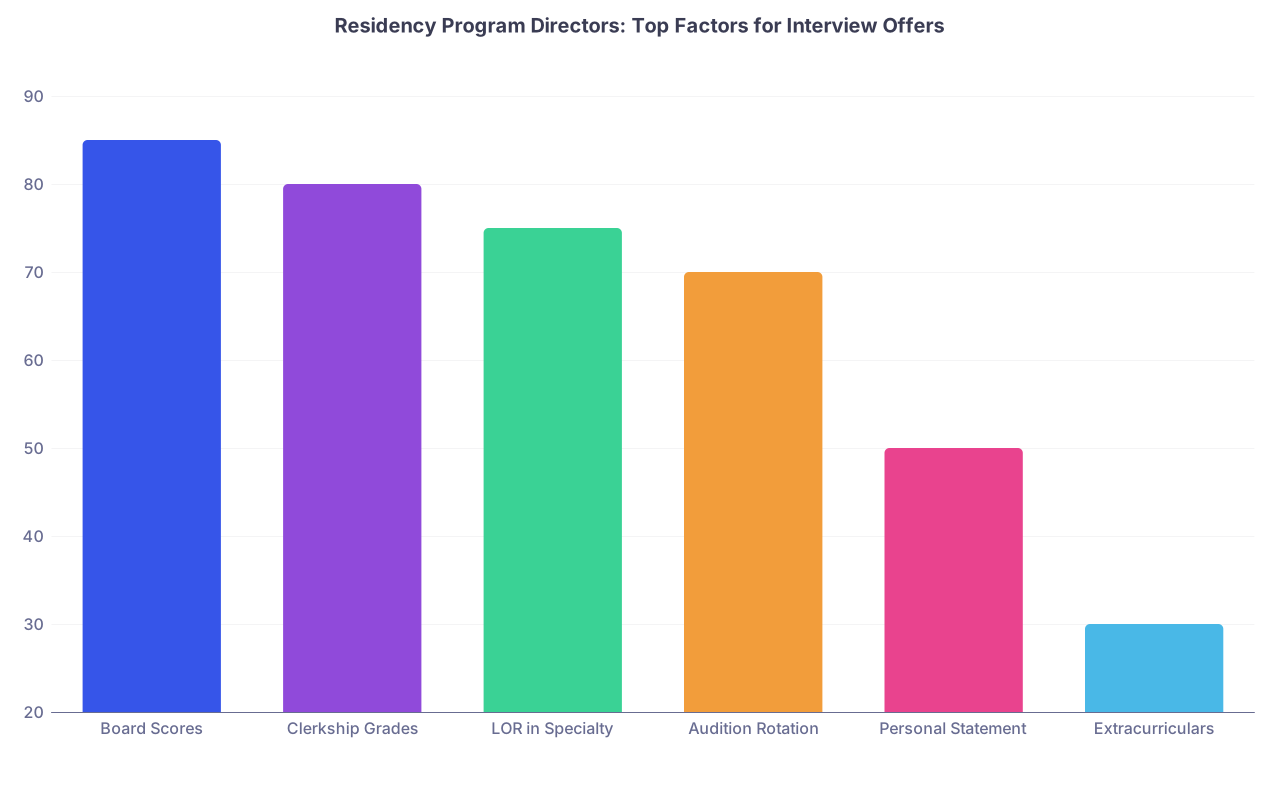
The NRMP’s “Program Director Survey” is ugly reading if you’re still clinging to the idea that scattershot involvement gives you an edge. Year after year, the same pattern shows up.
| Category | Value |
|---|---|
| Board Scores | 85 |
| Clerkship Grades | 80 |
| LOR in Specialty | 75 |
| Audition Rotation | 70 |
| Personal Statement | 50 |
| Extracurriculars | 30 |
Interpretation in plain English:
- Board scores, clerkship grades, and specialty‑specific letters dominate.
- Audition/sub‑I performance in that specialty matters a lot.
- Generic extracurriculars? They’re way down the list.
When program directors are asked what makes them rank someone highly, you see similar themes: clinical performance in the specialty, letters from people they trust, demonstrated interest and commitment to that field.
Not “was president of six committees.” Not “has a random mix of unrelated activities in multiple specialties.”
There’s also this uncomfortable reality: attention is finite. When a reviewer looks at your experiences section and sees 16 entries, they’re not thinking, “What a dynamic, multifaceted star.” They’re thinking, “I have 60 seconds per application and no time to figure out who this person is.”
An unfocused CV doesn’t tell a story. It hides the story.
How Unfocused CVs Actually Backfire
I’ve sat in rooms where faculty flip through ERAS apps on a projector and I’ve heard the commentary out loud. Here’s what really happens to the “well‑rounded” CV.
1. You look indecisive
Applicant’s CV:
- First‑author abstract in cardiology.
- Two little ortho research blurbs.
- Peds interest group officer.
- Dermatology shadowing.
- One month of rural family medicine volunteering.
The committee dialogue is painfully predictable:
“So… what does this person actually want to do?”
“Feels like they were chasing anything that might stick.”
“Pass, we have others who are clearly committed to IM.”
You thought you were showcasing range. They see lack of direction.
Programs invest three or more years training you. They’re not eager to take someone who still looks like they’re shopping for a specialty or just padding for prestige.
2. Your genuine strengths get buried
Maybe you have one legitimately strong thread:
- Two‑year longitudinal project in quality improvement in ICU workflows.
- An abstract presented at SCCM.
- QI committee participation.
- Strong letter from the intensivist PI saying you showed up every week.
That’s the stuff that should define you to an internal medicine or anesthesia PD.
But then you tack on:
- Three half‑baked volunteer roles, each lasting a few months.
- An interest group treasurer position with nothing to show for it.
- One “global health” week that was basically medical tourism.
- Five “other experiences” that are generic and obviously low‑effort.
The noise drowns out the signal.
Reviewers scanning quickly just see clutter. They don’t have time to reverse‑engineer which of your 20 items actually matter. So they default to what’s easy: board scores, letters, and does this CV give off a clear specialty identity in 30 seconds or less.
Yours doesn’t.
3. You invite awkward interview questions
An unfocused CV is a trap you set for yourself.
Interviewer: “You listed 30 activities. Tell me which two you cared about most.”
You: internally panicking because you can’t remember half of them, and the ones you do remember were box‑checking.
Or worse:
Interviewer: “I see you did derm research, ortho shadowing, peds volunteering, and now you’re applying to neurology. Help me understand that path.”
If your honest answer is, “I was just trying to be well‑rounded and match somewhere competitive,” they’ll hear: opportunistic, externally driven, no real spine.
When your CV screams “I dabbled everywhere,” you force yourself into a defensive position in the interview, justifying your choices instead of building a strong narrative.
Programs Want “Spiky,” Not Bland
Here’s the contrarian truth: residency programs are more comfortable with spiky applicants than you think.
Spiky = someone clearly stronger in some dimensions than others, with a visible center of gravity.
You do not need to be great at everything. You need to be obviously serious about something that aligns with the specialty.
For example, for internal medicine or pediatrics, a compelling profile might be:
- Solid, not stellar scores.
- Consistently strong IM or peds clerkship evals.
- One sustained thread: outpatient underserved care, or QI, or education, or research in a disease area.
Compare two hypothetical CVs.
| Feature | Focused Applicant | Unfocused Applicant |
|---|---|---|
| Research | 2‑year IM QI project, 1 poster | 5 short projects in 4 specialties, no pubs |
| Volunteering | 3 years at same clinic | 6 short-term activities, each <6 months |
| Leadership | One meaningful role with outcomes | 4 titles, little described impact |
| Specialty Signaling | Strong, consistent for IM | Mixed: derm, ortho, peds, IM |
| Overall Impression | Committed, reliable, developing niche | Uncertain, opportunistic, hard to place |
The focused applicant is easier to believe, easier to advocate for in a rank meeting, and easier to remember: “Oh yeah, that’s the IM QI person who worked with Dr. X.”
The unfocused one? Just “one of those applicants with a ton of stuff.”
Being memorable for one coherent thread beats being vaguely “well‑rounded” every single time.
What a Strategic, Focused CV Actually Looks Like
Let me be very concrete. A focused CV is not narrow to the point of absurdity (“I only ever did one thing, once”). But the pieces fit together.
Depth over breadth
Programs read “3 years” of consistent involvement in one clinic or lab very differently from “3 years” split across seven unrelated activities.
A focused CV usually has:
- 1–2 major longitudinal commitments (research, clinic, teaching).
- A small number of clearly described leadership or impact roles.
- Activities that point in roughly the same direction as your chosen specialty.
And no, this does not mean if you did something in another specialty you should hide it. It means you contextualize it. You show a trajectory, not chaos.
For example, you explain in your experiences and personal statement:
- You started med school thinking about surgery.
- You did an ortho project MS1.
- Third year, you fell in love with psychiatry, you can articulate why, and your later CV reflects that shift.
That reads as growth and self‑awareness, not flailing, because the later part of the CV is actually aligned.
Aligned with specialty culture
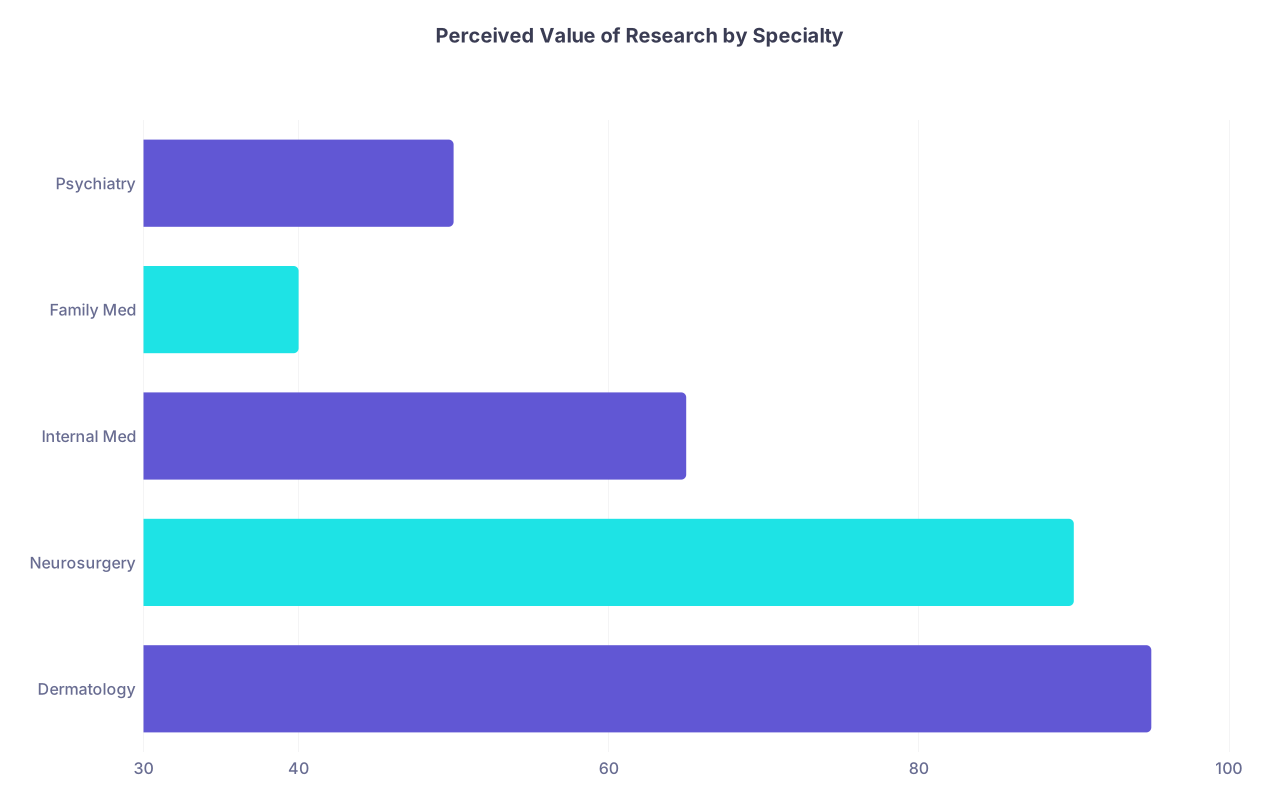
Different specialties care about different things. Pretending otherwise is cute but not reality.
| Category | Value |
|---|---|
| Dermatology | 95 |
| Neurosurgery | 90 |
| Internal Med | 65 |
| Family Med | 40 |
| Psychiatry | 50 |
If you’re applying to:
- Dermatology or neurosurgery: a random soup of volunteer and leadership without any anchored research or scholarly work in the field looks unserious.
- Family medicine: five disconnected basic science abstracts but not a single sustained community or continuity‑of‑care experience makes less sense.
- Psychiatry: no psych‑relevant exposure but three surgical interest groups and then a last‑minute psych sub‑I? You will be questioned.
A focused CV doesn’t mean you only ever touched that one specialty. It means, by the time you apply, a reasonable person could say, “Yes, this past year or two clearly supports this choice.”
How to Fix a “Well‑Rounded” Mess Before You Apply
If you’re early in med school, you’re in better shape than you think. You have time to stop collecting fluff and start choosing.
If you’re closer to ERAS season and already have an overgrown CV, you’re not doomed. But you need to be ruthless.
1. Prune, do not just add
You are not obligated to list everything you ever did. ERAS isn’t your LinkedIn graveyard.
I’ve watched applicants with 25 activities cut down to 10–12 and immediately look stronger. Why? Because now the story is legible.
Ask yourself, for each line item:
- Does this support my narrative for this specialty?
- Did I actually contribute something here, or did I just attend?
- Could I speak about this for 5 minutes without sounding like I’m bluffing?
If the answer is no, you’re better off dropping or minimizing it.
2. Elevate the few things that matter
For the top 3–5 most important experiences:
- Use the space to describe impact, not duties.
- Mention outcomes (presentation, policy change, curriculum, QI metric).
- Name the population, setting, or method in ways that connect to your specialty.
Example: “Led a longitudinal QI project to reduce 30‑day readmissions in heart failure patients on the inpatient IM service; collaborated with nursing and case management to implement standardized discharge checklists.”
That beats: “Member, QI committee.”
3. Align the rest of your application around that focus
A focused CV only works if the rest matches.
- Personal statement: isn’t a generic “I like helping people” essay. It points to the same themes your CV does.
- Letters: at least two from people who can speak to you in that specialty context.
- Interviews: you can tell a coherent story of exploration → decision → commitment.
If your CV says “community‑oriented family med,” your PS talks only about molecular research, and your letters are from a neurosurgeon and a pathologist, you’ve just undone yourself.

| Step | Description |
|---|---|
| Step 1 | Overstuffed CV |
| Step 2 | Prune Low-Impact Activities |
| Step 3 | Identify 3-5 Core Experiences |
| Step 4 | Rewrite Descriptions for Impact |
| Step 5 | Align Personal Statement |
| Step 6 | Secure Specialty-Specific Letters |
| Step 7 | Coherent, Focused Application |
The One Exception: When “Well‑Rounded” Really Helps
There is one scenario where your broader life can matter: when it shows you’re a functional human who can survive residency.
Not 17 premed clubs. Real life.
Things like:
- High‑level athletics that show discipline and time management.
- Deep involvement in music or art that carried through med school.
- Significant work experience before medicine that matured you.
These are not “padding.” They actually give committees confidence that you won’t burn out the minute things get stressful because you’ve handled real responsibility before.
The key difference: these are deep non‑medical commitments. They’re not the same as “joined nine campus organizations for the CV.”
What You Should Actually Aim For
Strip away the mythology and the signal you want to send is simple:
- You know what specialty you’re applying to and you can articulate why like an adult, not a cliché machine.
- Your past 1–2 years look like someone preparing to enter that field, not someone spray‑painting their CV with random prestige jargon.
- The people in that field who’ve actually worked with you think you’re safe, teachable, and a good colleague.
If your application does those three things, nobody will punish you for not being “well‑rounded” in the superficial, premed sense.
The dangerous part isn’t being focused. The dangerous part is being generic.
Key Takeaways
“Well‑rounded” as most students use the term—tons of shallow, scattered activities—is overrated and often harmful. Committees prefer clear, believable specialty alignment over random breadth.
A focused CV with a few deep, coherent threads tied to your chosen field is more persuasive, more memorable, and easier for a program director to defend in the rank meeting than an unfocused CV packed with fluff.