Meta description: Balanced MCAT or one standout section for MD and DO admissions? Learn how committees interpret subsection imbalance, risk, retakes, and school lists.
Educational disclaimer: This article is for general educational purposes only. It is not individualized admissions, financial, legal, tax, or professional advising. Medical school policies and application strategy vary by school and applicant, so review official school resources and consult qualified advisors for guidance specific to your situation.
I know this moment too well. You open your MCAT score report, your eyes jump straight past the total, and suddenly your whole future seems to depend on one ugly little subsection. Maybe you pulled a monster CARS score and now you're wondering if that proves you're brilliant enough to survive admissions. Or maybe you crushed Chem/Phys and you're trying to convince yourself that a weaker Psych/Soc section is just a footnote nobody will care about.
That is not how it feels at 11:47 p.m., obviously.
At 11:47 p.m., it feels like triage. Like your application is bleeding out and you're trying to figure out whether that one gorgeous 131 or 132 can save it. You start doing the same tortured math every applicant does: “If MD schools love strong readers, maybe my CARS carries me.” “If DO schools are holistic, maybe they’ll overlook the unevenness.” “If my total is decent, maybe no one notices that one low section.” Then the panic turns louder. Will MD schools see me as risky? Will DO schools think I’m inconsistent? Did I just become the applicant who is almost good enough?
Here’s the answer I wish more people would give clearly: a balanced MCAT is usually safer and easier for admissions committees to trust. One standout section can help. It can even help a lot in the right context. But no, one heroic subsection usually does not erase broader concerns if the rest of the score profile looks shaky.
That’s the real question here. Not “Is one strong section good?” Of course it is. The real question is whether it matters more than balance for MD and DO admissions. Usually, it doesn’t. But the details matter, and pretending there’s one magical rule for every school is how applicants spiral for no reason.
What MD and DO admissions teams really notice in MCAT patterns
Admissions readers are not staring at your MCAT the way you are. They’re not zooming in emotionally on your highest number and building a fantasy around it. They’re scanning for readiness. Risk. Consistency. Whether your academics look like they can hold up under real medical school pressure.
That means the overall MCAT usually matters more than any one section.
That’s the blunt truth. If your total score is strong and your sections are all solid, your profile is easier to interpret. It reads as stable. Reliable. Less likely to crash when the coursework gets brutal. Medical school admissions is many things, but one thing it definitely is: risk management. Schools are not eager to gamble on applicants with obvious academic warning signs just because one subsection sparkles.
A balanced score profile tends to send a clean message:
- you can perform across multiple domains
- you probably won’t fall apart in one major area
- your preparation looks complete, not patchy
- you are less of an academic risk
That matters at both MD and DO schools.
Where MD schools often get a bit tougher is with low subsections that suggest a real weakness. A single low section can raise concern if it falls far enough below the rest, especially at schools with higher academic expectations or large pools of applicants with uniformly strong stats. They may wonder whether that low section reflects a gap in reading, reasoning, scientific foundation, or test-taking consistency. And yes, if the total score is also borderline for that school, the unevenness can hurt more.
DO schools often review the application more holistically, and that does help. But “holistic” does not mean “academically careless.” I think applicants romanticize this point way too much. They hear that DO schools value the whole person and somehow translate that into “my weak subsection won’t matter.” Bad assumption. DO schools still want students who can handle hard science, board prep, dense reading, and long exams under pressure. They are not handing out sympathy acceptances because your best section was beautiful.
What a strong section can do is add shape to your application. It can support a narrative. A very high CARS score may reinforce strengths in communication, critical reading, and discussion-heavy learning. A standout Bio/Biochem section may reassure committees that your science foundation is stronger than they feared. A high Chem/Phys score can suggest real quantitative and analytical competence. Those things are useful. They are not meaningless.
But useful is not the same as rescuing.
If your score pattern is something like one 132, two middling sections, and one clearly weak subsection, the standout score may attract attention. It may even earn a positive comment in review. But if the weak area looks serious enough, that concern doesn’t disappear because of one pretty number. Admissions committees are not children distracted by shiny objects. They’ve seen every weird score pattern imaginable.
Different schools also weigh MCAT patterns differently. This is where applicants get themselves into trouble by wanting a universal answer. There isn’t one. A research-heavy MD program with median stats through the roof may be very unimpressed by an uneven score if the total is already below its norm. Another school with a broader mission and stronger emphasis on service or geographic fit may be more forgiving if the overall application is compelling. Same with DO schools. Some are more numbers-conscious than applicants realize. Others are more willing to contextualize the score if the rest of the file is strong.
So don’t ask, “Is one strong section enough?” Ask:
- Is my total score in range for the schools I want?
- Are any subsections low enough to trigger concern?
- Does the standout section reinforce a real strength in my application?
- Is the rest of my academic record stable enough to soften the imbalance?
That’s the grown-up way to read this. Less drama. More strategy.
When one strong section helps and when it does not
One strong section helps most when the rest of your score is still acceptable.
That’s the line. Cross it, and the standout score becomes an asset. Miss it, and it becomes trivia.
Say you have a very high CARS score and the rest of your sections are solid if not dazzling. That can absolutely help. It may make admissions readers more confident about your reading speed, verbal reasoning, and communication potential. If your writing is excellent, your interviews are strong, and your activities show teaching, advocacy, or patient-facing maturity, that CARS score starts to fit into a believable story. Same if your Bio/Biochem section is especially high and your coursework backs it up. Now your score pattern isn’t random. It means something.
It can also help if there’s an upward trend behind it. Maybe your earlier academic record was uneven, but your MCAT shows you’ve developed stronger reasoning or science discipline. I’ve seen applicants use that well. Not as a magic eraser. As evidence of growth.
But here’s when it does not help enough: when one excellent subsection is paired with multiple weak ones, or when the total score still lands below the typical range for your target schools.
That’s the trap. Applicants get hypnotized by the one elite number because it feels emotionally safer than facing the whole profile. You’ll hear people say things like, “But I got a 131 in C/P, so schools will know I’m capable.” Maybe. They’ll also know you got the rest of the score report too. That’s how score reports work. There is no admissions fairy who covers the bad boxes with her hand.
Balanced scores are less dramatic, and because they’re less dramatic, people underrate them. Big mistake. A student with four steady, respectable subsection scores often reads as more trustworthy than a student with one exceptional peak and several valleys. It’s boring. Boring is good in admissions. Boring means lower risk.
That doesn’t mean you should be ashamed of a lopsided score. It means you should read it honestly.
Ask yourself:
- Are the weaker sections still above the level that would scare schools?
- Is the total score competitive where I’m applying?
- Does the standout section support, rather than distract from, my overall story?
- Am I trying to make one number do way too much emotional labor?
Because a lot of applicants are. They want one section to redeem months of uncertainty. I get it. But hope is not a strategy.
MD vs DO: how to think about balance without spiraling
If you’re applying MD, balance matters because MD schools are often quicker to flag academic vulnerability, especially if your numbers are already hovering near the lower end of their range. That doesn’t mean every uneven MCAT kills an MD application. It means you need to be more realistic. If your total is competitive and the low section isn’t truly alarming, you may still be fine. But if your score pattern is jagged and your school list is built on wishful thinking, you are setting your own money on fire.
For DO applicants, the picture is often a little more forgiving. Often. Not infinitely.
DO schools absolutely care about whether you can handle rigorous coursework. They may give more weight to your full story: GPA trend, clinical depth, service, fit with osteopathic values, resilience, professionalism. That can help if your MCAT is imperfect but not disastrous. Still, a lopsided MCAT is not something to shrug off with “they’re holistic.” I really hate that phrase when people use it lazily. Holistic review means the score isn’t the whole story. It does not mean the score is irrelevant.
So how should you think about it?
If you have a competitive total score but weaker balance, be strategic. Your school list needs more care, not less. This is not the time for ego applications to ten reach-heavy MD programs just because one subsection looks sexy. Build around reality:
- schools where your total is near or above the median
- programs less likely to punish one modestly weaker section
- mission fit that makes your application more coherent
- a mix of MD and DO if your numbers are in the gray zone

And remember the part anxious applicants love to forget: context can soften the blow of imperfection. A strong GPA. An upward academic trend. Real clinical exposure. Thoughtful school selection. Strong letters. Clear service commitments. Good interviewing. All of that matters.
No, context does not magically erase a bad MCAT profile. But it can absolutely change how an uneven score is interpreted. An applicant with a slightly low subsection and years of steady academic performance may be seen very differently from an applicant with the same subsection plus a shaky GPA and no evidence of recovery. Same number. Different risk.
That’s why catastrophizing over one section is often the wrong use of your energy. You need to zoom out. Admissions committees do.
How to respond if your MCAT is unbalanced
First, stop staring at the score report like it’s a moral judgment. It isn’t. It’s data. Stressful data, yes. But still data.
Your next step is to compare that data against actual schools, not against whatever panic says at 1 a.m. Look at the total score and the subsection spread. Then ask whether this profile fits the programs you want. Not vaguely. Specifically.
A practical response looks like this:
- check recent school stats and score ranges
- note whether your total score is competitive
- look for any subsection that falls noticeably below what target schools tend to accept
- decide whether your school list needs to shift, expand, or split between MD and DO
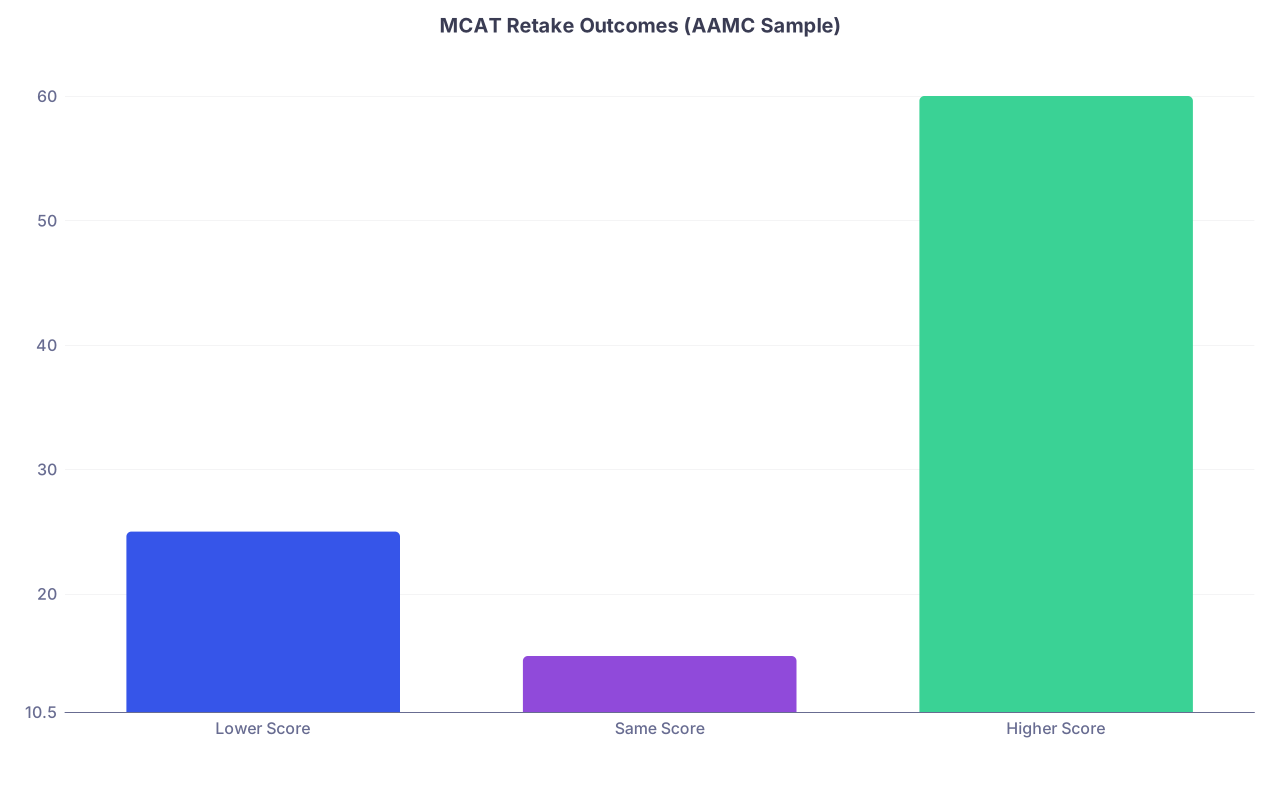
A retake may be worth considering if multiple sections are below target, if one subsection is low enough to raise a repeated competency concern, or if your total score meaningfully limits your options. But don’t retake just because the score “looks weird” and hurts your feelings. That’s how people turn a decent result into a worse one. Retakes are expensive, draining, and risky. If your total is solid and the weaker sections are still acceptable for your target schools, a retake may do more harm than good.
You also need to build the rest of the application intelligently. If your MCAT is unbalanced, the rest of your file should reduce uncertainty, not add to it.
That means:
- strong academic evidence elsewhere, especially in science coursework
- thoughtful clinical experience that shows maturity and follow-through
- a personal statement that sounds grounded, not defensive
- secondaries that show fit and self-awareness
- an explanation of growth only if it’s truly needed and genuinely supported

And please don’t panic-submit a school list built from hope, Reddit folklore, and one cousin’s opinion. That is applicant self-sabotage. Use real data. Be honest about where your profile is strong, where it is vulnerable, and where it is simply average. Average is not fatal. Delusion is.
Closing reflection: the score is one signal, not the whole story
If you want the shortest answer, here it is: balanced MCAT scores usually matter more because they feel safer to admissions committees. One very strong section can help, sometimes meaningfully, but it rarely wipes away concerns from multiple weak subsections or a weak total score.
That sounds harsh. I know. But I actually think it’s reassuring once you stop fighting it.
Why? Because it means your future is not hanging on one sparkling box or one disappointing one. Applicants treat MCAT subsection data like a verdict on their worth, their intelligence, or their chances. It’s not. It’s one signal. A loud signal, yes. An important signal, yes. The whole story? No.
So if your score is balanced, that’s a strength even if it doesn’t look flashy. If one section is outstanding, good. Take the win. Just don’t ask it to do a job it can’t do alone.
Judge the whole profile. Build a realistic school list. Be strategic instead of superstitious. And if you feel yourself spiraling over one subsection, zoom out before you decide that one number has already decided your life.
It hasn’t.