Overcoming MCAT Anxiety with Mindfulness: A Practical Guide for Test Takers
The MCAT is more than just another standardized exam—it is a major gateway to medical school admissions and often feels like a referendum on your future in medicine. Because of this high-stakes context, MCAT anxiety is extremely common, even among well-prepared students.
The good news: you can learn to manage that anxiety effectively. Mindfulness techniques, when integrated into your MCAT preparation and test-taking strategies, can significantly reduce stress, improve focus, and help you perform closer to your true potential on exam day.
This guide reframes MCAT anxiety not as a personal failing, but as a predictable response to a major challenge—and shows you how to use mindfulness-based tools to handle it skillfully.
Understanding MCAT Anxiety in the Context of Medical School Admissions
MCAT anxiety is not simply “nervousness.” It is a combination of psychological, cognitive, and physical reactions triggered by the perceived importance and difficulty of the exam.
Common Sources of MCAT Anxiety
Performance Pressure and Fear of Failure
For many students, the MCAT feels like a verdict on whether they “deserve” to be a doctor. Thoughts like:- “If I don’t score above X, I’ll never get into medical school.”
- “Everyone else seems more prepared than I am.” can spiral into self-doubt, perfectionism, and paralysis.
Time Constraints and Endurance Concerns
The MCAT is long—over 7 hours including breaks. Students often worry about:- Running out of time on sections
- Maintaining focus during the later passages
- Managing breaks effectively to avoid burnout
Unpredictable Content and Difficulty
Even with a well-structured MCAT preparation plan, you can’t predict exactly which topics, passages, or question styles will appear. This uncertainty can fuel anxiety:- “What if they ask about the one thing I forgot?”
- “What if the CARS passages are much harder than what I’ve practiced?”
High Stakes for Medical School Admissions
MCAT scores are a core component of admissions decisions. Anxiety may intensify around:- Pressure from family, mentors, or peers
- Concern about reapplying if you don’t achieve your target score
- Financial and time investment in preparation
Recognizing the Symptoms of MCAT Anxiety
Recognizing how anxiety shows up in your body and mind is the first step in managing it. Common signs include:
- Physical symptoms: muscle tension, headaches, stomach discomfort, rapid heartbeat, sweating, fatigue, trouble sleeping
- Cognitive symptoms: racing thoughts, difficulty concentrating, catastrophizing (“I’m going to fail”), mental blanking
- Emotional symptoms: irritability, frustration, hopelessness, feeling overwhelmed
- Behavioral symptoms: procrastination, avoiding practice exams, overstudying without rest, constantly changing strategies
Mindfulness techniques specifically target these dimensions. They won’t remove all stress (and you don’t want zero arousal for performance), but they can convert overwhelming anxiety into manageable, performance-enhancing alertness.
What Is Mindfulness and Why Does It Help with MCAT Preparation?
Mindfulness is not about “emptying your mind” or forcing yourself to be calm. Instead, it is the practice of paying purposeful, nonjudgmental attention to the present moment.
Core Components of Mindfulness
Awareness
Noticing what is happening in your thoughts, emotions, and body—right now.
Example: “I notice my heart is racing, and I’m thinking ‘I’m going to bomb this practice test.’”Acceptance (Nonjudgmental Stance)
Allowing your internal experience to be what it is—without labeling it as “good” or “bad” or trying to instantly fix it.
Example: “Anxiety is present. This is a normal response to a high-stakes exam.”Present-Moment Focus
Redirecting your attention from past regrets and future worries to the task at hand.
Example: “Right now, my job is to answer this one question—not to solve my entire future.”
How Mindfulness Supports MCAT Performance
Research across high-stakes testing and health professions education shows that mindfulness can:
- Decrease test-related anxiety and physiological stress
- Improve working memory, focus, and sustained attention
- Strengthen emotional regulation (e.g., recovering quickly after a tough passage)
- Enhance decision-making under pressure
For MCAT takers, this translates into:
- Fewer mental spirals during practice and test day
- Greater ability to refocus after distractions
- More consistent performance across the entire exam
- Better alignment between your true knowledge level and your score
Mindfulness is a skill, not a personality trait. You can train it, just as you train for content knowledge and test-taking strategies.
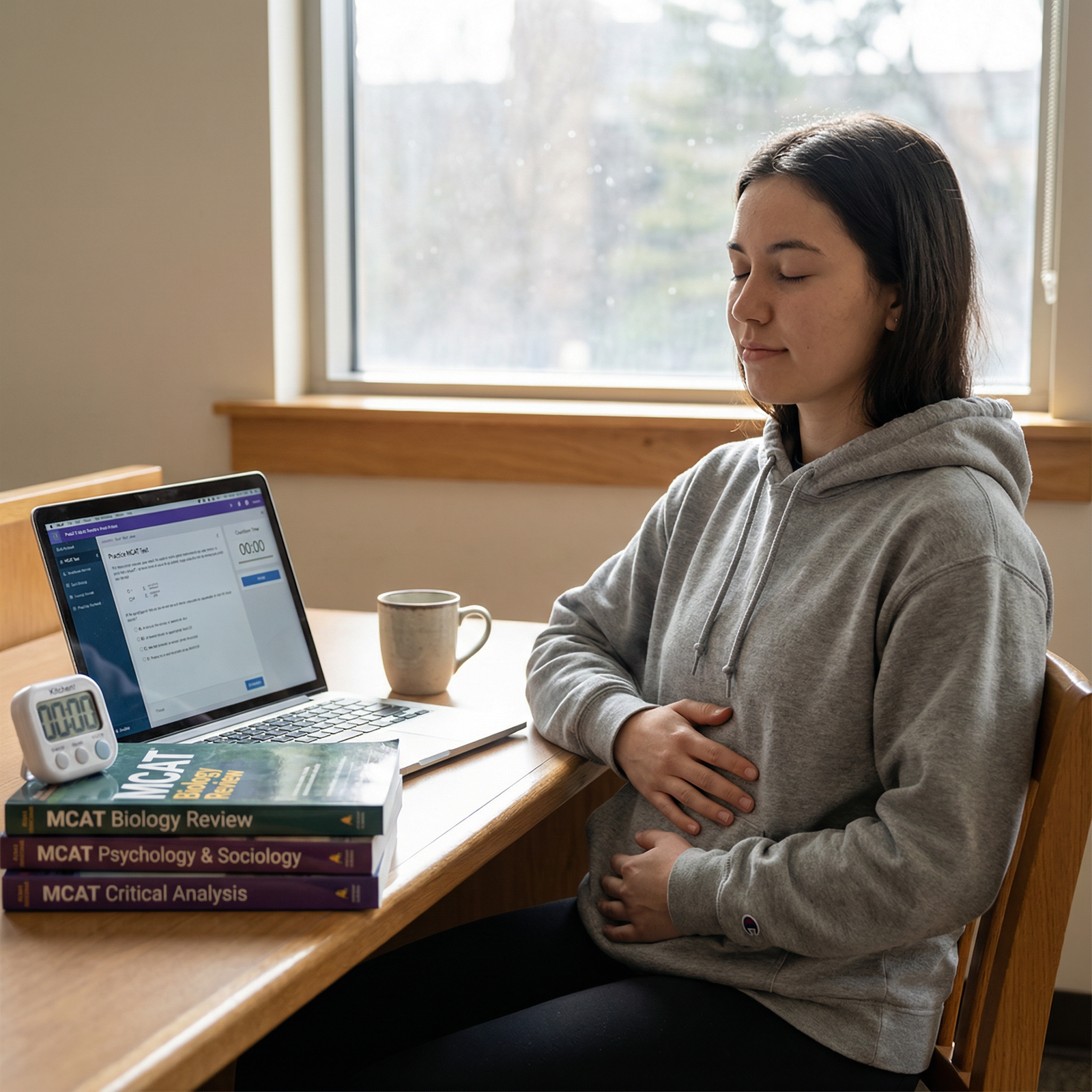
Core Mindfulness Techniques for MCAT Test Takers
The following techniques are specifically adapted for MCAT anxiety management and can be integrated into both your daily study routine and your exam-day plan.
1. Mindful Breathing Exercises for Rapid Anxiety Reduction
Mindful breathing is one of the fastest ways to calm your nervous system and regain control during moments of stress.
How to Practice Mindful Breathing
Basic 4–4–6 Breathing (5–10 minutes)
- Position: Sit with feet flat on the floor, back straight but not rigid, hands resting on your thighs or desk.
- Inhale: Breathe in through your nose for a count of 4, feeling your belly expand.
- Hold: Gently hold your breath for a count of 4 (without straining).
- Exhale: Slowly exhale through your mouth for a count of 6, feeling your shoulders soften.
- Focus: Place your full attention on the feeling of breathing. When your mind wanders (it will), gently bring it back to the breath, without criticism.
- Repeat: Continue for 10–20 cycles, or for 5–10 minutes.
When to Use This
- Before starting a study block or practice exam
- During breaks between MCAT sections
- When you feel panic rising while reviewing difficult content or a hard passage
- At night if pre-exam anxiety is keeping you awake
Over time, your body will begin to associate this practice with calm and focus, making it an excellent anchor during both preparation and test day.
2. Grounding Techniques to Reset During Overwhelm
Grounding techniques help you reconnect with your senses and the present moment—especially when your mind is lost in “what ifs.”
The 5–4–3–2–1 Grounding Exercise (2–3 minutes)
5 things you can see
Slowly look around and name (silently or out loud) five things:
“Blue notebook, wall clock, laptop screen, window, water bottle.”4 things you can feel
Notice physical sensations:
“The chair under me, my hands on the desk, the fabric of my shirt, my feet in my shoes.”3 things you can hear
Listen for subtle sounds:
“Distant traffic, the hum of the computer, pages turning.”2 things you can smell
Actual or imagined:
“My coffee, the faint scent of the room” (if nothing is obvious, recall two pleasant scents).1 thing you can taste
Sip water, chew gum, or simply notice the natural taste in your mouth.
This technique is especially useful:
- If you feel frozen or unable to move on to the next question
- After encountering a confusing passage or experimental-sounding question
- When you catch yourself spiraling about your score mid-exam
You’re not trying to eliminate anxiety; you’re anchoring your attention to the here and now so you can continue functioning effectively.
3. Mindful Visualization for Confidence and Test-Day Readiness
Visualization (also called mental rehearsal) combines imagery with mindfulness to train your brain for the test-day environment.
Guided MCAT Visualization (5–10 minutes, 3–4x/week)
- Settle In: Sit quietly, close your eyes, and do 1–2 minutes of mindful breathing.
- Create the Scene:
Imagine walking into the test center: the check-in process, the locker area, the testing room. Visualize details—lighting, desks, headphones, the computer screen. - See Yourself Calm and Prepared:
Picture yourself:- Adjusting your chair and keyboard
- Taking a few slow breaths before starting each section
- Reading passages with steady focus
- Rehearse Challenges:
Intentionally imagine:- A harder-than-expected passage, then see yourself calmly flagging a question and moving on
- Running low on time, responding by calmly prioritizing and making your best choices
- Add Positive, Realistic Affirmations:
Use statements grounded in your actual effort, such as:- “I have prepared thoroughly; I can handle difficult questions.”
- “I don’t need to be perfect; I just need to stay present and do my best on each question.”
- “I can feel anxious and still perform effectively.”
- End with Success:
Visualize finishing the exam, taking a deep breath, and feeling a sense of earned relief and accomplishment.
Visualization is most powerful when practiced consistently. You’re teaching your nervous system that this environment is familiar and manageable.
4. Progressive Muscle Relaxation (PMR) to Release Physical Tension
Anxiety often shows up as muscle tension—tight shoulders, clenched jaw, or a “knot” in your stomach. Progressive Muscle Relaxation helps you notice and release that tension.
Short PMR Routine (10–15 minutes)
Start with Your Feet:
- Tense your toes and feet for ~5 seconds.
- Release completely and notice the difference between tension and relaxation.
Move Upward Through the Body:
- Calves and thighs
- Hips and abdomen
- Hands and forearms
- Upper arms and shoulders
- Neck and jaw
- Eyes and forehead
Breathe Throughout:
Inhale as you tense, exhale as you release.
PMR is especially helpful:
- The night before the exam to improve sleep quality
- After long study sessions to reset your body
- On practice test days to mimic your test-day routine
With practice, you’ll learn to release tension quickly in specific areas, even while sitting at the exam computer.
5. Mindfulness Meditation as a Daily Mental Training Tool
Mindfulness meditation is the “strength training” of anxiety management: consistent practice builds your capacity to notice thoughts and redirect your attention.
Simple Mindfulness Meditation (5–15 minutes daily)
- Posture: Sit comfortably, either on a chair or cushion, with an upright but relaxed spine.
- Anchor: Choose a focus—most commonly the breath, but you can also focus on sounds or bodily sensations.
- Observe:
- As you inhale and exhale, notice the sensation (e.g., air at the nostrils, rise and fall of the abdomen).
- When thoughts arise (“What if I get a low score?”), acknowledge: “Thinking,” then gently return to the breath.
- Nonjudgment:
- There is no “perfect” meditation.
- Your practice is the process of noticing distraction and returning, again and again.
Start small—even 3–5 minutes daily can make a difference if you’re consistent. Gradually work up to 10–15 minutes on most days.
Benefits for MCAT preparation:
- Improved focus during long passages and question sets
- Less reactivity when you encounter difficult or unfamiliar content
- More stable mood across the ups and downs of your study process
Building a Mindfulness-Integrated MCAT Study Routine
Mindfulness is most effective when it’s woven into your existing MCAT preparation and test-taking strategies, not treated as a separate “extra.”
Daily and Weekly Mindfulness Plan
Daily (10–20 minutes total):
- 5–10 minutes of mindfulness meditation (morning or evening)
- 2–3 short mindful breathing or grounding breaks during study blocks
- 1–2 minutes of calm breathing before and after practice sets
Weekly:
- 1–2 sessions of visualization, especially in the final 4–6 weeks before your exam date
- 1–2 sessions of PMR, particularly on heavier study days or when sleep is affected
Integrating Mindfulness into Practice Exams
On every full-length test:
- Before starting:
Do 5 minutes of mindful breathing to simulate your test-day warm-up. - Before each section:
Take 3–5 deep, slow breaths; feel your body in the chair. - During the section:
If you notice anxiety climbing, take one slow breath between questions without breaking your timing rhythm. - During breaks:
Use the 5–4–3–2–1 grounding exercise or brief PMR for shoulders/neck.
By incorporating these routines into your practice exams, you train your brain and body to respond similarly on the real test day.
Using Mindfulness to Adjust Unrealistic Expectations
Mindfulness also helps you observe unhelpful thought patterns that sabotage your confidence:
- “If I don’t get a 520+, I’ll never be a good doctor.”
- “Everyone else is handling this better than I am.”
- “One bad practice test means I’m doomed.”
Instead of automatically believing these thoughts, mindfulness allows you to:
- Notice the thought: “I’m having the thought that I’m doomed.”
- Label it: “This is anxiety speaking, not objective truth.”
- Refocus: “What’s the next specific action I can take? Review this passage? Reassess my timing? Take a 5-minute reset and continue?”
This shift from catastrophizing to constructive problem-solving is crucial, both for MCAT performance and for your future as a clinician.

Frequently Asked Questions: MCAT Anxiety, Mindfulness, and Test-Day Performance
1. How exactly can mindfulness improve my MCAT score?
Mindfulness doesn’t directly “raise your score” the way content review might, but it creates the mental conditions for you to perform at your true level. Specifically, it can:
- Reduce distracting anxiety and negative self-talk during the exam
- Improve focus and working memory, especially in later sections
- Help you recover quickly from tough passages or time pressure
- Prevent panic-induced mistakes, such as misreading questions or changing correct answers impulsively
When combined with strong content review and intentional test-taking strategies, mindfulness can help close the gap between your potential and your actual score.
2. I’ve never meditated before. Can I still benefit from mindfulness for MCAT preparation?
Yes. You do not need any prior experience to benefit from mindfulness techniques.
A progression that works well for many premeds:
- Start with 1–2 minutes of mindful breathing before study sessions.
- Add short grounding exercises when you feel overwhelmed.
- Introduce 5 minutes of daily mindfulness meditation, increasing slowly as it becomes more comfortable.
- Integrate visualization and PMR in the final weeks leading up to your exam.
The key is consistency rather than perfection. Even brief, repeated practice can create meaningful changes in how you respond to exam-related stress.
3. How far in advance of my exam should I start practicing mindfulness techniques?
Ideally, begin building mindfulness into your MCAT preparation early in your study plan—at least 2–3 months before your test date. This gives you time to:
- Learn the techniques without feeling rushed
- Practice them during multiple full-length practice exams
- Make mindfulness a normal part of your routine, so it feels natural on test day
However, even if your exam is only a few weeks away, it’s not too late. You can still:
- Use breathing exercises and grounding techniques to manage peak anxiety
- Practice brief visualization sessions to prepare for test day
- Implement PMR and breathwork to protect your sleep and recovery
4. What if I practice mindfulness and I still feel anxious on test day?
Feeling some anxiety on test day is normal—and can even be helpful. The goal of mindfulness is not to eliminate anxiety but to change your relationship with it.
On test day, you might think:
- “My heart is racing, and I feel tense.”
With mindfulness, you can respond:
- “My body is gearing up for something important. I can feel this anxiety and still read carefully, think clearly, and use my strategies.”
Use your tools:
- Take 3–5 slow breaths before starting each section
- Do a quick 5–4–3–2–1 grounding if you begin to spiral
- Remind yourself: “I’ve practiced for this. One question at a time.”
Anxiety may still be present, but it does not have to control your behavior or your performance.
5. How do mindfulness techniques fit with other MCAT test-taking strategies?
Mindfulness complements, rather than replaces, traditional MCAT strategies. Think of it as the foundation that helps you apply your strategies reliably. You should still:
- Use evidence-based MCAT preparation resources and a structured study schedule
- Learn content thoroughly and practice with high-quality questions
- Develop specific strategies for CARS, passage mapping, timing, and educated guessing
Mindfulness supports these strategies by helping you:
- Stay calm enough to implement them when stressed
- Avoid overreacting to difficult questions or temporary setbacks
- Maintain endurance and concentration throughout all sections
Together, these elements—content knowledge, test-taking strategies, and mindfulness-based anxiety management—form a comprehensive approach to MCAT success.
Conclusion: Using Mindfulness to Navigate MCAT Anxiety and Move Confidently Toward Medical School
MCAT anxiety is not a sign that you’re unprepared or unfit for medicine. It is a normal human reaction to a demanding, high-stakes experience. What matters is how you respond to that anxiety.
By integrating mindfulness techniques—such as mindful breathing, grounding exercises, visualization, progressive muscle relaxation, and daily meditation—into your MCAT preparation, you can:
- Reduce the intensity and impact of anxiety
- Protect your focus, memory, and decision-making under pressure
- Develop resilience that will serve you not only on test day, but throughout medical school and your clinical career
Mindfulness is a skill you can start developing today. Pair it with deliberate MCAT preparation and solid test-taking strategies, and you’ll not only improve your chances of achieving a strong score—you’ll also cultivate the calm, present, and reflective mindset that defines an effective future physician.