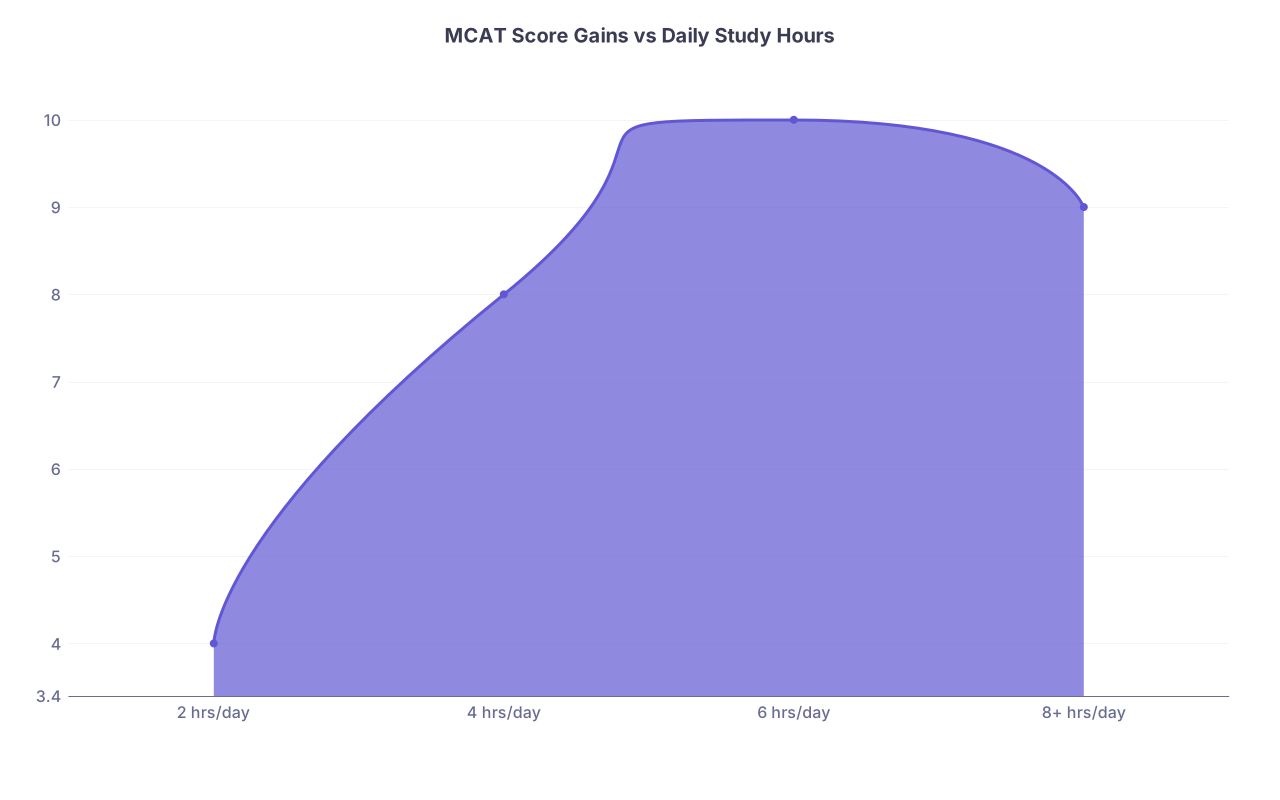
The MCAT Cheat Sheet: High‑Yield Formulas and Concepts You Must Know
The Medical College Admission Test (MCAT) is one of the most critical milestones on the path to medical school. It doesn’t just test facts; it assesses whether you can apply scientific knowledge, analyze data, and reason through complex passages in ways that reflect how you’ll think as a future physician.
Because the exam covers such a broad range of topics—from Chemical Concepts and physics to biological pathways and Psychological Foundations of behavior—an organized, high‑yield summary is invaluable. This enhanced MCAT “cheat sheet” goes beyond a simple list of formulas: it connects equations to concepts, shows how they’re tested, and gives study tips to help you retain and apply them efficiently.
Use this guide alongside full‑length practice exams and content review to strengthen your MCAT preparation and improve both speed and accuracy on test day.
MCAT Structure and How to Use a Formula Cheat Sheet Strategically
Understanding the exam blueprint helps you prioritize what to memorize and how to practice.
The Four MCAT Sections
Chemical and Physical Foundations of Biological Systems (Chem/Phys)
- Focus: General chemistry, organic chemistry, physics, biochemistry, some biology.
- Emphasis: Chemical Concepts and physical principles in the context of biological systems (e.g., blood flow, membranes, enzyme kinetics).
- Heavy on formulas, units, and problem-solving.
Critical Analysis and Reasoning Skills (CARS)
- Focus: Reading comprehension and reasoning based on passages in humanities and social sciences.
- No formulas to memorize; success is about reading strategies, critical thinking, and timing.
Biological and Biochemical Foundations of Living Systems (Bio/Biochem)
- Focus: Molecular biology, biochemistry, physiology, genetics, and cell biology.
- Requires understanding of pathways (e.g., glycolysis), regulation, and experiments rather than pure memorization.
Psychological, Social, and Biological Foundations of Behavior (Psych/Soc)
- Focus: Psychological Foundations of behavior, social structures, cognition, learning, mental disorders, and research methods.
- More concept-heavy than calculation-heavy, but includes key statistics and study design terminology.
How a Cheat Sheet Fits into Your MCAT Preparation
A formula and concepts cheat sheet is most valuable when you:
- Use it as a review tool, not a substitute for learning. You should understand where each equation comes from and in which scenarios it applies.
- Integrate it with practice questions. After missing a question, add the relevant formula or concept (and a quick note about the mistake) to your sheet.
- Organize it by section, mirroring the MCAT structure, so your brain associates formulas with the types of passages where they appear.
High‑Yield Chemical and Physical Foundations Formulas and Concepts
This section is where memorized formulas matter most. However, the MCAT tests whether you can apply them in biological contexts (e.g., gas laws in respiration, optics in the eye, circuits in neurons).
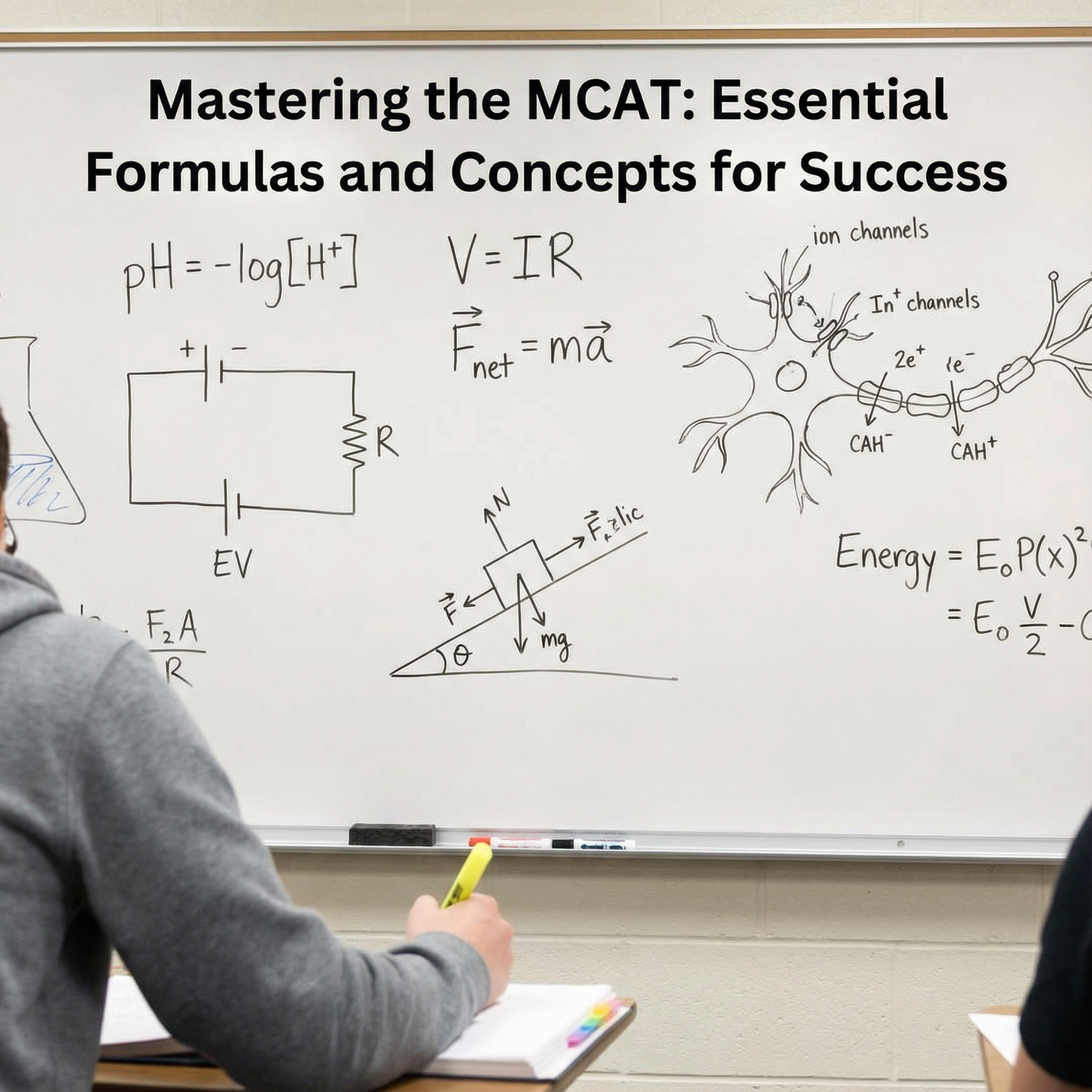
General Chemistry: Core Chemical Concepts
1. Solutions, Concentrations, and Equilibria
Molarity (M)
[ M = \frac{\text{moles of solute}}{\text{liters of solution}} ]- MCAT application: Dilutions, reaction stoichiometry, osmolarity in physiology.
- Quick tip: Remember (M_1V_1 = M_2V_2) for dilution problems (constant moles).
Percent Composition and Density (supporting concepts)
- Density: (\rho = \frac{m}{V})
Useful for buoyancy and phase problems.
- Density: (\rho = \frac{m}{V})
Equilibrium Constant (K)
For reaction (aA + bB \rightleftharpoons cC + dD):
[ K_{eq} = \frac{[C]^c [D]^d}{[A]^a [B]^b} ]- MCAT often explores Le Châtelier’s principle, not just plugging into equations.
2. Acid–Base Chemistry: pH, pKa, and Buffers
pH and pOH
[ \text{pH} = -\log[H^+] \quad\quad \text{pOH} = -\log[OH^-] ]
[ \text{pH} + \text{pOH} = 14 \quad (\text{at } 25^\circ C) ]pKa
[ \text{pKa} = -\log K_a ]Henderson–Hasselbalch Equation (high-yield for MCAT and physiology)
[ \text{pH} = \text{pKa} + \log \left(\frac{[\text{A}^-]}{[\text{HA}]}\right) ]- Used in buffer systems, especially bicarbonate buffer in blood.
- Helps relate pH to ratio of conjugate base to weak acid.
3. Gas Laws
Ideal Gas Law
[ PV = nRT ]- (P): pressure, (V): volume, (n): moles, (R): gas constant, (T): temperature (K).
- MCAT often uses proportional reasoning: e.g., at constant (T), (P \propto \frac{1}{V}).
Combined Gas Law
[ \frac{P_1 V_1}{T_1} = \frac{P_2 V_2}{T_2} ]Key Relationships to Remember
- At constant (n) and (T):
- (P \propto \frac{1}{V}) (Boyle’s law)
- (V \propto T) (Charles’s law)
- At constant (n) and (T):
Physics: Forces, Energy, Fluids, and Circuits
1. Kinematics and Newton’s Laws
Newton’s Second Law
[ F = ma ]- Foundation for almost any motion problem.
Kinematic Equations for Constant Acceleration
Common forms:
[ v = v_0 + at ]
[ x = v_0 t + \tfrac{1}{2} a t^2 ]
[ v^2 = v_0^2 + 2a\Delta x ]- MCAT questions may embed these in contexts such as blood flow or muscle movement.
2. Work, Energy, and Power
Kinetic Energy
[ KE = \frac{1}{2} m v^2 ]Gravitational Potential Energy
[ PE = mgh ]Work
[ W = Fd\cos\theta ]- When force and displacement are in the same direction, (\theta = 0), so (W = Fd).
Work–Energy Theorem
[ W_{net} = \Delta KE ]- Very useful when multiple forces act on an object.
Power
[ P = \frac{W}{t} \quad \text{or} \quad P = Fv \quad (\text{for constant velocity}) ]
3. Fluids: Essential for Physiology Questions
Density
[ \rho = \frac{m}{V} ]Pressure
[ P = \frac{F}{A} ]Hydrostatic Pressure
[ P = \rho g h ]- Think about blood pressure differences with body position.
Continuity Equation (Incompressible Fluids)
[ A_1 v_1 = A_2 v_2 ]- Smaller area → higher velocity (e.g., constricted blood vessels).
Bernoulli’s Equation (Conceptual Level)
[ P + \tfrac{1}{2} \rho v^2 + \rho g h = \text{constant} ]- Explains trade‑offs between pressure, velocity, and height in flowing fluids.
4. Circuits and Electricity
Ohm’s Law
[ V = IR ]Power in Circuits
[ P = IV = I^2 R = \frac{V^2}{R} ]Series vs. Parallel (Key Relationships)
- Series:
- (R_{eq} = R_1 + R_2 + \dots)
- Current is the same through each component.
- Parallel:
- (\frac{1}{R_{eq}} = \frac{1}{R_1} + \frac{1}{R_2} + \dots)
- Voltage is the same across each branch.
- Series:
Biological and Biochemical Foundations: Pathways, Genetics, and Molecular Concepts
In this section, equations matter, but conceptual understanding is even more important. You must understand how biochemical pathways integrate and how molecular changes alter physiology.
Key Biochemical Pathways and Energetics
1. Glycolysis and Cellular Respiration
Overall Glycolysis Equation
[ \text{Glucose} + 2 \text{NAD}^+ + 2 \text{ADP} + 2 P_i \rightarrow 2 \text{Pyruvate} + 2 \text{NADH} + 2 \text{ATP} + 2 \text{H}_2\text{O} ]MCAT Emphasis:
- Where steps occur: cytosol vs. mitochondria.
- ATP yield differences between aerobic vs. anaerobic conditions.
- Regulation by key enzymes (e.g., phosphofructokinase‑1).
ATP Accounting (Approximate)
- Glycolysis: net 2 ATP + 2 NADH.
- Complete aerobic respiration: ~30–32 ATP per glucose (conceptual, not precise arithmetic, is usually tested).
2. Photosynthesis (Mostly Conceptual but Know Overall Reaction)
Overall Photosynthesis Reaction
[ 6 \text{CO}_2 + 6 \text{H}_2\text{O} \xrightarrow[]{\text{light}} \text{C}6\text{H}{12}\text{O}_6 + 6 \text{O}_2 ]MCAT Focus:
- Energy conversion and electron flow.
- Plant systems primarily appear to test general biochemical logic.
3. Enzyme Kinetics (Michaelis–Menten)
Even if not in the original text, enzyme kinetics are high yield.
Michaelis–Menten Equation
[ v = \frac{V_{max}[S]}{K_m + [S]} ]- (V_{max}): maximum reaction velocity.
- (K_m): substrate concentration at half (V_{max}).
- Lower (K_m) → higher affinity.
Inhibition Types (Conceptual)
- Competitive: increases (K_m), same (V_{max}).
- Noncompetitive: decreases (V_{max}), same (K_m).
Genetics and Population Biology
1. Hardy–Weinberg Principle (Population Genetics)
Equation
[ p^2 + 2pq + q^2 = 1 ]- (p): frequency of dominant allele.
- (q): frequency of recessive allele.
- (p^2): frequency of homozygous dominant genotype.
- (2pq): frequency of heterozygotes.
- (q^2): frequency of homozygous recessive genotype.
Typical MCAT Uses:
- Given disease prevalence (often recessive: (q^2)), find carrier frequency ((2pq)).
- Assess assumptions: large population, random mating, no mutation/migration/selection.
2. Central Dogma and Molecular Concepts
Even with minimal equations, these are high yield:
- DNA → RNA → Protein
- Transcription (nucleus) and translation (cytoplasm).
- Mutation types: missense, nonsense, frameshift, silent.
- Mendelian inheritance patterns and pedigrees.
Psychological, Social, and Biological Foundations: Theories, Behavior, and Statistics
The Psych/Soc section is less about computation and more about conceptual frameworks and Psychological Foundations of behavior. However, some quantitative and definitional elements are worth memorizing.

Core Psychological and Sociological Theories
1. Maslow’s Hierarchy of Needs
A classic model of human motivation:
- Physiological Needs – food, water, sleep.
- Safety Needs – security, stability, health.
- Love/Belonging – relationships, friendships, intimacy.
- Esteem – respect, self-esteem, recognition.
- Self-Actualization – achieving one’s full potential, creativity.
- MCAT Angle:
- Predict behavior when certain needs are unmet.
- Distinguish between deficiency needs (lower levels) vs. growth needs (self-actualization).
2. Learning and Conditioning (High Yield)
Classical Conditioning
- Pairing a neutral stimulus with an unconditioned stimulus to produce a conditioned response.
- Terms: UCS, UCR, CS, CR; extinction; generalization; discrimination.
Operant Conditioning (Skinner)
- Behavior shaped by reinforcement and punishment.
- Positive vs. negative reinforcement; positive vs. negative punishment.
- Reinforcement schedules: fixed/variable ratio, fixed/variable interval.
Research Methods and Basic Statistics
Even simple quantitative concepts can appear in data-based questions.
1. Measures of Central Tendency
Mean
[ \text{Mean} = \frac{\sum X}{N} ]Median
- The middle value in an ordered dataset.
Mode
- The most frequently occurring value.
2. Variability and Correlation (Conceptual)
Standard Deviation:
- Measure of spread of data around the mean.
Correlation Coefficient (r):
- Between -1 and +1; indicates direction and strength of a linear relationship.
- Correlation ≠ causation (a recurrent MCAT theme).
3. Study Designs and Validity (Conceptual Must‑Knows)
- Independent vs. dependent variables.
- Randomization, blinding, control groups.
- Internal vs. external validity, reliability, confounding variables.
High‑Yield Study Tips to Memorize and Apply MCAT Formulas and Concepts
Formulas alone won’t raise your score unless you can recall and apply them under timed conditions. Integrating effective study strategies into your MCAT preparation is essential.
1. Active Recall Over Passive Review
- Instead of rereading notes, close your book and write out formulas from memory.
- Create mini “quizzes” for yourself:
- Example: “Write all the kinematics equations and label each variable.”
- “From memory, list the levels of Maslow’s hierarchy and provide a real-world example for each.”
2. Spaced Repetition for Long‑Term Retention
- Use Anki or another spaced repetition tool:
- One card: “Ideal gas law?” → Back: (PV = nRT) + a one-sentence example.
- Another: “Hardy–Weinberg: If q² = 0.01, what is carrier frequency?”
- Schedule short, daily review sessions rather than cramming.
3. Practice Problems in MCAT-Like Contexts
- The MCAT rarely asks, “What is the formula for kinetic energy?”
It embeds concepts in passages with figures, tables, and experimental data. - For every formula:
- Find or create 2–3 practice questions that require using it in a biological or experimental setting.
- After solving, explain in words: “Why does this formula apply here?”
4. Group Study and Teaching Others
- Teach a friend:
- “Here’s how I remember the difference between competitive and noncompetitive inhibition…”
- If you can explain a concept clearly without notes, you likely understand it well enough for the exam.
5. Visual Aids and Concept Mapping
- Draw flowcharts for pathways (e.g., glycolysis → Krebs cycle → ETC).
- Create mind maps linking:
- Fluids → blood circulation → pressure and flow.
- Psychological theories → behavior examples → clinical analogies.
6. Simulate Test Conditions Regularly
- Use full-length practice tests under timed conditions:
- After each, identify which equations or concepts slowed you down.
- Add those to your cheat sheet with a brief note (“Forget to convert Celsius to Kelvin here – always check units!”).
Frequently Asked Questions: MCAT Formulas, Concepts, and Study Strategy

1. How should I prioritize what to memorize for the MCAT?
Start with high-yield topics that are tested frequently and require precise recall:
- For Chem/Phys: gas laws, kinematics, work/energy, circuits, acid–base formulas.
- For Bio/Biochem: major metabolic pathways (glycolysis, Krebs, ETC), enzyme kinetics, genetics principles like Hardy–Weinberg.
- For Psych/Soc: major theories (Maslow, conditioning, identity theories), research methods, and basic statistics.
Use the AAMC content outline and reputable MCAT preparation resources (e.g., Kaplan, Princeton Review, UWorld, Khan Academy) to identify top priorities. Then, make sure you understand each formula conceptually, not just symbolically.
2. Are there specific resources that help with memorizing MCAT formulas and Chemical Concepts?
Yes. Consider integrating:
- MCAT prep books that include formula summaries at the end of chapters.
- Flashcard decks (e.g., Anki) specifically designed for MCAT equations and Chemical Concepts.
- Khan Academy and AAMC videos explaining derivations and applications of key formulas in real biological scenarios.
- Formula sheets you create yourself—the act of building your own cheat sheet is a powerful learning tool.
3. What is the best way to practice using these formulas under exam conditions?
- Timed sets of discrete and passage-based questions, focusing on one section at a time (e.g., a 45-minute Chem/Phys block).
- When you review:
- Identify which equations you needed but couldn’t recall quickly.
- Add them to a “high-priority” list and drill them daily for a week.
- Repeat full-length exams every 1–2 weeks as your test date approaches to practice integrating formulas across sections.
4. How often should I review my MCAT cheat sheet?
Aim to review at least briefly every 2–3 days, especially early in your MCAT preparation:
- Early phase: daily quick review (10–15 minutes) to solidify initial memorization.
- Mid phase: every 2–3 days, focusing on weak areas.
- Final month: daily targeted review of the most high-yield formulas and concepts, plus error patterns from practice questions.
Adjust based on spaced repetition principles—review items more frequently when you’re forgetting them and less frequently once they’re solid.
5. Can I rely solely on a cheat sheet to succeed on the MCAT?
No. A cheat sheet is a supplement, not a replacement for comprehensive study:
- It helps consolidate information and speed recall.
- However, the MCAT emphasizes application, reasoning, and data interpretation.
- You must combine:
- Solid content review,
- Ample practice questions and full-length exams,
- Strategic review of mistakes,
- And strong test-taking strategies (time management, passage mapping, logical elimination).
Used wisely, a well-designed cheat sheet will help you quickly access the formulas and key concepts you need so you can focus your mental energy on reasoning through the questions—the true core of MCAT success.
By integrating this organized, high-yield overview into your MCAT preparation plan—and pairing it with active practice and reflection—you’ll build both the knowledge base and the problem-solving stamina required to perform at your best on test day and move confidently toward medical school.