Time Management Mastery for MCAT Preparation: How to Study, Thrive, and Still Have a Life
Preparing for the MCAT is one of the most demanding phases of the premed journey. Between upper-level coursework, jobs, research, volunteering, family responsibilities, and the pressure of building a strong medical school application, it can feel like there is simply not enough time.
Yet thousands of students every year manage to balance MCAT Preparation with the rest of their lives—and you can too. The difference often comes down to intentional Time Management, realistic planning, and consistent attention to Self-Care.
This enhanced guide will walk you through practical, evidence-informed Study Strategies and scheduling techniques to help you:
- Build a realistic, high-yield MCAT study plan
- Balance studying with work, coursework, and personal life
- Protect your mental health and avoid burnout
- Maintain relationships and hobbies while you prepare
- Stay flexible when life inevitably changes your plans
The goal is not just a strong MCAT score—it’s sustainable Student Success and well-being throughout your premed and medical school preparation journey.
Understanding the MCAT and Your Starting Point
Effective Time Management starts with understanding exactly what you are preparing for and where you are starting from.
The MCAT at a Glance
The MCAT is about 7.5 hours long and includes four sections:
- Biological and Biochemical Foundations of Living Systems (Bio/Biochem)
- Chemical and Physical Foundations of Biological Systems (Chem/Phys)
- Psychological, Social, and Biological Foundations of Behavior (Psych/Soc)
- Critical Analysis and Reasoning Skills (CARS)
Each section tests not just memorized content but also your ability to apply concepts, interpret data, and reason under time pressure. That’s why MCAT Preparation must include both content review and extensive practice with passages and full-length exams.
Most students need 3–6 months of consistent, focused study to be fully prepared. Your exact timeline depends on:
- How long it’s been since you took prerequisites
- Your comfort level with test-taking and standardized exams
- Your baseline score (from a diagnostic test)
- How many hours per week you can realistically dedicate
Step 1: Assess Your Life Commitments and Available Time
Before building a study schedule, you need a clear picture of your actual weekly life.
List out all ongoing commitments, such as:
- Academics: Current courses, labs, exams, projects
- Work: Part-time or full-time job hours (including commute)
- Activities: Research, volunteering, leadership roles, shadowing
- Personal: Family responsibilities, religious services, appointments
- Self-Care: Exercise, hobbies, rest, mental health care
Then, for each, estimate:
- Average hours per week
- Flexibility (fixed vs. adjustable times)
Once you map out your week, you’ll see how many realistic, focused study hours you can commit. For many students, this ranges from 10–25 hours per week, depending on whether they are full-time students, working, or on a lighter semester.
Being honest here is crucial. A sustainable 15 hours per week for 5 months is far better than aiming for 35 hours, burning out in three weeks, and losing momentum.
Building a Structured and Realistic MCAT Study Schedule
Once you understand your constraints, you can build a schedule that works with your life instead of against it.
1. Define Your Target: Score, Test Date, and Timeline
Start with three clarifying questions:
What is your target MCAT score?
Base this on the median accepted scores of the schools you’re considering, plus your own goals.When do you plan to take the MCAT?
Consider application timelines (typically testing by late spring/early summer of your application year) and your other responsibilities.How many weeks do you have until your test date?
Multiply by your realistic weekly study hours to find your total study hours.
For example:
- 20 weeks until exam × 15 hours/week = 300 hours of preparation time
- 30 weeks × 20 hours/week = 600 hours
This gives you a rough sense of how intensive your schedule can be and helps you prioritize.
2. Use a Diagnostic to Guide Your Study Strategies
Before diving into content review, take a full-length diagnostic exam (preferably from AAMC or a reputable company).
From your diagnostic:
- Note section scores (Bio/Biochem, Chem/Phys, Psych/Soc, CARS)
- Identify content gaps (e.g., weak in physics, organic chemistry, or biochemistry)
- Note strategic or timing issues (e.g., running out of time in CARS, misreading data in graphs)
This information allows you to:
- Prioritize weaker sections in your schedule
- Allocate more practice to your weakest question types
- Adjust your timing strategies early
3. Design a Weekly MCAT Study Framework
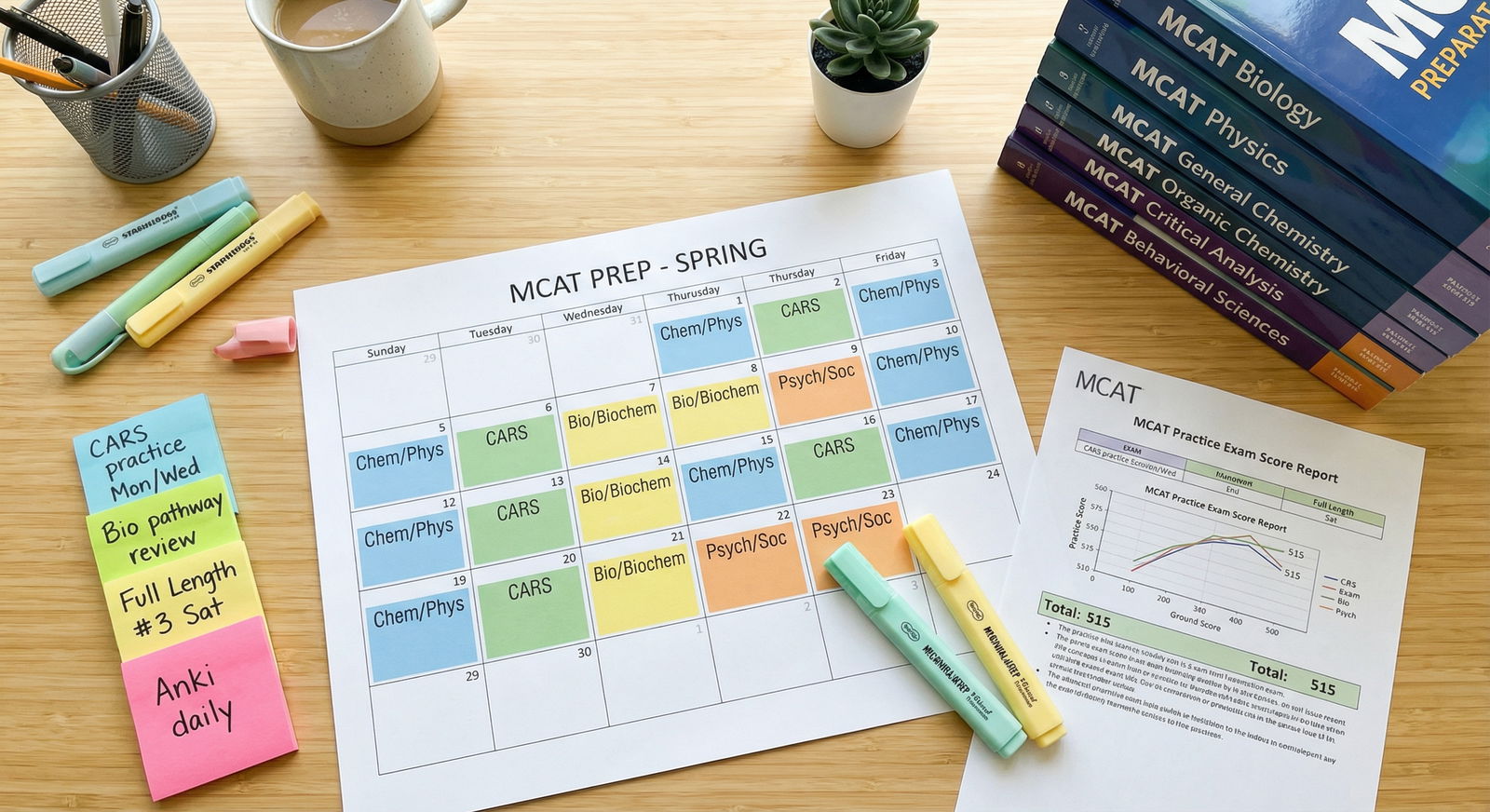
Rather than planning every minute, build a weekly framework that balances content review, passage practice, and full-length exams.
A sample weekly outline (for ~15 hours/week):
Content Review (6–7 hours/week)
- 1–1.5 hours/day, 4–5 days/week
- Rotate major subjects: Bio, Chem/Phys, Psych/Soc, CARS skills
Practice Passages / Question Banks (5–6 hours/week)
- 45–90 minutes/day, 4–5 days/week
- Mixed practice or focused on that day’s content
Full-Length or Section Exams (3–4 hours/week)
- Full-length every 2–3 weeks in early/mid-phase
- Weekly full-lengths in final 4–6 weeks
Review (1–2 hours/week)
- Dedicated time for reviewing missed questions and making Anki/flashcards
As you move from the early to the late phase of your MCAT Preparation, gradually shift emphasis from content review to practice exams and review.
4. Use Time Blocking for Deep Work and Focus
Time blocking is one of the most powerful Study Strategies for MCAT success.
How to use time blocking:
Divide your day into blocks (e.g., 60–120 minutes) with a specific task assigned:
- 9:00–11:00: Chem/Phys content + 2 passages
- 2:00–3:30: Psych/Soc flashcards + question bank
During each block:
- Silence notifications; put your phone away or use focus apps
- Study in a quiet, consistent environment (library, study room, dedicated desk)
- Use active learning: teach concepts aloud, write key points, draw pathways
Use breaks strategically:
- 5–10 minutes every 45–60 minutes
- 30–60 minutes between major blocks
- Avoid scrolling social media; instead stretch, hydrate, or take a brief walk
This focused, distraction-free Time Management approach lets you get high-quality study done in fewer hours.
5. Track Progress and Adjust Weekly
An MCAT study plan should be living, not rigid.
Each week, briefly review:
- What you planned vs. what you actually completed
- Practice questions: proportion correct, patterns in errors
- Full-length score trends and section-level performance
Then adjust:
- Shift time toward persistently weak areas
- Re-balance if you’re neglecting a section (CARS is often under-prioritized)
- Update your weekly goals based on upcoming exams, work shifts, or personal events
This ongoing reflection keeps your Study Strategies efficient and aligned with your goals.
Balancing MCAT Prep, Work, Classes, and Life
MCAT Preparation doesn’t happen in a vacuum. Your success depends on how well you integrate studying with the rest of your life.
1. Time Management for Full-Time Students
If you’re taking a full course load:
- Identify lighter vs. heavier weeks (exam weeks, lab deadlines)
- During heavy weeks, reduce MCAT hours slightly rather than eliminating them; even 30–60 minutes/day of light review or flashcards maintains momentum
- Use small pockets of time between classes for:
- Anki or flashcards
- Reviewing notes
- Short sets of practice questions
Consider lighter academic terms (summer, reduced course load) for intensive MCAT study if possible.
2. Strategies for Students Working Part-Time or Full-Time
Balancing a job with MCAT study requires extra structure:
- Map your work schedule first, then place study blocks around it
- Prioritize high-focus tasks (like dense content or CARS) when you’re mentally freshest—often mornings or days off
- Use commute time (if not driving) for:
- Flashcards
- Audio summaries or MCAT podcasts
- Protect at least one full day per week for deeper, extended study if possible
For full-time workers, a common pattern is:
- 1–2 hours of study on workdays
- 4–6 hours on each weekend day
- Total: ~15–20 hours/week
3. Maintaining Relationships and Social Connections
Healthy relationships are not a distraction—they’re essential for long-term Student Success and emotional stability.
To balance both:
- Communicate early and clearly with family, partners, and friends about your MCAT timeline and study needs
- Share your study schedule, so they know when not to interrupt and when you’re available
- Plan intentional social time, even if it’s brief:
- A weekly dinner with family
- A movie night or coffee with a friend
- A short walk with a roommate in the evening
Quality over quantity matters. Short but meaningful interactions can help recharge you without derailing your study plans.
4. Using Support Systems and Accountability
Don’t try to do everything alone.
Effective supports include:
Study Groups:
- Use them for concept review, teaching each other, and discussing difficult passages
- Keep them structured and time-limited to avoid turning into social hangouts
Accountability Partners:
- Check in with another premed weekly to share goals and progress
- Celebrate each other’s wins and troubleshoot challenges
Tutors or Prep Courses:
- Consider if you’re plateauing, struggling with specific topics, or overwhelmed with planning
- A tutor can help personalize Study Strategies and clarify weak concepts efficiently
Support systems help you remain consistent, motivated, and grounded.
Protecting Your Well-Being: Self-Care and Burnout Prevention
MCAT Preparation is a marathon, not a sprint. Without intentional Self-Care and realistic expectations, burnout becomes a real risk.

1. Sleep: Your Highest-Yield “Study Tool”
Protecting sleep is one of the most powerful ways to improve concentration, memory, and test performance.
Aim for:
- 7–9 hours of sleep per night, consistently
- A wind-down routine: dim lights, no screens 30–60 minutes before bed
- Avoiding late-night caffeine and “cramming” that sacrifices the next day’s productivity
Students frequently underestimate how much poor sleep reduces the effectiveness of their study hours.
2. Exercise and Nutrition for Cognitive Performance
You don’t need to become a fitness fanatic, but regular movement and good nutrition strongly support brain function.
Exercise:
- 20–30 minutes of moderate activity (walking, jogging, yoga) most days
- Short walks between study blocks can help reset your focus
Nutrition:
- Emphasize whole foods: fruits, vegetables, lean proteins, whole grains
- Stay hydrated; keep water at your study space
- Avoid relying heavily on sugar and energy drinks, which can lead to crashes
Think of your body as the hardware your brain runs on. Good “maintenance” helps your MCAT study software run smoothly.
3. Mindfulness, Stress Management, and Mental Health
Preparing for the MCAT brings pressure, self-doubt, and comparison. Integrating simple mental-health habits into your routine can buffer against burnout.
Helpful approaches:
Mindfulness exercises:
- 5–10 minutes of guided meditation apps or simple deep breathing
- Brief check-ins: “What am I feeling? What do I need right now?”
Journaling:
- Track progress, note challenges, and remind yourself of your “why”—your motivation to pursue medicine
Boundaries with comparison:
- Limit time on forums or group chats that increase anxiety
- Remember: people often share highlights, not struggles
If you notice persistent anxiety, depression, or feeling overwhelmed to the point of dysfunction, consider talking with a mental health professional or campus counseling center. Seeking help is a sign of maturity and professionalism, not weakness.
4. Avoiding Burnout Through Realistic Expectations
To keep going over months of MCAT Preparation:
- Accept that not every study day will be perfect
- Build in at least one partial rest day each week to reset
- Recognize that:
- The MCAT is high-stakes, but it is one part of your application
- Many successful physicians did not get their dream score on their first attempt—but adapted and persevered
Self-compassion is a powerful antidote to burnout. Treat yourself as you would treat a close friend going through the same process.
5. Celebrate Small Wins and Milestones
Motivation often fades if you only celebrate the final score. Instead:
Mark milestones:
- Finishing a prep book
- Completing your first full-length exam
- Improving your section score by a few points
Create a simple reward system:
- Favorite snack, a movie, a short trip, or time on a hobby after a big study week
- Sharing your progress with a friend or mentor
Recognizing progress, even when imperfect, keeps you engaged and resilient.
Putting It All Together: A Sample 4-Week MCAT Study Snapshot
Below is a simplified example to illustrate how Time Management, Study Strategies, and Self-Care can fit together. Adjust based on your own situation and timeline.
| Week | Primary Focus | Study Hours (Approx.) | Key Tasks |
|---|---|---|---|
| 1 | Bio/Biochem Review + CARS Skills | 12–15 | Diagnostic exam, Bio/Biochem content, 3–4 CARS passages |
| 2 | Chem/Phys Foundations + Psych/Soc Basics | 12–15 | Physics & gen chem review, Psych/Soc terms, passages |
| 3 | Psych/Soc + Bio/Biochem Application | 12–15 | High-yield Psych/Soc, mixed passages, half-length exam |
| 4 | CARS Focus + Mixed Practice | 12–15 | Daily CARS, mixed sets from all sections, extended FL |
Across all weeks:
- Time-blocked sessions
- Protected sleep and exercise windows
- Weekly reflection and plan adjustment
- At least one lighter or partial rest day
This type of intentional, sustainable approach is far more effective than sporadic cramming or all-nighters.
Frequently Asked Questions About MCAT Time Management and Balance
1. How many hours per week should I study for the MCAT?
Most students do well with 15–25 hours per week for 3–6 months, depending on their baseline knowledge and test date. If you have a strong science background and good test-taking skills, you may lean toward the lower end; if you’re further out from your science courses or balancing a full-time job, you may extend your timeline. Focus on consistent, high-quality study rather than chasing a specific number of hours.
2. Is it realistic to prepare for the MCAT while working or taking a full course load?
Yes, many students successfully balance MCAT Preparation with work or classes, but it requires:
- Honest assessment of your available time
- Structured Time Management with clear study blocks
- Willingness to cut back on nonessential commitments
- Strong boundaries with distractions and low-yield activities
In some cases, students choose to reduce work hours, take one lighter semester, or use summer for more intensive MCAT prep. There is no single “right” path—choose what protects both your performance and your mental health.
3. What are the most effective Study Strategies for the MCAT?
High-yield Study Strategies include:
- Active learning (teaching concepts aloud, making diagrams, doing practice questions)
- Practice passages and full-length exams under timed conditions
- Thorough review of every missed or guessed question (identify why you missed it and what to change)
- Spaced repetition for formulas, definitions, and high-yield facts (Anki or similar tools)
- CARS-specific practice several days per week using timed passages
Purely passive review (re-reading, highlighting) is usually low-yield unless paired with active recall and practice.
4. How do I prevent burnout while preparing for the MCAT?
To protect your well-being:
- Maintain regular sleep, exercise, and nutrition
- Schedule at least one partial rest day each week
- Build in short, meaningful breaks and social connections
- Adjust your plan when life events or stress levels change—flexibility is not failure
- Practice self-compassion: tough days don’t erase your progress
If you notice worsening anxiety, depression, or inability to function, reach out to a counselor, physician, or mental health professional. Taking care of your mind is essential for long-term Student Success.
5. Are time management strategies different for non-traditional or post-bac students?
Non-traditional students often have additional responsibilities—full-time jobs, families, or returning to school after time away. The core principles are the same, but:
- Realistic weekly study hours may be lower; timelines may be longer
- Time blocking and strict prioritization become even more crucial
- Early planning for childcare, work adjustments, or family support can make a big difference
The advantage many non-traditional students have is maturity in self-awareness and discipline. Use that strength to create a realistic, sustainable plan tailored to your life.
Balancing your life while preparing for the MCAT is absolutely possible. With realistic goals, structured Time Management, evidence-based Study Strategies, and consistent Self-Care, you can pursue a strong MCAT score and protect your well-being. These skills will serve you not just for this exam, but throughout medical school and your future medical career.