MCAT Score Boosting Techniques: How to Raise Your Score in 30 Days
MCAT Preparation in 30 days is intense, but it can be transformative if you are strategic and disciplined. In a month, you probably won’t relearn an entire undergraduate education—but you can dramatically refine your test strategies, close key content gaps, and turn an average score into a competitive one for medical school admissions.
This guide expands on a focused, 30‑day MCAT study plan designed to maximize score improvement in a short time. You’ll learn how to:
- Diagnose your strengths and weaknesses quickly
- Build a realistic, high-yield study schedule
- Use practice questions and full-lengths strategically
- Sharpen your test strategies, especially for CARS
- Manage stress and protect your performance on test day
Use this as a playbook, customizing the details to your baseline score, available hours, and target schools.
Understanding the MCAT Structure & What It Really Tests
Before planning how to raise your score, you need to understand what the exam is actually measuring. The MCAT is not just a content test—it is a critical thinking and application test built around four sections:
- Chemical and Physical Foundations of Biological Systems (CPBS)
- Critical Analysis and Reasoning Skills (CARS)
- Biological and Biochemical Foundations of Living Systems (BBLS)
- Psychological, Social, and Biological Foundations of Behavior (PSBB)
Each section is scored from 118–132, with a total score range of 472–528. Every section counts equally for medical school admissions, which is why balanced score improvement is so important.
What Each Section Emphasizes
CPBS (Chem/Phys)
- General chemistry, organic chemistry, physics, biochemistry
- Data interpretation (graphs, tables), experimental setups
- Math in scientific context (ratios, exponents, logs, unit conversions)
CARS
- Dense, unfamiliar passages (humanities, social sciences)
- No outside content—this is pure reading, reasoning, and inference
- Time pressure and question phrasing make this a major pain point
BBLS (Bio/Biochem)
- Molecular biology, cell biology, genetics, physiology, biochemistry
- Heavy focus on experimental design and data interpretation
- Requires both memorized knowledge and conceptual understanding
PSBB (Psych/Soc)
- Introductory psychology and sociology, with a health and behavior focus
- Theories, researchers, terminology, and research methods
- Often memorization-heavy but very pattern-based and high-yield
Why Structure Matters for a 30-Day Plan
In a short timeline, you cannot treat all content equally. You need to:
- Prioritize high-yield topics and skills
- Focus on application and practice, not passive reading
- Use practice exam feedback to constantly refine your focus
Understanding the MCAT blueprint allows you to design a 30-day plan that targets what actually moves your score—not just what feels productive.
Week 1: Assess, Analyze, and Organize for Maximum Impact
Week 1 is about intelligent setup, not mindless grinding. The goal is to create a data-driven, personalized MCAT Preparation plan.
Step 1: Take a Full-Length Diagnostic Under Real Conditions
Within the first 1–2 days, take a full-length practice exam:
- Use an AAMC practice test if you have one available (most predictive), or a reputable third-party test (Blueprint, Kaplan, Princeton Review, etc.).
- Simulate test day: early start, timed sections, minimal breaks, no phone.
This diagnostic provides:
- A baseline total score and sectional scores
- Insight into stamina, focus, and timing
- A concrete starting point for realistic score improvement goals
Don’t wait to “review content” before this test. You need an honest snapshot of where you stand today.
Step 2: Deep-Dive Analysis of Your Diagnostic Results
Score reports are gold—if you analyze them correctly. Spend at least 4–6 hours dissecting the exam.
Look for patterns in:
Content Gaps
- Do you miss questions on specific topics (e.g., acid–base, cardiac physiology, operant conditioning)?
- Note recurring topics in a spreadsheet or notebook labeled by section.
Reasoning and Strategy Issues
- Questions where you understood the topic but chose the wrong answer
- Misinterpretation of graphs, passages, or question stems
- CARS questions where two choices seemed equally plausible
Timing Problems
- Did you run out of time in certain sections?
- Did you rush the last 10 questions?
- Did you linger too long on dense or calculation-heavy passages?
Create a “Weakness Map”:
- For each section, list your:
- Top 3–5 content weaknesses
- Top 2–3 strategy/timing issues
This map will guide your 30-day plan more than any generic study schedule.
Step 3: Organize Your Study Materials and Environment
You can’t waste time scrambling for resources in a 30-day sprint.
Gather and organize:
- Core content books (Kaplan, Princeton Review, Examkrackers, etc.)
- AAMC official materials (Section Banks, Question Packs, Practice Tests)
- Question banks (e.g., UWorld, Kaplan Qbank, Blueprint Qbank)
- Free resources like Khan Academy videos for targeted review
- Anki or premade flashcards for psych/soc, amino acids, equations, etc.
Then:
- Create one centralized folder (digital or physical) for:
- Your schedule
- Weakness map
- Error logs from practice questions
- Set up a distraction-minimized study environment
- Silence notifications
- Use website blockers if needed
- Keep only necessary materials at your desk
Your goal by the end of Week 1: You know your weaknesses, have your resources ready, and have a realistic picture of what the next 3 weeks must accomplish.
Week 2: High-Yield Content Review with Strategic Study Techniques
With only 30 days, your goal is not to reread textbooks cover to cover. It is to systematically attack your highest-yield weaknesses while maintaining daily practice.
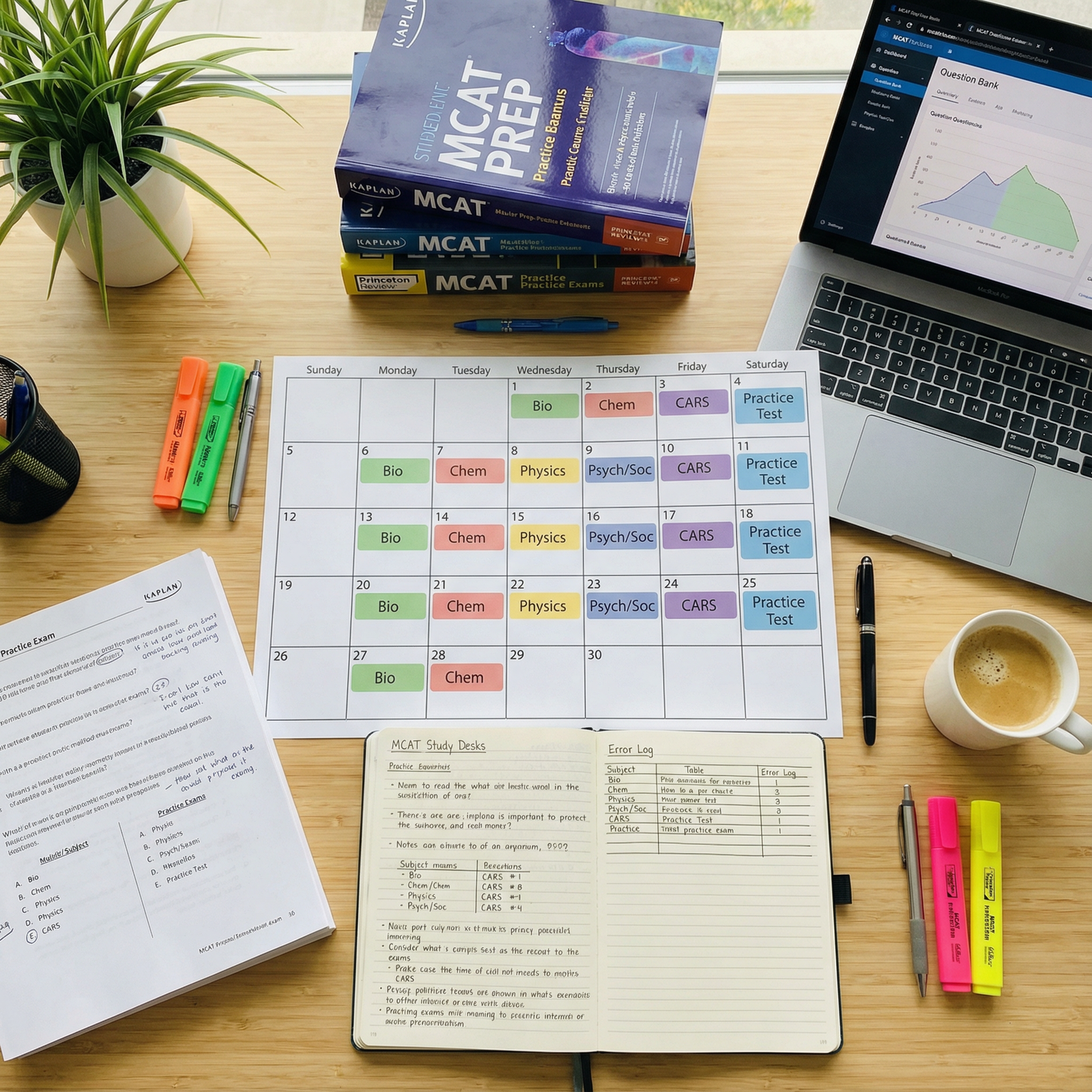
Build a Realistic High-Intensity Study Schedule
Assuming you can commit 4–8 hours per day, design a structured schedule that mixes:
- Content review (40–50%)
- Practice questions (30–40%)
- Review of mistakes and error logging (10–20%)
An example Week 2 schedule:
Monday
- 2 hours: Bio/Biochem – enzymes, metabolism, genetics
- 1 hour: 25–30 BBLS questions (UWorld or AAMC)
- 1 hour: Review questions, update error log
- 45 min: CARS passage practice (3–4 passages)
Tuesday
- 2 hours: Chem/Phys – electrochemistry, fluids, circuits
- 1 hour: 25–30 CPBS questions
- 1 hour: Psych/Soc terminology + Anki
- 30 min: Quick equation review
Wednesday
- 2 hours: Psych/Soc – major theories and researchers
- 1 hour: 25–30 PSBB questions
- 1 hour: CARS practice (4–5 passages)
- 30 min: Flashcard review
Thursday
- 2 hours: Biochem – amino acids, protein structure, enzymes, metabolic pathways
- 1 hour: 25–30 BBLS questions
- 1 hour: Mistake review
Friday
- 2 hours: Physics – kinematics, energy, fluids, optics (as needed from weakness map)
- 1 hour: 25–30 CPBS questions
- 1 hour: CARS timed set
Saturday
- 5–7 hours: Full-length exam or two full sections + in-depth review
Sunday
- 3–4 hours: Targeted review of most-missed topics and error log patterns
Adjust the schedule to your own weaknesses, but maintain:
- Daily CARS practice (even just 2–4 passages)
- A regular mix of content + practice, never one without the other
Targeted Content Review: Focus on What Moves the Needle
Use the diagnostic and early practice to select your priority topics:
For Chem/Phys:
- Acid–base, pH/pKa, buffers
- Electrochemistry, redox
- Circuits, fluids, forces, work, energy
- Gas laws, kinetics, thermodynamics
- Lab techniques common in passages (chromatography, spectroscopy)
For Bio/Biochem:
- Amino acids (structures, properties, pKa, 3-letter/1-letter codes)
- Enzyme kinetics and inhibition
- Cellular respiration, glycolysis, TCA, ETC
- DNA replication, transcription, translation
- Endocrine system and hormone pathways
For Psych/Soc:
- Major theories: behaviorism, functionalism, conflict theory, symbolic interactionism, social constructionism
- Research methods and study designs
- Learning & memory, socialization, attitudes, bias, stereotypes
- Mental disorders, stress, and health behavior
Use active study techniques:
- Teach concepts out loud as if tutoring a friend
- Draw pathways, diagrams, and concept maps
- Use Anki or focused flashcards with spaced repetition for memorization-heavy material
Passive reading feels comforting but leads to minimal score improvement. Your MCAT Preparation must be active and retrieval-based.
Week 3: Intensive Practice, Test Strategies, and Score Refinement
By Week 3, content review becomes more targeted, and practice takes center stage. This is where most score improvement occurs.
Daily Practice Questions with Thorough Review
Aim for 60–80 high-quality questions per day, spread across sections (or adjusted for your endurance). You might structure it like:
- Morning: 30–40 questions from your weakest section
- Afternoon: 20–30 mixed-section questions
- Evening: CARS passages + detailed review
Key principles:
Treat every question as a learning opportunity
- Don’t just check if you were “right” or “wrong”—ask why.
- For wrong answers, determine:
- Content gap?
- Misread the question?
- Rushed?
- Fell for a trap answer?
Maintain an Error Log
- Log each mistake with:
- Section and topic
- Short summary of the question
- Why you got it wrong
- The correct takeaway or rule
- Log each mistake with:
Revisit the log daily or every other day
- Patterns will emerge (e.g., always missing endocrine pathways, or misreading “EXCEPT” questions).
- These patterns guide your next study blocks.
Full-Length Exam in Mid-Week and Strategic Review
In Week 3, take at least one full-length exam, ideally mid-week:
- Use an AAMC exam if available (most predictive for Medical School Admissions evaluation).
- Simulate exact testing conditions (including breaks, timing, and environment).
Spend as long reviewing the exam as it took to take it. During review:
- Classify each missed or guessed question:
- Content knowledge issue
- Misinterpretation of passage or stem
- Poor elimination strategy
- Timing-induced error
This helps you refine both content priorities and test strategies for the final stretch.
Sharpening Test Strategies for Each Section
Timing and Pacing
- Learn your ideal pace:
- Roughly 9–10 minutes per passage (CPBS, BBLS, PSBB)
- ~10 minutes per CARS passage
- Use timed sets to practice:
- Don’t spend more than ~1 min 45 sec per question on average.
- If stuck, make your best guess, mark it, and move on.
Elimination Techniques
When unsure:
- Eliminate answers that:
- Contradict passage data
- Are too extreme or absolute (always, never)
- Introduce outside information not supported by the passage
Reducing from 4 choices to 2 by elimination can dramatically increase your effective score, even when you guess.
CARS-Specific Strategies
CARS is often where large score jumps are possible with better strategy:
- Read for author’s tone, main idea, and argument, not details.
- After each paragraph, mentally summarize in one sentence.
- Don’t bring in outside knowledge—stick to what the passage says or implies.
- Avoid overanalyzing; often the simplest, most directly supported answer is best.
Practice CARS every day to build speed and familiarity.

Week 4: Refinement, Full-Lengths, and Mental Preparation
Week 4 is about polishing, not cramming. You are consolidating, stabilizing, and preparing your mind and body for test day.
Step 1: Focused Review of Weakness Patterns
Use your error logs, full-length reviews, and question performance to identify:
- The top 3–5 topics per section where you still struggle
- Persistent strategy issues (e.g., changing answers too often, rushing last questions, panicking in CARS)
For each weak topic:
- Spend 30–60 minutes:
- Reviewing key concepts
- Doing 5–10 targeted practice questions
- Re-explaining the topic in your own words
Avoid opening entirely new resources or diving into obscure, low-yield topics at this stage.
Step 2: Final Full-Length Exams
Ideally, in the final 7–10 days, take 2 more full-length exams, spaced apart (e.g., Day –10 and Day –5 relative to test day):
- Use remaining AAMC exams if possible.
- Replicate test day routines (wake time, meals, breaks).
After each:
- Review thoroughly, but avoid staying up late or exhausting yourself.
- Focus on:
- Timing improvements
- Question types that still trick you
- Confidence-building: note what you’re now consistently getting right
If a single practice test goes poorly late in the game, don’t panic. Look at trends, not just one data point.
Step 3: Mental, Physical, and Logistical Preparation
Your brain performs best when your body and mind are supported. In the last 3–4 days:
Sleep and Routine
- Shift your schedule to match test day timing.
- Aim for 7–9 hours of sleep consistently—not just the night before.
Light Review Only
- Focus on:
- Flashcards (amino acids, equations, psych/soc terms)
- Brief topic summaries
- Reviewing marked questions or notes
Avoid new, dense content. Your goal is to keep everything sharp but calm.
Stress Management
Integrate simple techniques:
- 5–10 minutes of mindfulness or breathing exercises daily
- Light physical activity (walking, stretching, yoga)
- Avoid excessive caffeine, energy drinks, or late-night study marathons
Exam Day Logistics
The night before, prepare:
- Valid ID
- Snacks and water for breaks (non-messy, familiar foods)
- Comfortable layered clothing
- Route and timing to the test center (and a backup plan)
On exam day:
- Eat a stable, protein-rich breakfast.
- Arrive early.
- During the exam, if anxiety spikes, use slow deep breaths (inhale 4 seconds, hold 4, exhale 6–8).
Remember: your 30-day MCAT Preparation has trained you for this. Trust your process.
Exam Day Quick Checklist
Pack the Night Before
- ID, confirmation email, snacks, water, layers, any allowed comfort items.
Protect Your Sleep
- Screen-free wind-down time, consistent bedtime.
Fuel Smartly
- Balanced breakfast and familiar snacks to avoid GI upset or sugar crashes.
Arrive Early
- Aim to be at the test center 30–45 minutes before check-in.
Stay Process-Focused, Not Score-Focused
- One passage at a time, one question at a time.
- If one section feels rough, reset mentally; the next section is a fresh start.
Frequently Asked Questions (FAQ)
Q1: Can I really raise my MCAT score significantly in just 30 days?
Yes, meaningful score improvement in 30 days is realistic—especially if:
- You already have some content foundation from previous coursework or prior MCAT Preparation
- You can dedicate consistent, focused hours daily (4–8 hours)
- You use data-driven strategies (diagnostics, error logs, targeted practice)
Typical improvements in a month might range from 3–10 points, depending on your starting point and intensity. Very large jumps (10+ points) are more likely if your initial score was significantly below your potential and you address major weaknesses efficiently.
Q2: What should I focus on for last-minute (final week) revisions?
In the final week, prioritize:
- High-yield content:
- Amino acids, equations, metabolic pathways
- Common psych/soc theories and definitions
- Persistent weak topics identified in your error log
- CARS practice in shorter, timed sets
- Light review of:
- Flashcards (Anki), summary sheets, and formula lists
Avoid starting brand-new resources or deeply obscure topics. The goal is reinforcement, not expansion.
Q3: How many full-length practice tests should I take in 30 days?
For a 30-day intensive plan, aim for:
- 1 diagnostic at the start (Week 1)
- 1 full-length in Week 3
- 2 full-lengths in Week 4
So, roughly 3–4 full-length exams total. More is not always better—each exam must be followed by thorough review. If you’re extremely time-limited, prioritize AAMC exams over third-party ones, as they best reflect real MCAT style and scoring.
Q4: Is it better to study alone or with a group in a 30-day sprint?
It depends on your learning style and time management:
Study alone if:
- You’re easily distracted by others
- Your schedule is irregular
- You need full control over pacing and focus
Study with a partner or small group if:
- You benefit from accountability
- You like explaining concepts aloud
- You can keep the group strictly focused (e.g., timed passages together, teaching sessions, reviewing practice questions)
In a compressed 30-day timeline, avoid large, unfocused groups. Even if you study mostly solo, consider brief weekly check-ins with a peer or tutor to keep you on track.
Q5: What are the most essential resources for a 30-day MCAT score boost?
For efficient MCAT Preparation and score improvement in 30 days, prioritize:
- AAMC official materials
- Practice tests, Section Bank, Question Packs
- One solid set of content books
- Kaplan, Princeton Review, Examkrackers, or similar
- A high-quality question bank
- UWorld, Kaplan Qbank, Blueprint Qbank
- Free supplemental resources
- Khan Academy MCAT videos for quick topic refreshers
- Anki or other spaced repetition tools
- Especially for psych/soc, biochem, and equations
Don’t spread yourself thin across too many resources. Depth and repeated exposure to representative questions matter more than sheer variety.
By combining focused content review, deliberate practice, and refined test strategies in a disciplined 30-day plan, you can meaningfully boost your MCAT score and strengthen your position in the medical school admissions process. Treat this month as a sprint—but a smart, structured sprint—and you’ll give yourself the best chance to reach the score you’re truly capable of.