Preparing for the Medical College Admission Test (MCAT) can feel like training for a mental marathon. It’s long, high-stakes, and often determines where you’ll stand as a competitive applicant for medical school. Yet most score-damaging mistakes are not due to intelligence or potential—they’re due to preventable errors in planning, execution, and mindset.
This guide breaks down the most common mistakes students make during MCAT preparation and on test day, and provides concrete, evidence-based strategies to avoid them. Whether you’re just starting to plan your exam date or you’re a month away from test day, you can use this as a checklist to tighten your study strategies and maximize your score.
Understanding the MCAT: More Than a Content Exam
Before you can avoid mistakes, you need a clear picture of what the MCAT actually tests and how.
The MCAT assesses four major sections:
- Biological and Biochemical Foundations of Living Systems (Bio/Biochem)
- Chemical and Physical Foundations of Biological Systems (Chem/Phys)
- Psychological, Social, and Biological Foundations of Behavior (Psych/Soc)
- Critical Analysis and Reasoning Skills (CARS)
Each section:
- Uses passage-based questions that require you to apply knowledge, not just recall facts.
- Tests scientific reasoning, critical thinking, and data interpretation.
- Is timed tightly enough that pacing and stamina matter almost as much as content mastery.
Key exam facts to keep in mind:
- About 230 multiple-choice questions
- Around 7.5 hours total, including breaks
- Computer-based, administered at secure testing centers
- Scored from 472–528, with 500 as the approximate average
Many students mistakenly treat MCAT Preparation like they’re studying for four separate content exams. In reality, it’s one integrated assessment of how you think under pressure with complex information. That mindset shift is essential to avoid the pitfalls described below.
1. Poor Study Planning and Disorganized MCAT Preparation
One of the biggest reasons capable students underperform is studying hard but not strategically. Without a structured, realistic plan, your effort doesn’t translate into score gains.
Common Planning Mistakes
- Studying “whatever feels urgent” instead of following a strategic sequence
- Cramming heavily in the final month instead of spreading preparation over time
- Ignoring weaker subjects because they feel uncomfortable
- Failing to build in time for full-length exams and thorough review
- Setting an exam date before understanding the time you realistically need
How to Avoid Poor Planning
Build a Data-Driven Study Schedule
Start with a diagnostic test
- Take an official or reputable full-length exam before you begin serious studying.
- Use it to assess your baseline in each section (Chem/Phys, CARS, Bio/Biochem, Psych/Soc).
Map out your timeline realistically
- For most students, 3–6 months of structured MCAT Preparation is ideal, depending on:
- Course background (e.g., have you completed biochemistry, psychology, and sociology?)
- Weekly hours available (job, classes, family responsibilities)
- As a rough guide:
- 10–15 hours/week → ~6 months
- 20–25 hours/week → ~4–5 months
- 30+ hours/week → ~3 months
- For most students, 3–6 months of structured MCAT Preparation is ideal, depending on:
Use SMART goals to structure your weeks
Instead of vague goals like “study physics,” use SMART goals:- Specific: “Review kinematics and Newton’s laws chapters.”
- Measurable: “Complete 40 related practice questions.”
- Achievable: Realistic in your available time.
- Relevant: Directly tied to your MCAT weaknesses.
- Time-bound: “By Friday night.”
Example weekly SMART goal set:
- “By Sunday, I will complete and review 2 CARS passages per day (14 total).”
- “By Wednesday, I will finish the AAMC Question Pack for Psych/Soc #1 and tag all missed concepts for review.”
- “By the end of the month, I will complete one full-length exam and spend two full days reviewing it.”
Balance Content Review and Practice
A strong plan includes:
- Early phase (weeks 1–4 or 1–6):
Heavy content review + light practice questions - Middle phase:
Balanced content and practice (question banks, sections, CARS daily) - Final phase (last 4–6 weeks):
Practice-heavy with full-length exams and targeted review, minimal new content
Without this structure, students often know “a lot of stuff” but are not ready for how the MCAT asks questions.

2. Underestimating the CARS Section
The CARS section is often the silent score killer. Many science-oriented students assume strong grades in biology or chemistry will carry them through. They don’t.
Why CARS Is Frequently Mishandled
- It doesn’t test science content, so students feel it’s “less important” or “less relevant.”
- Improvement can feel slow, so students abandon consistent practice.
- There’s a false belief that “you can’t really study for CARS.”
How to Avoid CARS-Related Mistakes
Treat CARS Like a Skill-Based Course
CARS tests:
- Reading comprehension
- Author intent and tone
- Logical reasoning
- Inference and application of ideas
These are trainable skills—but only with frequent, deliberate practice.
Actionable strategies:
Daily practice, even if brief
- Aim for 2–3 CARS passages per day, 5–6 days a week.
- Simulate real timing conditions (10 minutes per passage).
Use active reading techniques
While reading a passage, ask yourself:- What is the main idea of this passage?
- What problem or question is the author addressing?
- What is the author’s tone (critical, supportive, neutral)?
- How does each paragraph contribute to the overall argument?
Read diverse, challenging material
Supplement official CARS practice with:- Humanities and social science essays
- Thought pieces from The Economist, The Atlantic, Scientific American, philosophy or ethics articles
- Editorials and op-eds that require you to identify argument structures
Analyze your mistakes by pattern
Track:- Do you often miss inference questions?
- Do you misinterpret tone or attitude?
- Do you struggle when passages involve unfamiliar topics?
Use this analysis to adjust your reading strategy and the types of questions you drill.
3. Neglecting Full-Length Practice Exams and Deep Review
Content knowledge alone does not equal MCAT success. Many students:
- Spend months on flashcards and videos
- Take only 1–2 full-length exams, or rush them at the end
- Rarely do systematic post-exam review
This leads to poor stamina, weak timing, and repeating the same mistakes.
How to Use Full-Length Exams Effectively
Schedule Multiple Full-Lengths
Aim for at least:
- 3–5 full-length exams minimum, ideally 6–8 if time allows
- The last 4–6 weeks of MCAT Preparation should be built around these exams
Example schedule (final 6 weeks):
- Week 6: FL #1 → 2 days of review
- Week 5: FL #2 → 2 days of review
- Week 4: FL #3 → 2 days of review
- Week 3: FL #4 → 2 days of review
- Week 2: FL #5 → Review + light content
- Week 1: Optional FL #6 early in the week → light review, then taper
Simulate Test Day Conditions
When you take a full-length exam:
- Start at the same time as your real exam (e.g., 8 AM).
- Use full, correct break lengths.
- Sit at a desk, with no phone, music, or interruptions.
- Use only what you’ll have on test day (scratch paper/laminated sheets, earplugs if allowed, etc.).
This not only builds endurance but also reduces test anxiety because the real exam feels familiar.
Review Each Exam Thoroughly
Deep review is where most score gains happen. Don’t just check which questions you got wrong—understand why.
For each section:
- Create an error log or spreadsheet.
- For every missed or guessed question, note:
- Question number and topic
- Type of error (content gap, misread question, timing, overthinking, changed answer)
- Correct reasoning for the right answer
- What you will change in your approach next time
Turn this into a personalized study guide to drive your next week of review.
4. Relying on Memorization Instead of Conceptual Understanding
The MCAT is designed to punish pure memorization and reward students who understand core mechanisms and can apply them in new contexts.
Common Conceptual Pitfalls
- Memorizing reaction names without understanding mechanisms
- Learning physics formulas without knowing when and why to use them
- Memorizing psychological definitions but not understanding how they apply in experimental setups
- Focusing on isolated facts instead of integrated, system-level thinking
How to Build Deep Conceptual Understanding
Connect Concepts Across Disciplines
The MCAT loves integrated questions, such as:
- A cardiovascular physiology passage that requires fluid dynamics equations (physics)
- A metabolism passage that combines organic chemistry and biochemistry
- A behavioral study that integrates psychology, sociology, and biology
Strategies:
- When learning a concept, ask:
- “Where else does this show up in the human body or behavior?”
- “How could this be tested in a research experiment?”
- “How might a physician use this information clinically?”
Example: Instead of just memorizing the equation for cardiac output (CO = HR × SV), practice:
- Applying it to exercise physiology
- Predicting how hemorrhage or heart failure changes these variables
- Connecting it to blood pressure and perfusion
Teach and Explain Concepts Aloud
- Use study groups, tutoring, or even an empty room to explain concepts out loud.
- If you can’t clearly and confidently teach a topic without notes, you haven’t mastered it yet.
- Try the “Feynman technique”: explain a tough topic in simple language, as if teaching a friend with no science background.
Prioritize High-Yield Topics
Not all content is equal. Focus deeply on high-yield topics such as:
- Biochemistry (metabolism, amino acids, enzymes)
- Physiology (cardio, respiratory, renal, nervous system)
- Behavioral sciences (learning, memory, social structures, research methods)
- High-yield organic chemistry (acid-base, carbonyl reactions, spectroscopy)
- Core physics (kinematics, forces, fluids, electricity, light and optics)
You don’t need to know every niche detail—but you must deeply understand the key building blocks.
5. Ignoring Official Guidelines, Resources, and Test Logistics
Another preventable mistake is failing to understand the exam environment, rules, and scoring, which can lead to unnecessary surprises on test day.
How to Avoid Administrative and Logistical Errors
Study the Official AAMC Materials
- Read the AAMC MCAT Essentials document carefully.
- Understand:
- Identification requirements
- Test center rules (breaks, snacks, personal items)
- Rescheduling or cancellation policies
- How score reporting works and when schools will see your scores
Use Official Practice Materials Strategically
The AAMC practice materials are the closest representation of the real exam style:
- Official full-length exams
- Section banks
- Question packs
- CARS practice passages
Plan to use most of these AAMC resources in the second half of your preparation, once you have a foundation, so you get maximum diagnostic value from them.
Understand the Scoring System
- Each of the 4 sections is scored from 118–132.
- Total score: 472–528, with 500 around the mean.
- Competitive medical schools often look for scores 510+, though context matters (GPA, experiences, school list).
Use your section scores from full-lengths to:
- Adjust your study emphasis (e.g., if CARS is consistently lowest, increase daily CARS volume).
- Decide whether your current test date is realistic or if you should consider postponing.
6. Poor Time Management and Weak Pacing Strategy
You can know the material and still lose points if you run out of time or rush recklessly.
Typical Timing Mistakes
- Spending too long on the first few passages
- Getting “stuck” on a single difficult question and burning minutes
- Not leaving time to bubble answers or review marked questions
- Panicking when behind schedule, leading to rushed reading and careless mistakes
How to Build an Effective Timing Strategy
Know Your Time Budget
Approximate section timing:
- Chem/Phys, Bio/Biochem, Psych/Soc: 59 questions in 95 minutes
- CARS: 53 questions in 90 minutes
A useful approach is pacing by passages, not individual questions.
For the science sections (usually 10 passages + some discrete questions), a typical target is:
- About 9 minutes per passage (reading + questions), adjusting slightly as needed
- Reserve ~10 minutes total for discrete questions and quick review
For CARS:
- Aim for roughly 10 minutes per passage.
Practice with Timing from Day One
- Don’t wait until full-length exams to introduce timing.
- When doing practice passages, use a timer to simulate real conditions.
- Right after each timed set, briefly reflect:
- Did I run out of time, finish early, or hit the target?
- Did I rush the passage reading or the questions?
Learn When to Move On
Develop rules for yourself, such as:
- If you have spent more than 90 seconds on a single question and are still unsure:
- Eliminate clearly wrong options.
- Make your best educated guess.
- Mark the question and move on.
Saving time for easier questions can raise your overall score more than obsessing over one tough item.
7. Test Anxiety, Stress, and Burnout
Even strong students can underperform due to test anxiety and chronic stress. This is not a character flaw—it’s a common human response to high-stakes situations.
How Test Anxiety Affects Performance
- Difficulty focusing on passages and questions
- Second-guessing right answers and changing them to wrong ones
- Physical symptoms (racing heart, sweating, shallow breathing)
- Mental fatigue and low confidence
Evidence-Based Strategies to Manage Test Anxiety
Normalize the Experience
- Recognize that anxiety is extremely common among premeds and medical students.
- The goal isn’t “no anxiety” but manageable anxiety that doesn’t control your decisions.
Practice Mindfulness and Relaxation
Incorporate short daily or near-daily practices:
- Box breathing (4 seconds inhale, 4 hold, 4 exhale, 4 hold)
- Progressive muscle relaxation (tensing and relaxing muscle groups)
- Guided mindfulness apps or short meditations focused on observing thoughts without judgment
Use these same techniques during breaks on practice exams and on test day.
Simulate Test Day Repeatedly
- Every full-length practice is a dress rehearsal for your mindset.
- Follow the same routine you plan for test day:
- Wake-up time
- Breakfast and hydration
- Clothing layers
- Break snacks
The more familiar the experience feels, the less overwhelming the real exam will be.
8. Overstudying, Skipping Breaks, and Neglecting Self-Care
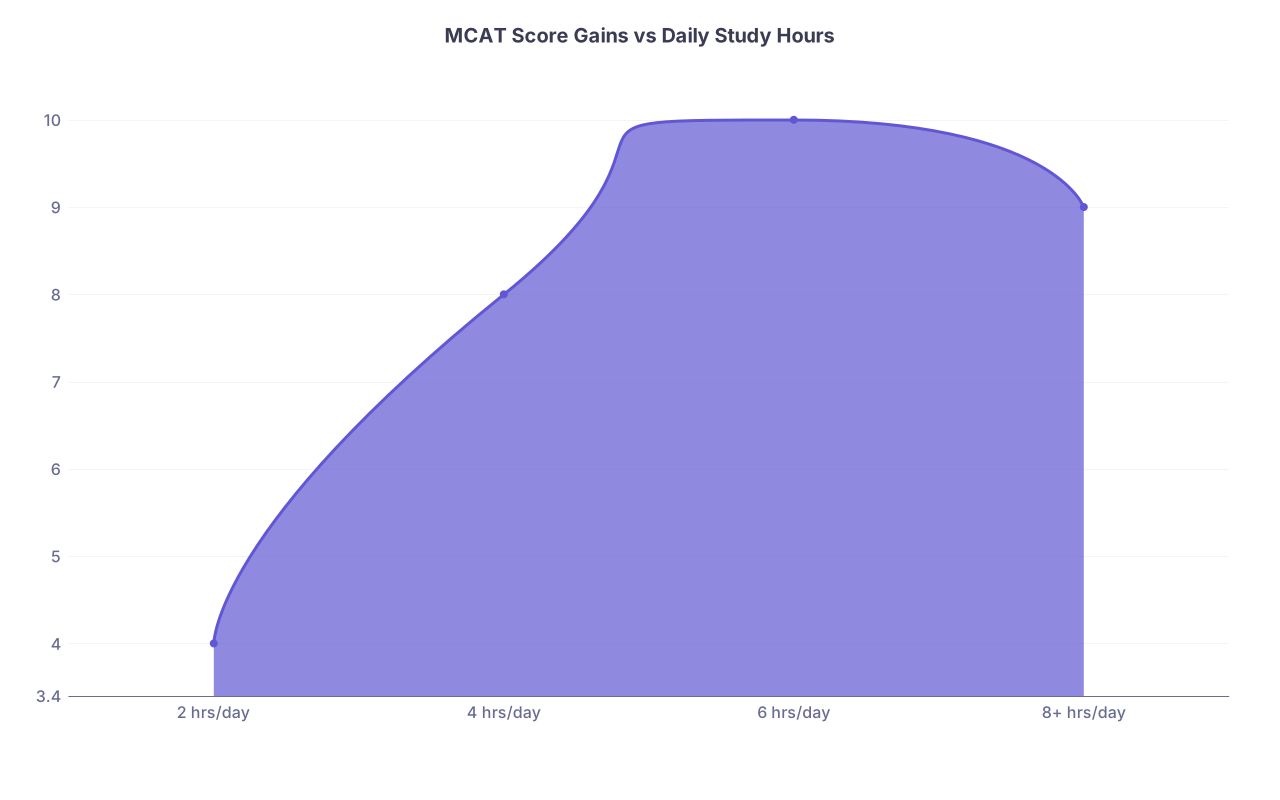
Many premeds equate “more hours” with “better preparation,” but exhaustion is the enemy of retention and reasoning.
Signs You May Be Overdoing It
- Mental fog or trouble concentrating even after sleep
- Dreading studying every day despite normally liking science
- Worsening performance on practice tests despite more hours
- Irritability, headaches, or sleep disturbances
How to Integrate Rest Into Your Study Strategies
Use Structured Study Blocks
- Consider techniques like the Pomodoro method:
- 25 minutes focused study → 5 minutes break
- After 3–4 cycles, take a longer 20–30 minute break
- During breaks, avoid scrolling social media that can spike stress. Instead:
- Stretch
- Walk
- Hydrate
- Do a quick mindfulness exercise
Schedule Non-Negotiable Downtime
- Build at least one lighter day per week into your MCAT Preparation.
- Protect sleep as fiercely as content time. Most adults need 7–9 hours to function at their cognitive best.
Self-care is not optional: it is part of your MCAT strategy and your long-term survival in medical training.

FAQs: MCAT Preparation, Study Strategies, and Common Pitfalls
Q1: How long should I study for the MCAT to avoid common mistakes?
The ideal length of MCAT Preparation depends on your background and schedule:
3–4 months if:
- You’ve recently completed most prerequisite courses
- You can dedicate 25–30+ hours per week
5–6+ months if:
- Your coursework is older or incomplete
- You’re balancing a job, school, or other responsibilities
- Your diagnostic score is far from your target
What matters most is consistency and structure, not just total calendar time. Build a plan that includes content review, regular practice questions, and at least 3–5 full-length exams with thorough review.
Q2: Should I focus more on practice questions or content review?
Both are essential, but their relative emphasis changes over time:
- Early phase: ~60–70% content review, 30–40% practice questions
- Middle phase: ~50% content, 50% practice
- Final phase: ~20–30% content, 70–80% practice (passages + full-lengths)
You learn how the MCAT asks questions primarily through practice. If you're doing lots of content but your scores aren’t improving, shift more time into timed practice and review.
Q3: What are effective strategies specifically for managing test anxiety on MCAT day?
To manage test anxiety:
- Develop a test-day routine in advance and rehearse it on full-length days (wake time, breakfast, commute).
- Bring familiar snacks and drinks that you’ve already tested during practice exams.
- Use your breaks to:
- Walk, stretch
- Do 1–2 minutes of deep breathing
- Avoid talking about the test content with others
- If anxiety spikes during a section:
- Pause for 15–30 seconds, take 2–3 slow breaths
- Re-anchor your attention on the current passage, not past mistakes
Learning these skills beforehand is far more effective than trying them for the first time on test day.
Q4: When is the best time to take the MCAT during the premed timeline?
Most students do best when they:
- Take the MCAT after completing core prerequisites (general chemistry, organic chemistry, biology, physics, biochemistry, psychology, sociology).
- Aim for a test date that allows scores to be available before or early in the application cycle (usually late spring to early summer for those applying that year).
- Choose a date that aligns with readiness, not just the calendar. It is better to postpone by one administration and test well-prepared than to rush and need a retake.
Q5: Can I retake the MCAT if I don’t achieve my desired score, and what should change before a retake?
Yes, you can retake the MCAT, within AAMC limits. Many successful medical students improved their scores on a second attempt. However, a retake should come with substantially different preparation:
- Perform a detailed post-mortem of your prior attempt:
- Were your weaknesses mainly content, timing, stamina, anxiety, or CARS?
- Adjust your plan:
- More full-lengths with deep review
- Daily CARS practice
- Targeted review of weak content areas using spaced repetition
- Deliberate practice addressing your specific error patterns
Medical schools generally prefer a strong upward trend with a thoughtful explanation over multiple similar scores.
By recognizing and avoiding these common MCAT mistakes—poor planning, neglecting CARS, skipping full-lengths, relying on memorization, ignoring official guidelines, mismanaging time, letting test anxiety dominate, and neglecting self-care—you can transform your preparation from scattered effort into a strategic, high-yield plan.
The MCAT is challenging, but it is predictable and navigable with the right approach. Treat your preparation as training for how you will think and perform as a future physician: organized, reflective, resilient, and intentional.