The 5 Essential Resources for Truly Comprehensive MCAT Preparation
Preparing for the MCAT is one of the most significant milestones on the road to medical school. It’s not just another standardized test; it’s a rigorous assessment of how well you can integrate science knowledge, critical thinking, and reasoning under time pressure. Strong MCAT scores can open doors to more medical school options and scholarships, so it’s worth building a thoughtful, strategic plan.
The challenge? The MCAT preparation landscape is crowded. New companies, apps, and “must-have” resources appear constantly. Without a clear strategy, it’s easy to overspend, overcollect materials, and underuse what you actually have.
This guide walks through five essential resource types that together create a comprehensive, efficient MCAT preparation plan. We’ll keep the core recommendations from the original article (Princeton Review, UWorld, AAMC, Kaplan, and community support), but expand with specific strategies, practical examples, and test-day–oriented Exam Tips and Test Strategy insights.
Use this as a blueprint to choose high-yield resources, build a realistic schedule, and study smarter—not just harder.
Understanding the MCAT: Why Your Resource Choices Matter
Before selecting MCAT preparation tools, it’s essential to understand what the exam really tests and why certain resources are more valuable than others.
The MCAT is a 7.5-hour exam with four sections:
Chemical and Physical Foundations of Biological Systems (CPBS)
- Focus: General chemistry, organic chemistry, physics, biochemistry, and basic biology
- Skills: Applying physical and chemical principles to biological systems; handling math under time pressure
Critical Analysis and Reasoning Skills (CARS)
- Focus: Reading and analyzing dense passages from the humanities and social sciences
- Skills: Inference, reasoning, argument analysis—no outside science knowledge required
Biological and Biochemical Foundations of Living Systems (BBLS)
- Focus: Biology, biochemistry, and a bit of organic/general chemistry
- Skills: Applying core biological concepts to experimental and clinical scenarios
Psychological, Social, and Biological Foundations of Behavior (PSBB)
- Focus: Psychology, sociology, and relevant biology
- Skills: Understanding behavior, social systems, and health disparities
Unlike many undergraduate exams, the MCAT is application-focused, not memorization-focused. This is why your Test Strategy and practice-oriented Study Resources matter as much as content review. The best MCAT Preparation plan combines:
- Solid content foundations
- Extensive practice with exam-style questions
- Realistic full-length practice exams
- Strategic guidance and accountability
- Emotional support and community
The five resource categories below are built around that framework.
1. Comprehensive MCAT Study Guides: Building Your Content Foundation
Your first step in MCAT preparation is mastering the underlying science and social science content. A good set of MCAT Study Resources provides structured, exam-focused review so you’re not piecing everything together from random lecture notes and YouTube videos.
Why a Comprehensive Study Guide Set Matters
A complete, MCAT-specific study guide set helps you:
- Ensure you’ve covered every AAMC-listed topic
- Learn concepts at the right depth and scope for the exam
- Avoid wasting time on hyper-detailed or irrelevant content
- Build a logical sequence of review (e.g., general chemistry → biochemistry → biology)
The Princeton Review MCAT Subject Review Complete Set
One of the most widely used options is the Princeton Review MCAT Subject Review Complete Set, which includes individual books for:
- General Chemistry
- Organic Chemistry
- Biochemistry
- Physics & Math
- Biology
- Psychology & Sociology
- Critical Analysis and Reasoning Skills (CARS)
Key strengths:
In-depth yet exam-focused content review
Each chapter targets high-yield MCAT topics. For example, biochemical pathways are discussed in the context of how they appear in passages, rather than as endless pathway memorization.Practice questions built into every chapter
Instead of reading passively, you can immediately test comprehension with discrete and passage-based questions. The most effective approach:- Read a section →
- Do its corresponding practice questions →
- Review every explanation, including ones you got right (to confirm reasoning)
High-quality visuals and diagrams
Complex processes (e.g., cardiac cycle, enzyme kinetics, sociological theories) are broken down visually, which improves retention.Online extras
Many Princeton Review packages include online quizzes and at least one full-length practice exam. Use these to test content mastery before diving into official AAMC exams.
How to Use Study Guides Effectively
Regardless of which book set you choose (Princeton Review, Kaplan, Examkrackers, etc.), follow these principles:
Create a realistic reading schedule
- 3–4 chapters per week if studying part-time over 4–6 months
- 1–2 chapters per day if on a dedicated 2–3 month MCAT study block
Active learning over passive reading
- Summarize each section in your own words
- Make an equation/formula sheet for CPBS and BBLS
- Teach difficult concepts to a friend or study partner
Integrate with practice early
Don’t wait until you “finish content review” to do questions. Start practice questions within the first 1–2 weeks of MCAT Preparation, even if you feel underprepared. This accelerates your learning and reveals your knowledge gaps.Track weak areas
Keep a running list of topics that frequently cost you points (e.g., circuits, acid–base, biostatistics, research methods in psychology). Revisit those chapters multiple times.

2. High-Quality Practice Question Banks: Turning Knowledge into Score
Once you have a growing content foundation, the most important thing you can do for your MCAT score is consistent practice with realistic questions. Question banks are where your Test Strategy is forged.
Why Question Banks Are Non-Negotiable
Practice question banks help you:
- Learn how the MCAT uses familiar content in unfamiliar ways
- Improve timing and endurance under pressure
- Train your brain to think in MCAT-style logic
- Identify not just what you got wrong, but why you got it wrong (content vs. reasoning vs. misreading)
UWorld MCAT QBank
The UWorld MCAT QBank is widely regarded as one of the most powerful Study Resources for MCAT Preparation due to its:
Extremely detailed explanations
Every question includes a breakdown of why the correct answer is right and why each incorrect option is wrong. The explanations often feel like mini-tutorials, which is ideal for deeper learning.Exam-style passages
Questions mimic AAMC style—multistep reasoning, experiment-based passages, and integrated figures/tables. This prepares you for the style and difficulty of the real exam.Customizable practice
You can filter by subject, topic, or difficulty, and do timed or untimed sets. This allows you to target weak areas (e.g., physics passage sets, or social psychology concepts).Performance analytics
Dashboards highlight patterns in your errors—crucial for optimizing your study plan.
How to Get the Most from UWorld (or Any QBank)
Prioritize review over volume
- Doing 40 questions and thoroughly reviewing them is more valuable than blowing through 100 with superficial review.
- For each missed or guessed question, ask:
- Was the issue content, reasoning, or rushing?
- Did I misread the question stem or answer choices?
Annotate and make error logs
- Capture recurring mistakes: “I keep misreading graphs in bio passages” or “I forget to convert units in physics.”
- Create a spreadsheet or notebook where you categorize errors and revisit them weekly.
Simulate testing conditions regularly
- Do timed blocks of 59 questions (a full MCAT section) occasionally, especially in the last 6–8 weeks.
- Turn off outside distractions (phone, music, social media).
Use explanations as content review
- When a UWorld explanation covers a concept you’re weak on (e.g., enzyme inhibition graphs, classical vs. operant conditioning), treat that as a cue to revisit your study guide and solidify the topic.
3. AAMC Official Full-Length Practice Exams: The Gold Standard for Readiness
Full-length practice exams are the backbone of Test Strategy for the MCAT. They test not only your knowledge and reasoning, but also your endurance, focus, and pacing across 7.5 hours.
Why Official AAMC Exams Are Essential
The AAMC Official MCAT Practice Exams are made by the same organization that writes the real exam. That means:
- Question style, passage length, and difficulty closely mirror the real test
- Scoring is more predictive of your actual test-day performance
- You get practice with the exact digital testing interface you’ll see on test day
The AAMC currently offers multiple full-length exams, plus:
- Free sample questions and sections
- A question pack library and section banks focusing on specific topics (especially CARS, bio, and psych/soc)
- A comprehensive exam blueprint listing tested topics and skills
When and How to Use Full-Length Exams
Timing in your study timeline
- If studying 4–6 months:
- Start official full-lengths around 8–10 weeks before your test date
- If in an accelerated 2–3 month plan:
- Start full-lengths by week 3–4 of your MCAT Preparation
- If studying 4–6 months:
Testing protocol
Every full-length should be treated exactly like test day:- Start at the same time as your scheduled exam
- Observe all breaks and section lengths
- Use only allowed items (scratch paper, earplugs, snack/water on breaks)
- Avoid checking your phone during breaks
Deep review is where the learning happens
Plan one full day (or two half-days) for post-exam review. For each question:- Understand why the correct answer is correct
- Identify why you missed it (content vs. reasoning vs. fatigue vs. rushing)
- Note any new patterns (e.g., “I slow down and lose focus in the last 10 CARS questions”)
Score interpretation and readiness
- Your last 2–3 AAMC full-length scores are the best predictors of your test-day performance.
- If your practice average is consistently below your target score, consider whether:
- You need more time before test day
- You have major content gaps that need targeted review
- Your strategy for specific sections (especially CARS) needs adjustment
Additional Exam Tips for Full-Lengths
- Practice nutrition and hydration strategy: what you eat on breaks can affect your focus.
- Develop a pacing strategy: for example, aiming to finish each passage with 1–2 minutes to spare for quick review.
- Use mental stamina training: Avoid pausing or splitting full-lengths. You need to prove to yourself you can maintain performance for the full 7.5 hours.
4. Structured Online MCAT Courses and Test Prep Programs
Some students thrive with self-directed MCAT Preparation, while others perform better with structure, guidance, and accountability. This is where comprehensive prep courses come in.
When a Prep Course Is Worth Considering
A structured MCAT course can help if you:
- Feel overwhelmed and don’t know where to start
- Struggle to stay on track without external deadlines
- Prefer having instructors explain complex topics live or via video
- Want access to curated Study Resources without having to research every option yourself
Kaplan MCAT Prep Course
The Kaplan MCAT Prep Course is a long-standing, popular choice offering both in-person and online formats.
Core features:
Interactive content lectures
Kaplan’s video and live classes break down high-yield topics, walk through passage-based questions, and demonstrate how to think through MCAT-style problems.Structured study plans
Kaplan often provides calendars that lay out what to study each day/week. This is especially valuable if you’re balancing MCAT prep with a full course load or job.Extensive practice material
Their courses usually include:- Multiple full-length practice exams (in addition to AAMC exams you’ll purchase separately)
- Large question banks
- Topic-specific practice sets
Instructor and peer support
Many courses offer office hours, Q&A sessions, and peer discussion boards or group chats.
How to Maximize Value from a Prep Course
Follow the schedule, but customize when needed
Use their calendar as a backbone, but modify to emphasize your weaker areas (e.g., add extra physics practice if that’s your lowest section).Show up prepared to every class
- Skim the chapter or topic before the lesson
- Bring specific questions from your practice
Use the course for strategy as much as for content
Pay attention to how instructors:- Break down passages
- Eliminate answer choices
- Manage timing under pressure
Don’t neglect AAMC materials
Even if your course includes its own full-length exams, always prioritize AAMC practice in the last 4–6 weeks of MCAT Preparation.Evaluate progress mid-course
After 3–4 weeks or a couple of full-lengths, ask:- Are my scores improving?
- Do I feel more confident with test strategy?
- What still feels unclear, and can I bring that to office hours or instructors?

5. Community and Peer Support: The Hidden MCAT Advantage
MCAT preparation can be isolating. Long study hours, high stakes, and constant self-assessment can take a toll on your motivation and mental health. Community support is often the difference between burning out and staying resilient.
Online Forums and Study Groups
Platforms such as Reddit’s r/MCAT and various Discord MCAT servers are popular and surprisingly powerful tools when used wisely.
Benefits of online communities:
Real-time advice and Exam Tips
Students share what worked for them, how they structured their MCAT Preparation timelines, and reviews of different Study Resources.Accountability and motivation
Study partners or small groups can keep you on track, especially for long-term prep over 3–6 months.Clarifying difficult concepts
Explaining content to someone else, or having a peer explain a tricky passage, can dramatically speed up understanding.Emotional support
It’s reassuring to know others share the same anxieties about low practice scores, test rescheduling, or balancing school and MCAT.
How to Use Community Resources Strategically
Join with clear boundaries
- Limit browsing to specific times (e.g., 15–20 minutes per day) so you don’t get sucked into anxiety-provoking comparison.
- Avoid obsessively reading test-day experience posts right before your exam.
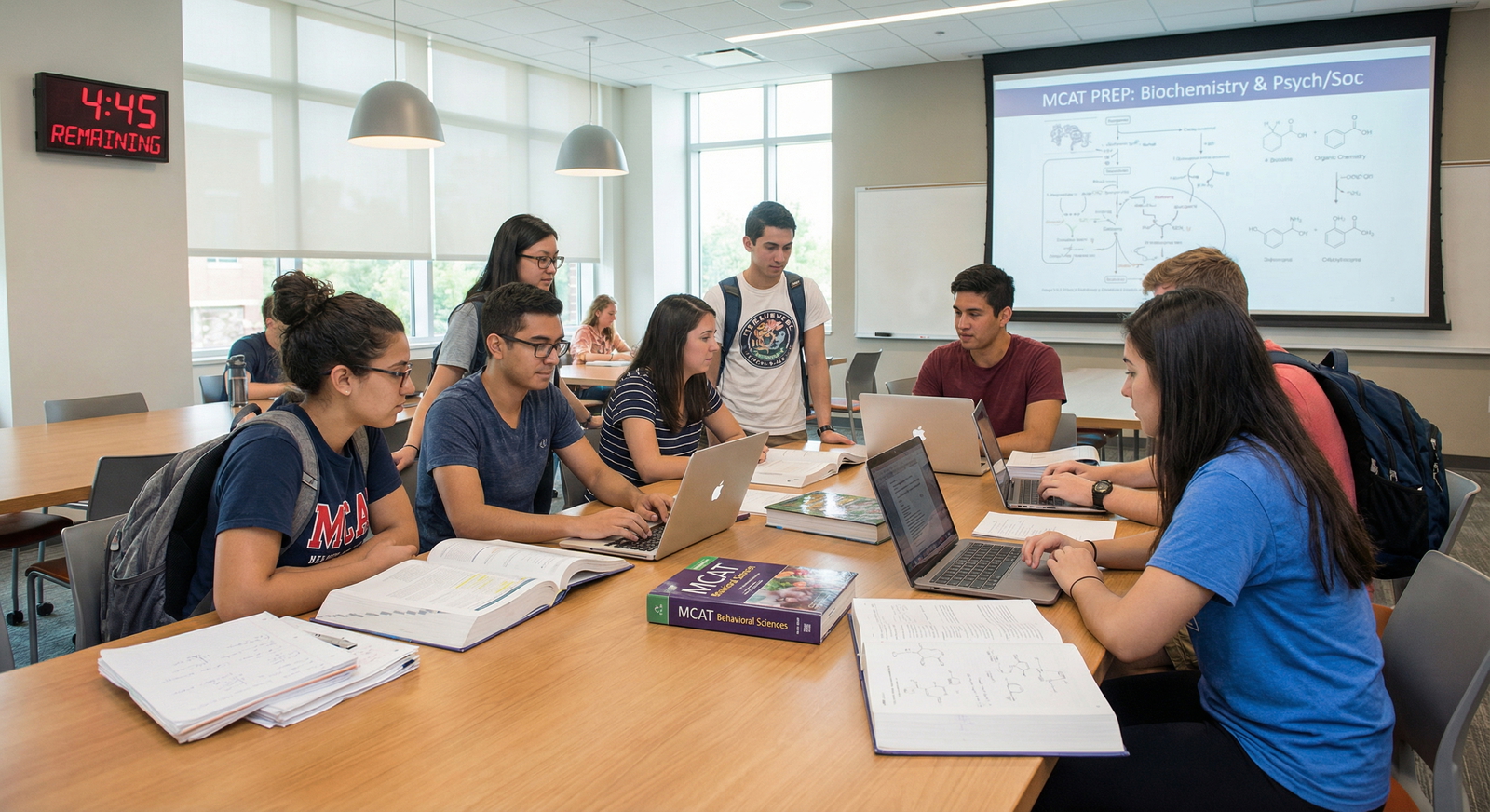
Form or join a small study group
Ideal group size: 2–4 students. Suggested format:- Weekly check-in: each person shares goals and progress
- Group review sessions: pick a set of questions, complete them individually, then discuss rationales together
- Topic “teach-backs”: each member teaches a challenging topic (e.g., optics, enzyme kinetics, social stratification)
Cross-check advice with official sources
Remember that what worked for one person may not work for you. Always verify:- Test format changes through AAMC
- Scoring and registration policies through official channels
Use community resources for materials and strategies, not shortcuts
Avoid falling into the trap of constantly hunting for “magic” Exam Tips. Consistent practice with high-quality resources matters far more than secret tricks.
Putting It All Together: A Sample Integrated MCAT Study Plan
To illustrate how these five resource types can work together, here’s a simplified example of a 12-week MCAT Preparation plan:
Weeks 1–4: Content-Heavy + Intro to Questions
- Primary focus: Princeton Review (or similar) study guides
- Daily:
- 2–3 hours content review
- 30–45 minutes of UWorld (10–20 questions)
- Weekly:
- 1–2 AAMC question packs or section bank sets (untimed at first)
- 1 group study session or online discussion
- Goal: Finish 40–50% of content; identify early weak areas
Weeks 5–8: Balanced Content + Practice
- Primary focus: Finish content and ramp up practice
- Daily:
- 1–2 hours of targeted content review (weak areas only)
- 40–60 UWorld questions with deep review
- Weekly:
- 1 full-length exam (Kaplan or other third-party at first, then start AAMC)
- 1–2 hours reviewing exam in detail
- Goal: Shift mindset from “learning material” to “practicing the exam”
Weeks 9–12: Exam Simulation and Refinement
- Primary focus: AAMC practice and strategy
- Weekly:
- 1 AAMC full-length exam
- 1–2 days of detailed review
- Daily (non–full-length days):
- 1–2 hours of UWorld or AAMC section banks
- 1 hour revisiting high-yield weaknesses (based on exam reviews)
- Goal: Stabilize scores near or above your target; refine pacing, endurance, and confidence
Adjust hours and intensity based on whether you’re studying full-time or balancing school/work.
FAQ: MCAT Preparation, Resources, and Strategy
1. How many hours should I plan to study for the MCAT overall?
Most students benefit from 300–500 total hours of MCAT Preparation, spread over 3–6 months.
- If you have a strong science background and lighter schedule: ~300–350 hours may be enough.
- If your pre-reqs are older, or you feel weaker in sciences or CARS: aim for 400–500 hours.
Track your hours weekly to stay realistic and adjust your pace.
2. When should I start MCAT preparation relative to applying to medical school?
Ideally, you should test no later than the spring or early summer of the year you plan to apply. Working backwards:
- If taking the exam in April–June, start focused studying 3–6 months earlier (e.g., January–March).
- If you’re still completing core prerequisites, start with light review and practice, then ramp up once coursework is complete.
3. Is a commercial prep course (like Kaplan) necessary to get a high score?
No, a prep course is not required to score well. Many students achieve competitive scores using only:
- High-quality book sets (e.g., Princeton Review)
- Question banks (e.g., UWorld)
- Official AAMC materials
- Free online resources and peer support
A course adds structure, accountability, and guided instruction, which can be very helpful if you’re overwhelmed or struggle to self-organize. But self-study can be just as effective with a disciplined plan.
4. How can I tell if I’m ready to take the MCAT or should postpone?
Use your AAMC full-length scores as your primary gauge. Consider postponing if:
- Your last 2–3 AAMC full-lengths are consistently 5+ points below your target score
- Your scores are still trending upward quickly (meaning more time could yield a significantly better outcome)
You’re likely ready if: - Your recent AAMC scores are at or within 2–3 points of your target,
- Your performance is stable, and
- You feel confident with timing and endurance.
5. What are the most common MCAT preparation mistakes, and how can I avoid them?
Common pitfalls include:
- Overemphasizing memorization instead of practicing passage-based reasoning
- Delaying practice questions until “after content review”
- Ignoring CARS until the last minute
- Not thoroughly reviewing practice exams and question banks
To avoid these, integrate practice from week one, schedule regular CARS practice, and devote as much time to reviewing questions as to doing them.
By combining a strong content foundation (study guides), targeted practice (question banks), realistic simulation (AAMC full-lengths), structured guidance (courses), and steady community support, you can build a comprehensive, efficient MCAT Preparation plan. With disciplined use of these five essential resources and thoughtful Test Strategy, you’ll be well-positioned to earn a score that supports your medical school goals.