MCAT Study Schedules: Finding the Right Rhythm for Your Success
Preparing for the MCAT is one of the most consequential steps in Medical School Preparation. A strong score can open doors to more schools and scholarships; a weak one can delay or derail an otherwise competitive application. Yet many students underestimate how much the structure of their MCAT Study Guide matters.
An effective MCAT study schedule is more than a calendar with topics; it is a living plan that integrates content review, active practice, wellness, and realistic time management. The goal is not just to “get through” the material but to build the knowledge, skills, and test stamina necessary to perform at your peak on exam day.
This guide will walk you through how to design, adjust, and optimize a Study Schedule tailored to your circumstances, whether you have 3, 6, or 9+ months to prepare.
Understanding the MCAT: What You’re Really Preparing For
Before you can build a powerful schedule, you need a clear map of the terrain: what the MCAT covers, how it’s structured, and what it actually tests.
The Four Sections of the MCAT
The MCAT is a standardized multiple-choice exam designed to assess both knowledge and reasoning skills across four sections:
Chemical and Physical Foundations of Biological Systems (Chem/Phys)
- Focus: General chemistry, organic chemistry, physics, biochemistry, and some biology
- Emphasis: Application of physical and chemical principles in biological contexts
Critical Analysis and Reasoning Skills (CARS)
- Focus: Reading comprehension and critical analysis
- Content: Humanities and social science passages (no outside content knowledge required)
- Emphasis: Reasoning, inference, argument structure, and tone
Biological and Biochemical Foundations of Living Systems (Bio/Biochem)
- Focus: Biology, biochemistry, and basic organic/inorganic chemistry
- Emphasis: Cellular processes, organ systems, genetics, and molecular biology
Psychological, Social, and Biological Foundations of Behavior (Psych/Soc)
- Focus: Psychology, sociology, and related biology
- Emphasis: Behavior, mental processes, social structures, and health determinants
Each section is timed and passage-based, testing your ability to apply content, not simply recall it.
Why One-Size-Fits-All Schedules Don’t Work
MCAT content is broad and deep; students come in with very different backgrounds:
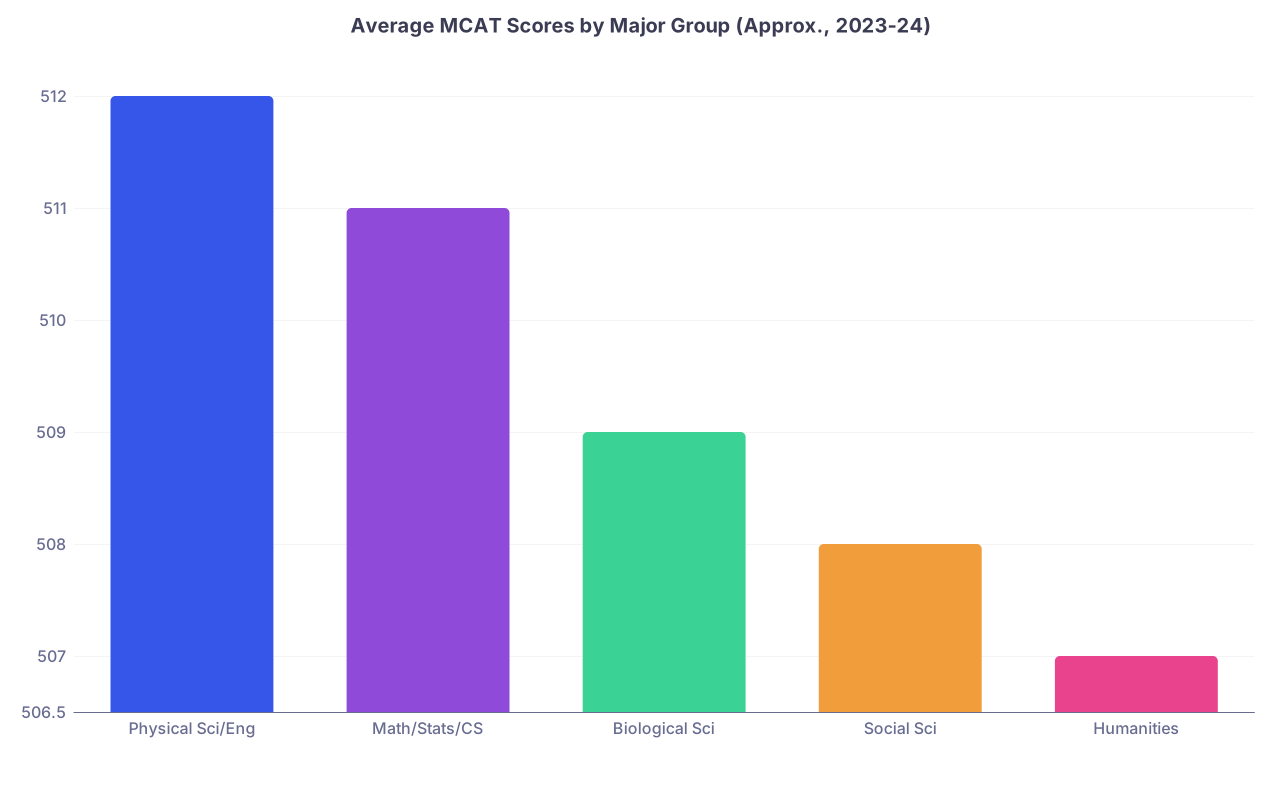
- A biochemistry major might breeze through Bio/Biochem but struggle with Psych/Soc.
- A humanities major may excel in CARS but need more time for Chem/Phys.
- Non-traditional students balancing full-time work or family will have different constraints than full-time undergraduates.
For these reasons, a generic MCAT Study Guide that doesn’t account for your baseline, lifestyle, and learning style will only take you so far. The most effective Test Preparation plans are personalized and adaptive.
Core Building Blocks of an Effective MCAT Study Schedule
Design your schedule using these key components. Think of them as the “non-negotiables” for strong Exam Strategies and preparation.
1. Define Your Timeline and Overall Study Hours
Your first decision: When will you take the MCAT, and how much time do you realistically have before then?
Common MCAT Timelines
3-Month Intensive Schedule (10–30 hours per week)
- Best for: Students between semesters, on break, or able to dedicate most of their time to MCAT prep.
- Focus: Highly structured days, rapid content review paired with frequent practice tests.
- Tradeoff: Less room for falling behind or re-learning weak foundations.
6-Month Moderate Schedule (8–20 hours per week)
- Best for: Students with part-time commitments (lighter course load, part-time work).
- Focus: Balanced pace, thorough content review, and regular full-length exams.
- Advantage: More flexibility to revisit weaknesses and refine strategies.
9-Month (or Longer) Extended Schedule (5–15 hours per week)
- Best for: Students taking full course loads, working full-time, or balancing family responsibilities.
- Focus: Gradual content build, spaced repetition, and long-term retention.
- Caution: Risk of burnout or loss of momentum if not structured carefully.
Total Hours to Aim For
Most students target 300–400+ total hours of MCAT preparation over 3–6 months. This is an estimate, not a rule. You may need more if:
- Your science coursework is older or incomplete.
- Your diagnostic score is far below your target.
- You have significant test anxiety or weak reading skills.
Start by mapping backward from your test date, then distribute those hours realistically across weeks and days.
2. Evaluate Your Baseline: Where Are You Starting?
Your Study Schedule should be driven by data, not assumptions.
Take a Diagnostic Exam Early
Within your first week of preparation:
- Take a full-length diagnostic test (ideally from the AAMC or a reputable third-party provider).
- Simulate test conditions as much as possible (quiet room, timed sections, minimal breaks).
Use this not to judge yourself, but to gather critical information:
- Section scores (Chem/Phys, CARS, Bio/Biochem, Psych/Soc)
- Question types you consistently miss (calculation, interpretation, data analysis, experimental design, etc.)
- Content areas you are clearly unfamiliar with
Turn Results into a Targeted Plan
From your diagnostic:
- Identify strong sections: You’ll still review them, but you may spend less time here.
- Flag weak sections: These become higher priority in your early schedule.
- Make a list of high-yield topics you clearly need to relearn (e.g., circuits, amino acids, operons, classical conditioning).
This baseline assessment makes your MCAT Study Guide more efficient: instead of treating all topics equally, you direct more time and resources to where they will have the largest score impact.

3. Build a Consistent and Sustainable Study Routine
Once you know your timeline and baseline, convert that into a weekly rhythm that you can maintain.
Choose Study Windows That Match Your Energy
Pay attention to when your brain is sharpest:
- Morning-focused: If you’re most alert in the morning, reserve those hours for the most cognitively demanding tasks (CARS passages, practice questions, full-length exams).
- Evening-focused: If you do your best thinking later in the day, schedule review and high-focus tasks then, and use earlier times for lighter activities (flashcards, content summaries).
MCAT Test Preparation is not about sheer number of hours; it’s about quality of hours.
Structure Your Study Days
A balanced MCAT study day often includes:
- Content Review (30–50%)
- Reading chapters, watching concept videos, annotating.
- Active Practice (30–50%)
- Practice passages, discrete questions, and question review.
- Spaced Review (10–20%)
- Flashcards (Anki), formula sheets, concept maps, revisiting old errors.
For example (for a 4–6 hour study day):
- 2 hours: Chem/Phys content review + 15 practice questions
- 1.5 hours: CARS passages + detailed review
- 1 hour: Psych/Soc flashcards and summary notes
- 30 minutes: Reviewing mistakes from the prior day
Anchoring your days with a predictable Study Schedule reduces decision fatigue and helps you build momentum.
4. Choose High-Yield Study Materials and Resources
Your MCAT Study Guide is only as good as the tools you use.
Core Resources
- Comprehensive Prep Books
- Kaplan, Princeton Review, Blueprint, Examkrackers, etc.
- Use one main set, not several; depth > duplication.
- AAMC Official Resources (Essential)
- Question Packs (especially for CARS)
- Section Bank (high-yield, especially for Bio/Biochem and Chem/Phys)
- Official full-length exams
- Free Online Content
- Khan Academy (legacy MCAT videos are still valuable for many topics)
- Open-access question banks and notes from reputable premed sources
How to Use Materials Strategically
- Match content review with targeted questions immediately afterward.
- Reserve AAMC materials for the later half of your preparation when your content foundation is stronger; these resources best reflect the real exam and should be used intentionally.
- Track which resources you’ve completed and which you plan to revisit.
5. Build in Systematic Review and Full-Length Practice
Regular review and testing are the engine of MCAT improvement.
Weekly Review: Reinforce and Integrate
At least once per week:
- Set aside a half- or full-day for review only:
- Revisit missed questions and annotate why you missed them.
- Summarize high-yield topics covered that week.
- Refresh older material briefly via flashcards or quick outlines.
This practice combats forgetting and helps connect concepts across sections (e.g., physiology in Bio/Biochem with physics in Chem/Phys).
Full-Length Exams: The Heart of Test Preparation
Plan your full-length exams intentionally:
3-Month Plan:
- Weeks 1–2: Diagnostic + 1 exam
- Weeks 3–8: One full-length every 1–2 weeks
- Final 2–3 weeks: 2–3 full-lengths to fine-tune timing and stamina
6-Month Plan:
- Month 1: Diagnostic only
- Months 2–4: One full-length every 3–4 weeks
- Months 5–6: One full-length every 1–2 weeks
9-Month Plan:
- Early phase: 1–2 full-lengths just to get familiar
- Middle phase: One full-length every 4–6 weeks
- Final 3 months: Gradually move to one full-length every 1–2 weeks
Crucial:
Devote at least as much time to reviewing a full-length as you spent taking it. For each exam:
- Categorize missed questions:
- Content gap?
- Misread question?
- Rushed or timing error?
- Strategy issue (elimination, passage mapping, etc.)?
- Note patterns and adjust your upcoming weeks accordingly (e.g., add extra time for experimental design if repeatedly struggling with data-based questions).
6. Adjust Your Study Schedule Based on Data and Feedback
An MCAT study plan is not static—it must evolve with your progress.
Biweekly Self-Assessments
Every 2 weeks, ask:
- Are my section scores improving in practice sets or full-lengths?
- Which content areas still feel shaky?
- Am I consistently running out of time in any section?
- How is my energy and mental health?
Based on your answers:
- Reallocate hours toward persistently weak sections.
- Add focused drills (e.g., daily CARS passages if timing is an issue).
- Consider shortening sessions or increasing breaks if you’re burning out.
Signs Your Schedule Needs Adjustment
- Scores have plateaued for several weeks with no clear reason.
- You routinely skip or compress planned study blocks due to fatigue.
- You are neglecting one section (often Psych/Soc or CARS) because it feels less urgent.
Flexibility is a strength, not a weakness. Effective Exam Strategies are built by iterating your plan in response to real data, not by rigidly following a calendar you made months ago.
7. Protect Your Wellness: The Hidden Key to High Performance
MCAT preparation is a marathon, not a sprint. No Study Schedule is sustainable if it ignores your physical and mental health.
Build Breaks into Your Day
Use structured techniques to avoid burnout:
- Pomodoro method:
- 25 minutes focused study + 5-minute break (repeat 3–4 times, then take a longer break)
- Longer cycles:
- 60–90 minutes work + 10–15 minutes break
During breaks:
- Stand up, stretch, walk, or hydrate.
- Avoid scrolling on your phone or going deep into distractions.
Sleep, Exercise, and Nutrition
- Sleep: Aim for 7–9 hours. Chronic sleep deprivation dramatically impairs memory, attention, and reasoning—exactly what you need for the MCAT.
- Exercise: Even 20–30 minutes of walking, light jogging, or strength training a few times a week improves focus and stress resilience.
- Nutrition: Favor stable energy foods (whole grains, lean proteins, fruits, vegetables) and avoid heavy, high-sugar meals before long study sessions or practice exams.
Mental Health and Support
- Talk to friends, family, or mentors about your goals and struggles.
- If anxiety or depression is impacting your ability to study, consider professional support early.
- Join MCAT study groups, online communities, or campus premed organizations to share strategies and maintain motivation—but be cautious about comparison anxiety in score-sharing spaces.
Taking care of your wellbeing is not a luxury; it is part of your Medical School Preparation and will serve you far beyond the MCAT.
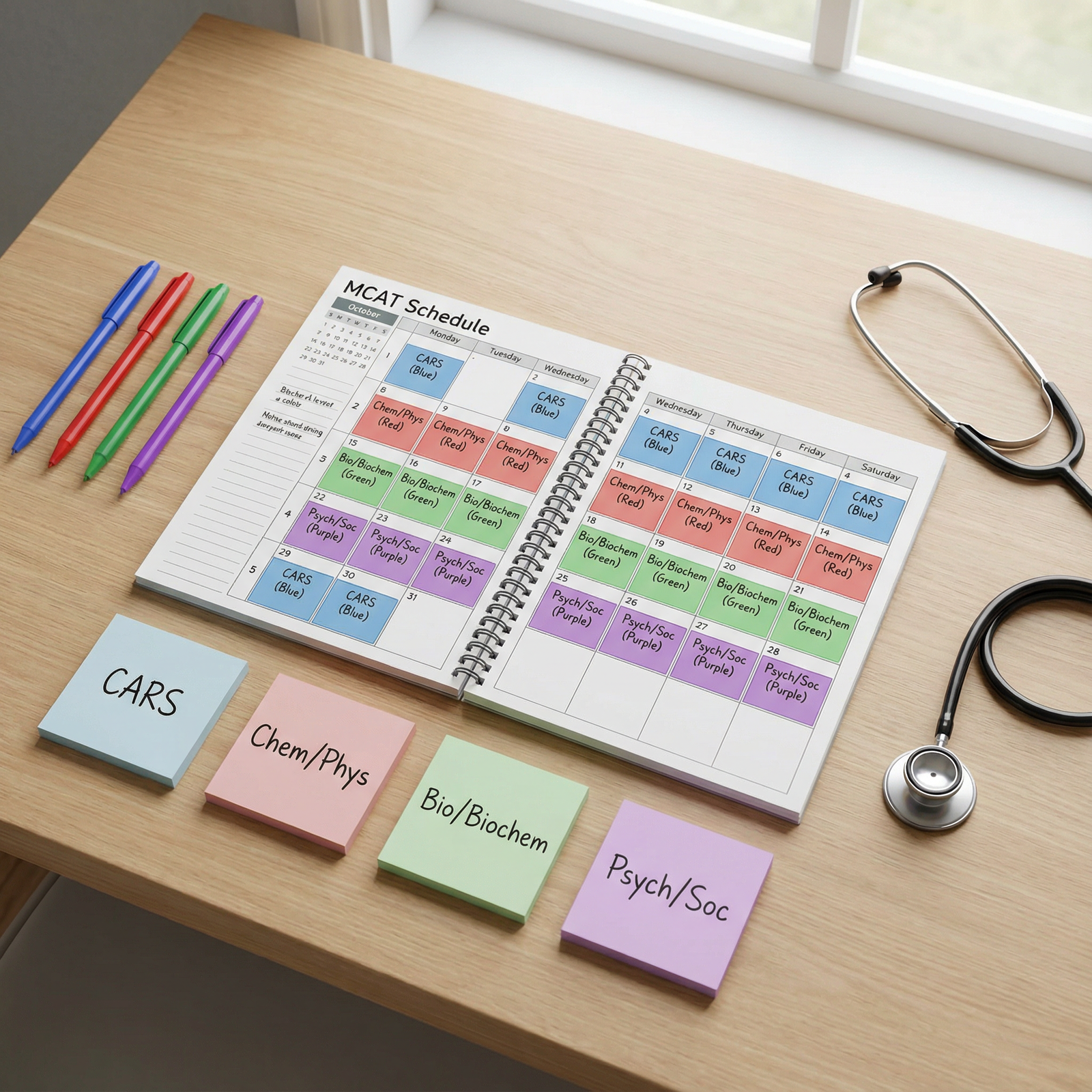
Example MCAT Study Schedule Template (7-Week Intensive Plan)
Below is a more detailed version of the original 7-week template, designed for a short, intensive preparation window. You can scale this framework up (spread across more weeks) or down (compress for fewer weeks) depending on your situation.
Week 1: Diagnostic and Foundation Building
Goal: Establish baseline, organize resources, and review core science fundamentals.
Monday
- 9:00–11:00: General Chemistry review (atomic structure, periodic trends)
- 11:00–11:30: Break
- 11:30–1:30: Physics review (kinematics, forces)
- 1:30–2:00: Quick flashcards (basic equations and units)
Wednesday
- 9:00–11:00: Biology review (cell structure, organelles, membranes)
- 11:00–11:30: Break
- 11:30–1:30: Biochemistry review (amino acids, protein structure)
Friday
- 9:00–1:00: Full-length diagnostic exam (or first full-length)
- 1:00–2:00: Break and decompress
- 2:00–3:00: High-level review of score report; list strengths and weaknesses
Weekend (Optional/Recommended)
- 2–3 hours: Light Psych/Soc content review and introduction to key terms
Week 2: Targeted Content Review Based on Weaknesses
Goal: Focus on weak areas identified in Week 1 while maintaining exposure to all sections.
- Daily (4–6 hours):
- 2 hours: Weakest science section (e.g., Chem/Phys or Bio/Biochem)
- 1–1.5 hours: Psych/Soc content + 10–15 practice questions
- 45 minutes: CARS (2–3 passages + review)
- 30–45 minutes: Flashcards (equations, amino acids, Psych/Soc terms)
By the end of Week 2, aim to have covered most of the foundational topics in your weakest section and seen at least 30–40 CARS passages.
Week 3: Introduce CARS Focus and More Practice
Goal: Deepen CARS practice and continue building science content.
- 1–1.5 hours every day:
- CARS practice (3–4 passages) with detailed review of every question, including correct ones.
- 2 hours:
- Rotating science content blocks (e.g., cardiovascular system, electrochemistry, genetics).
- 1 hour:
- Mixed practice questions (from Q-banks) across multiple sections.
Consider a half-length timed exam late in Week 3 to assess your pace and endurance.
Weeks 4–6: Integration, Practice Exams, and Refinement
Goal: Transition from heavy content review to integrated practice and exam simulation.
At least one full-length exam every 1–2 weeks
- Take under strict timed conditions.
- Dedicate the following day (or two) to thorough review.
On non-exam days:
- 1–2 hours: Review mistakes from the most recent full-length; create “error logs” describing what went wrong (content vs. strategy).
- 2–3 hours: Mixed practice sets (passages from Chem/Phys, Bio/Biochem, Psych/Soc, and CARS).
- 30–60 minutes: High-yield review (amino acids, common experimental methods, major psychological theories, statistical concepts).
Saturdays (or one day per week):
- “Spiral review” – revisit older topics briefly to keep them fresh.
By the end of Week 6:
- You should have completed several full-lengths.
- Your timing should be more consistent.
- Major content gaps should be shrinking.
Week 7: Final Review and Test Readiness
Goal: Solidify knowledge, fine-tune strategies, and taper intensity slightly before test day.
Early in the week:
- Take 1–2 full-length exams (e.g., AAMC exams if not already used).
- Meticulously review them.
Mid-late week:
- Light to moderate content review only—focus on:
- Equations and key definitions
- High-yield figures, pathways (e.g., glycolysis, TCA, ETC)
- Frequent Psych/Soc terms and theories
- Short practice sets to maintain rhythm, not to “cram.”
- Light to moderate content review only—focus on:
Two days before the exam:
- No full-lengths.
- Only light review, relaxation, exercise, and sleep.
Day before the exam:
- Very minimal studying; aim to reduce anxiety and rest.
Adapt this template to longer timelines by stretching content phases and spacing full-length exams more widely in the early months.
MCAT Study Schedule FAQs
1. How many total hours should I study for the MCAT?
Most students benefit from 300–400 total hours of focused MCAT preparation over 3–6 months. However, this range is flexible:
You may need more time if:
- Your prerequisite coursework is incomplete or several years old.
- Your diagnostic score is significantly below your target.
- You can only study a few hours per week due to work or school.
You may need fewer hours if:
- You recently completed all the prerequisites with strong grades.
- Your diagnostic is already near your target score.
- You have prior standardized test experience and strong reading skills.
Track your progress through practice exams and adjust the total hours and timeline based on real performance, not just recommended averages.
2. Should I take practice exams before I finish all my content review?
Yes. Waiting until you “finish content” to start practice exams is a common mistake. Full-length exams and practice sections:
- Reveal how well you apply content under timed conditions.
- Expose weaknesses that pure reading or note-taking might miss.
- Build stamina and mental endurance, which you can only develop through simulation.
Start with at least a diagnostic exam early, then add more full-lengths as your content foundation grows. By the second half of your preparation, practice exams should be a regular part of your Study Schedule.
3. What are the best resources for MCAT preparation?
There is no single “best” resource for everyone, but a strong MCAT Study Guide typically includes:
- One primary set of prep books (Kaplan, Princeton Review, Blueprint, Examkrackers, etc.)
- AAMC official materials (Question Packs, Section Bank, and full-length exams) – these should be prioritized.
- Free or low-cost online content:
- Khan Academy legacy MCAT videos
- High-quality YouTube channels and Anki decks vetted by premed communities
- Question banks from reputable companies for additional practice.
Use resources consistently and deeply, rather than spreading yourself thin across too many books and courses.
4. How should I adjust my study schedule if I’m falling behind?
If you notice that you’re not keeping up with your original plan:
Reassess your weekly capacity:
- Are you overestimating how many hours you can study?
- Do you need to cut back on other commitments or extend your timeline?
Prioritize:
- Focus on the highest-yield topics and your weakest areas.
- Drop lower-yield tasks or overly detailed note-taking that doesn’t translate into score gains.
Integrate more practice:
- Replace some pure reading with question-based learning and review.
Consider adjusting your test date:
- If you are significantly behind and your practice scores are far from your target, it may be wise to postpone the exam rather than test underprepared.
Falling behind is common; adjusting early and realistically is far better than pushing through a failing plan.
5. How important is self-care during MCAT prep, and what does that look like in practice?
Self-care is critical; it directly affects your ability to concentrate, retain information, and think clearly on exam day. Practical self-care during MCAT prep includes:
- Consistent sleep (7–9 hours per night)
- Regular movement or exercise, even if brief
- Planned downtime each week to disconnect from MCAT studying
- Healthy boundaries with social media and score comparison
- Seeking support from friends, mentors, or mental health professionals if stress becomes overwhelming
Your MCAT is one step in a long medical career. Protecting your wellbeing now sets a healthier foundation for medical school and beyond.
By building a realistic, personalized, and flexible MCAT study schedule—and by pairing it with consistent practice, strategic review, and attention to your health—you give yourself the best chance to succeed on this pivotal exam and move confidently toward your goal of becoming a physician.