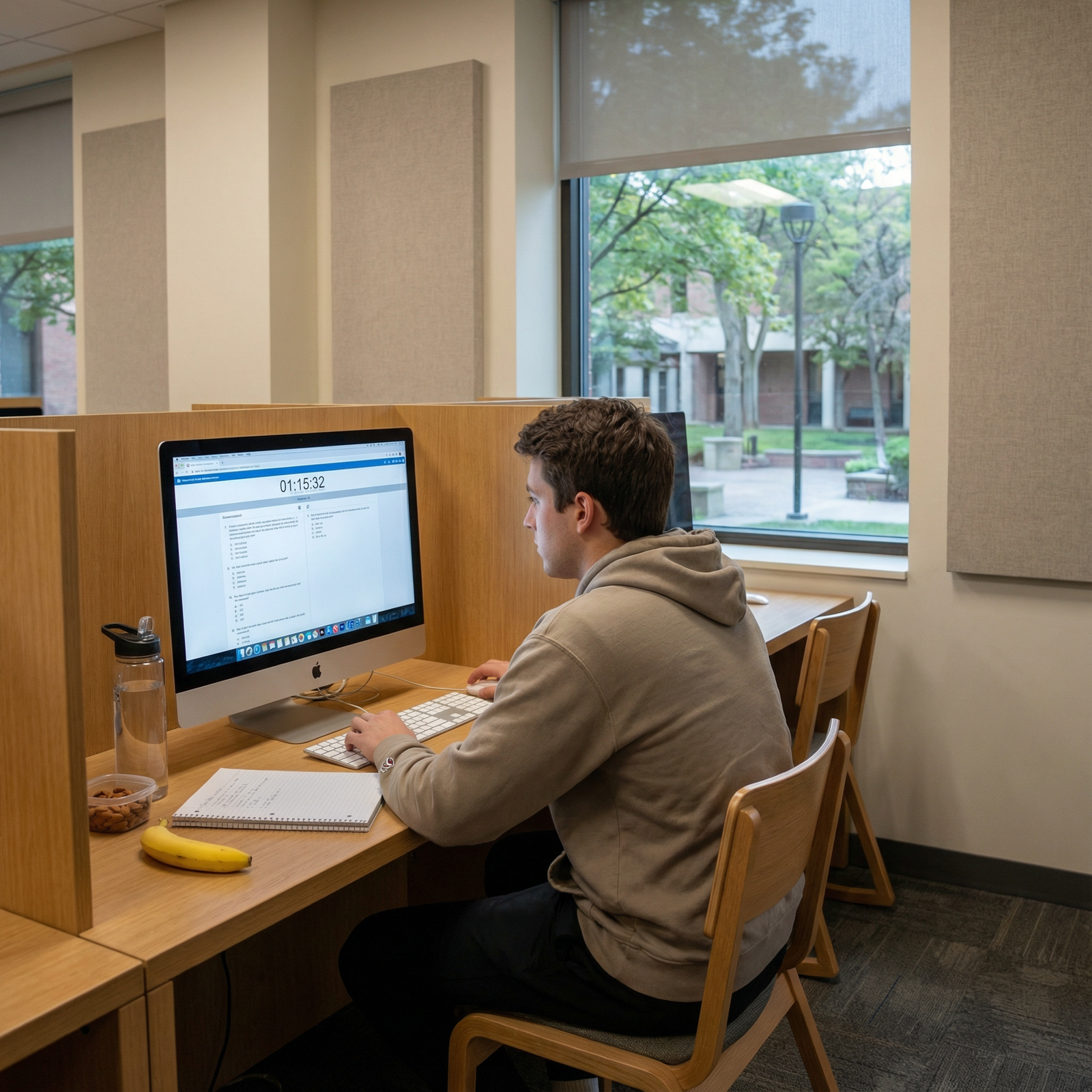
From Practice to Performance: How to Get the Most Out of MCAT Practice Tests
Preparing for the MCAT is one of the most important milestones in your journey toward medical school and a career in medicine. Strong scores don’t just happen from memorizing content—they come from strategic MCAT preparation, deliberate practice, and knowing how to turn every practice test into a powerful learning tool.
Practice tests are more than score checks; they’re training sessions for your brain, your endurance, and your test-taking strategies. Used correctly, they bridge the gap between knowing the material and performing under pressure on test day.
This guide walks you step-by-step through how to use MCAT practice tests effectively—from planning and simulation to in-depth review and refinement of your study techniques—so you can turn practice into real performance on exam day.
Why MCAT Practice Tests Are Essential for High Performance
Practice tests are central to effective MCAT preparation for several reasons. When used intentionally, they enhance both content mastery and strategy.
1. Building Familiarity with MCAT Format and Structure
The MCAT is not just a science exam; it’s a long, complex, passage-based test with its own logic and style. Full-length practice exams help you:
Internalize the section structure
- Chemical and Physical Foundations of Biological Systems (Chem/Phys)
- Critical Analysis and Reasoning Skills (CARS)
- Biological and Biochemical Foundations of Living Systems (Bio/Biochem)
- Psychological, Social, and Biological Foundations of Behavior (Psych/Soc)
Understand question style and difficulty
You’ll recognize common patterns: dense passages, data interpretation, experimental setups, and distractors that test reasoning rather than simple recall.Develop pacing intuition
Over time, you learn what “normal” timing feels like for you: how long you can spend per passage, when to move on, and when to guess strategically.
This familiarity reduces anxiety and cognitive load on test day—you’re not figuring out how to take the test; you’re just executing your plan.
2. Honest Assessment of Knowledge and Skills
High-yield MCAT practice tests expose the gap between what you think you know and what you can actually apply under time pressure. They help you:
- Identify content gaps (e.g., weak in organic chemistry reactions, endocrine physiology, or sociological theories)
- Reveal reasoning weaknesses (e.g., struggling to interpret graphs, misreading question stems, missing experimental details)
- Distinguish conceptual errors from careless mistakes
Used regularly, practice exams give you a data-driven picture of your readiness and help you prioritize what to study next.
3. Training Critical Test-Taking Strategies
Practice tests are where your test-taking strategies are developed, tested, and refined. They help you practice:
- Time management: learning when to skip, flag, and return
- Answer elimination: systematically ruling out wrong choices
- Passage mapping: identifying key hypotheses, variables, and results
- Stamina management: sustaining focus over a 7.5-hour testing day
MCAT success is not just about information; it’s about applying that information under constraints. Practice exams are the best environment for building those skills.
4. Tracking Progress and Maintaining Motivation
Meaningful MCAT preparation is a long process. Regular full-length practice tests allow you to:
- Track score trends over weeks and months
- See improvements in specific sections (e.g., CARS or Psych/Soc)
- Verify that your study techniques are working—or adjust if they’re not
- Stay motivated by watching your performance gradually rise
Even when scores plateau or dip, thoughtful analysis of practice tests can reorient your approach and keep you moving forward.
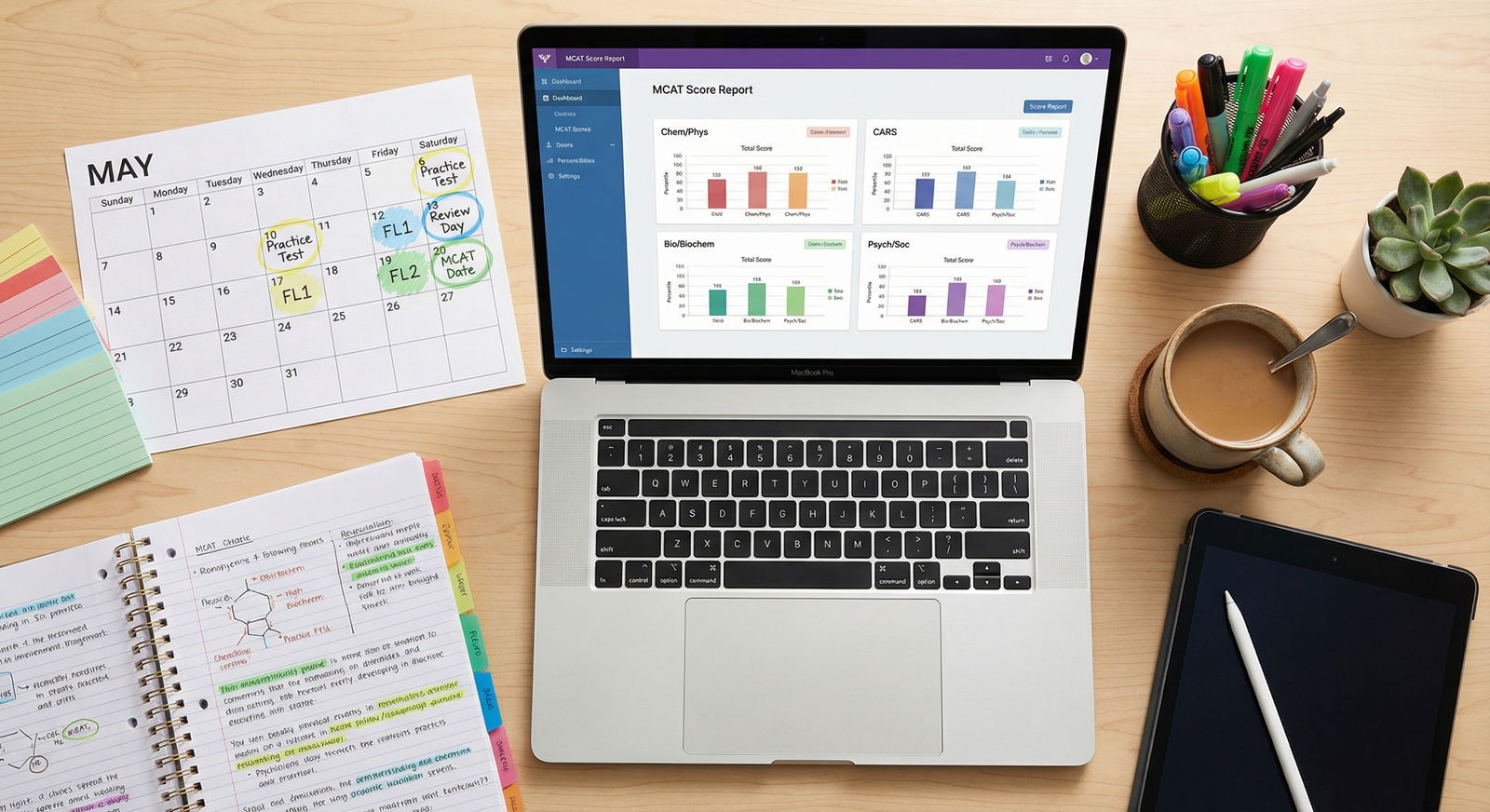
Designing a Strategic Practice Test Schedule
A strong MCAT preparation plan weaves full-length tests into your overall study strategy—not just at the end, but from early on in your prep.
1. Map Out Your Timeline from Day One
Start by determining:
- Your target test date
- Your current level (diagnostic exam score, if available)
- Your weekly time availability (classes, work, family commitments)
Then build a realistic plan that integrates:
- Content review blocks
- Practice tests
- Dedicated review days
- Rest and recovery
Suggested Practice Test Cadence
While this can vary by student, a common structure is:
Early phase (10–16 weeks out):
- 1 diagnostic full-length exam
- Then 1 full-length every 3–4 weeks
- Focus: Identifying weaknesses, broad content review
Middle phase (6–10 weeks out):
- 1 full-length every 2 weeks
- Focus: Mixed practice + targeted content, experiment with test-taking strategies
Final phase (3–6 weeks out):
- 1 full-length every 7–10 days (many students do 4–6 total AAMC exams in this window)
- Focus: Fine-tuning timing, simulating test-day conditions, confidence-building
Last week:
- Typically 1 final exam ~7 days before your test
- Then lighter practice, targeted review, and rest—not heavy testing
2. Protect Your Full-Length Days and Review Days
Treat practice tests like real commitments—similar to a clinical shift or exam:
- Block 5–7 hours for the full test (including breaks)
- Block at least 1 full day (or two half days) afterward for in-depth review
- Avoid scheduling intense commitments (like exams or night shifts) immediately before or after
Consistency is key. Your brain and body adapt to this rhythm, which reduces stress and improves performance over time.
Choosing High-Quality MCAT Practice Test Resources
Not all practice tests are equally valuable. For Medical Admissions, the highest-yield resources are those that closely mirror the real exam in style, difficulty, and interface.
1. AAMC Official Practice Materials (Highest Priority)
The Association of American Medical Colleges (AAMC) creates the actual MCAT, so their materials are the gold standard:
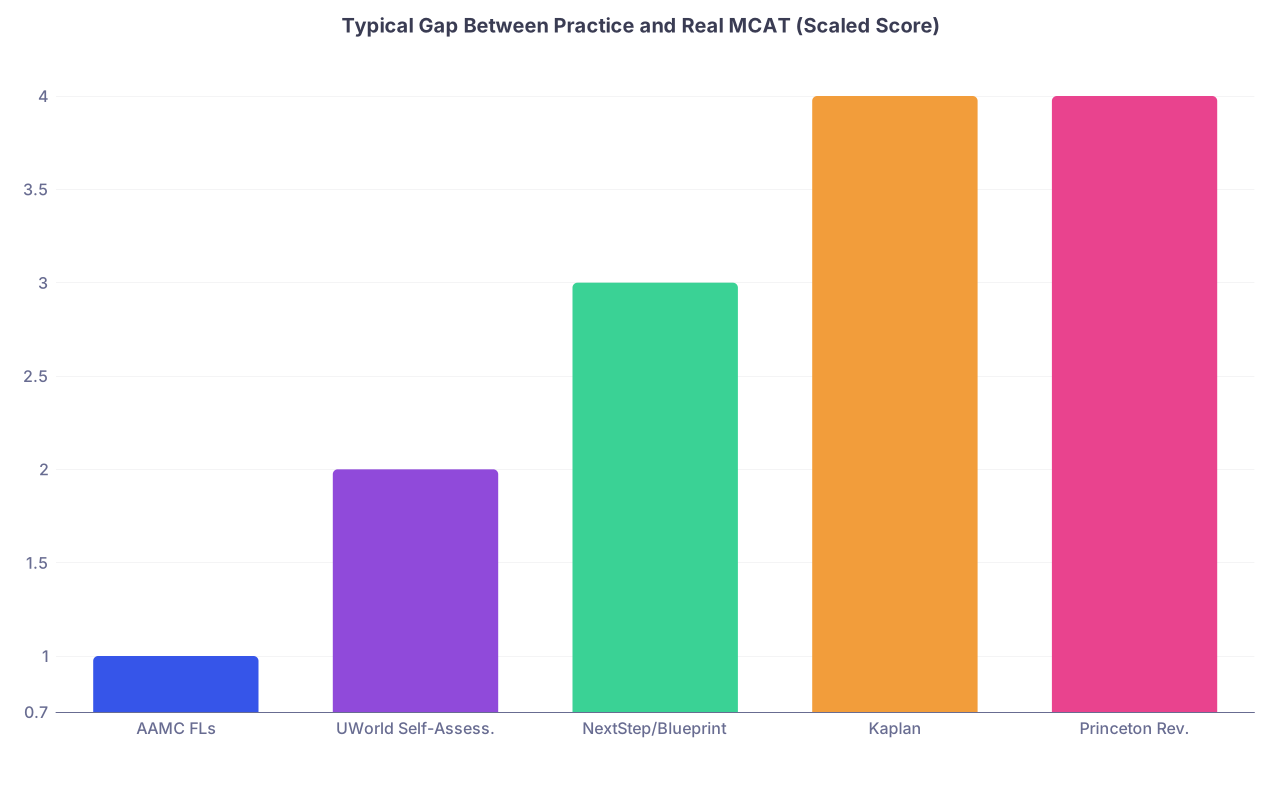
- AAMC Full-Length Practice Exams (usually 4–5 versions available)
- Section Banks (especially high-yield and often harder than the real exam)
- Question Packs and Official Guide Questions
- Sample Test (unscored but very valuable for format and practice)
Prioritize these for your final 4–6 weeks of prep, when you want the most accurate prediction of test-day performance and the closest match in style.
2. High-Quality Third-Party Full-Length Exams
Third-party practice tests are ideal earlier in your preparation, when you’re still building your foundational skills and endurance.
Reputable providers include:
- Kaplan
- The Princeton Review
- Blueprint
- Next Step / NS
- UWorld (particularly strong for passage-based question banks and explanations)
Use them to:
- Build stamina and timing early
- Practice diverse question styles
- Identify content weaknesses before you “spend” your AAMC exams
3. Using Free Practice Tests Wisely
Free MCAT practice tests (offered by several companies) can be helpful as:
- An initial diagnostic exam
- Additional practice if you’re on a limited budget
- Extra timing and endurance practice
However, weigh them carefully:
- Prioritize accuracy to the real exam over sheer quantity
- Don’t obsess over scores from low-quality or poorly calibrated tests
- Always compare timing, style, and passage length to AAMC standards
Simulating Real MCAT Test-Day Conditions
To get the most out of your practice tests, treat them as dress rehearsals for the real exam. The closer you can match test-day conditions, the more transferable your test-taking skills will be.
1. Replicate the Testing Environment
Try to simulate:
Timing:
Use official MCAT timing for each section and break. No extra pauses, no stopping mid-section, no rewinding time.Environment:
- Quiet space (library study room, private desk, or quiet home office)
- Earplugs or noise-cancelling headphones if you plan to use them
- Minimal visual clutter or distractions
Materials:
- Scratch paper or note boards similar to those used at testing centers
- Simple pens or markers (as allowed by the actual exam policies)
- No outside notes or study aids during the test
Computer-based format:
Take your practice exams on a desktop or laptop, not on a phone or tablet, to get accustomed to the interface and scrolling.
2. Practice Stamina and Break Management
The MCAT is long. One of the most underestimated skills is sustained focus. During your practice exams:
- Take breaks exactly as scheduled (don’t shorten or lengthen them)
- Use breaks wisely:
- Hydrate and have a light snack
- Use the restroom
- Do a few deep-breathing exercises or light stretching
- Avoid:
- Checking your phone
- Reviewing content
- Looking at your scores mid-exam
You’re training your mind and body to follow a predictable pattern—this lowers stress and conserves mental energy for the next section.
Turning Practice Tests into Learning Tools: Deep Review and Analysis
Simply taking practice tests is not enough. The real gains come from how you review each exam.

1. Start with a High-Level Performance Overview
After each test:
Record:
- Total score and percentile (if available)
- Section scores (Chem/Phys, CARS, Bio/Biochem, Psych/Soc)
- Raw number correct/incorrect per section (if provided)
Look for:
- Section trends (e.g., CARS lagging behind science sections)
- Question-type weaknesses (e.g., data interpretation, experimental design, inference questions)
- Timing issues (e.g., rushing last 10 questions, running out of time in CARS)
Keep a practice test log (spreadsheet or notebook) with:
- Test date
- Resource (AAMC FL 1, Kaplan FL 3, etc.)
- Scores by section
- Key takeaways and next steps
Over time, this becomes a powerful diagnostic tool.
2. Review Every Mistake—But Also the “Lucky” Correct Answers
For each section:
- Go through every question you got wrong
- Also review:
- Questions you guessed but got right
- Questions you answered correctly but weren’t confident about
For each item, ask:
What type of error was this?
- Content gap (I didn’t know the concept)
- Misread question/passage
- Reasoning error (jumped to conclusion, ignored data)
- Timing/panic decision
- Overthinking or second-guessing
What is the fix?
- Add to a content review list
- Create a flashcard
- Write a “lesson learned” (e.g., “Always check whether the question asks for increased or decreased.”)
- Adjust a test-taking strategy (e.g., “When confused by a graph, always identify axes first.”)
3. Create a Personalized Error Log
An error log is one of the most powerful study techniques for MCAT preparation. Consider organizing it by columns such as:
- Question ID / Practice Test #
- Section (Chem/Phys, CARS, Bio/Biochem, Psych/Soc)
- Topic (e.g., acid-base, renal physiology, research methods)
- Error type (content, reasoning, timing, misread, etc.)
- What I did
- What I should have done
- Follow-up action (review chapter X, make flashcard, do 10 extra questions on this topic)
Regularly reviewing this log will:
- Show which patterns keep repeating
- Prevent you from making the same mistake “for free” multiple times
- Help you set targeted goals for each week (e.g., “Fix my recurring electrochemistry mistakes”)
4. Link Practice Test Review to Specific Study Sessions
Don’t let your insights from practice exams sit idle. Translate them into specific, scheduled actions, such as:
If CARS scores lag:
- Add 2–3 timed CARS passages daily
- Practice reading dense humanities or social science articles (e.g., from The Atlantic, philosophy essays) and summarizing arguments
- Focus on question types that give you trouble (e.g., main idea vs. inference)
If Chem/Phys is weak:
- Review key equations and practice recalling them from memory
- Work more passage-based questions that integrate math with conceptual understanding
- Do targeted sets on topics like kinetics, optics, or fluid dynamics
If timing is the problem:
- Practice with shorter timed sets (e.g., 3 passages in 30 minutes)
- Stop yourself strictly at time limits to build pacing discipline
- Use a “mark and move on” strategy when stuck more than 60–90 seconds
Your practice tests should drive your study plan, not just reflect it.
Integrating Self-Care and Sustainability into MCAT Prep
High-performing students treat MCAT preparation like marathon training, not a frantic sprint. Performance depends on both strategy and well-being.
1. Protect Sleep as a Non-Negotiable
Cognitive performance, memory consolidation, and emotional regulation all depend heavily on sleep.
- Aim for 7–9 hours per night, especially before practice tests and critical study days
- Avoid late-night cramming that sacrifices rest
- Try to align your daily rhythm so your peak focus hours overlap with your actual MCAT test time
2. Incorporate Physical Activity
You don’t need intense workouts, but regular movement helps:
- Reduce anxiety and stress hormones
- Improve mood and focus
- Break up long sedentary study blocks
Simple options:
- 20–30 minutes of walking, jogging, or light exercise 3–5 times per week
- Stretching or yoga during breaks
- Short movement breaks every 60–90 minutes of studying
3. Plan Breaks and Recovery Days
Burnout is real, and it can sabotage even the best-designed MCAT preparation plan.
- Schedule planned days off every 1–2 weeks
- After each full-length exam, build in lighter days focused on review rather than new content
- Use off-days for:
- Social connection
- Hobbies unrelated to medicine
- Mental reset
Short strategic rest improves long-term productivity and performance.
Adapting Your Approach: Using Data from Practice Tests to Evolve Your Strategy
One of the biggest advantages of regular practice testing is the ability to adapt your preparation as you learn more about your strengths and weaknesses.
1. Adjusting Your Study Emphasis by Section
As trends become clear in your practice test log:
If CARS consistently lags:
- Increase daily CARS practice
- Focus on reading comprehension and argument structure rather than memorization
- Experiment with different passage approaches (e.g., detailed annotation vs. minimal note-taking)
If science sections lag:
- Identify whether gaps are content or application
- For content: schedule structured review plus spaced-repetition flashcards
- For application: do passage-based questions rather than only discrete items
2. Refining Test-Taking Strategies Over Time
You can also use practice tests to experiment with:
- Different pacing strategies (e.g., answering easier questions first, how long to spend per passage)
- Note-taking methods:
- Minimal underlining vs. structured passage mapping
- Quick diagrams for experiments or metabolic pathways
- Answering approach:
- Reading questions before or after passages in CARS or science sections
- Systematic elimination of answer choices based on evidence from the passage
Treat earlier third-party exams as practice labs for strategy. By the time you reach AAMC practice tests, your approach should be mostly stable and refined.
3. Using Study Groups and Accountability Partners
MCAT practice tests don’t have to be a completely solitary effort. Consider:
Reviewing exams with a study buddy or group
- Compare reasoning on difficult questions
- Teach each other concepts you’ve mastered
- Share test-taking strategies that worked for you
Accountability benefits
- Scheduling full-length days together keeps you consistent
- Group post-test review sessions can make analysis more thorough and less tedious
Just ensure group time stays focused and doesn’t devolve into unproductive venting.
Real-World Style Case Examples: How Practice Testing Drives Improvement
Emily: Transforming a Weak CARS Score
Emily started her MCAT preparation with a strong science background and a goal of scoring in the 90th percentile. Her first diagnostic exam revealed:
- Strong performance in Chem/Phys and Bio/Biochem
- Below-target CARS score
Instead of panicking, she used this data:
- She added daily CARS passages (4–5 per day) to her study plan
- She began reading high-level humanities and social science articles for 20 minutes each morning, summarizing arguments in her own words
- She kept a CARS error log, where she tracked:
- Over-reliance on personal opinion
- Missing the author’s main point
- Misinterpreting tone
Over 8–10 weeks and multiple practice tests, Emily’s CARS score steadily rose. By her final AAMC full-length, she was performing at or above her target—and she ultimately scored very competitively on test day.
Jason: Solving a Timing Problem
Jason felt overwhelmed by the amount of content on the MCAT. After several early practice tests, he noticed a clear pattern:
- He consistently ran out of time in Chem/Phys and Bio/Biochem
- His last 5–7 questions in each section were rushed guesses
Through careful review, he realized that he:
- Spent too long getting stuck on 1–2 very difficult passages
- Tried to “perfectly” understand every detail before answering
To fix this, Jason:
- Practiced short timed sets (3–4 passages) with strict time limits
- Adopted a “60–90 second rule”—if he wasn’t making progress, he would choose the best answer he could, mark it, and move on
- Developed a habit of quickly identifying main variables and experimental design at the start of each science passage
By his final month of preparation, Jason was finishing sections on time with more consistent accuracy. His scores improved to a level that made him a competitive candidate for multiple medical schools.
MCAT Practice Tests FAQ
How many MCAT practice tests should I take before my exam?
Most students benefit from at least 6–8 full-length practice tests, including:
- 1 early diagnostic exam
- Several third-party tests during the middle phase of prep
- All available AAMC full-length exams in the final 4–6 weeks
The key is not just the number of tests, but how thoroughly you review each one and integrate what you learn into your ongoing study plan.
When should I start taking full-length practice exams during my MCAT preparation?
You should take a diagnostic full-length near the start of your study period—even if you haven’t reviewed much content yet. This:
- Establishes a baseline
- Reveals your natural strengths and weaknesses
- Helps you design a targeted study plan
After that, begin incorporating full-length tests every 2–4 weeks, increasing frequency as you approach your test date. Don’t wait until you “finish all content” to begin practice tests—you’ll miss out on critical strategy and pacing practice.
How do I know if my practice test scores are high enough for my target schools?
First, research the median MCAT scores for accepted students at your target medical schools. As a general guideline:
- Your AAMC full-length scores (especially the last 2–3) are the best predictors of your actual MCAT score.
- Aim to have your practice test average at or slightly above the median score of your target schools.
- Remember that upward trends over multiple exams are encouraging, even if individual tests fluctuate.
Always interpret practice test scores in context: resource used, timing issues, fatigue, and where you are in your prep timeline.
What should I do if my practice test scores plateau?
Plateaus are common and often signal the need to change your approach, not necessarily to work harder. Consider:
- Reviewing your error log for recurring patterns
- Increasing focus on passage-based reasoning rather than isolated content
- Adjusting your timing strategy or passage-reading methods
- Taking a short rest period (1–3 lighter days) to recover and reset
Often, scores jump after you fix a key structural issue in your approach, not just by adding more hours.
Are third-party practice tests as good as AAMC exams?
Third-party practice tests are valuable—especially earlier in your MCAT preparation—for:
- Building stamina
- Stress-testing your content knowledge
- Practicing under timed, exam-like conditions
However:
- AAMC exams are the most accurate in style, difficulty, and scoring
- Use third-party tests primarily in the early and middle phases
- Reserve AAMC full-lengths for the final phase when you want the best prediction of your test-day performance
By integrating high-quality MCAT practice tests into a thoughtful, data-driven preparation plan—and by reviewing each exam deeply—you can steadily convert practice into peak performance. Every full-length exam becomes not just a score, but a roadmap guiding you toward your best possible MCAT and, ultimately, a stronger application for medical admissions.