
Mastering Time Management in Medical School: Your Key to Reducing Stress and Avoiding Burnout
Time Management in Medical School is not just a “nice-to-have” skill—it’s a survival tool. Between pre-clinical coursework, exams, clinical rotations, shelf prep, research, extracurriculars, and basic life responsibilities, it can feel like there simply aren’t enough hours in the day. When this pressure builds without structure, stress levels skyrocket and Self-Care is often the first thing to disappear.
Effective Time Management is one of the most powerful strategies for Stress Reduction, protecting your mental health, and sustaining Productivity over the long haul of medical training. With a realistic system, you can move from constantly reacting to crises to actively directing your days with intention.
This guide will walk you through practical, evidence-informed strategies specifically tailored for medical students and early trainees. You’ll learn how to prioritize, plan, and protect your time—while making space for sleep, relationships, and activities that keep you grounded.
Why Time Management Matters So Much in Medical School
The Unique Demands of Medical Training
Medical school life isn’t like undergraduate or most graduate programs. The sheer volume of information and the emotional and cognitive demands of clinical work make time feel perpetually scarce.
You’re balancing:
- Academic responsibilities: Lectures, labs, small groups, PBL/CBL, assignments, exams, and board prep.
- Clinical responsibilities: Rounds, pre-rounding, notes, call, procedures, patient follow-up.
- Professional development: Research, quality improvement, leadership roles, teaching, conferences.
- Personal life: Family, friends, finances, chores, and Self-Care activities like exercise and hobbies.
Without a system, it’s easy to chronically feel behind, guilty when you’re not studying, and exhausted when you are. Thoughtful Time Management gives you a framework to handle these competing demands more rationally and compassionately.
Four Core Benefits of Effective Time Management
Balancing Competing Responsibilities More Realistically
Instead of trying to “do everything,” a structured approach helps you:- Identify what truly matters this week or month.
- Say no to commitments that don’t align with your priorities.
- Allocate time in a way that reflects your values (e.g., board prep, sleep, relationships).
Stress Reduction and Emotional Stability
Much of medical school stress comes from uncertainty: “Am I doing enough? Am I forgetting something important?”
When you have a clear plan:- Ambiguity decreases.
- Last-minute crises are less frequent.
- You experience more control and predictability, which is strongly linked with lower anxiety and burnout risk.
Sustainable Productivity (Not Just Working More Hours)
Good Time Management isn’t about stuffing every minute with work. It’s about:- Matching demanding tasks to your peak focus times.
- Protecting deep work blocks from interruptions.
- Building in rest so you can stay sharp across months and years—not just a single exam week.
Protecting Your Health and Self-Care
Without structure, Self-Care gets squeezed out first. With deliberate planning, you:- Reserve time for sleep, meals, and movement.
- Make space for therapy, counseling, meditation, or spiritual practices if helpful.
- Maintain relationships that buffer stress and support resilience.
Core Time Management Strategies for Medical Students
1. Prioritize Intelligently with the Eisenhower Matrix
The Eisenhower Matrix is a simple yet powerful way to sort your to-do list into what truly deserves your attention.
The four quadrants:
Urgent and Important
Tasks with immediate deadlines or serious consequences if delayed.
Examples:- Exam tomorrow
- Shelf exam in two days
- Required assignment due tonight
- Patient follow-up that must be completed before rounds
Important but Not Urgent
Long-term, high-impact activities that rarely “scream” for your attention.
Examples:- Daily Anki or spaced-repetition review
- Long-range USMLE/COMLEX board prep
- Regular exercise and sleep
- Relationships, hobbies, and mental health appointments
- Drafting a manuscript or scholarship application well in advance
Urgent but Not Important
Time-sensitive, but not necessarily aligned with your biggest goals.
Examples:- Many emails
- Some student-org requests or committee tasks
- Non-critical texts and messages
Neither Urgent Nor Important
Low-value distractions that consume time without meaningful benefit.
Examples:- Endless social media scrolling
- YouTube or Netflix “just one more episode” spirals
- Browsing random websites instead of doing intentional rest
How to Implement This as a Medical Student
Weekly Brain Dump
Every Sunday (or a fixed weekly time), list all tasks for the upcoming week: exams, labs, rotation duties, research milestones, personal commitments.Sort into Quadrants
Label each item as:- UI (Urgent & Important)
- IN (Important, Not urgent)
- UN (Urgent, Not important)
- NN (Neither)
Plan Around Your Top Two Quadrants
- Schedule UI tasks first in your calendar.
- Protect IN tasks by assigning them dedicated time blocks—this is where long-term success and Stress Reduction are built.
Limit UN and NN Tasks
- Batch urgent-but-not-important items (like routine emails) into specific 15–30 minute windows.
- Set boundaries around NN tasks by time-limiting them or cutting them out on busy weeks.
This method ensures that board prep, exercise, and sleep—often “Important but Not Urgent”—don’t forever get pushed to “someday.”
2. Design an Effective Weekly Study and Life Schedule
A well-designed schedule is more than a fixed calendar—it’s a realistic map of your energy, responsibilities, and recovery time.
Building Your Weekly Framework
Start with Non-Negotiables
- Class/lecture times or required small groups
- Clinical hours or call shifts
- Commute time
- Sleep (aim for 7–9 hours/night—protect this like an exam)
Layer in High-Yield Study Blocks
- Block 2–4 hours/day for focused study, ideally during your most alert times (morning for many people).
- Break long blocks into smaller sessions with short breaks (see Pomodoro below).
- During clinical rotations, you may only have 1–2 solid hours—plan them intentionally.
Include Maintenance Tasks
- Chores (laundry, dishes, groceries)
- Meal prep (huge time saver during exam weeks)
- Administrative tasks (emails, scheduling, paperwork)
Schedule Self-Care and Relationships
- Exercise 2–5 times/week (even 20–30 minutes counts).
- Time with friends, family, or partners.
- Hobbies or relaxation (reading, music, gaming—within limits).
- Therapy, coaching, or mentoring sessions if part of your support system.
Build in Flexibility
- Add 10–20% “buffer time” for the unexpected: pages, extra rounds, sudden fatigue, or social opportunities.
- Consider a “catch-up block” each week for anything that slipped.
Example: A Balanced Weekday (Pre-Clinical)
- 7:00–8:00 – Wake, breakfast, quick review of Anki cards
- 8:00–12:00 – Lectures/labs
- 12:00–13:00 – Lunch + short walk
- 13:00–15:00 – Focused study: review morning material
- 15:00–15:15 – Break (snack, stretch)
- 15:15–17:00 – Practice questions / board prep
- 17:00–18:00 – Exercise + shower
- 18:00–19:00 – Dinner + downtime
- 19:00–20:30 – Light review, prep for next day
- 20:30–22:30 – Relax, social time, wind down
- 22:30–23:00 – Bedtime routine
You’ll adjust the structure for clinical rotations, but the principles—blocking, breaks, and protected rest—remain the same.
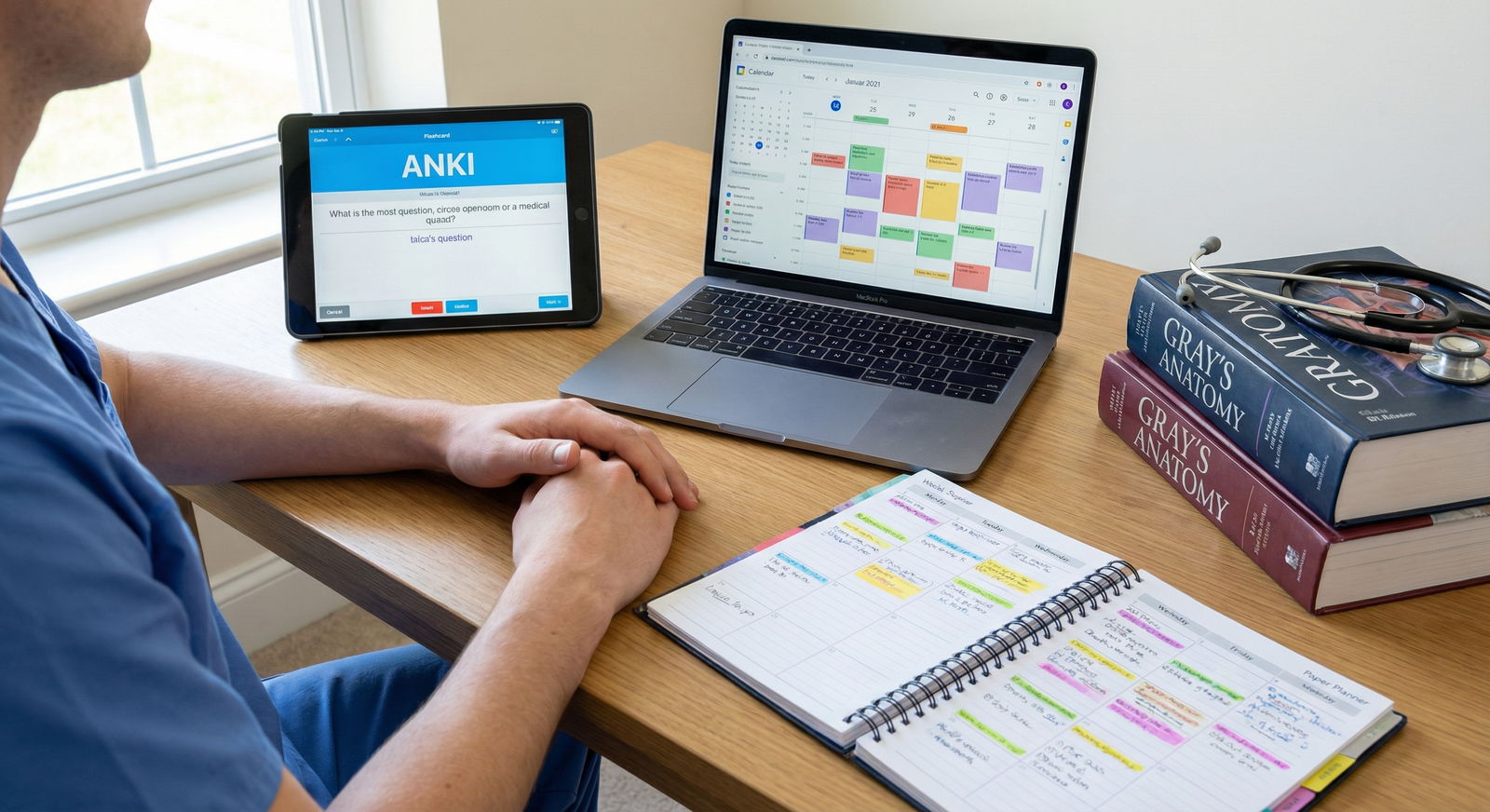
3. Boost Focus with the Pomodoro Technique and Variations
The Pomodoro Technique is a classic approach to boost Productivity while minimizing mental fatigue.
Basic Pomodoro Method
- Choose a single task (e.g., renal physiology, UWorld questions).
- Set a timer for 25 minutes and work with full focus.
- Take a 5-minute break—stand up, stretch, breathe, or grab water.
- Repeat for 4 cycles, then take a 15–30 minute longer break.
This is especially helpful for:
- Starting tasks you’re avoiding.
- Breaking large topics into manageable chunks.
- Fighting the urge to multitask.
Clinical and Board Prep Adaptations
Longer Focus Blocks: Many medical students prefer 40–50 minutes on / 10 minutes off when doing practice questions or reading.
Question-Based Pomodoros: Instead of timing, group by questions:
- 10 questions + review → short break
- Repeat for 3–4 sets, then take a longer break.
Distraction Management:
During a Pomodoro:- Silence phone notifications.
- Use website blockers (e.g., Freedom, Cold Turkey, StayFocusd).
- Keep a scrap paper “inbox” for intrusive thoughts (e.g., “email Dr. X”—write it down, then return to work).
The key is consistency and honesty—if you’re interrupted or check your phone, restart the timer. Over time, your ability to focus deeply improves.
4. Leverage Technology Without Letting It Control You
Digital tools can drastically streamline your Time Management in Medical School—if used intentionally.
Core Categories of Helpful Tools
Task and Project Management
- Todoist, TickTick, Microsoft To Do
- Organize tasks by course, rotation, or project.
- Set due dates and recurring tasks (e.g., “Daily Anki,” “Review USMLE questions”).
- Trello, Notion, or Asana
- Great for research or group projects.
- Use boards like “To Do,” “Doing,” and “Done” to visualize your progress.
- Todoist, TickTick, Microsoft To Do
Calendar and Scheduling
- Google Calendar, Outlook, Apple Calendar
- Time-block your day with study periods, classes, Self-Care, and rest.
- Add reminders for exams, assignment deadlines, and meetings.
- Color-code: e.g., green for self-care, blue for classes, red for deadlines.
- Google Calendar, Outlook, Apple Calendar
Study and Knowledge Retention
- Anki (spaced repetition) for long-term memory.
- Notion, OneNote, or Obsidian for organized notes.
- Question banks with built-in scheduling, like UWorld, AMBOSS, Rx, etc.
Best Practices for Tech Use
Set App “Office Hours”
Check email or messaging apps at scheduled times (e.g., 2–3 times/day) instead of constantly.Create a “Single Source of Truth”
Use one main system (e.g., Google Calendar + Todoist) instead of multiple overlapping tools.Avoid Tool-Procrastination
Don’t spend hours tweaking systems; aim for “good enough” and start using them.
5. Set SMART Goals for Exams, Rotations, and Well-Being
Vague intentions like “study more” or “be healthier” rarely change behavior. SMART goals are:
- Specific
- Measurable
- Achievable
- Relevant
- Time-bound
High-Yield Examples for Medical Students
Academic Goal
Instead of: “I’ll work on cardio this week.”
Use: “From Monday to Friday, I will complete and thoroughly review 40 cardiovascular questions per day from my board QBank between 3–5 PM.”Clinical Rotation Goal
Instead of: “I want to be better at presentations.”
Use: “By the end of this week, I will practice and deliver at least one complete patient presentation each day on rounds, using a written template I review the night before.”Self-Care Goal
Instead of: “I need to exercise more.”
Use: “For the next two weeks, I will do 20 minutes of walking or light exercise on Monday, Wednesday, and Friday after I get home from clinic.”
SMART goals align with Time Management because they tell you exactly when and how to fit key behaviors into your schedule.
6. Protect Your Mental Health: Mindfulness and Self-Care as Non-Negotiables
Time Management without Self-Care is just a more organized path to burnout. Stress Reduction and emotional resilience require active maintenance.
Practical Mindfulness Strategies
You don’t need long meditation retreats. Short, consistent practices can help:
3–5 Minute Breathing Exercises
Use apps like Headspace, Calm, or Insight Timer between tasks or before sleep.Mindful Moments on the Wards
Before entering a patient’s room, pause for one slow breath and set an intention: “Be present, be kind.”Body Scan Before Sleep
Lying in bed, mentally scan from head to toe, gently releasing tension.
These small practices can reduce reactivity and emotional exhaustion over time.
Building Sustainable Self-Care Habits
Sleep Hygiene
- Aim for consistent sleep and wake times, even around call when possible.
- Limit late-night screen exposure; use blue-light filters.
- Avoid heavy studying in bed—reserve it for sleep when you can.
Movement
- Think “something is better than nothing”: 10 minutes of stretching, stairs instead of elevators, or brisk walks between buildings.
- Use short workouts (HIIT, bodyweight circuits) during intense exam periods.
Nutrition
- Plan simple, balanced meals and snacks.
- Keep healthy options on hand: nuts, yogurt, fruit, pre-cut vegetables, protein bars.
- Meal prep on weekends to save time on weekdays.
Connection and Support
- Schedule regular check-ins with a friend, partner, or family member.
- Talk openly with peers about stress; you’re rarely alone in feeling overwhelmed.
- Use counseling and wellness services through your medical school when needed.
Treat Self-Care appointments with the same seriousness as mandatory lectures or rounds—they are essential parts of your training, not luxuries.
7. Learn to Say No: Protecting Your Time and Energy
Medicine often rewards saying “yes” to extra tasks, but never-ending yeses are a major pathway to burnout.
When to Consider Saying No
- You’re already consistently sacrificing sleep to keep up.
- Your core responsibilities (classes, clinical work, major exams) are at risk.
- The new commitment doesn’t clearly align with your current goals (e.g., research in a specialty you’re not interested in when you’re already stretched thin).
- You’re experiencing signs of chronic stress: irritability, constant exhaustion, or dread.
How to Say No Professionally
Be Honest and Respectful
“Thank you so much for thinking of me. Right now, my schedule is fully committed with [rotation/exams/research], and I wouldn’t be able to give this project the attention it deserves.”Offer Alternatives (If Appropriate)
“I can’t join the project, but I’d be happy to share it with classmates who might be interested.”Delay, Don’t Dismiss (When That’s True)
“I’m very interested, but I have a major exam in three weeks. Could we revisit this afterwards?”
Learning to say no strategically protects your mental health, your Time Management system, and your long-term Productivity.
Staying Motivated and Adapting Over Time
Even with the best system, motivation fluctuates—especially during long exam blocks or demanding rotations.
Strategies to Maintain Motivation
Use Visual Progress Tracking
- Habit trackers, progress bars, or checklists for question blocks or Anki reviews.
- Marking off completed tasks provides a sense of accomplishment.
Reward Systems
- After finishing a study block or exam, reward yourself:
- An episode of a show.
- Coffee with a friend.
- A guilt-free afternoon off.
- After finishing a study block or exam, reward yourself:
Reconnect with Your “Why”
- Reflect on meaningful patient encounters or journal 1–2 lines about something you learned or appreciated each day.
- Keep reminders of your long-term goals visible (a note on your wall, a photo, or a statement in your planner).
Adjust and Iterate Regularly
- Every 1–2 weeks, ask:
- What worked well?
- What consistently fell off the schedule?
- What needs to change in my plan?
- Time Management is a skill you refine, not a one-time setup.
- Every 1–2 weeks, ask:
If you find persistent low motivation, hopelessness, or signs of depression or anxiety, reach out to mental health services or trusted mentors—even the best schedule can’t replace professional support when it’s needed.

FAQ: Time Management, Stress, and Self-Care in Medical School
Q1: What is the most effective Time Management strategy for medical students?
There is no single “best” strategy for everyone. Most students benefit from combining:
- A weekly time-blocked schedule (using a calendar),
- A prioritization tool like the Eisenhower Matrix,
- And a focus method such as Pomodoro or 50/10 study cycles.
Experiment for 2–3 weeks with a consistent system before changing it, and then adjust based on what realistically fits your life and learning style.
Q2: How can I reduce stress when I feel like I’m always behind?
First, pause and assess rather than pushing harder blindly:
- Do a brain dump of all tasks and deadlines.
- Prioritize using urgent/important categories.
- Create a realistic plan, even for just the next 48–72 hours.
- Schedule short, intentional breaks and protect sleep as much as realistically possible.
If chronic stress persists or you feel overwhelmed most days, talk with a mentor, advisor, or mental health professional—Stress Reduction often requires both structural changes and emotional support.
Q3: Are there specific apps that really help with Productivity and scheduling?
Yes. Many medical students successfully use:
- Google Calendar or Outlook for time-blocking and reminders.
- Todoist, TickTick, or Microsoft To Do for tasks and recurring habits (like daily Anki).
- Anki for spaced-repetition flashcards.
- Notion or OneNote to organize notes and resources.
Choose a simple combination that you can maintain daily; too many tools can become a distraction.
Q4: How do I make Self-Care a priority when my schedule is already full?
Start small and intentional:
- Schedule Self-Care like any other appointment: 20–30 minutes of exercise, a weekly social call, or a short nightly wind-down routine.
- Integrate it into existing routines: walk while listening to recorded lectures, stretch during question breaks, do a 5-minute meditation before bed.
- Reframe rest as performance-enhancing: adequate sleep and movement improve concentration, memory, and clinical judgment, directly helping your academic and clinical performance.
Q5: What should I do if Time Management strategies don’t seem to help and I still feel overwhelmed?
If you’re consistently overwhelmed despite trying structured approaches:
- Check whether your plan is realistic for your actual energy and obligations.
- Consider whether you’re taking on too many extracurriculars or research projects at once.
- Talk with:
- A faculty advisor or dean of students about workload and expectations.
- A mental health professional if you’re noticing signs of anxiety, depression, or burnout.
- Trusted peers or mentors for practical tips within your specific curriculum.
Remember: needing help is not a failure. Many highly successful physicians have sought support during training.
Mastering Time Management in Medical School is less about perfection and more about building flexible, sustainable habits that protect your well-being. By prioritizing what matters most, planning your days with intention, and safeguarding Self-Care, you create the conditions to learn effectively, care for patients compassionately, and graduate not just as a competent physician, but as a healthier human being.