Creating a Healthy Study Environment to Enhance Mental Well-Being in Medical School
A healthy Study Environment is not a luxury in medical school—it is a core strategy for Academic Success, Stress Reduction, and protecting your Mental Well-Being over the long haul. Between dense syllabi, high-stakes exams, and clinical responsibilities, your surroundings can either drain your energy or quietly support your focus, productivity, and emotional health.
This guide expands beyond simple “clean your desk” advice. It will help you intentionally design your physical and digital study spaces, structure your time, and integrate wellness habits that support both learning and mental health. The goal: a study environment that helps you perform well and feel well.
Why Your Study Environment Is a Mental Health Intervention
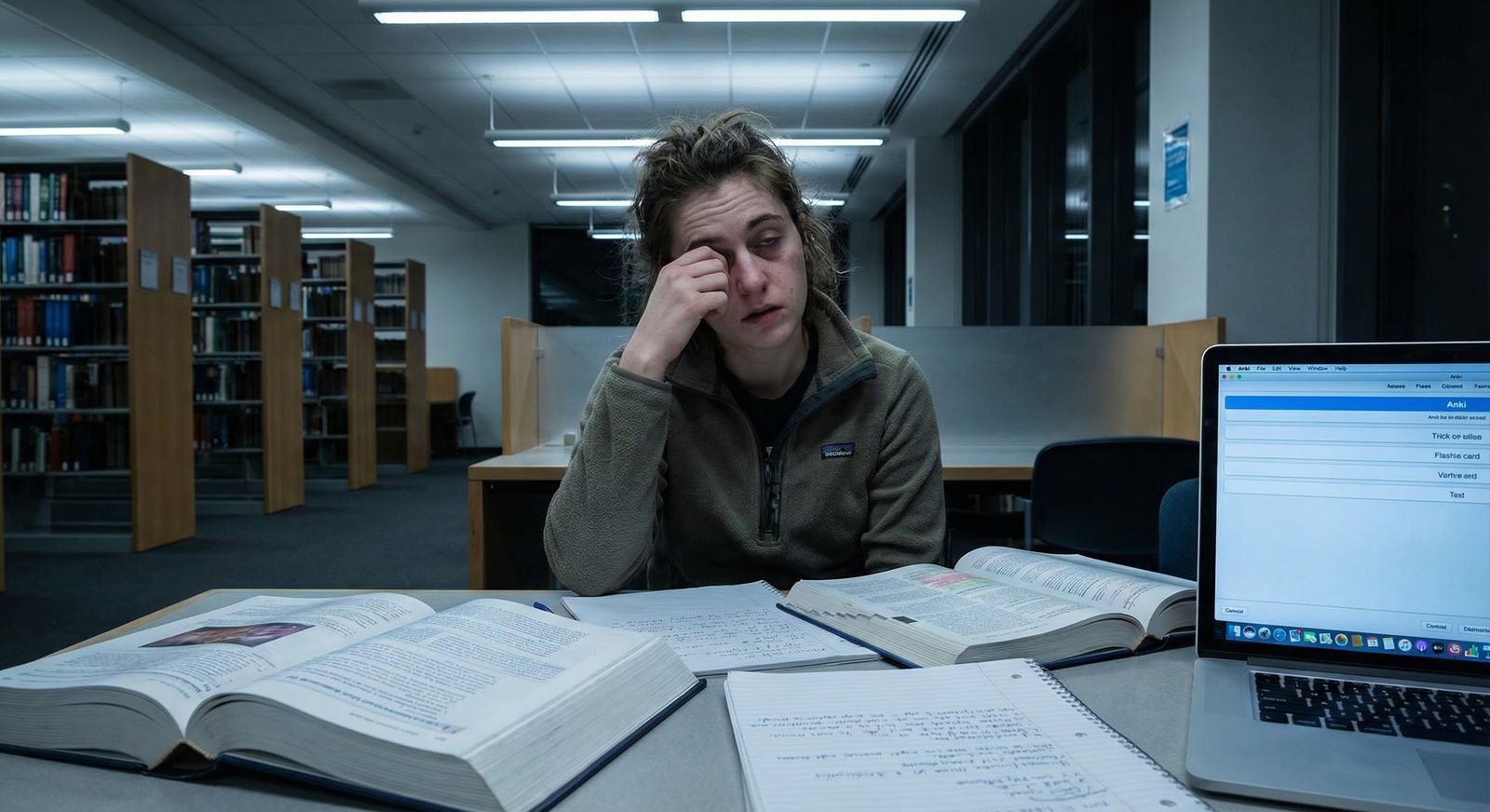
Your study space is not just where you work—it constantly sends signals to your brain. Those cues can either increase anxiety and procrastination or foster calm and concentration.
How Environment Impacts Cognitive Function and Emotions
Research in environmental psychology and occupational health consistently shows that:
- Clutter increases cognitive load. Visual and physical clutter competes for your attention and makes it harder to filter out distractions.
- Poor ergonomics contribute to fatigue and pain. Back, neck, and eye strain reduce your ability to sustain focus and may associate studying with discomfort.
- Lighting and noise influence mood. Harsh artificial light, dim rooms, or chaotic noise can worsen stress and irritability.
- Order and predictability support self-regulation. A consistent, organized Study Environment lowers the “activation energy” to start work and stick with it.
For medical students facing long hours of reading, note-taking, and practice questions, even small improvements in your environment can translate into better focus, improved Productivity, and lower perceived stress.
Key Reasons to Prioritize Your Study Environment
Better Focus and Concentration
An organized, appropriately quiet or structured space makes it easier to enter a state of deep work, reducing the time you spend “warming up” or fighting distractions.Protection of Mental Well-Being
A calm, predictable environment reduces background stress and supports anxiety management. Over time, this can protect against burnout and emotional exhaustion.Increased Motivation and Consistency
When your study space feels inviting instead of draining, you’re more willing to sit down and get started—even on difficult days.Stronger Boundaries Between Work and Rest
Physical cues (like a dedicated desk) help your brain distinguish “study mode” from “relax mode,” improving both productivity and sleep quality.
Core Elements of a Healthy Study Environment for Medical Students
Creating a supportive Study Environment involves more than just a desk and a chair. Think of it as designing a personal “learning ecosystem” that makes studying as frictionless and sustainable as possible.
1. Optimize Your Physical Space for Focus and Comfort
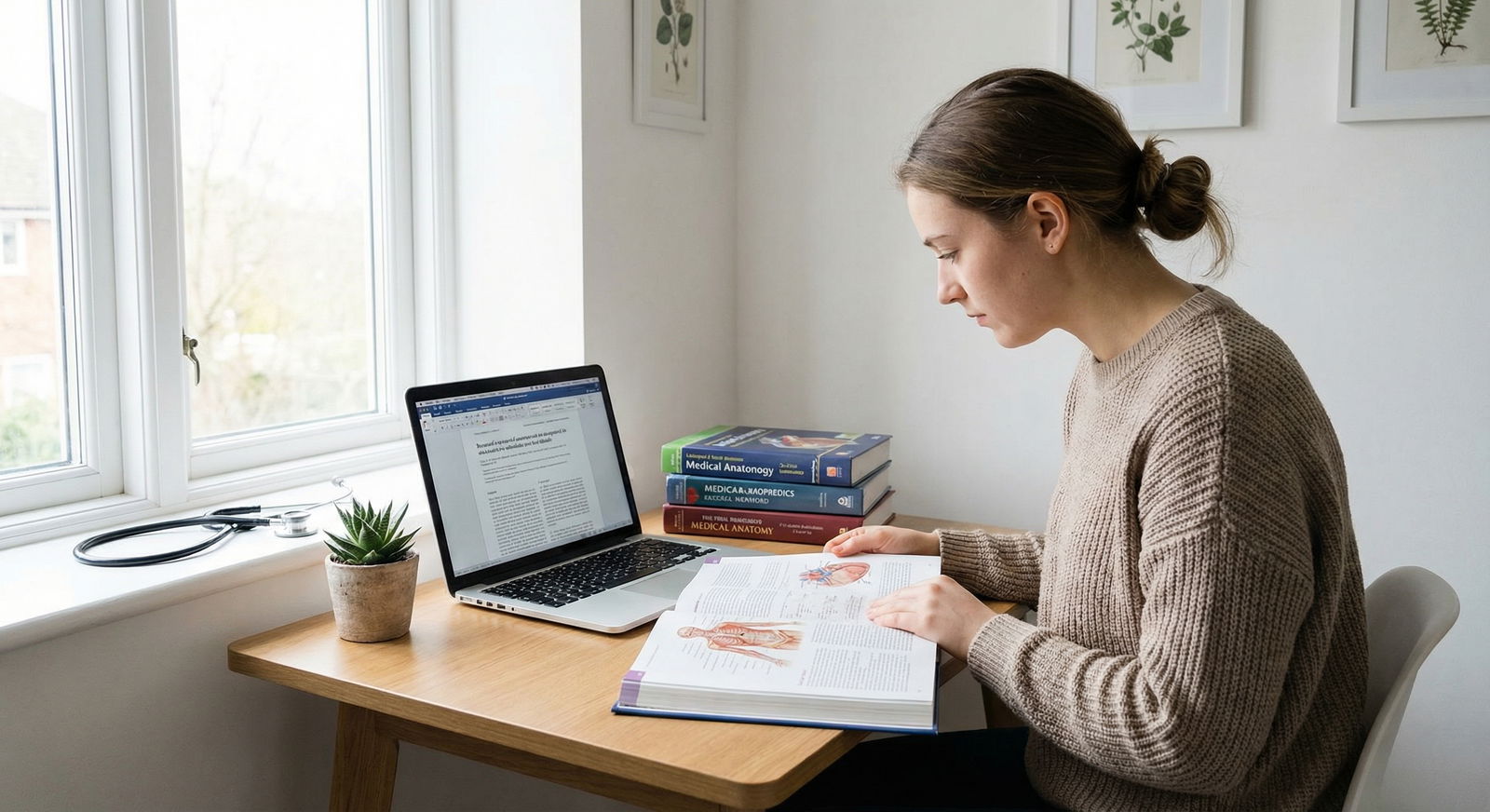
Your physical setup is the foundation. Whether you study in a dorm, apartment, shared house, or library, you can apply these principles.
Declutter and Organize With Intention
- Start with a reset:
Clear everything off your desk. Put back only what you use daily: laptop, a notebook, one or two pens, a water bottle, and perhaps a small plant or photo. - Create “homes” for things:
- Use file folders or magazine holders for notes, printed articles, and important documents.
- Use drawer organizers or small containers for pens, highlighters, and stationery.
- Keep only your current rotation or block’s materials within arm’s reach.
- Minimize visual noise:
Avoid stacking books or papers in front of you. Store extras on a shelf or in a box so your visual field remains clean.
This streamlined space improves your ability to sustain attention and reduces the “where is that?” frustration that eats into your study time and Mental Well-Being.
Prioritize Ergonomics to Protect Your Body
Long study hours plus poor posture are a recipe for chronic pain and fatigue.
Key ergonomic adjustments:
- Chair:
- Choose a chair that supports your lower back.
- Adjust height so your feet are flat on the floor (or on a footrest) and your knees are roughly at hip level.
- Desk and arm position:
- Your elbows should rest at about 90 degrees on the desk.
- Your shoulders should feel relaxed, not hunched.
- Screen height and distance:
- Top of your screen at or slightly below eye level.
- About an arm’s length away from your eyes.
- Keyboard and mouse:
- Wrists straight, not bent upward.
- Consider an external keyboard and mouse if you use a laptop.
Proper ergonomics doesn’t just prevent discomfort; it extends your effective study time and helps associate studying with less physical strain—an underrated but significant win for your overall Mental Well-Being.
Harness the Power of Light
Lighting is a subtle but powerful component of Academic Success and mood regulation.
- Maximize natural light when possible:
- Position your desk near a window.
- Use sheer curtains or blinds to avoid glare while maintaining brightness.
- Use layered artificial lighting:
- Overhead light + a desk lamp with warm-white or neutral-white bulbs.
- Avoid harsh, overly cool (blue) lighting late at night to protect your sleep-wake cycle.
- Adjust screen brightness:
Use blue-light filters or “night mode” in the evening to reduce eyestrain and protect your circadian rhythm.
2. Shape the Atmosphere and Ambiance for Stress Reduction
Once the physical basics are in place, refine the “feel” of your space. This often has an outsized impact on anxiety, motivation, and stress.

Manage Sound Intentionally
Different tasks require different sound environments:
- Silence or near-silence for dense reading, pathophysiology, or complex reasoning.
- Low-level background sound for repetitive tasks (Anki reviews, rewriting notes).
- Options to consider:
- Instrumental or lo-fi music (no lyrics to avoid language-processing distraction).
- Nature sounds, white noise, or ambient soundtracks (e.g., café sounds if that helps you).
- Noise-canceling headphones in shared or noisy spaces.
Experiment and notice what actually supports your Productivity and comprehension—not just what “feels nice.”
Consider Scent and Sensory Cues
Gentle sensory inputs can signal your brain that “it’s time to focus.”
- Aromatherapy options (used safely and lightly):
- Lavender or chamomile: calming, good for anxiety and evening study.
- Citrus (lemon, orange): mildly energizing, useful for daytime studying.
- Peppermint or eucalyptus: associated with alertness for some people.
- Guidelines:
- Keep scents light, especially in shared spaces.
- Be mindful of allergies or sensitivities (yours and others’).
- Use diffusers or candles only in safe, supervised ways.
Maintain a Comfortable Temperature
Your brain works best in a temperature range that’s not too hot or too cold.
- Aim for a moderate range (commonly around 20–24°C / 68–75°F).
- Use layers—hoodie, cardigan, or blanket—so you can adjust quickly.
- Use a small fan, space heater (if safe), or open window as needed.
A neutral temperature helps your body devote more resources to cognition instead of thermoregulation, subtly improving both focus and comfort.
Add Personal, Uplifting Touches
Your environment should remind you that you are a person, not just a test-taking machine.
- A small plant, postcard, family photo, or meaningful quote.
- A vision board with:
- Long-term goals (e.g., specialty you’re aiming for).
- Values (e.g., compassion, service, curiosity).
- Short-term motivators (e.g., “Pass Step 1 while caring for myself.”)
These cues can support resilience and Mental Well-Being during intense exam periods.
Equip Yourself: Tools, Materials, and Digital Environment
Your tools and resources can either streamline your studying or create more chaos.
3. Curate Study Tools and Materials Strategically
Balance Digital and Traditional Resources
Different tasks may benefit from different formats:
- Digital tools are great for:
- Question banks and flashcards (e.g., UWorld, AMBOSS, Anki).
- Quick reference apps and guidelines.
- Collaborative documents for group study.
- Paper-based tools excel for:
- Concept mapping and diagramming (e.g., anatomy, physiology pathways).
- Handwritten summaries that aid retention.
- Reducing screen fatigue during long days.
Choose the combination that reduces friction and supports deep understanding, not just passive exposure.
Keep Resources Current and High-Quality
- Use materials that align with:
- Your school’s curriculum.
- Current exam blueprints and guidelines.
- Ask upperclassmen, residents, or faculty which resources are both high-yield and realistic in volume.
- Avoid hoarding too many resources “just in case”—this often increases anxiety and decision paralysis.
Visual Aids and Spatial Learning
Enhance understanding and memory by embedding learning into your physical space:
- Hang key diagrams (e.g., cardiac cycle, renal physiology) near your desk.
- Use whiteboards for:
- Pathways (e.g., glycolysis, coagulation).
- Differential diagnoses.
- Algorithms (e.g., ACLS, sepsis management).
- Color-code concepts by system or priority.
This turns your Study Environment into a living memory palace that reinforces learning passively.
4. Design Your Digital Environment to Minimize Distraction
Your laptop or tablet is both your greatest tool and your biggest distraction risk.
- Tidy your digital desktop:
- Create folders by course, system, or rotation.
- Remove non-essential icons from your desktop.
- Use website blockers during study blocks:
- Apps like Freedom, Cold Turkey, or StayFocusd can help you avoid social media and news sites.
- Separate “study mode” from “relax mode”:
- Use different browser profiles (one for academic use only).
- Log out of distracting apps during dedicated study times.
- Turn off non-critical notifications:
- Silence group chats, social apps, and non-urgent email alerts while you’re working.
These simple digital boundaries significantly improve Productivity and reduce the constant micro-interruptions that strain attention and increase Stress.
Time Management and Structure: Turning Environment into Consistent Action
Even the best-designed space won’t help if your study time is chaotic. Structure supports both performance and Mental Well-Being.
5. Build a Realistic, Sustainable Study Schedule
Use Time Blocking for Clarity
- Divide your day into blocks:
- Morning: High-focus tasks (e.g., new content, practice questions).
- Afternoon: Review and consolidation.
- Evening: Lighter tasks (e.g., flashcards, planning, low-stakes reading).
- Include:
- Short breaks every 25–50 minutes.
- At least one longer break (30–60 minutes) during longer study days.
This structure reduces decision fatigue: you don’t sit down wondering “what should I do?”—you already know.
Try the Pomodoro Technique (And Adapt It)
The Pomodoro Technique (25 minutes focused work + 5-minute break, repeated) can be very effective for Stress Reduction and steady Productivity.
You can adapt it by:
- Extending focused sessions to 45–50 minutes if you can maintain concentration.
- Using the 5–10 minute breaks for:
- Stretching or a short walk.
- Breathing exercises.
- Getting water or a small snack.
- Not scrolling social media, which can overstimulate your brain.
After 3–4 cycles, take a longer 20–30 minute break.
Set SMART Goals (Specific, Measurable, Achievable, Relevant, Time-bound)
Instead of “study cardio,” try:
- “Complete 40 cardiology UWorld questions and review explanations in 2 hours.”
- “Summarize the indications and mechanisms of the top 20 antibiotics before 6 PM.”
- “Review Anki cards for renal and endocrine for 30 minutes each.”
Clear, bounded goals make progress tangible and decrease feeling overwhelmed.
Integrating Health and Wellness Into Your Study Routine
You are not just a brain preparing for exams; you are a whole person. Sustainable Academic Success depends heavily on how you care for your body and mind.
6. Protect Your Physical Health During Study Sessions
Take Intentional, Restorative Breaks
Use breaks to reset, not to exhaust your attention further.
- Every 25–50 minutes:
- Stand up.
- Stretch your neck, shoulders, and back.
- Look out a window or at something distant to relax your eyes.
- Once or twice daily:
- Take a 20–30 minute walk.
- Do brief bodyweight exercises or yoga.
This counters the physical strain of prolonged sitting and helps maintain energy and alertness.
Support Your Brain With Nutrition and Hydration
- Keep a water bottle on your desk as a visual cue.
- Favor snacks that provide sustained energy:
- Nuts, yogurt, fruit, cheese, hummus with vegetables, whole-grain crackers.
- Avoid heavy, high-sugar meals before long study sessions—these can cause energy crashes and sluggishness.
Small, consistent choices contribute to better concentration and more stable mood.
7. Mental Health Practices You Can Embed in Your Study Environment
Your study space can also be a place where you intentionally practice Stress Reduction.
Brief Mindfulness and Breathing Practices
Integrate 2–5 minute practices between blocks:
- Box breathing:
Inhale 4 seconds → hold 4 seconds → exhale 4 seconds → hold 4 seconds. Repeat 4–6 cycles. - Grounding with senses:
Pause and notice 5 things you see, 4 you feel, 3 you hear, 2 you smell, 1 you taste.
These techniques help reset your nervous system, especially when anxiety spikes before an exam or while dealing with dense material.
Build Coping Tools Into Your Space
Keep one or two small coping tools at your desk:
- A stress ball, fidget item, or putty.
- A short list of affirmations or grounding statements:
- “I am allowed to learn at a human pace.”
- “Progress, not perfection.”
- “Taking care of myself improves my performance.”
These visible cues can help interrupt spirals of self-criticism or panic.
Sleep Hygiene and Environment Boundaries
Separating studying from sleeping is crucial for Mental Well-Being:
- Avoid studying in bed when possible. Reserve the bed for sleep and rest.
- Dim lights and close books/screens at least 30–60 minutes before sleep.
- Have a mini “shutdown ritual”:
- Clear your desk.
- Write your top 3 tasks for tomorrow.
- Close your laptop.
This helps your brain transition out of “study mode,” improving sleep quality and emotional resilience.
Social Connections and Supportive Study Culture
You don’t have to build a healthy Study Environment alone. People are part of your environment too.
8. Study Groups and Peer Support
Use Study Groups Strategically
Well-run study groups can improve understanding and motivation:
- Ideal group size: 2–4 people.
- Suggested structure:
- 5 minutes: Set goals.
- 40–60 minutes: Silent or focused individual work.
- 20–30 minutes: Discuss tricky questions, teach each other, or quiz one another.
- Keep the focus on learning, not just commiseration. Both have their place, but mixing them can dilute effectiveness.
Communicate Boundaries With Roommates and Family
Explain your study schedule and needs:
- Ask for quieter times during key blocks.
- Agree on signals (e.g., headphones on = please do not disturb unless urgent).
- Be flexible and respectful, but clear about your requirements during exam periods.
9. Knowing When to Ask for Help
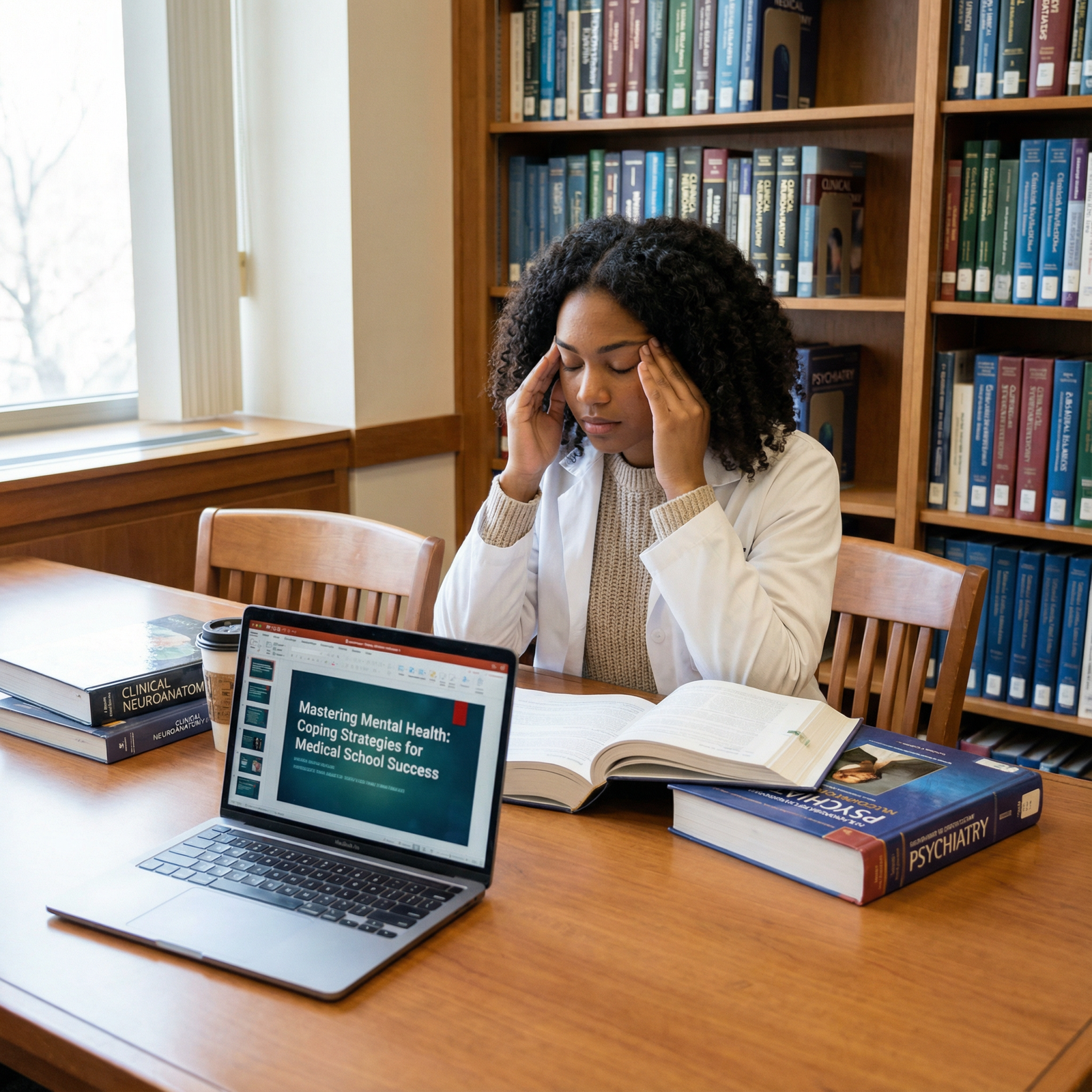
A healthy environment includes access to support when your Mental Well-Being is struggling.
- Signs you may need additional support:
- Persistent insomnia or severe fatigue.
- Loss of motivation beyond normal exam stress.
- Ongoing feelings of worthlessness or hopelessness.
- Panic attacks or severe anxiety affecting daily function.
- Resources to consider:
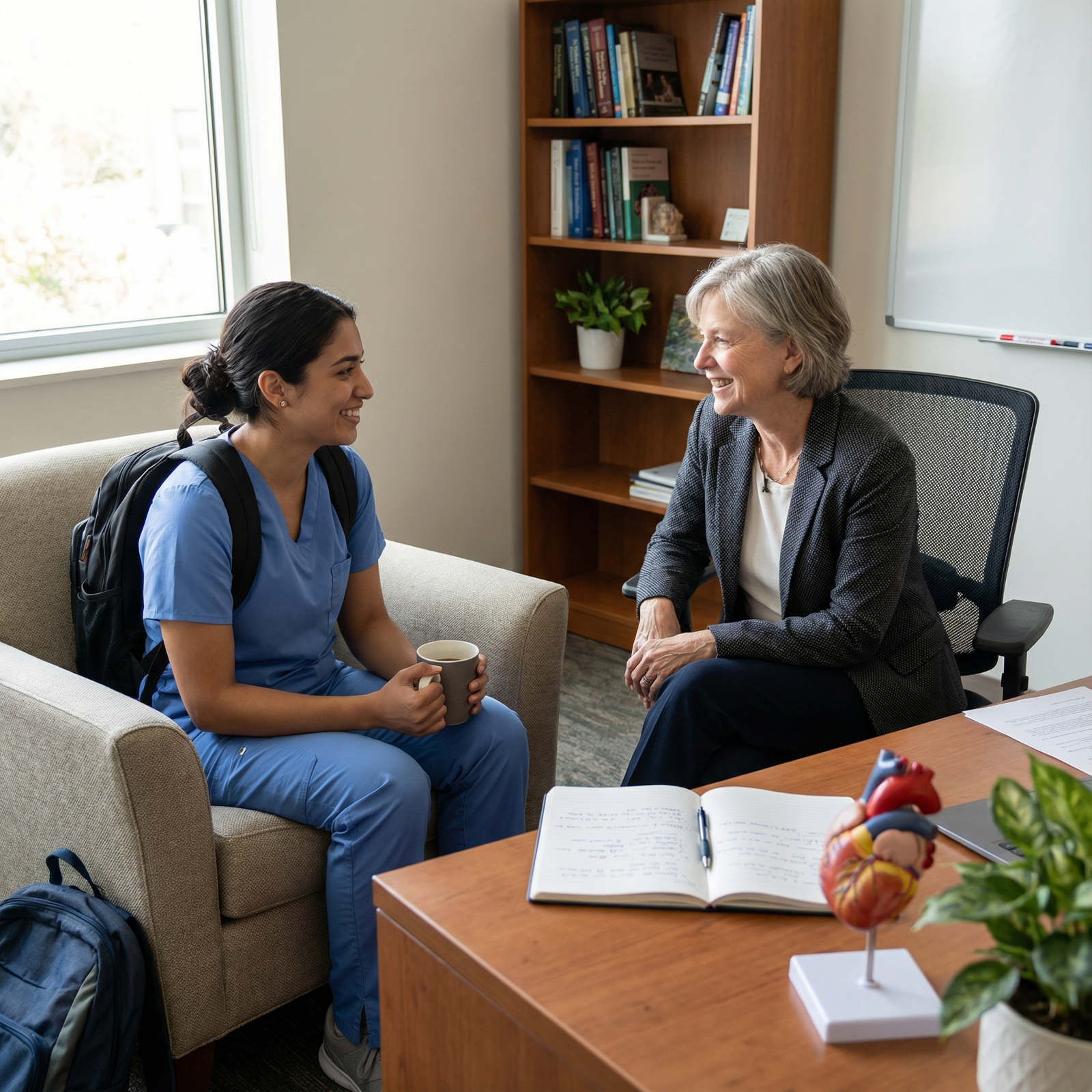
- Your school’s counseling or mental health services.
- A trusted faculty mentor or advisor.
- Peer support groups for medical students.
- Your primary care clinician or psychiatrist when indicated.
Seeking help is not a weakness; it is a professional skill and an investment in your future patients, who need you well.
FAQs: Healthy Study Environment, Mental Well-Being, and Academic Success
1. What are some quick, high‑impact changes I can make to improve my study space today?
- Clear everything off your desk except essentials (laptop, notebook, pen, water).
- Adjust your chair and screen for better posture.
- Move closer to natural light or add a desk lamp.
- Put your phone out of reach or in another room during study blocks.
- Decide on one calming sensory element (plant, small photo, or soft background sound).
These small changes can immediately reduce distractions and improve your sense of control.
2. How can I maintain my Mental Well-Being during intense exam periods?
- Schedule recovery time on purpose—short walks, meals away from your desk, brief mindfulness practices.
- Use realistic daily goals rather than trying to “cram everything.”
- Prioritize sleep—chronic sleep deprivation damages memory, mood, and performance.
- Stay connected: brief check-ins with family or friends, even by text or a 10-minute call.
- Ask for help early if you notice anxiety or low mood escalating.
Viewing well-being habits as integral to studying—not optional extras—helps you sustain performance and protect your mental health.
3. How do I handle digital distractions like my phone and social media?
- Keep your phone physically away from your study area or face down and on “Do Not Disturb.”
- Use website or app blockers during planned study blocks.
- Schedule 2–3 specific times daily to check messages and social apps, instead of constant small interruptions.
- Turn off non-essential notifications, especially from group chats and social platforms.
By controlling when you engage with these tools, you regain a sense of agency and protect your focus.
4. What should I keep near my desk to support both Productivity and well-being?
Consider:
- Water bottle and healthy snacks.
- A simple to-do list or daily plan.
- One small item that brings joy (plant, photo, encouraging quote).
- Earplugs or headphones for noise control.
- A notepad to “brain dump” intrusive thoughts or unrelated tasks so they don’t distract you.
This combination supports concentration while also taking care of your physical and emotional needs.
5. Can changing my study environment really improve Academic Success, or is it just about willpower?
Environment and willpower work together. A supportive Study Environment:
- Lowers the effort needed to get started.
- Reduces the number of distractions you have to fight.
- Protects your body from strain, improving stamina.
- Supports Stress Reduction and Mental Well-Being, which are directly linked to memory, attention, and decision-making.
In medical training—where demands are high and time is limited—designing your environment strategically is one of the most efficient Productivity Tips you can implement.
By approaching your Study Environment as an integral part of your training—not an afterthought—you set yourself up for more sustainable learning, stronger Academic Success, and far better Mental Well-Being throughout medical school and beyond.