
Most clinicians get this wrong. They hear “patient wants to record the visit” and jump straight to: absolutely not, illegal. That’s not what the law actually says.
Here’s the real answer: sometimes yes, sometimes no. Annoying? Sure. But medicine is full of people pretending a messy answer is simple because simple feels safer. Recording laws depend on state consent rules, institutional policy, who’s in the room, whether audio is involved, and whether the phone is picking up protected health information belonging to someone other than the patient. A patient recording their own encounter is not the same thing as a random person filming in a waiting room. And it’s definitely not automatically forbidden.
This matters because smartphones are now part of the anatomy. Patients use them to remember medication changes, replay discharge instructions, share explanations with family, and compensate for stress, pain, age, or cognitive overload. I’ve seen patients forget half of what was said before they reach the parking lot. Recording can help. It can also create a privacy mess in about three seconds if it captures another patient, a nurse at the doorway, the clinic schedule on a monitor, or a whiteboard with names on it.
So let’s separate law from discomfort. They are not the same thing. You may hate being recorded and still be in a setting where it’s lawful. Or you may feel perfectly fine with it and still be in a place where policy or state law says no. That distinction matters.
This article is for education only, not legal advice. Recording law, privacy rules, and institutional policies vary by state and setting, and edge cases matter. If you’re making policy or facing a dispute, get advice from your institution’s legal or compliance team.
The core legal answer: sometimes yes, sometimes no
Start with the blunt truth: a patient may be legally allowed to record their own medical visit in some circumstances, but that does not mean every recording is lawful or permissible.
The biggest legal fork in the road is consent law for recording conversations. Many states allow one-party consent, meaning one participant in the conversation can consent to recording. If the patient is part of the conversation, that may be enough. Other states require all-party or two-party consent, especially for audio recording. That means the clinician’s consent matters too. And yes, audio is often the hidden landmine. People fixate on video, but the legal trigger in many jurisdictions is the capture of the conversation.
That’s why a silent photo is one issue, a silent video is another, and audio or video-with-audio is the real legal headache.
Then comes policy. Hospitals and clinics can impose workplace rules that are stricter than what the bare minimum law allows, especially to protect privacy, workflow, and staff. So even if state law might allow a patient-participant recording, a clinic may still prohibit it in certain locations or require explicit permission. That’s not automatically oppressive. Sometimes it’s the only practical way to stop recordings from scooping up other people’s confidential information.
And here’s the part clinicians routinely underestimate: if the recording captures staff members, trainees, interpreters, other patients, shared workspaces, computer screens, or hallway conversations, the legal and ethical analysis changes fast.
So no, “the patient is in the conversation” is not a magic phrase that makes everything fine. It’s a factor. Not a blank check.
What clinicians should worry about: privacy, consent, and professionalism
A lot of doctors frame this as: “What if I’m secretly filmed?” That’s understandable, but it’s also self-centered. The bigger issue is usually collateral capture.
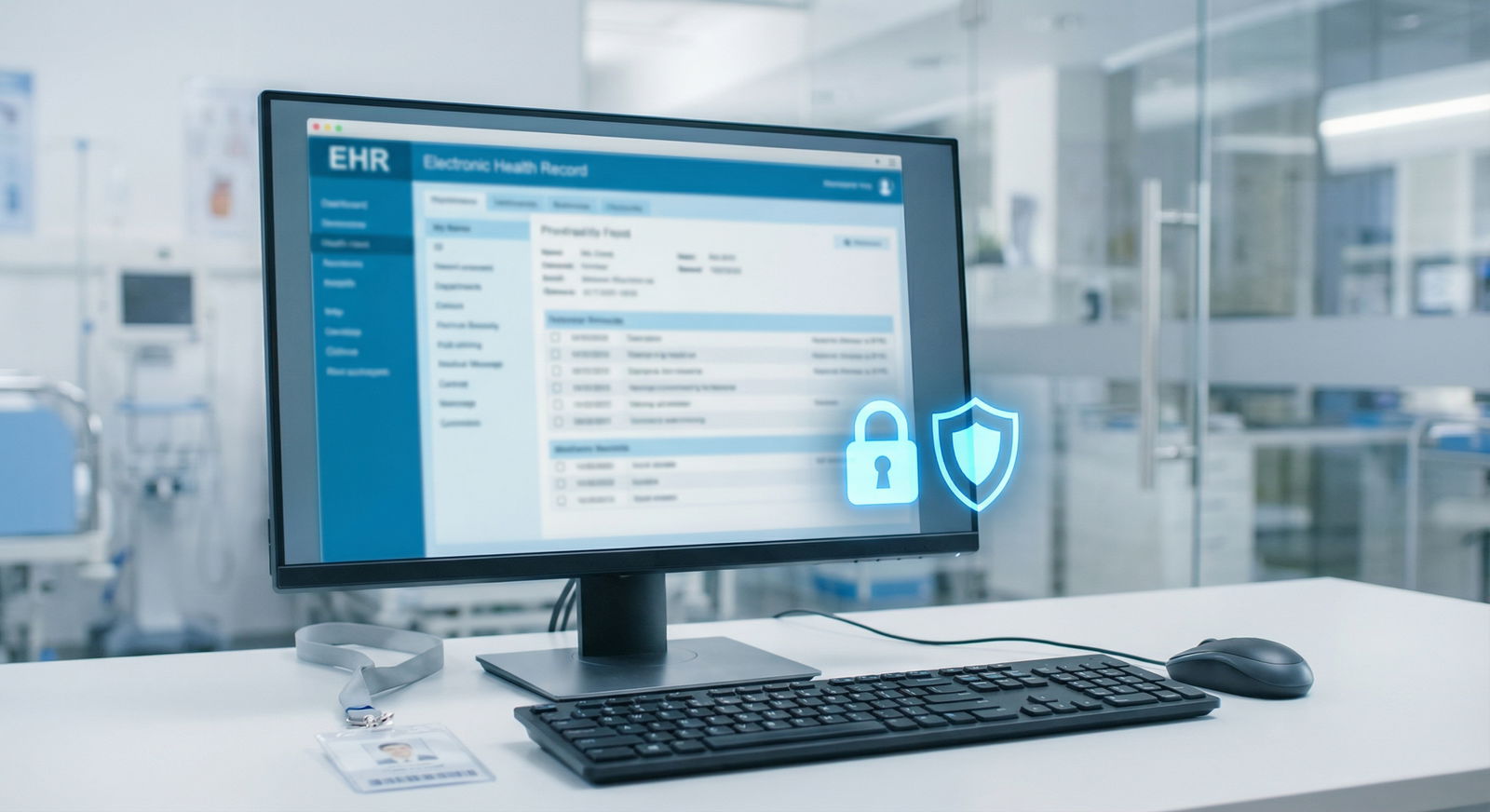
The phone doesn’t just record your explanation of hypertension. It may also catch the medical assistant walking in, a badge with a full name, the patient list on your workstation, a family member in the next bay, an interpreter on speaker, or the whiteboard where somebody lazily wrote room assignments. That’s where real risk lives.
If recording is allowed, the environment has to be controlled. Close the door. Move the camera angle. Keep screens dark or turned away. Don’t let convenience become a HIPAA-adjacent clown show.
And yes, your professionalism matters. Actually, it matters more when a recording is present. Not because you should perform, but because you should already be speaking clearly, respectfully, and accurately. A recording shouldn’t force good behavior; it should reveal whether good behavior was there in the first place. If the thought of replaying your counseling makes you nervous, the problem may not be the phone.
That said, clinicians are entitled to transparency. A patient should not be treated as unreasonable for asking to record, and a clinician should not be treated as paranoid for wanting clear rules. Hidden recordings poison trust. Open discussion protects it.
So tell patients the rule before the visit gets far. If recording is allowed, say what’s allowed. If it’s limited, explain the limits. If it’s prohibited, say so plainly and offer an alternative. Ambiguity is how people end up angry later.
Best-practice policy: how to handle a patient request without creating legal risk
Here’s the sane approach. Not the macho approach. Not the panicked approach.
Step 1: Pause
Don’t answer reflexively. “Sure, whatever” is sloppy. “Absolutely not” may also be sloppy. You need about 20 seconds of thought.
Step 2: Ask why they want to record
Usually the answer is boring and legitimate: “I won’t remember this,” “My daughter couldn’t come,” “I want to replay the wound care instructions.” Good. Now you’re solving a problem instead of reacting to a device.
Step 3: Check the rule set
You need three things:
- Your state’s recording consent law
- Your institution’s policy
- The realities of the room you’re in
If you don’t know the law or policy, don’t wing it. That’s how smart people create dumb liability.
Step 4: Define boundaries
If recording is permitted, set conditions clearly:
- Only this visit, not the waiting room or hallway
- No recording of other patients or staff not involved in the encounter
- No filming computer screens, charts, tracking boards, or posted patient information
- One designated device only
- Clinician can pause recording for physical exam portions or sensitive discussions if policy allows
That last point matters. A lot of encounters are not one continuous chunk of harmless education.
Step 5: Document it
A brief note helps:
- Patient requested to record counseling/discharge instructions
- Recording permitted or declined per policy
- Limits explained
- Participants identified
Simple. Boring. Protective.
Step 6: Escalate when needed
You should stop and get help if:
- The patient refuses boundaries
- The recording would involve a shared room or open clinical area
- The discussion involves a minor, custody conflict, behavioral health, trauma, sexual health, or other highly sensitive content
- An interpreter is involved and consent is unclear
- Staff are uncomfortable because policy is uncertain, not because they’re being dramatic
And let’s be honest: some settings are just bad candidates for casual recording. Behavioral health visits. High-conflict family meetings. Consent for surgery. Encounters involving impaired capacity. You need tighter controls there.
Real-world examples, edge cases, and what to say to patients
A patient wants to record discharge instructions after an ED visit. Usually the most defensible scenario. Clear educational purpose. Limited scope. Easy to supervise.
A parent wants to record a pediatric visit. Often reasonable, but be careful if custody, adolescent confidentiality, or sensitive history is involved. A 6-month-old with reflux is one thing. A 16-year-old discussing contraception is another.
A patient wants to record therapy or behavioral health. That’s where people get naive. These visits can involve third parties, trauma disclosures, safety planning, and a very different expectation of candor. Extra caution is not overkill here. It’s judgment.
A patient secretly records after being told no. That’s not just awkward. It may violate law, policy, and the therapeutic relationship. You don’t need to explode. You do need to document what happened and involve risk management or administration if appropriate.
Edge cases change everything:
- Minors: who has authority to consent may be disputed
- Incapacitated adults: a surrogate may be involved, but authority has limits
- Interpreter use: you now have another participant whose rights and agency matter
- Telehealth: platform terms, state law, and household privacy all matter
- Shared rooms: almost always higher risk
- Team discussions: more participants, more consent issues
Here are scripts that actually work:
If yes, with limits:
“Recording the instructions is okay, but only for this part of the visit. Please keep the camera on me, not the screen or doorway, and don’t record staff or other patients.”
If no, because of policy or law:
“I understand why you want to record, but our policy doesn’t allow recording in this setting because of privacy rules. I can give you a written summary and go over the key points slowly.”
If you want a safer alternative:
“Let’s do this a better way. I’ll print the after-visit instructions, write down the medication changes, and we can call your family member now if you want.”

Bottom line: legal permission is not the same as good practice
Here’s the myth to kill: patients do not have an unlimited right to record anything they want in a healthcare setting. But the opposite myth is just as bad: recording is not automatically illegal or forbidden.
The real answer is narrower and more useful. A patient may be allowed to record their own visit in some circumstances, especially if state law permits participant recording and institutional policy allows it. But that permission can collapse fast when audio consent rules, staff presence, other patients, shared spaces, or sensitive content enter the picture.
So don’t improvise. Know your state law. Know your institution’s policy. Tell patients the rule up front. If recording is permitted, set boundaries and document them. If it isn’t, explain why and offer something useful instead, like a written summary, after-visit instructions, or a speakerphone call with family.
That’s the grown-up answer. Not fear. Not blanket bans. Not fake certainty. Just facts, boundaries, and decent judgment.
Key takeaways
- A patient recording a visit isn’t automatically illegal or automatically allowed; the answer depends on state law, clinic policy, and privacy risks.
- The biggest dangers usually aren’t about the doctor’s ego. They’re accidental capture of PHI, staff, other patients, and sensitive room content.
- Best practice is simple: ask upfront, set limits, document the decision, and offer safer alternatives when recording isn’t appropriate.