

You are on inpatient psych call. The new PGY‑1 you have been supervising for the past month is suddenly admitted overnight after a suicide attempt. Morning sign‑out ends, and now everyone is quietly asking the same question: “Who’s going to be their attending?” The chief looks at you. This is your trainee. Now also your patient. And the room goes very still.
That is the dual‑role problem in medicine in one frame.
Not hypothetical. Not rare. And when it goes badly, it goes very badly: boundary complaints, licensing issues, fractured teams, and damaged careers. When it goes well, you almost do not notice—because the ethical work is invisible. But somebody thought it through.
Let me break this down specifically.
The Core Problem: Why Dual Roles Are Ethically Dangerous
The phrase “dual role” is too polite. What you are really dealing with is a conflict of loyalties combined with an imbalance of power.
You have at least two roles at once:
- Clinician, with obligations of beneficence, non‑maleficence, confidentiality, and respect for autonomy.
- Teacher/supervisor/employer, with obligations of evaluation, discipline, promotion, and program protection.
When your patient is also your student or trainee, these roles collide.
You cannot fully:
- Protect their privacy and also fulfill your duty to evaluate them.
- Give them undiluted clinical advocacy and also protect the program or institution.
- Be a neutral evaluator while holding highly sensitive mental health or health‑related data about them.
And they cannot:
- Freely disclose impairing symptoms, substance use, or errors without worrying about your evaluation of them.
- Decline recommended treatment without fearing career fallout.
- Easily say “no” to your suggestions or “yes” to an independent second opinion.
That is why every major ethics code warns against dual relationships and conflicting roles. Not because you are a bad person. Because the structure itself is bad.
The Legal and Policy Backdrop You Cannot Ignore
You need to know what landscape you are standing on. This is not just “what feels right.” There are guardrails.
Professional Guidance
Several bodies have weighed in, explicitly or implicitly:
- AMA Code of Medical Ethics: Discourages dual relationships that “undermine the patient–physician relationship” and emphasizes avoiding treating close associates when possible.
- ACGME and specialty colleges: Emphasize that residents must have confidential access to health care and support, and that evaluation and treatment roles should be separated.
- World Medical Association: Repeatedly warns against exploitation and misuse of power in clinical and educational relationships.
None of these documents are written for fun. They exist because people have crashed into these problems already.
Confidentiality and Employment
In most academic centers, the “patient who is also a trainee” sits at the intersection of:
- Medical privacy law (HIPAA or local equivalents).
- Employment law and institutional policy.
- Licensure and board reporting obligations.
The tension is obvious:
- As a clinician, you must protect their confidentiality.
- As a program leader, you must ensure patient safety and trainee competence.
- As a mandated reporter (in some contexts), you may have obligations around impairment, risk of harm, etc.
If you are both their treating physician and their supervisor, it becomes nearly impossible to prove you kept those domains cleanly separated. Courts and boards do not love “trust me, I compartmentalized it in my head.”
Which is why a lot of institutions now have explicit policies that faculty who evaluate trainees should not be their treating clinicians for serious or ongoing conditions. If your hospital has such a policy, ignoring it is reckless. If your hospital does not, you should still behave as if it does.
Where Dual Roles Actually Show Up in Real Life
Let’s move from theory to scenarios you will actually encounter.
1. The Trainee as Mental Health Patient
The most charged version.
Your psychiatry resident, who you have been evaluating all year, starts to deteriorate. Panic attacks, missed deadlines, odd charting. Eventually they break down in your office and ask: “Can you be my doctor? I trust you.”
You are tempted. You care about them. You know their history. They do not want to see “some random psychiatrist” across town.
This is exactly the moment to say no.
Why? Because you cannot:
- Write objective milestone evaluations while privately knowing about their trauma history, medication non‑adherence, or suicidal ideation.
- Decide about fitness for duty while also trying to maintain a long‑term therapeutic alliance.
- Be free to hospitalize them, adjust call, or recommend leave, without them interpreting everything through the lens of “will this end my career?”
What you do instead:
- You acknowledge the trust.
- You state clearly you cannot be their treating psychiatrist because you are also their supervisor/evaluator.
- You help them connect quickly to an independent clinician, ideally outside your program or even outside your institution.
- You make sure there is institutional support: occupational health, GME, wellness services.
That structure is not cold. It is protective—for both of you.

2. The Student with a Medical Condition You Could Manage
You are a cardiologist. A third‑year medical student on your team has poorly controlled hypertension. They ask if you will take them on as a patient and “just manage my meds, honestly.”
Tempting. Simple problem, clear guidelines, you see them every day anyway.
Still a bad idea.
Even in “simple” cases, problems arise:
- Side effects, non‑adherence, or missed appointments become part of your mental model of them as a student.
- They may under‑report symptoms to avoid being labeled “unreliable” or “sickly.”
- You may unconsciously adjust evaluations because you “feel bad for them” or, the opposite, resent the extra time.
There is also the exam room dynamic: the student may feel obligated to agree to treatment plans because you control their grade. That is not informed consent. That is quiet coercion.
Better pattern: direct them to a separate student health or off‑site clinician. You can still care about how they are doing. You just are not the one titrating their lisinopril.
3. Procedural Teaching vs. Treatment
Here is a more subtle one. You are supervising a resident’s first central line on an ICU patient. The resident is nervous but ready. The patient consents to the procedure by “the team.”
Now imagine the trainee on the bed is actually your own student, admitted for sepsis, and they say, “I trust you, but I do not want the intern practicing on me.”
You are simultaneously:
- Their treating clinician.
- Their educator.
- A steward of the ICU workflow.
The right hierarchy is simple: patient role dominates. Every time.
You do not use their body as a teaching opportunity they explicitly declined, regardless of your feelings about “missed learning.” That would be an abuse of power, even if technically “safe.”
The clean move: ensure their clinical care is provided by people they are comfortable with, and if that means no one from the usual teaching team places their line, so be it.
Why “I Can Keep It Separate” Is Usually an Illusion
I have heard this sentence many times: “I know it is technically dual‑role, but I can keep those roles separate.”
No, you cannot. Not reliably. And not in a way that withstands scrutiny.
The cognitive science here is ruthless:
- You cannot un‑know sensitive information when writing evaluations or making promotion decisions.
- You are subject to bias: halo effect (“I like them, so I inflate their evaluations”), horns effect (“They were difficult as a patient, must be difficult as a resident”), rescue fantasies, guilt, frustration.
- Under stress, your protective instincts for the institution or for the trainee will dominate, and you will not always predict which one.
Worse, in any later complaint or legal action, your nice story about “compartmentalization” looks like exactly what it is: self‑serving.
The only truly durable solution is structural separation: don’t hold both roles for the same person whenever you can avoid it. When you cannot, you limit and time‑bound the clinical role, and you document your reasoning and handoff.
A Practical Framework: How to Assess and Handle Dual Roles
Let me give you a simple mental algorithm you can run when this hits your desk.

| Step | Description |
|---|---|
| Step 1 | Identify dual role risk |
| Step 2 | Refer to independent clinician |
| Step 3 | Limit and time bind clinical role |
| Step 4 | Document rationale |
| Step 5 | Involve ethics or GME |
| Step 6 | Monitor and reassess |
| Step 7 | Can roles be separated? |
Breakdown of each step:
Step 1: Name the Dual Role
Do not pretend it is “just helping out.” Say it plainly, at least to yourself and often out loud:
- “I am this person’s attending and their evaluator.”
- “I am this resident’s PD and their therapist? That is not acceptable.”
- “I am teaching this student and being asked to prescribe controlled substances for them.”
If you cannot label the problem, you will rationalize it.
Step 2: Ask: Can I Reasonably Avoid This Dual Role?
Often the answer is yes.
Examples:
- There is another attending who can take the trainee as a patient.
- Student health or an external provider can take over routine care.
- A different staff physician can give the treatment recommendation while you stay in the educator role.
If an alternative exists that does not put the trainee at a disadvantage, that is almost always your ethical obligation.
Step 3: If You Cannot Avoid, Limit and Time‑Bind
Sometimes you truly cannot step away immediately:
- You are the only specialist in a rural setting.
- It is the middle of the night on call and you are the clinician present.
- The trainee is acutely suicidal or medically unstable and transferring care right now is unsafe.
In those cases:
- Provide necessary acute care.
- Be transparent: “I am in two roles here. I will handle your immediate medical needs, then we will transfer your care to someone who is not involved in your evaluation.”
- Hand off as soon as it is clinically safe. Do not let “temporary” quietly become permanent.
And document. Not a five‑page manifesto. A short note in the chart and, if applicable, an email to your PD / department chair or GME: “Due to lack of alternative at time X, I provided emergent care, then arranged transfer to Dr. Y.”

Power, Coercion, and “Consent” in Dual Relationships
One of the most misunderstood parts of dual roles is consent. People say things like:
“They asked me to be their doctor. They consented. So it must be ethical.”
No. You cannot fix a power imbalance with a consent form.
In education and employment settings, consent is heavily constrained:
- Trainees rely on you for grades, letters, recommendations, and advancement.
- Students and residents often believe (sometimes correctly) that refusing you will have consequences, even if subtle.
- Cultural norms in medicine reward compliance and punish “difficult” behavior.
So the fact that they “asked for you” does not neutralize the power gap. In many cases, it makes it worse: they are trying to secure your loyalty by deepening the relationship.
Your job as the more powerful party is to decline the invitation when it creates a conflict that they cannot fully see.
That is not paternalism. That is boundary‑keeping.
Institutional Responsibilities: Building Systems That Don’t Set You Up to Fail
You can be as ethically fastidious as you like; if the institution sets up bad structures, dual roles will keep appearing.
Healthy programs adopt explicit policies like:
| Safeguard | Practical Example |
|---|---|
| Separate treating and evaluating | Residents see external mental health clinicians |
| Clear conflict-of-interest rules | Faculty cannot treat trainees in their own program |
| Confidential access to care | Off-site, no billing through departmental channels |
| Defined emergency exceptions | Policy for temporary care during acute crises |
| Ethics or GME consultation path | Named contact and process for dual-role dilemmas |
If your institution lacks these structures, you will feel that every case is a bespoke moral crisis. It does not need to be.
You can push, even as a junior faculty:
- Ask your GME committee what the official policy is on residents being patients.
- Propose that student and resident mental health care be contracted out to independent clinicians.
- Request that PDs and core evaluators not be allowed to prescribe for trainees except in true emergencies.
I have seen programs reverse years of bad habits after one ugly incident—grievance, lawsuit, media attention. Better to address it before that.
Special Cases That Trip People Up
Let us go into some trickier edge areas that people mishandle.
“Just” Writing a Script
Scenario: Your fellow says, “Can you just write me a quick 30‑day supply of my ADHD meds? My doc is out of town.”
This is not a neutral favor. It is you entering the treatment relationship, however briefly, in a highly regulated area (controlled substances, neuropsych meds).
Risks:
- You may miss contraindications, drug interactions, or misuse patterns because you are not doing a full assessment.
- You now own prescribing responsibility if something goes wrong.
- It blurs the line: next time, it will not be “just once.”
Better response:
- Decline to prescribe, explain the boundary clearly.
- Help them connect with urgent coverage from their own clinician, a covering provider, or student/resident health.
The more “quick favors” you do, the less credible it is later when you say, “I maintain clear boundaries.”
Informal “Hallway Therapy”
Students and residents routinely disclose mental health distress in informal settings: after rounds, during feedback sessions, in your office hours. There is a line between supportive mentorship and entering into actual therapy.
Signs you are crossing into therapy‑land:
- Repeated, scheduled 1:1 meetings focused primarily on their symptoms, trauma, or relationships.
- Detailed exploration of childhood, family dynamics, or trauma histories.
- Safety planning, suicide risk assessments, ongoing monitoring of symptoms.
You can listen. You can recommend help. You can normalize getting care. But if you are a mental health clinician by training, be especially careful not to “slide” into full‑on therapy with your own trainee. Even if it feels natural.
You want to be able to say, honestly, “I was their teacher and mentor, but I was not their treating clinician.”
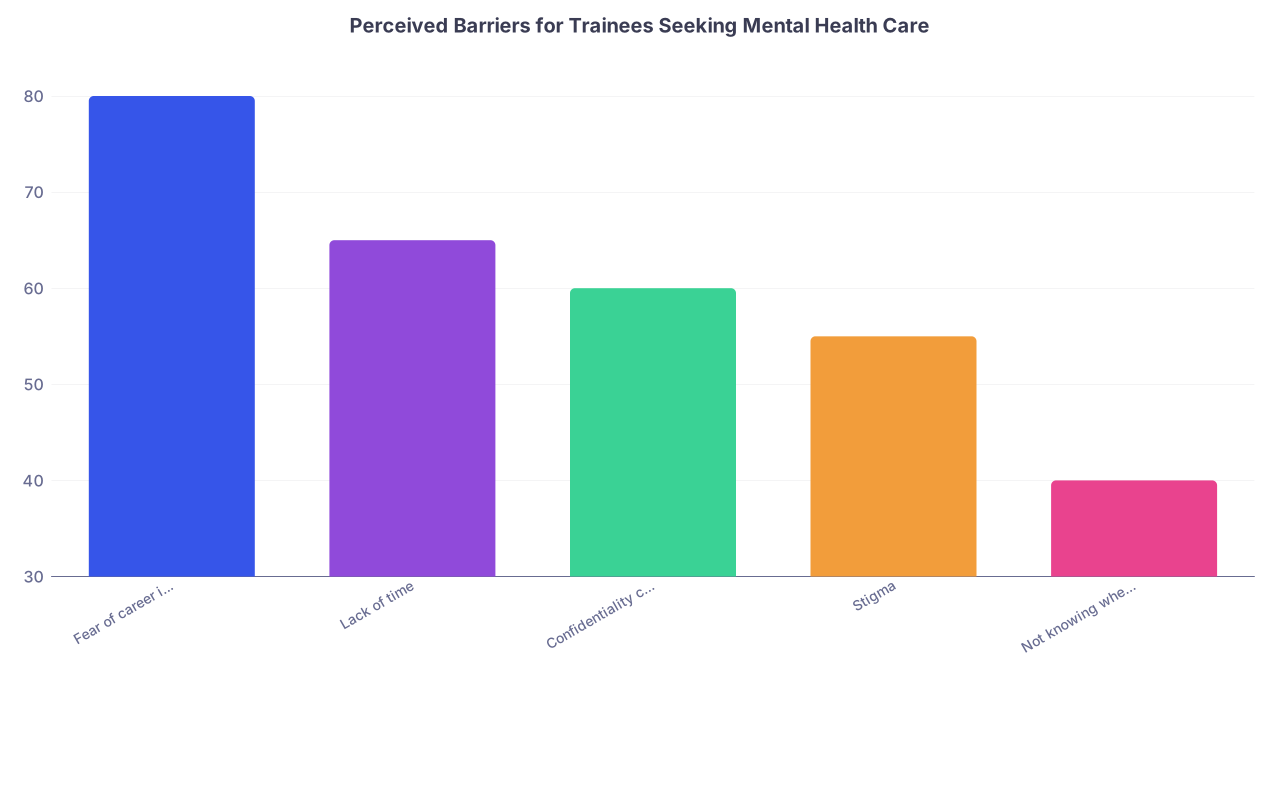
| Category | Value |
|---|---|
| Fear of career impact | 80 |
| Lack of time | 65 |
| Confidentiality concerns | 60 |
| Stigma | 55 |
| Not knowing where to go | 40 |
When You’re The Trainee: Protecting Yourself from Problematic Dual Roles
So far I have been speaking mostly from the faculty angle. But many readers are trainees. You have your own duties here.
Red flags that your clinician–teacher boundary is off:
- Your supervisor offers to “just be your doctor” for ongoing issues.
- A faculty member who will be writing your evaluation starts prescribing long‑term medications or wants to “do some therapy” with you.
- A PD or senior clinician pressures you to keep your care “in house” for convenience or “team cohesion.”
- You feel you cannot switch doctors because it will anger or disadvantage someone in power over you.
You are allowed to say:
- “I appreciate the offer, but I prefer to keep my care separate from my evaluations.”
- “I would be more comfortable seeing someone who is not involved in my supervision or grading.”
- “Can you point me to an independent provider or wellness service?”
If that is not respected, you are looking at a structural problem, not a personal weakness. That is when you loop in:
- GME office.
- Student affairs / dean’s office.
- Institutional ombudsperson or equivalent.
- A confidential external advisor (physician health program, for example).
Your health care should not be a currency in the educational system. If it starts feeling that way, you have every right to push back.

Documentation, Transparency, and Protecting Yourself
Let me be blunt: one day, someone will question your decisions in a dual‑role scenario. Could be a trainee. Could be a department chair. Could be a lawyer.
You want a paper trail that shows three things:
- You recognized the dual‑role risk.
- You tried to avoid it or limit it.
- You followed or sought institutional guidance.
Concrete habits:
- Chart precisely why you are involved in the trainee’s care (e.g., “on‑call attending, no alternative immediate coverage”), and how you transferred care when feasible.
- Email GME or your chair briefly when you end up in unavoidable dual‑role situations: “For awareness, last night I was the only on‑call attending and had to assess our resident X for acute issue Y; I arranged follow‑up with independent clinician Z today.”
- If you decline to take on a trainee as a patient, you do not need to document that in the EMR, but you can privately note the interaction in your own faculty log if you keep one, in case there are later complaints of “they refused to help me.”
None of this is about defensive medicine theatrics. It is about being able to show that your decisions were principled rather than ad hoc.
How to Talk About Dual Roles Without Making It Weird
One reason people slip into dual relationships is that they feel awkward saying no. So they mumble something vague and the trainee hears: “You are not important enough for my care” or “You are too problematic.”
You can do better.
Here is language that works:
- “Because I am also responsible for evaluating you, it would not be fair to you for me to also be your doctor. I want you to have someone who can purely focus on your care.”
- “We take boundaries seriously for trainees. We try very hard not to mix education and treatment roles. Let me help you find someone independent.”
- “In emergencies, I will of course treat you. For ongoing care, we will set you up with a clinician who is not involved in your training, so you can speak freely.”
This frames the boundary as a protection for them, which it is. You are not rejecting them. You are declining a conflict.
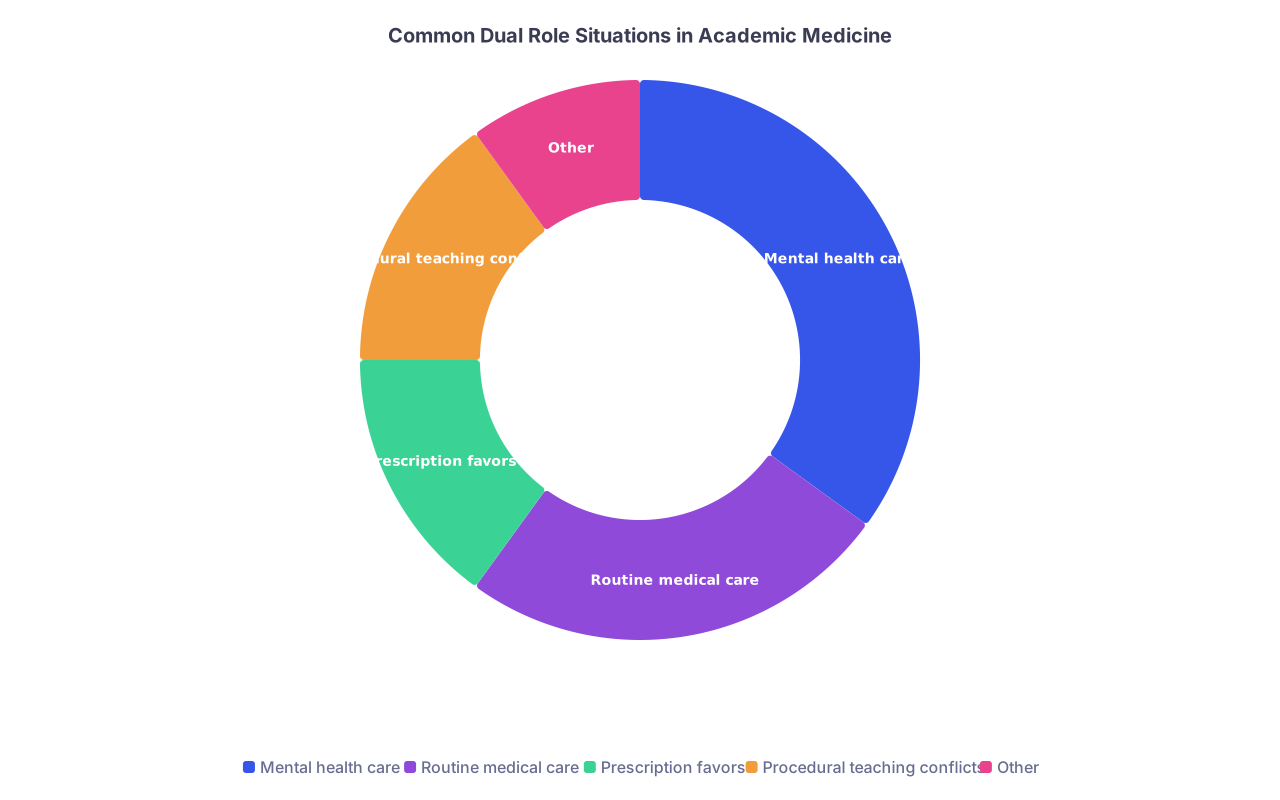
| Category | Value |
|---|---|
| Mental health care | 35 |
| Routine medical care | 25 |
| Prescription favors | 15 |
| Procedural teaching conflicts | 15 |
| Other | 10 |
The Bottom Line
Three points to walk away with:
Dual roles with trainees are structurally dangerous. Good intentions do not fix power imbalances or conflicts of interest. Separation of treatment and evaluation is the norm to aim for, not an optional luxury.
When you cannot avoid a dual role, keep it acute, limited, and clearly documented, then hand off to an independent clinician as soon as it is safe. Communicate boundaries explicitly; do not leave them implicit.
Institutions have a duty to create systems—separate care pathways, clear policies, ethics support—that make the right thing the easy thing. If yours does not, you will have to protect both your trainees and yourself by being the person who names and pushes on these issues.


