
It is July 7th. Your email signature now says “Attending Physician” or “Consultant.” Yesterday you were the fellow informally running things while someone else’s name sat on the line. Today, orders, notes, and complaints are coming under your name. The pager has not stopped once. A resident just asked, “So… what should we do?” and every eye turned to you.
This is the exact moment your ethics job description changes.
You are no longer “the strong fellow” arguing for your patient. You are the consultant whose recommendation can override, redirect, or quietly crush everyone else’s plan. Power shift. Liability shift. Moral responsibility shift.
Let’s walk this chronologically—from the last 3–6 months of fellowship into your first full year as consultant—and put the ethical challenges where they actually show up in time.
3–6 Months Before Fellowship Ends: Reframing Your Role Ethically
At this point you are still the fellow, but the identity shift has to start now. Otherwise July will hit like a truck.
1. Start asking, “What would I do if I were the attending?”
Every consult, every admission, every difficult family meeting:
- Do your usual assessment.
- Then add one explicit layer: “If I were the attending, would I:
- sign this?
- defend this plan at M&M?
- explain this to risk management?
- explain this to a grieving spouse?”
This is not theoretical. I have watched very strong fellows freeze in August because they never practiced “owning” decisions.
At this stage, you should:
- Review recent ethics and legal hot spots in your specialty:
- End-of-life decisions (ventilator withdrawal, DNR/DNI, ECMO stops).
- Capacity vs. competency in your usual patient population.
- Consent in gray zones (sedated, delirious, language gaps).
- Conflicts of interest (industry, referrals, internal politics).
- Error disclosure and near-misses.
- Ask your attending: “If something went really wrong in this case and it was on the front page tomorrow, what would you worry about ethically?”
You are not trying to become defensive. You are calibrating your ethical risk sensors.
2. Clarify what “consultant” actually means where you work
“Consultant” is not the same job everywhere.
- In some hospitals, you are purely advisory.
- In others, you are functionally co-primary.
- In many, you are held responsible for outcomes even when you technically “just recommended.”
Figure this out before you sign your first attending contract.
| Model | Who owns final decision? | Ethical tension focus |
|---|---|---|
| Pure advisory | Primary team | Respecting autonomy vs safety |
| Co-management | Shared | Role clarity, accountability |
| Full transfer | Consultant | Resource use, triage, futility |
Ask directly in your new group:
- “When medicine calls us, are we advisory or co-managing?”
- “If we recommend X and they refuse, does our group expect us to escalate?”
- “Who owns code status conversations in practice?”
If people give you vague answers, flag that. Vague structures create messy ethics.
1–2 Months Before You Start: Put Guardrails in Place
You are signing contracts, arranging housing, finishing your board prep. This is when you set some practical ethical scaffolding.
1. Know your policies cold
Not all policies, obviously. But the ones that drive consultant-level ethical decisions:
- Capacity determinations and surrogate decision-making.
- DNR/DNI, withdrawal of life-sustaining therapy.
- Use of restraints, involuntary holds (if relevant).
- Conflict of interest and industry interaction.
- Duty to report impaired colleagues or unsafe systems.
Print or bookmark the actual policy documents. Skimming a PDF once in orientation is not enough.
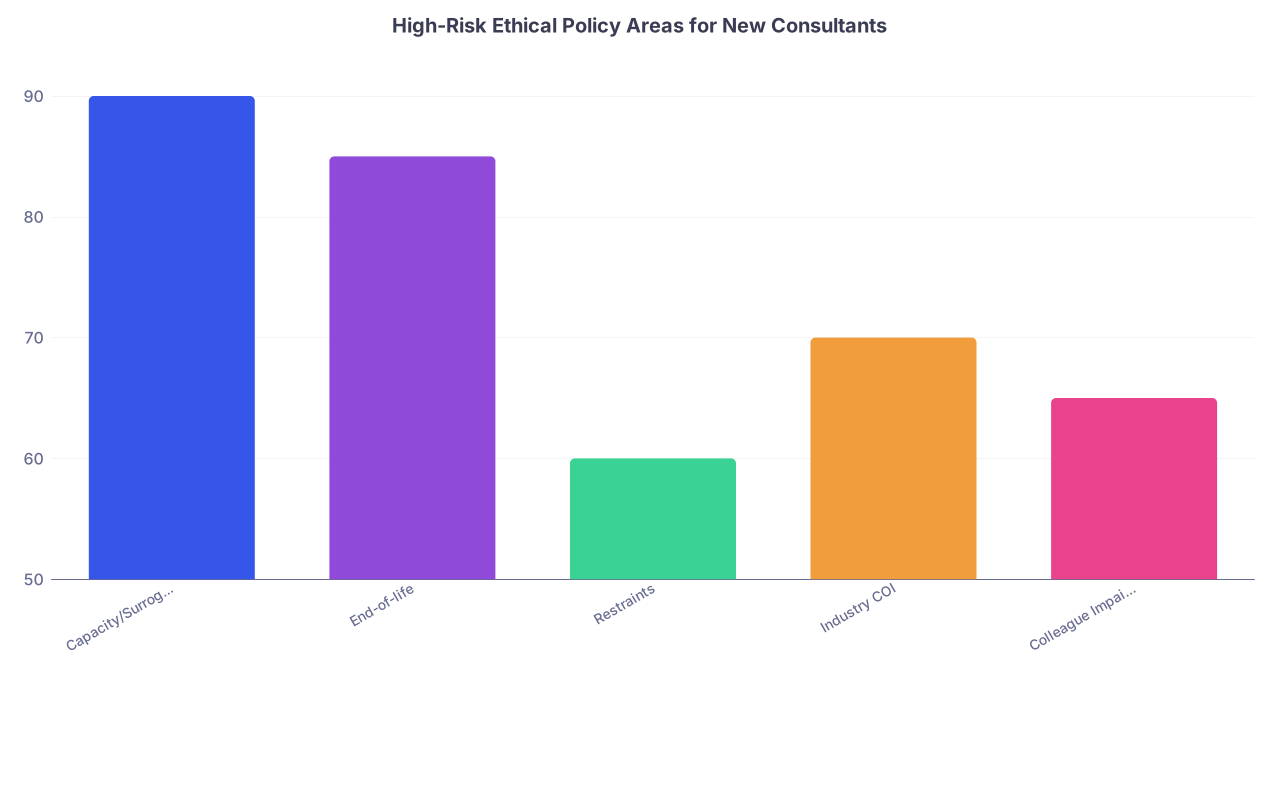
| Category | Value |
|---|---|
| Capacity/Surrogates | 90 |
| End-of-life | 85 |
| Restraints | 60 |
| Industry COI | 70 |
| Colleague Impairment | 65 |
(Values approximate “risk level” out of 100—capacity and end-of-life are where new attendings usually get burned.)
2. Line up your ethics “bat phone”
You will need help. Not often. But when you do, you need it now, not after digging through the intranet.
Before July 1, you should:
- Save ethics consult pager / on-call number.
- Identify at least one:
- hospital lawyer you have actually met
- senior attending known for solid judgment (not just big reputation)
- palliative care lead (if relevant to your field)
- Ask each: “If I am stuck on a real-time ethical decision at 2 am, is it appropriate to call you?”
You are building a small informal ethics advisory board. You will use it.
3. Set your own non-negotiables
Quietly, for yourself, decide:
- Under what circumstances will you:
- refuse to provide a requested intervention as consultant?
- override a trainee’s plan?
- escalate to department leadership?
- What conflicts of interest you will simply not accept:
- Industry dinners?
- “Informal” referral expectations?
- Pressure to admit to a particular service for financial reasons?
Write these down. Seriously. You will be tempted later to rationalize around them when you are tired, flattered, or scared.
First 2–4 Weeks as Consultant: Real-Time Ethical Shocks
Now it is live. Orders under your name. Plans with your signature. You will see the same scenarios as before, but the ethical stakes feel different.
1. Day 1–7: Power dynamics change overnight
Yesterday you were “the fellow we like.” Today you are “the consultant who said no.”
You will notice:
- Residents hedge more around you.
- Nurses test how responsive and fair you are.
- Other attendings (especially surgical or procedural colleagues) may push hard for what they want from your service.
At this point you should:
- Make your ethical stance explicit on rounds:
- “Our first duty is to the patient, not to throughput.”
- “We are not doing procedures that do not help the patient just because someone ordered them.”
- Signal to trainees that they can question you:
- “If you think I am missing something, I need you to say it out loud.”
Do not just say “My door is always open.” That is lazy. On your third or fourth day, ask a resident privately, “Did I shut you down at all this week? Be honest.” Then fix whatever they tell you.
2. Conflicts with primary teams
This is the classic early-attending ethics trap.
Scenario: You are the nephrology consultant. Primary team wants dialysis for a patient with metastatic cancer, multiorgan failure, and no realistic path to meaningful recovery. Family is conflicted. You do not believe dialysis helps this patient.
You now have to decide:
- Do you offer dialysis “because they asked”?
- Do you refuse and risk being labeled “difficult”?
- Do you negotiate a time-limited trial?
- How do you communicate all this to the family honestly, without throwing the primary team under the bus?
The ethical structure here:
- Your direct obligation is to the patient.
- You also owe some loyalty and respect to colleagues.
- You cannot mislead the family to keep the peace.
At this point you should:
- Use direct but neutral language in your note:
- “In my judgment, dialysis is unlikely to change outcome or improve quality of life and may cause harm. I do not recommend initiating dialysis.”
- Say to the primary attending (not just the resident): “I am concerned this is non-beneficial. Can we talk together with the family?”
- Offer a structured compromise only if it fits your conscience:
- “If family feels strongly after we explain the prognosis clearly, I would consider a 48-hour time-limited trial with clearly defined stopping criteria.”
If they push for “Just do it and write something softer,” ask yourself if you are willing to see your consult note read aloud in court. That tends to clarify things.
Weeks 3–8: Balancing Autonomy, Beneficence, and Reality
By now you know where the bathrooms are and who answers the phone. The ethical issues get more subtle.
1. Patient autonomy vs. consultant judgment
You will run into:
- Patients demanding interventions you know are low-value or harmful.
- Families insisting “everything” be done.
- Refusal of treatments in ways that scare other teams.
The big shift as consultant: you are the one certifying capacity and documenting risk–benefit analysis.
At this point you should:
- Standardize your own quick capacity check (even if psych is available):
- Can the patient state the decision?
- Do they understand the relevant information?
- Can they explain reasoning that is at least minimally coherent?
- Can they communicate a stable choice?
If they pass this, you are often ethically obliged to respect choices you think are bad. That is how autonomy works.
But you do not have to offer every possible option. Saying “no” to an inappropriate intervention is not violating autonomy. It is doing non-maleficence correctly.
2. Teaching ethics while you are still learning it
You now supervise people. They learn ethics from you, mostly by osmosis.
On rounds:
- Call out ethical problems explicitly:
- “Notice how his son keeps answering instead of him? That is a surrogate speaking over the patient. We should ask the patient directly.”
- “The cancer team and we disagree. We need a unified message before the family meeting, or we will confuse and hurt them.”
- Let trainees see you struggle:
- “I am not totally comfortable with this plan; here is why. I am going to run this by ethics, and I want you to see how that process works.”
If you pretend certainty you do not have, they will either copy your bravado or quietly stop trusting you.

Months 3–6: System-Level Ethics and Reputation
Now your name is showing up in clinic schedules, committee invites, maybe M&M slides. Your ethical behavior starts to create a reputation—good or bad.
1. Referral patterns and conflicts of interest
Classic scenarios:
- Pressure (sometimes implied, sometimes explicit) to:
- Keep procedures in-house.
- Refer to certain surgeons, interventionalists, or hospitals.
- Prioritize “big donors” or VIP patients.
- Industry reps wanting “educational” dinners, device choices, or co-authored “projects.”
At this point you should:
- Make your referral rule simple and public:
- “I refer to the person/service I believe is best for this patient’s problem. If there are equivalent options, I offer a choice and disclose relationships.”
- Decline anything that makes you squirm on first read:
- Consulting contracts without clear deliverables.
- “We just need your name on this paper.”
- “Can you present our device data at the conference? We will make the slides for you.”
If you think, “I can manage the conflict; I won’t be influenced,” you have already lost. Bias is not optional. It is automatic.
2. Resource stewardship and triage
You will now get calls like:
- “Can you see this consult? The patient is technically stable but could deteriorate.”
- “Can we get this study/procedure today? The family is anxious.”
- “We have one ICU bed left and two candidates.”
You are not only treating individual patients. You are managing a scarce resource.
At this point you should:
- Be transparent in your reasoning in the chart:
- “Given limited ICU beds and relative prognoses, ICU admission is prioritized for Patient A, who has potentially reversible illness and higher likelihood of meaningful recovery.”
- Avoid “VIP” drift:
- If you make exceptions for well-connected or loud families, you are quietly punishing the quiet, poor, or language-limited patients. That is not neutral. It is inequity.
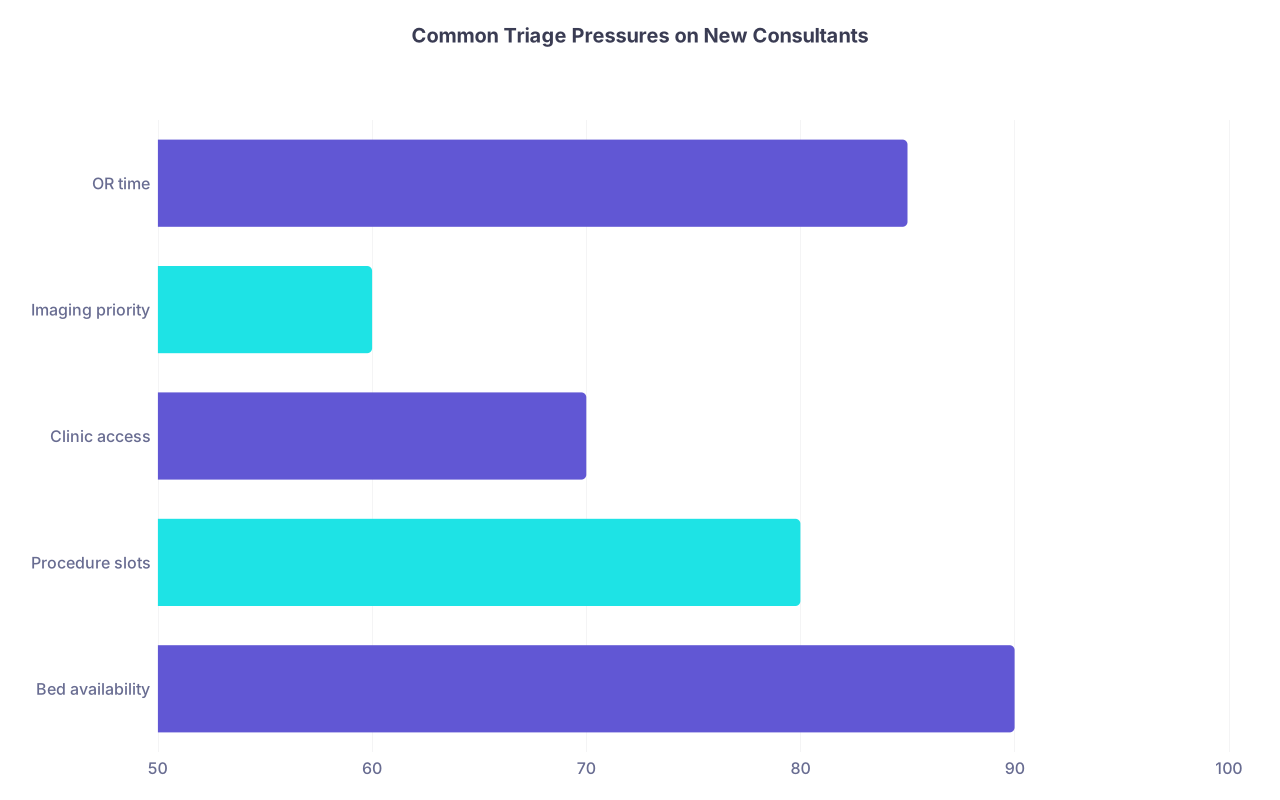
| Category | Value |
|---|---|
| Bed availability | 90 |
| Procedure slots | 80 |
| Clinic access | 70 |
| Imaging priority | 60 |
| OR time | 85 |
Again: imagine explaining your decision patterns to a skeptical jury. If you are comfortable, you are probably on the right track.
3. Dealing with impaired or unsafe colleagues
This one hits every new consultant eventually. You see:
- An attending making consistently dangerous decisions.
- A fellow or resident behaving erratically, maybe impaired.
- A nurse or tech cutting corners that actually risk patients.
You now have a legal and ethical duty to act. Silence is complicity. That is not dramatic language. It is reality.
At this point you should:
- Document facts, not conclusions, in your private notes and in the EMR (if relevant):
- “Dose of X was ordered at 10x standard. Order corrected after discussion.”
- Use reporting channels:
- Speak with your section chief or program director.
- Use confidential reporting if your system has it.
- Protect patients first, then relationships:
- If you have to choose, you choose the patient. Every time.

Months 6–12: Consolidating an Ethical Identity
By the middle of year one, the panic has softened. You are no longer constantly thinking “I am the attending now.” You just are. This is when people really start to know what you stand for.
1. Audit yourself
Once or twice in that first year, sit down for an hour and review:
- 3–5 cases that still bother you.
- 3–5 cases you are proud of.
- Notes from family meetings where you felt tension.
- Any complaints, patient relations emails, or “feedback” you received.
Ask:
- Did I let convenience or politics drive decisions anywhere?
- Did I mislead a patient or family by omission because it felt easier?
- Did I ever speak differently in the room vs. in the chart?
If you keep feeling sick about a specific case, consider bringing it to:
- M&M (if appropriate).
- Ethics committee.
- A trusted senior mentor for a debrief.
You are not looking for absolution. You are tuning your moral compass.
2. Formalize your teaching and leadership
By now you should be intentionally teaching ethical reasoning, not just reacting.
Ways to do this:
- Pick one case a week on rounds and frame it as an ethics mini-lesson:
- “Today, our focus is surrogate decision-making. Watch how I handle the discussion with the daughter.”
- Volunteer once a year to present a case at:
- Ethics committee.
- Division conference.
- Resident noon talk—“Ethics for new interns in [your specialty].”
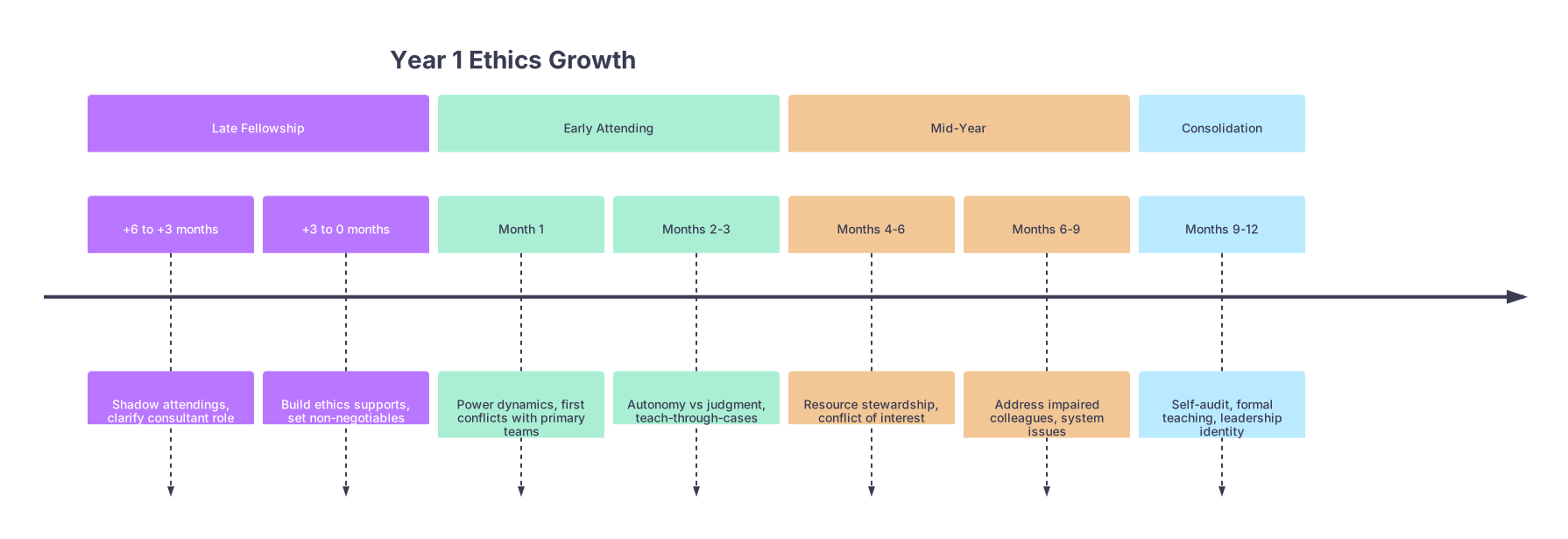
| Period | Event |
|---|---|
| Late Fellowship - +6 to +3 months | Shadow attendings, clarify consultant role |
| Late Fellowship - +3 to 0 months | Build ethics supports, set non-negotiables |
| Early Attending - Month 1 | Power dynamics, first conflicts with primary teams |
| Early Attending - Months 2-3 | Autonomy vs judgment, teach-through-cases |
| Mid-Year - Months 4-6 | Resource stewardship, conflict of interest |
| Mid-Year - Months 6-9 | Address impaired colleagues, system issues |
| Consolidation - Months 9-12 | Self-audit, formal teaching, leadership identity |
Quick Reference: “At This Point You Should…” Checklist
| Time Point | At this point you should… |
|---|---|
| 3–6 months pre-end | Practice “I am the attending” decisions, map consultant role |
| 1–2 months pre-start | Know key policies, build your ethics support network |
| Weeks 1–2 as consultant | Name your ethical priorities out loud to teams, invite pushback |
| Weeks 3–8 | Handle conflicts with primary teams, standardize capacity checks |
| Months 3–6 | Set firm boundaries on referrals and conflicts of interest |
| Months 6–12 | Self-audit troubling cases, start formal ethics teaching |

FAQ (Exactly 2 Questions)
1. What do I do if the primary team and family want an intervention I believe is non-beneficial or harmful?
State your recommendation clearly in the chart: that you do not recommend the intervention and why (prognosis, expected harms, lack of benefit). Then speak directly with the primary attending and offer to meet the family together. In that meeting, be honest about prognosis and your assessment. If, after a clear, honest conversation, the family still insists and the primary team supports proceeding, decide whether a tightly time-limited trial with explicit stopping rules is something you can ethically accept. If not, it is reasonable to decline to perform the intervention and, if needed, involve ethics consultation or your division leadership. Do not provide care you believe is clearly harmful just to avoid interpersonal conflict.
2. How do I handle situations where I suspect a colleague is impaired or consistently unsafe but I fear retaliation or being labeled “difficult”?
Document specific, objective concerns (dates, actions, outcomes) in a secure, appropriate place. Then use formal channels: speak with your division chief, program director, or equivalent, focusing strictly on patient safety and observed behavior, not character judgments. Many institutions also have confidential reporting systems. Your duty is to the patients first; failing to act when you see a pattern of unsafe behavior is itself an ethical breach. If you fear serious retaliation, consult with your hospital’s physician wellness or ombudsperson service or with risk management before acting, but do not let fear paralyze you indefinitely.
Key points:
- Your ethical responsibilities change abruptly when your name becomes the consultant of record; prepare before that day.
- In conflict—between teams, families, or systems—you answer to the patient first, and your chart should reflect that.
- Over the first year, intentionally build an ethical identity and teach it; if you do not, the system will give you one by default, and you may not like it.