

The malpractice risk gap between specialties is not a minor difference. It is an order-of-magnitude problem that shapes how ethical tension is experienced in daily practice.
The Data Reality: Malpractice Is Not Evenly Distributed
The data show a brutally simple pattern: a small cluster of specialties absorb a disproportionate share of malpractice claims, payouts, and career-long litigation exposure.
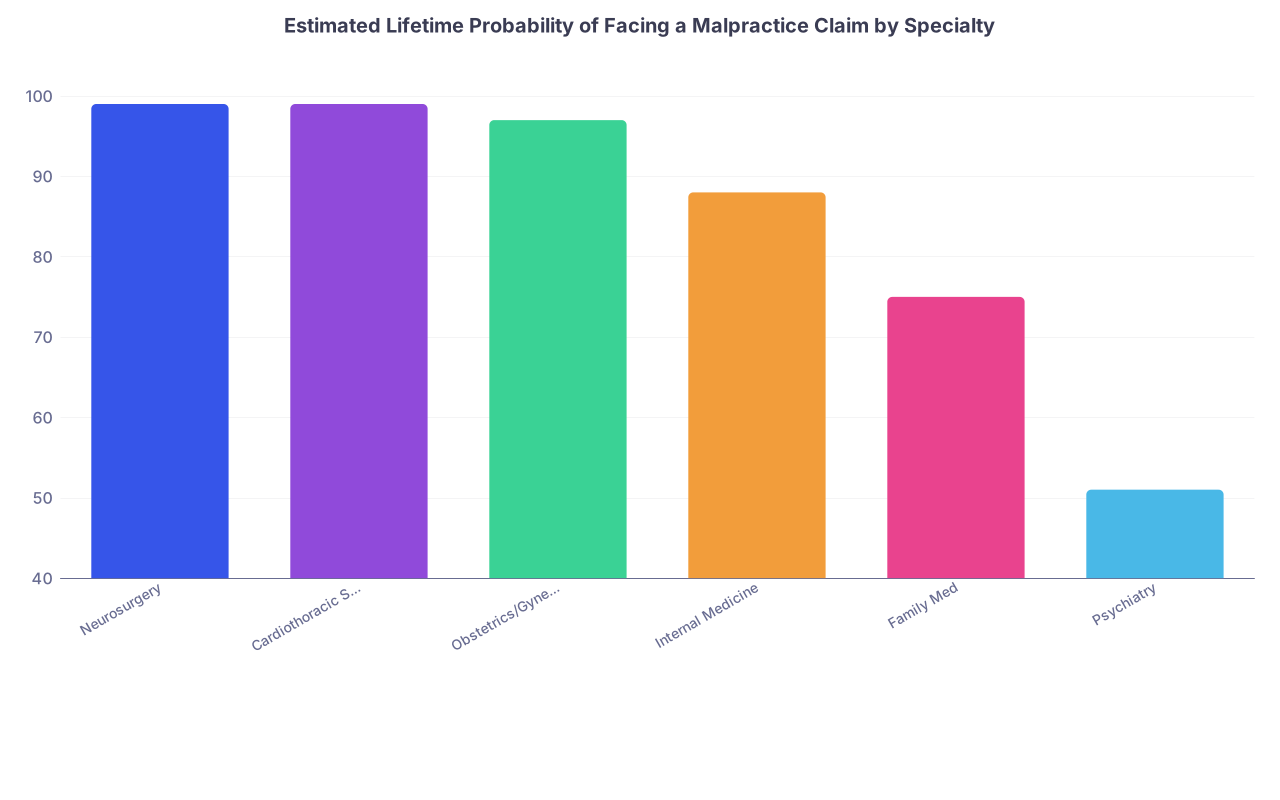
Take one of the most-cited datasets in this space: the New England Journal of Medicine study by Jena et al. (2011), which looked at physician malpractice risk over a career. Summarizing: the probability that a physician will face at least one claim by age 65 is very high, but the distribution is skewed.
| Category | Value |
|---|---|
| Neurosurgery | 99 |
| Cardiothoracic Surgery | 99 |
| Obstetrics/Gynecology | 97 |
| Internal Medicine | 88 |
| Family Med | 75 |
| Psychiatry | 51 |
If you are in neurosurgery, cardiothoracic surgery, or obstetrics/gynecology, you are essentially guaranteed—99 percent level—to face a malpractice claim over a career. Psychiatry sits near 50 percent. The ethical environment is simply not the same.
Now layer in payouts.
Closed-claims databases (e.g., Physician Insurers Association of America; National Practitioner Data Bank summaries) repeatedly show:
- Highest frequency of claims: internal medicine, family medicine, OB/GYN, general surgery.
- Highest mean or median payout per paid claim: neurosurgery, OB/GYN, anesthesiology, some surgical subspecialties.
- Longest tail of catastrophic payouts: OB/neonatal brain injury, neurosurgery, high-risk anesthesia cases.
To make that concrete, here is a simplified comparative view using representative ranges from aggregated insurer and NPDB reports (numbers rounded to keep focus on scale, not false precision):
| Specialty | Relative Claim Frequency | Relative Average Payout | Relative Lifetime Claim Risk |
|---|---|---|---|
| Neurosurgery | Medium–High | Very High | Very High (~99%) |
| OB/GYN | High | Very High | Very High (~97%) |
| General Surgery | High | High | High |
| Internal Medicine | Very High | Medium | High (~88%) |
| Family Medicine | High | Medium–Low | Moderate–High (~75%) |
| Psychiatry | Low | Low–Medium | Moderate (~50%) |
The ethical tension is not just “more lawsuits.” It is where law, probability, and the psychology of risk management lock together.
Where Claim Rates and Ethical Pressure Converge
Ethical tension spikes where three curves intersect:
- High malpractice claim frequency.
- High clinical uncertainty or unavoidable risk.
- High emotional or financial stakes for patients and families.
Several specialties repeatedly sit at that intersection.
Obstetrics / Gynecology: The Epicenter of Ethical Pressure
The numbers are relentless. OB/GYN is perennially at or near the top in:
- Lifetime probability of any claim.
- Share of claims involving catastrophic, lifelong injury (especially neonatal hypoxic injury).
- Large, headline-making payouts.
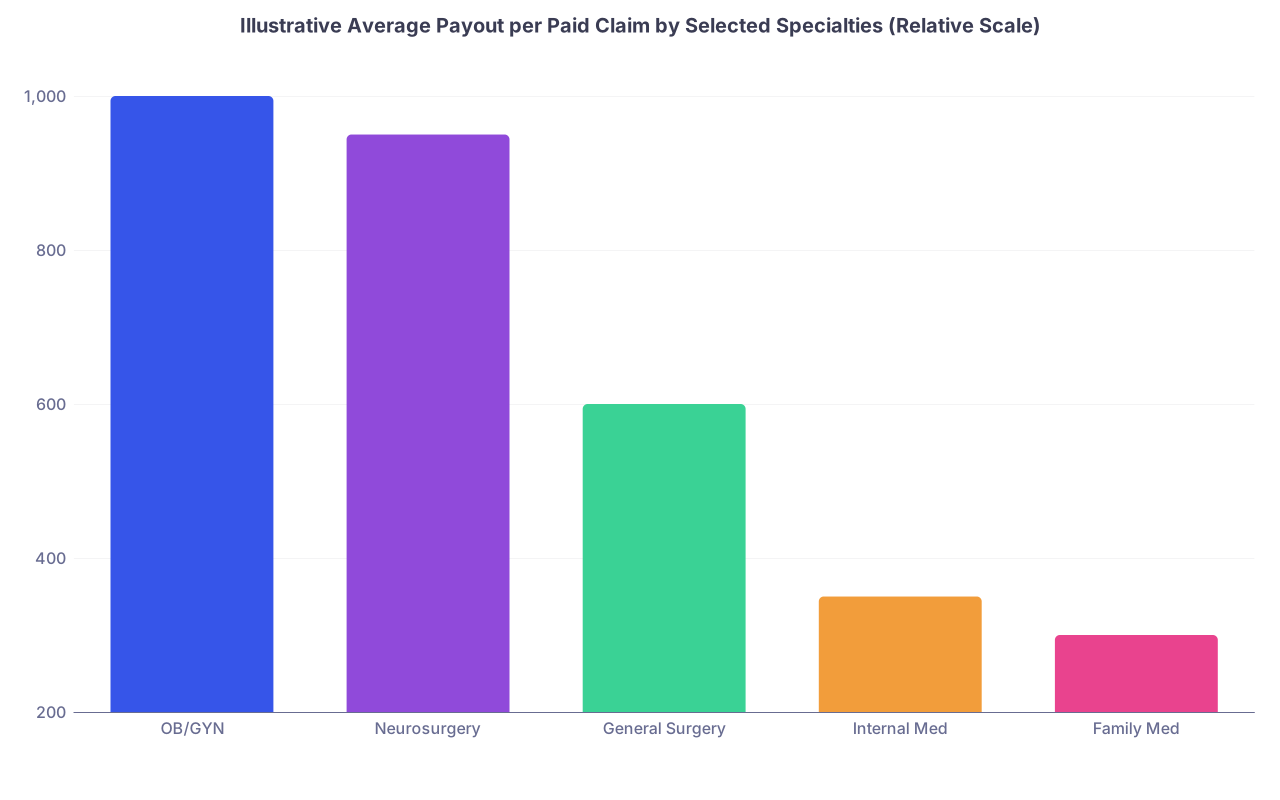
In some datasets, obstetrics accounts for a disproportionate fraction of indemnity dollars relative to its share of total claims, because a single birth-injury case can run into multi-million-dollar settlements.
| Category | Value |
|---|---|
| OB/GYN | 1000 |
| Neurosurgery | 950 |
| General Surgery | 600 |
| Internal Med | 350 |
| Family Med | 300 |
(Here, “1000” is a normalized index, not dollars. OB/GYN and neurosurgery sit at top scale.)
Ethically, what does that translate to at the bedside?
- Lower threshold for cesarean deliveries to avoid any suggestion of “delayed intervention.”
- Heavy reliance on defensive documentation about fetal monitoring, informed consent, and counseling.
- Constant awareness that minutes in decision-making can become the core of a legal narrative years later.
I have heard OB attendings say to residents, without drama: “Every baby you deliver is a future deposition risk. Chart like the parents will read it in court.”
That sentence is an ethical tension in a nutshell. You are balancing patient autonomy and shared decision-making with the very real pressure to choose whatever path is easiest to defend legally, not necessarily what is best for that specific patient in front of you.
Neurosurgery and High-Risk Surgical Fields: Catastrophe at Baseline
Neurosurgery’s malpractice profile is driven not by sheer claim count, but by severity. When things go wrong, they go very wrong—death, permanent paralysis, severe neurologic deficit. Those are exactly the outcomes that tend to generate lawsuits, especially when families struggle to separate inevitable risk from alleged error.
The quantitative pattern:
- Lifetime claim risk ~99 percent.
- Very high mean payout per paid claim.
- Large fraction of claims involve alleged “failure to timely diagnose,” “surgical error,” or “improper performance of procedure.”
Ethical tension here is not mainly “do I order more tests to protect myself?” It is:
- How do I convey risk that is truly unavoidable without understating or catastrophizing?
- How do I decide when to operate on a borderline case, knowing either path—operate vs. observe—can generate a lawsuit if the outcome is bad?
You see more aggressive informed consent practices in these fields: specific, enumerated risks; repeated documentation of discussions; sometimes second opinions specifically to reduce downstream allegations of hasty decision-making. Some of this is good medicine. Some of it is mainly legal positioning.
Again, tension.
Internal Medicine and Family Medicine: High Volume, Diffuse Risk
Now switch to internal medicine and family medicine. They do not have the same payout profile as neurosurgery or OB, but they dominate total claim counts in many datasets simply because they see so many patients, across long relationships, with complex chronic diseases.
The typical internal medicine malpractice pattern:
- High lifetime risk of any claim.
- Many claims involve:
- Missed or delayed diagnoses (cancer, MI, stroke, PE).
- Medication errors or adverse drug events.
- Failure to follow-up labs or imaging.
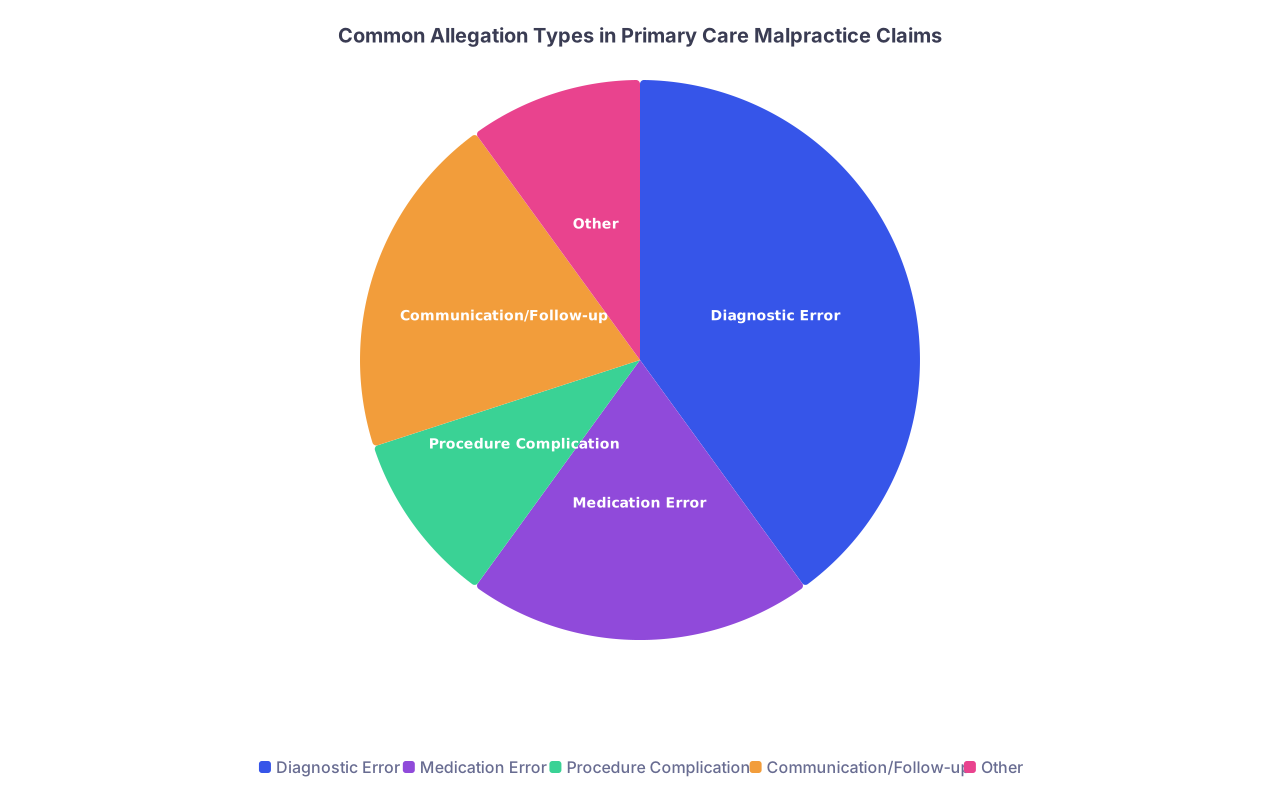
The data repeatedly show that “failure to diagnose or delay in diagnosis” is among the top allegation categories in primary care.
| Category | Value |
|---|---|
| Diagnostic Error | 40 |
| Medication Error | 20 |
| Procedure Complication | 10 |
| Communication/Follow-up | 20 |
| Other | 10 |
Ethically, this becomes a constant low-level background noise:
- Do I order another test or imaging study “just in case,” or do I trust my clinical judgment and spare the patient cost, radiation, and anxiety?
- How aggressively do I chase follow-up on a patient who is clearly non-adherent or disengaged?
The malpractice environment nudges behavior toward:
- More broad-spectrum testing.
- More referrals to specialists to shift responsibility.
- More templated notes that highlight “patient declined” and “risks discussed at length.”
Primary care is ground zero for classic defensive medicine. You can watch it grow as residents see their first near-miss stories or hear about massive verdicts tied to delayed diagnoses.
Psychiatry: Lower Claims, Higher Stigma Risk
Psychiatry typically sits at the low end for claim frequency and payout size. Yet the ethical tension is not trivial. The high-stakes failure modes are different:
- Suicide after recent discharge or contact.
- Violence toward others from a patient you evaluated.
- Medication-related adverse effects (e.g., tardive dyskinesia, metabolic syndrome) framed as negligence.
The data show fewer lawsuits, but when they occur, they often hinge on documentation of risk assessment, safety planning, and follow-up—areas where subjectivity is inherent.
Psychiatrists face a different ethical pull: the fear of being blamed for outcomes that were probabilistic and only partially controllable. That fear can push toward risk-averse decisions: more involuntary holds, more hospitalization, more aggressive pharmacologic treatment. All ethically loaded choices.
How Malpractice Data Drive Defensive Medicine
You cannot talk about ethical tension without talking about defensive medicine, because the two feed each other.
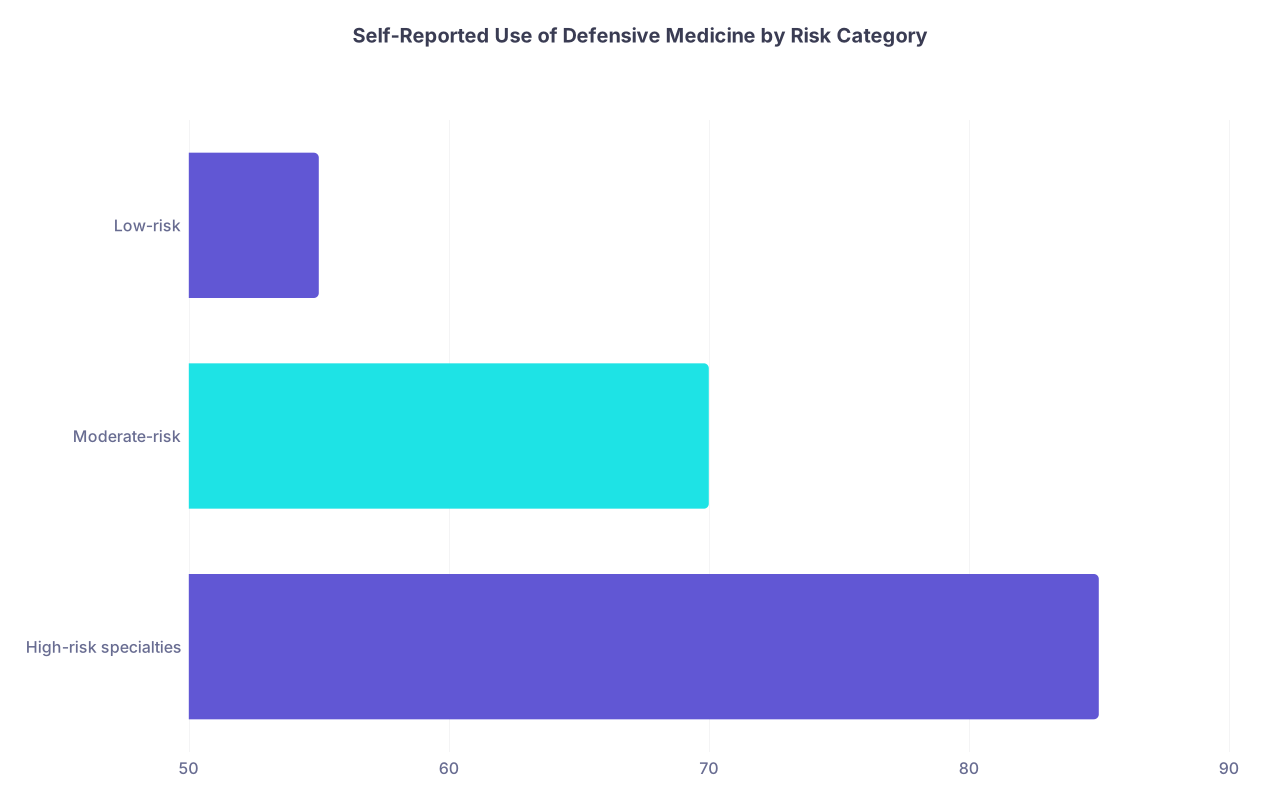
Defensive medicine is not a slogan. It is a measurable behavior. Survey-based estimates (e.g., Studdert et al., NEJM, 2005; Mello and colleagues in various policy analyses) repeatedly show:
- 75–90 percent of physicians in high-risk specialties report practicing some form of defensive medicine.
- Common defensive behaviors:
- Ordering tests of low clinical yield but high legal protection value.
- Making specialist referrals not because they are medically necessary, but because they share or shift potential blame.
- Avoiding certain procedures or high-risk patients entirely.
| Category | Value |
|---|---|
| High-risk specialties | 85 |
| Moderate-risk | 70 |
| Low-risk | 55 |
This is where ethics comes into sharp focus.
The four pillars—beneficence, nonmaleficence, autonomy, justice—do not contain “protect one’s own legal exposure” as a core duty. Yet in actual practice, physicians quietly add that as an implicit fifth pillar. Because the data say: ignore it and your career, finances, and mental health are at risk.
So you end up with specific ethical distortions:
- Beneficence vs. legal self-protection: Extra imaging for a low-risk headache. It protects you if the 0.1 percent aneurysm is missed, but it adds cost and incidental findings to 99.9 percent of patients.
- Autonomy vs. documentation: “Informed consent” conversations that are more about crafting a defensible chart than an honest, tailored exchange. Pages of boilerplate, little genuine dialogue.
- Justice vs. resource use: System-level overuse of high-cost testing driven by malpractice fears, reducing resources for patients who would truly benefit—an ethical problem at population scale.
The data do not just describe malpractice. They’re helping create it.
High-Risk Arenas of Ethical Tension by Case Type
It is not only about which specialty you choose. It is also about what types of cases within that specialty carry the heaviest load of legal and ethical pressure.
You see consistent clusters:
Time-sensitive emergencies:
- Chest pain/ACS
- Stroke/TIA
- Sepsis
- Ectopic pregnancy
- Fetal distress in labor
Allegations: delayed diagnosis, failure to act, failure to escalate.
Elective high-risk procedures:
- Spinal surgery
- Complex neurosurgery
- Bariatric surgery
- Cosmetic/plastic surgery
Allegations: inadequate informed consent, improper selection, technical error.
Long-horizon diseases:
- Cancer diagnoses in primary care
- Progressive neurologic diseases
- Chronic kidney disease
Allegations: failure to follow-up, misinterpretation of results, lack of screening.
If you look at malpractice databases and sort by allegation category, “failure or delay in diagnosis” typically occupies the top slot or close to it. That diagnostic uncertainty is precisely where ethical tension is highest: patients want certainty; science offers probabilities; the law judges retrospectively with the illusion of inevitability.
Specialty Choice: Reading the Risk Before You Commit
I am going to be blunt: ignoring malpractice data when you choose a specialty is naïve. You are choosing not just a clinical lifestyle, but an ethical and legal environment that will shape your daily mindset for decades.
A simplified comparison helps:
| Specialty | Claim Frequency | Payout Severity | Defensive Pressure | Ethical Tension Pattern |
|---|---|---|---|---|
| OB/GYN | Very High | Very High | Very High | Birth outcomes, C-section thresholds |
| Neurosurgery | High | Very High | Very High | Catastrophic risk, consent, indications |
| General Surgery | High | High | High | Procedure selection, complications |
| EM | High | Medium–High | Very High | Missed emergencies, low info decisions |
| Internal Med | Very High | Medium | High | Cancer, MI, stroke misses, follow-up |
| Family Med | High | Medium–Low | High | Broad scope, resource constraints |
| Psychiatry | Low | Low–Medium | Moderate | Suicide/violence risk, capacity decisions |
| Radiology | Medium–High | Medium | High | Missed findings on imaging |
Different specialties produce different flavors of ethical stress:
- OB/GYN: moment-to-moment decisions with future courtroom narratives in mind.
- Neurosurgery: consent and indication decisions where “do nothing” is often just as risky as “do something.”
- EM: massively time-constrained triage and workup decisions, often on incomplete data, later dissected with microscopic scrutiny.
- Internal medicine/family medicine: the ethics of uncertainty and follow-up in a sea of chronic disease, documentation, and patient adherence problems.
- Radiology/pathology: the ethics of perception and pattern recognition; workloads and fatigue that create fertile ground for error.
You should not pick a specialty solely to minimize lawsuits. That would be cowardly and intellectually dishonest. But pretending the numbers do not matter is equally irresponsible.
Using Data to Build Better Ethical Habits
Here is the part that actually helps you grow, not just scare you.
The data can be mined to generate specific, actionable ethical habits. Not vague “be thorough” platitudes. Concrete adaptations.
Focus where the claims cluster.
If 40 percent of claims in your area are diagnostic errors, your educational and ethical energy should match that proportion. Practice structured diagnostic reasoning. Use checklists. Cultivate explicit “diagnostic timeouts” for high-risk presentations.Treat documentation as an ethical tool, not just legal armor.
The chart will be read by future clinicians and maybe future jurors. Write for both. That means:- Clear reasoning: what you considered, why you chose a path, why you did not do certain things.
- Real consent notes: what the patient said, what their values were, not just “risks/benefits/alternatives discussed.”
Use claim data for simulation.
Many residency programs underutilize malpractice case data. They should be building simulations from past claims:- Take actual cases (de-identified).
- Recreate them in simulation labs or case conferences.
- Ask: at what point could a reasonable clinician have altered the trajectory ethically and clinically?
Recognize that over-testing and under-testing are both ethical failures.
Claims data rarely capture the harm from unnecessary tests; they overwhelmingly capture harm from misses. That is a blind spot. Ethically, you have to hold both in view. Build explicit personal heuristics: what number-needed-to-test are you comfortable with for a given condition and context?Confront your own risk tolerance.
Two physicians with the same data will make different calls because their risk tolerances differ. That is unavoidable. The ethical misstep is to be unaware of your own baseline and how fear of litigation is skewing it.
System-Level Reforms: Aligning Law and Ethics (Very Briefly)
You will hear constant talk about caps on non-economic damages, safe-harbor guidelines, health courts, and alternative dispute resolution. The evidence is mixed. Some reforms reduce claim frequency or payout volatility, but they do not erase the gap between what is legally safe and what is ethically right.
The more promising thread is this: using evidence-based clinical guidelines as legal safe harbors. If followed and documented, they create a presumption of non-negligence. That pushes behavior toward evidence-based practice rather than pure legal paranoia.
We are not there yet in most jurisdictions, but that is the direction with the best chance of aligning the malpractice system with real-world ethical practice.
Final Takeaways
Three points, without sugarcoating:
Malpractice risk is intensely specialty-dependent, and the data are clear: OB/GYN, neurosurgery, high-risk surgery, and emergency medicine live in the highest ethical pressure zones, with internal and family medicine carrying a heavy but different burden centered on diagnostic uncertainty.
Defensive medicine is a rational response to skewed legal incentives, but unchecked it distorts ethical practice—shifting decisions from patient-centered benefit to provider-centered risk control. You need to see that distortion in real time.
The smartest way to prepare is not to fear lawsuits abstractly but to study claim patterns in your chosen field, then deliberately build habits—diagnostic discipline, rigorous documentation, honest consent conversations—that are both ethically sound and empirically targeted to where things most often go wrong.


