

Last winter, I watched an attending make three laps around the ICU pod before finally walking past the door of a patient who had been intubated for two weeks, multi-organ failure, family in the waiting room. He glanced at the chart, checked a vent setting that did not need checking, then said to the resident: “We’ll talk to them tomorrow. Let’s give it another day.”
You will see this again and again. Not just from bad doctors. From very good ones. And if you’re not careful, you’ll become one of them.
Let me tell you the real reason some attendings avoid goals-of-care conversations. It’s not what they teach in ethics lectures. It’s what they say behind closed doors, what they mutter to each other in the workroom after you leave, and what they feel in their gut at 2 a.m. when they’re too tired to pretend otherwise.
What Everyone Pretends Is the Problem (And What Actually Is)
The official story sounds noble and tidy:
“Families aren’t ready.”
“The patient needs more time.”
“We don’t want to take away hope.”
“We’re waiting for more information.”
I’ve heard all of that in morbidity and mortality conferences, ethics committee meetings, on rounds with the palliative team. It’s not that those statements are completely false. They’re just incomplete. They’re the surface-level, chart-friendly version.
Underneath, here’s what’s really driving avoidance:
- Fear. Of being blamed. Of being seen as “giving up.” Of being the one who says out loud what everyone knows and no one wants to own.
- Discomfort with death. Yes, even in critical care, even in oncology, even in surgery.
- Time pressure and system incentives that make talking honestly about dying feel like a luxury.
- Identity. Many attendings have built their entire professional ego around fixing, not reframing, not redefining success.
Let me walk you through how this actually plays out in real hospitals—not CME slides, but the messier truth.
The Emotional Backstory Attendings Won’t Admit to You

People imagine attendings as emotionally bulletproof. They’re not. They’re just better at hiding the cracks.
I’ve watched a seasoned intensivist step out of a room after a failed resuscitation, close the door quietly, lean against the wall, and whisper, “I can’t do another family meeting tonight.” Then go dictate, order labs, adjust pressors—anything but sit with another family to talk about the obvious trajectory.
Here’s the emotional reality no one writes in the chart:
1. Death Feels Like Personal Failure
Some specialties are especially bad at this. Interventional cardiology. CT surgery. Neurocritical care. The culture you’re training in whispers (or screams): survival = good doctor, death = failure.
So when an attending sits down to have a goals-of-care conversation, they’re not only telling the family:
“We’re running out of treatments.”
They’re also admitting to themselves:
“I couldn’t fix this.”
Most of them would rather do another procedure than sit in that feeling for 45 minutes.
I’ve heard it said verbatim in a surgical workroom:
“I’d rather take them back to the OR again than have another hour-long conversation with that family.”
No one challenged him. Everyone understood.
2. They Are Carrying a Cemetery in Their Heads
You’re early in your career. You remember a few big cases. They remember hundreds, maybe thousands.
Every time they look at a patient circling the drain, their brain pulls up a reel of all the similar cases that ended badly. The patient who died the morning after agreeing to “one more surgery.” The family who accused them of “killing him” after a DNR discussion. The son who screamed in the hallway: “You never said it was this bad!”
Those encounters leave scars. So what looks to you like hesitation is sometimes a deeply conditioned reflex: keep it technical, keep it future-focused, don’t walk back into that emotional minefield unless you absolutely have to.
3. They’re Afraid of the Conversation Going Off the Rails
Behind closed doors, I’ve heard this more than anything else:
“It’s going to turn into a three-hour argument.”
“They’re going to demand we ‘do everything’ and file a complaint if we don’t.”
“They’re going to say we gave up because of his age/race/disability.”
Attendings have been burned. Once you’ve been yelled at by a family for “killing” their loved one, or pulled into a risk management meeting, you start to avoid any conversation that could even remotely go that way. It’s self-protection, not just laziness.
Ethics committees see this delay pattern constantly. Not because the physicians don’t know what’s right. Because they don’t want to re-live prior conflicts.
The System Is Quietly Rewarding Avoidance
Let’s be blunt: the hospital does not pay for good goals-of-care conversations. It pays for procedures, consults, and days in the ICU.
You feel the system on the ward but you may not realize how it shapes what attendings actually do, especially with the sickest patients.
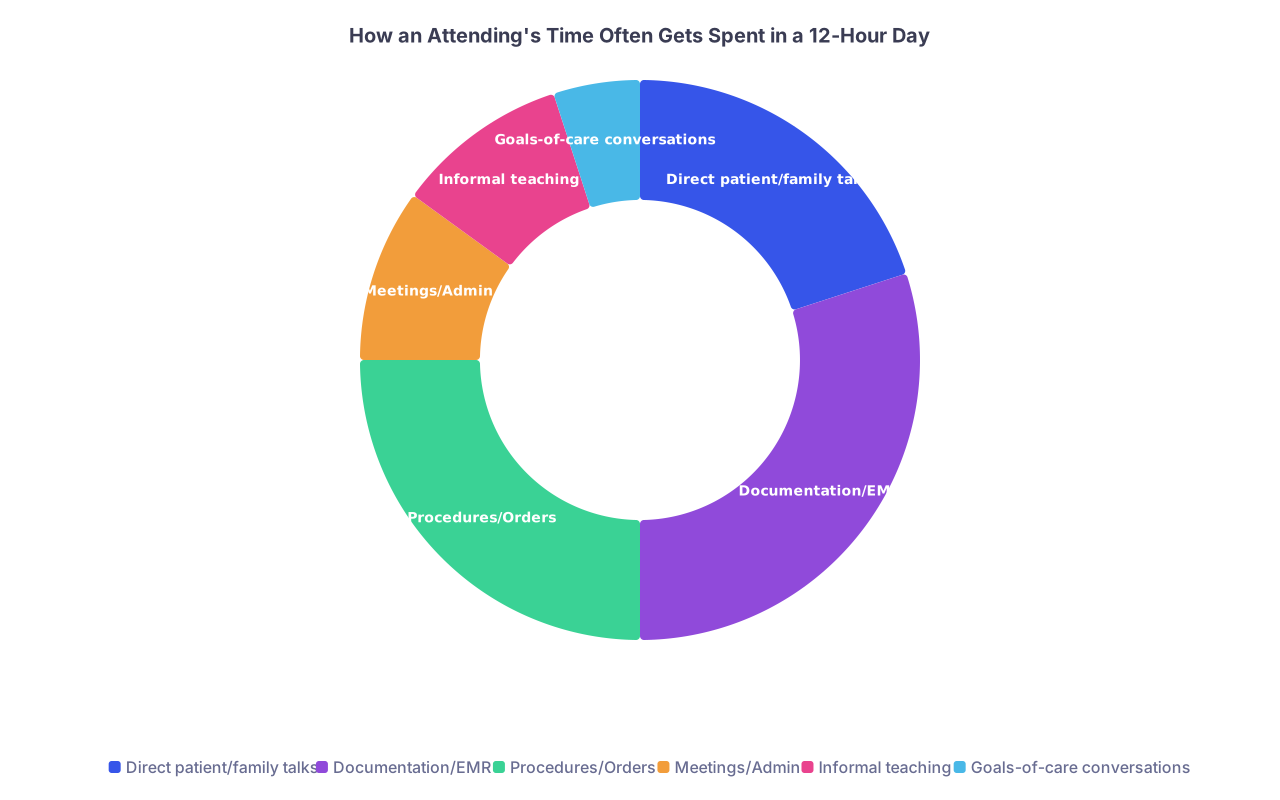
| Category | Value |
|---|---|
| Direct patient/family talks | 120 |
| Documentation/EMR | 180 |
| Procedures/Orders | 150 |
| Meetings/Admin | 60 |
| Informal teaching | 60 |
| Goals-of-care conversations | 30 |
Look at that last slice. In reality, many attendings spend less than 30 minutes a day on explicit goals-of-care talks, even on ICU-heavy rotations. They’ll spend three times that clicking through order sets.
Why?
- RVUs: Conversations don’t generate nearly as much revenue as a procedure or bronchoscopy.
- Metrics: Nobody pulls your data on “quality of end-of-life conversations.” They pull your length of stay, readmissions, and mortality.
- Schedule pressure: A thoughtful, unhurried goals-of-care talk requires time you don’t really have when you’re covering 18 patients, two new admissions, and three sign-outs.
The unspoken reality: the system gently nudges attendings toward doing more, not talking differently.
So when you hear, “Let’s give it another day and see,” what’s often baked into that is:
“I don’t have an hour right now to walk this family from ‘doing everything’ to accepting comfort-focused care.”
And yes, that’s ethically fraught. But it’s very real.
The Legal and Complaint Shadow No One Talks About on Rounds
This is the MEDICAL ETHICS LAW category, so let’s talk law and risk the way attendings actually experience it.
Not theoretical malpractice. The real-world fear: complaints, investigations, and being painted as the doctor who “pushed” a family into withdrawing care.
I’ve sat in risk management debriefs where the message—unsaid but obvious—was:
“Document more. Use softer language. Avoid saying ‘no’ explicitly.”
So attendings start avoiding phrases like:
“He is dying.”
“She will not recover meaningful function.”
“This ICU care is now prolonging the dying process, not life.”
Instead you get:
“She’s very sick.”
“We’re worried.”
“We’re at a crossroads.”
Vague. Non-committal. Legally safer. Ethically weaker.
Here’s the dirty little secret: some attendings avoid clear goals-of-care conversations because clarity creates accountability. If they say, “He is not going to survive this hospitalization,” and the family later claims they were “pressured” into a DNR, that clear prognostic statement gets dissected.
So they sidestep. They “warm the family up” endlessly but never land the plane.
Remember this paradox:
From an ethics standpoint, clarity and honesty are the gold standard.
From a risk standpoint, ambiguity and “we’ll see” often feel safer.
The best attendings fight that gravitational pull toward vagueness. Many do not.
Identity, Ego, and the Myth of the Hero Doctor

I’ve watched surgeons look at CT scans that scream “unsurvivable,” and still tell the team, “We need to take him back.” Sometimes it’s appropriate. Sometimes it’s denial wrapped in heroism.
A lot of attendings built their entire self-concept around being the one who can pull patients back from the brink. They were rewarded for it. They were praised for “aggressive care.” Their cases got talked about in conferences. Their names spread.
Now imagine being that doctor and walking into a room to say:
“No more surgeries. No more interventions. Now we focus on comfort.”
That is not just a medical pivot. That’s an identity crisis.
I’ve heard versions of this in surgical lounges at big-name places:
- “I didn’t go through all this training to watch people die.”
- “If there’s something left to try, I’m obligated to try it.”
- “It’s not my job to take away hope.”
Underneath all that rhetoric is one thing: ego, fused with a distorted sense of duty.
It’s easier to keep offering treatments than to acknowledge that, for this specific patient, more treatment is harm. It’s easier to keep “fighting” than to ask, “For whom are we doing this now?”
And once that pattern gets baked in, those attendings avoid any conversation that threatens their hero role. They punt it to palliative. They say, “Let’s have the palliative team help with the family,” which is often code for: “Let them be the ones to say what I don’t want to say.”
The Skill Gap No One Admits: Many Attendings Are Bad at These Conversations
Let’s be blunt again. A terrifying number of attendings are simply not good at goals-of-care conversations. Not because they’re stupid, but because:
- They were never properly trained.
- They’ve survived by winging it.
- No one gives them honest feedback.
Medical training still treats communication like something you pick up “along the way.” You get SP encounters in pre-clinical years, then it’s all about notes, orders, and exam questions. By the time you’re a fellow, the system assumes you know how to sit with a family and walk them from denial to understanding to acceptance.
Many do not.
I’ve watched attendings:
- Start a “goals-of-care” meeting by explaining creatinine trends.
- Tell a family “things are guarded” when the patient is actively dying.
- Drop “there’s nothing more we can do” like a grenade, then leave the room.
It’s not that they don’t know the buzzwords. They’ve all been to a workshop or two. But under pressure, people revert to habit. To jargon, to vagueness, to escape.
And here’s the twist: because they’re attendings, no one corrects them. Residents see it, feel that it’s off, and assume, “I guess that’s how it’s done here.” The cycle repeats.
What You’re Up Against as a Trainee
| Pressure Source | How It Shows Up |
|---|---|
| Time/RVUs | Rushing or postponing talks, favoring procedures |
| Risk/Legal | Vague language, over-documentation, reluctance to recommend limits |
| Culture | “Fight” language, stigma around palliative involvement |
| Emotion | Avoidance, irritability during family talks |
| Identity/Ego | Over-treatment, resistance to comfort-only care |
You’re in a tough spot. You see the suffering. You read the ethics. You sense when care has crossed into torture. But you’re also watching the people who control your evaluations dodge these conversations.
Here’s the pattern I’ve seen in residents and students:
- PGY-1: Shocked at how long “full code everything” is continued.
- PGY-2: Starts speaking up timidly, suggesting palliative involvement.
- PGY-3+: Learns which attendings will support that—and which will punish it.
- Senior: Starts to internalize the attendings’ habits, rationalizing them as “real world medicine.”
By the time they become attendings, many have muted the very instincts that made them uncomfortable as interns.
You do not have to follow that arc.
How Good Attendings Actually Handle Goals-of-Care (When You See It Done Right)
I want to be clear: not all attendings avoid these conversations. Some are exceptionally good at them. They’re just quieter. No one puts them on billboards.
When you see one in action, watch closely. Because that’s what you want to steal.
They do a few things differently:
They’re explicit without being brutal.
They say things like: “Given everything we’re seeing, I do not expect him to leave the hospital alive.” Not, “We’re worried.” Not, “Things are serious.” A clear sentence that orients everyone in the room.They recommend, they don’t just present options.
They don’t say, “We can do X, Y, or Z.” They say, “Given his condition and what we know about his values, I recommend we focus on comfort and allow a natural death.” Ethically and legally, this is stronger. It’s also harder. Many attendings duck this by hiding behind, “It’s up to you.”They treat the conversation as a clinical intervention.
Not as an afterthought wedged between notes. They clear time. They sit down. They prepare. They see it as part of good care, not a distraction from it.They absorb some of the blame—on purpose.
When families say, “We don’t want to give up,” they answer, “I’m not asking you to give up. I’m telling you that my treatments are no longer helping. That’s on me, not you.”
That’s what a real attending does. They carry the moral weight with the family, not hand it all to them.
When you see that, do not assume it’s natural talent. It’s practice, and it’s a choice.
What You Can Do Now Without Getting Crushed
You’re not the attending. You can’t unilaterally change plans. But you’re not powerless either.
Here’s the behind-the-scenes playbook that actually works without setting yourself on fire:
Narrate the trajectory in plain language on rounds.
Say: “Over the last week, he’s required increasing pressors, more oxygen, and has had worsening kidney function despite everything we’re doing.” You’re not making a recommendation. You’re forcing everyone to confront the pattern. Many attendings will respond to that opening by acknowledging, “Yes, we’re moving toward end-stage here.”Ask timing questions, not value judgments.
Instead of “Should we talk to the family about hospice?”, try: “When do you usually bring families into these discussions in a course like this?” You’re less threatening, more curious. That keeps the defensive walls lower.Offer to do the groundwork.
A lot of avoidance is time/energy. Say: “If you’d like, I can sit with the family to understand what they know already and what matters most to the patient before we all talk together.” Some attendings will seize that. It lowers their barrier.Use the chart strategically.
Document clearly when patients or families express values: “Patient states, ‘I would never want to live on machines if I can’t talk or recognize my family.’” That gives any later attending something to lean on when making recommendations.Study the attendings who are good at this—and align with them.
Ask to join their family meetings. Watch their language. Steal phrases that feel authentic to you. This is how you quietly build a skillset most of your peers won’t have.
The Ethical Line You’re Going to Have to Draw for Yourself
Let me be very clear: there will be days when you participate in care that you believe is inappropriate, maybe even cruel. Ventilators on patients who will never wake up. Chest compressions on a body with no chance of meaningful recovery. Dialysis on a dying cancer patient because “the family isn’t ready.”
You will feel complicit. Because you are, in a way. That’s part of the moral injury of modern medicine.
The bad attendings become numb. The good ones never fully do, but they also don’t let the guilt paralyze them. They work the problem from the inside: better conversations, earlier, clearer; advocating when it counts; refusing to lie to families even when everyone else wants to sugarcoat.
Your job now is not to fix the entire system. It’s to decide what kind of physician you’re going to be in it.
You won’t win every battle. Some attendings will keep dodging these talks. Some families will insist on “doing everything” until the last heartbeat. You’ll lose sleep over cases where you think, “We kept going two weeks too long.”
But if you understand the real reasons attendings avoid goals-of-care conversations—fear, ego, time, risk, skill gaps—you stop idealizing them, and you stop demonizing them. You see the forces you’ll inherit.
And then you can make a different choice.
Years from now, you won’t remember every ICU day or every cross-cover night. But you will remember the faces of the families you sat with and told the truth, even when your attending wanted to push it off till tomorrow. That’s the part of this work that actually stays with you—and the part that quietly changes who you become.


