

What to Do When You Disagree with Your Attending’s Care Plan
You are post-call, sitting in a cramped workroom. The night was ugly but manageable. You prerounded, checked the labs twice, and you are pretty sure your septic patient needs to stay on broad-spectrum antibiotics.
On rounds, your attending says: “They look better. Let’s narrow to ceftriaxone and stop the vanc.”
Your stomach drops. The blood cultures are still pending. The patient is borderline hypotensive. You do not think this is safe.
And now you are stuck between two bad options:
- Keep your mouth shut and feel complicit.
- Speak up and risk looking incompetent, insubordinate, or both.
This is the situation this article is about.
Disagreeing with an attending’s care plan is not a rare edge case. It happens all the time if you are paying attention. The difference between unsafe care and solid, ethical practice is not whether there is disagreement. It is what you do when there is disagreement.
Let me walk you through how to handle this like a professional instead of either a doormat or a bomb-thrower.
Step 1: Slow Down and Check Your Facts
Your first task is not to “win” or “prove you’re right.” It is to verify that you are not missing something obvious.
Run a quick internal triage:
Clarify the clinical question in your own head
What exactly do you disagree with?- The diagnosis?
- The choice of medication?
- The dose?
- The timing of a procedure?
- The decision to not do something (no CT scan, no consult, no antibiotics)?
Put it in one sentence in your mind:
“I think stopping X / not doing Y / delaying Z is unsafe because…”Re-check the objective data
Before you open your mouth, look again:- Vitals trends (not just single-point values)
- Labs and imaging
- Culture data and sensitivities
- Active medications and dosages
- Allergies, renal/hepatic function
- Code status and documented goals of care
Ask: what might the attending know that I do not?
Examples:- They saw a prior echo that shows end-stage disease.
- They know the family clearly wants comfort-focused care.
- They are balancing a risk you have not fully appreciated (e.g., bleed risk vs. clot risk).
- They are following a guideline or protocol you have not read.
You are not doing this to talk yourself out of your concern. You are doing it so that if you do speak, you sound like someone who has actually thought about the whole patient, not just a lab value.
Step 2: Use a Structured, Non-Confrontational Script
If you want to be taken seriously, stop relying on vague “I’m worried” and start using a predictable structure. I like a modified advocacy–inquiry approach.
Here is the core structure:
- State what you see (objective data).
- State what you think (your interpretation).
- State what you are worried about (the potential harm).
- Ask a direct clarifying question (invite their reasoning).
In plain language, it looks like this:
“Dr. Smith, the patient is still on norepi at 0.08, their lactate is trending up from 2.1 to 3.4, and cultures are still pending. I am concerned that narrowing from vanc/zosyn to ceftriaxone alone might miss MRSA or resistant gram negatives, and that they could decompensate. Can you walk me through your reasoning for narrowing now?”
Notice what you are not saying:
- “I think that’s wrong.”
- “I would not do that.”
- “Guidelines say we should not…”
You are making it easy for the attending to:
- Correct a misunderstanding.
- Share additional data.
- Reconsider their plan without losing face.
If you find yourself anxious or emotional, lean on this structure. It keeps you grounded and keeps the conversation clinical, not personal.
Step 3: Differentiate Between “I Would Do It Differently” and “This Is Unsafe”
This is where a lot of trainees mess up. Not every disagreement is an ethical problem. Some are just style differences.
Ask yourself two blunt questions:
Is this within a reasonable standard of care?
- There is more than one acceptable antibiotic regimen for community-acquired pneumonia.
- There are multiple valid transfusion thresholds depending on context.
- Some attendings like to “treat through” mild AKI, others are more conservative.
If their plan is within standard practice, you can still ask questions and learn, but you do not escalate it as an ethical issue. You file it under: “Different style, still safe.”
Or is this potentially harmful / outside reasonable practice?
Red flags:- Clearly ignoring guidelines without patient-specific justification.
- Withholding indicated treatment for personal convenience (e.g., “I do not want to call GI at night.”)
- Disregarding serious symptoms: chest pain, neuro deficits, sepsis signs, suicidal ideation.
- Making major decisions without considering the patient’s goals of care.
When you are in the second category, your obligations change. You are now in patient safety and ethics territory, not just academic disagreement.
Step 4: Know Your Ethical and Legal Duties
You are not a passive observer. Ethically and legally, you do have responsibilities, even as a student or PGY-1.
Four anchors you should have in your head
Patient’s best interest comes first
Yes, hierarchy matters in training. But it does not outrank patient safety. Every code of ethics in medicine, nursing, and allied fields says the same thing: your primary duty is to the patient.You are part of the care team, not a bystander
You wrote notes. You entered orders. You saw the patient. That makes you part of this care episode. Claiming “I was just following orders” is a weak defense if there was gross negligence and you saw it.You must speak up about serious safety concerns
Every hospital with a functioning compliance department will tell you this out loud during orientation.- Many have “chain of command” policies.
- Many have anonymous reporting systems.
- Some have “stop the line” safety authority for anyone who sees imminent harm (borrowed from aviation and nuclear industry).
Good faith concerns are protected
In a lot of jurisdictions, whistleblower and patient safety laws give some protection if you raise concerns in good faith through proper channels. Does retaliation still happen? Yes. But you are far from powerless.
You are not expected to be perfect. You are expected to say something when you truly believe a patient is at risk.
Step 5: Apply Chain of Command – With Discipline
If the attending listens, explains their reasoning, and you are reassured, you are done.
If you are not reassured and the plan still seems unsafe, you move up the chain. That is not being “a problem resident.” That is you doing your job.
Here is the basic structure:

| Step | Description |
|---|---|
| Step 1 | You identify unsafe plan |
| Step 2 | Raise concern directly to attending |
| Step 3 | Document and learn |
| Step 4 | Discuss with senior resident or fellow |
| Step 5 | Escalate to service chief or program leadership |
| Step 6 | Use formal safety report or hotline |
| Step 7 | Document concern and follow up |
| Step 8 | Still unsafe? |
| Step 9 | Resolved? |
| Step 10 | Imminent harm? |
Practical chain of command (typical hospital)
| Level | Who You Go To |
|---|---|
| 1 | Senior resident / fellow |
| 2 | Attending (if not already involved) |
| 3 | Service chief / backup attending |
| 4 | Program director / chief resident |
| 5 | Hospital patient safety / risk management |
How to talk to your senior or fellow
You are not gossiping. You are consulting.
Example script:
“Hey, I want to run something by you. On Ms. Lopez in 410, she is still on norepi, lactate rising, cultures pending. Attending wants to narrow to ceftriaxone only. I raised my concern and asked about MRSA/ESBL coverage, but I am still worried this is unsafe. Can you help me think this through or talk with them?”
You are:
- Concrete.
- Non-accusatory.
- Focused on the patient, not “my attending is wrong.”
If your senior says, “No, this is fine,” and gives you a detailed rationale that actually makes sense — good. You just learned something.
If your senior says, “Yeah, this makes me uncomfortable too,” then you have an ally to escalate with.
Step 6: When It Is Time to Push Hard
There are rare but real situations where you stop being “polite” and start being very direct.
Patterns I have seen:
- Attending refuses to call a stat consult for stroke symptoms.
- Clear septic shock and attending wants to “see how they do overnight” with no escalation.
- Active suicidal ideation and someone tries to discharge because they are “manipulative.”
In those cases, your calculus changes. You are now in imminent harm territory.
What “pushing hard” looks like clinically
Use clear, unambiguous language about risk:
- “I am worried this could lead to cardiac arrest / brain injury / death.”
- “I believe this is below our standard of care.”
Request explicit clarification:
- “Can you document in the chart that you are aware of X and choosing Y? I want the reasoning to be clear in case the patient deteriorates.”
Activate higher-level systems:
- Call the rapid response team if criteria are met.
- Page the on-call ICU attending if the patient meets their triggers.
- Use the patient safety hotline if you truly cannot get anyone to respond.
Is this comfortable? No. It is career-risky? Sometimes.
But you did not sign up for this profession to watch preventable harm in silence.
Step 7: Document Smartly (Without Sabotaging Yourself)
You are not going to write “I disagreed strongly with the attending and think this will hurt the patient” in the chart. That is amateur hour and exposes you and others legally.
But you do document clinically relevant facts and your actions:
In the medical record (clinical, neutral):
- The patient’s condition and objective data.
- The plan as directed by the attending.
- That the attending was notified or aware of key findings, when relevant.
Example:
“Worsening hypotension (BP 86/52 from 102/64), MAP 58, rising lactate 3.4 (prior 2.1). Primary team attending notified at 09:15, will continue current antibiotic regimen per attending.”
You are not editorializing. You are creating a timeline.
Outside the chart (for your protection and learning):
- Keep a private, de-identified log of difficult cases for your own reflection and for discussion in supervision or with program leadership.
- When there is a serious concern, send a brief, factual email to yourself with date/time and what actions you took. This helps you reconstruct events accurately if asked later.
Incident / safety reports:
- If your institution encourages these (most do), use them when there is a near-miss or harm.
- Again: factual, not emotional. Dates, times, orders, responses.
You are not building a legal case. You are behaving like a clinician who understands that memory is sloppy and documentation matters.
Step 8: Use Ethics and Risk Resources Before Things Explode
If you are in a case that feels ethically messy, do not wait until it becomes a disaster.
Most hospitals have:
- Ethics consult service
- Risk management or legal
- Patient safety office
- Ombudsperson / GME office
These are not just for dramatic end-of-life disputes. They are absolutely appropriate for situations like:
- Attending ignoring a patient’s clearly documented DNR to “do everything anyway.”
- Pressuring a family into a decision by withholding key information.
- Refusing indicated pain control due to prejudice (“they are drug-seeking”).
- Ignoring a patient’s lack of capacity and taking “consent” at face value.
You can request a confidential discussion:
“I am a resident on X service. I have concerns that a care plan may not align with the patient’s goals and may expose them to harm. I want guidance on how to proceed.”
They will not fix everything. But they often give you language, options, and some backup.
Step 9: Protect Your Training Relationships Without Selling Out
You have two parallel problems:
- Keep the patient safe.
- Avoid lighting your career on fire.
The way you speak and act matters.
A few rules that keep you out of avoidable trouble
Never blindside an attending in front of a crowd
Do not turn rounds into a courtroom. If the disagreement is major, ask to step aside:- “Can we discuss this at the workroom for a moment?”
- “I have some concerns I would like to run by you after we finish the list.”
Always frame it as “help me understand” first
Yes, sometimes you actually are missing something. And even if you are right, showing that you tried to understand the reasoning first makes you look thoughtful, not combative.Avoid language that attacks competence or motives
Bad:- “You are ignoring sepsis guidelines.”
- “You do not care about this patient.”
Better:
- “I am worried our plan does not address X.”
- “I am having trouble reconciling this plan with guideline Y, given this patient’s condition.”
If you escalate, own that decision
Do not be sneaky. If you go to the service chief or program director, be ready to say:- “I tried raising this directly with Dr. Smith. I remain concerned about harm to the patient and felt obligated to involve you.”
Use supervision spaces to process, not to vent aimlessly
With your program director or mentor, talk about patterns:- “I am consistently in situations where I feel pressure to go against what I believe is safe. How should I handle this?”
This is where you work on strategy, not just emotional release.
Step 10: Learn the Law and Policy Basics (Just Enough to Be Dangerous)
I am not telling you to get a JD. But you should understand a few concepts that affect you directly:
Standard of care vs. perfection
“Standard of care” is not “the best care possible.” It is what a reasonable, competent clinician would do in similar circumstances. Two different plans can both meet the standard.
Your red line for escalation should be:
- Care that clearly falls below that standard.
- Or care that is so risky without justification that harm is foreseeable.
Duty to report unsafe behavior
Many states and boards expect physicians to report colleagues whose impairment or incompetence threatens patient safety. That usually applies more to gross failures (drunk surgeon, falsified labs), but the principle is there: looking away forever is not an option.
Institutional policies matter
Know where these live:
- Chain of command policy
- Code of conduct
- Patient safety / near-miss reporting policy
- GME grievance or concern reporting system
Those documents are dry. They are also your shield when someone accuses you of “going around me.” You can say:
“I followed the hospital’s chain-of-command policy for patient safety concerns.”
A Simple Mental Checklist You Can Use Tomorrow
When you disagree with an attending’s plan, run this:
- Am I clear on what exactly I disagree with?
- Have I double-checked the data and context?
- Is this style difference or potential harm?
- Can I clearly state what I see, think, and fear?
- Have I raised it directly, respectfully, and concretely?
- If still unsafe, who is the next person in the chain of command?
- Is this imminent harm (do I need to push hard / use safety systems)?
- Have I documented key facts and my actions, neutrally?
Print that in your head. Use it instead of freezing.
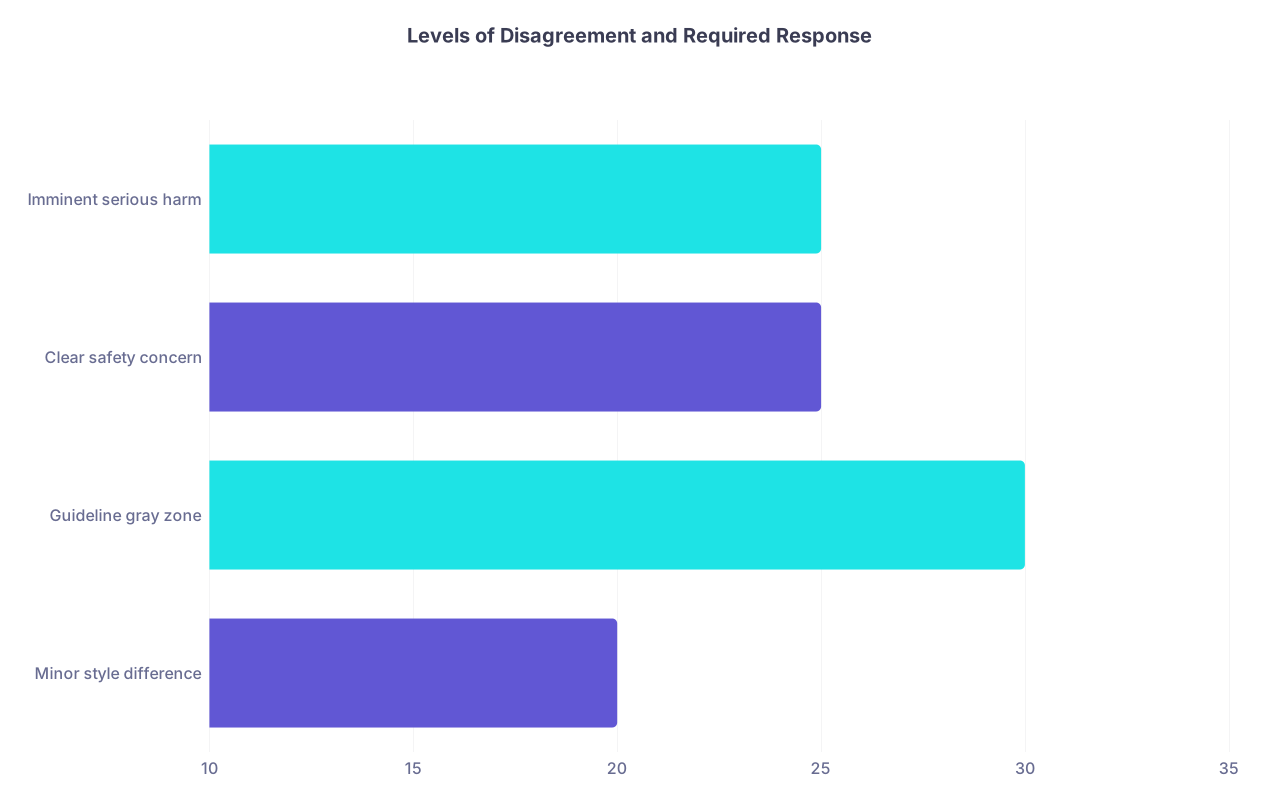
| Category | Value |
|---|---|
| Minor style difference | 20 |
| Guideline gray zone | 30 |
| Clear safety concern | 25 |
| Imminent serious harm | 25 |
Final Thoughts – What Actually Matters
Three points and we are done.
Your job is not to be agreeable. Your job is to be safe.
Polite silence in the face of unsafe care is not professionalism. It is cowardice dressed up as “respect for hierarchy.”Use structure, not emotion.
The person who has the clearest data, a calm script, and follows chain of command wins in the long run. Not the loudest voice. Not the fanciest title.This is part of growing up as a clinician.
If you never disagree with an attending, you are either not paying attention or you have stopped thinking. The goal is not to avoid conflict. The goal is to handle conflict in a way that protects the patient and lets you walk out of the hospital with your ethics intact.


