
Last winter, after a code that did not end well, a third-year resident sat in a silent workroom staring at her note. She’d documented exactly what happened, timestamps and all. Twenty minutes later, her attending opened the chart—and systematically rewrote major portions of what she’d just written. Nobody explained why. She just walked away feeling like something unethical, maybe even illegal, had just happened.
Let me tell you what actually goes on in those moments—because nobody will spell this out for you in orientation.
What’s Really Going On When Your Attending Rewrites Your Note
You think documentation is about “telling the truth.” Your attending thinks documentation is about “creating the official legal and clinical record.”
Those are not the same thing.
After a bad outcome—code death, missed diagnosis, unexpected transfer to ICU—attendings flip into risk‑management mode. Some do it consciously. Others have been conditioned over years of morbidity & mortality conferences, malpractice depositions, and quiet hallway conversations with risk management.
Here’s the tension they’re managing in their head when they open your note after a bad outcome:
- What actually happened (messy, imperfect, sometimes embarrassing)
- What’s already in the chart (orders, vitals, nursing notes, flowsheets)
- What a plaintiff attorney will see and weaponize in 2–5 years
- What hospital risk management expects to see
- What will get ripped apart at M&M
- What will make them look reckless vs. reasonable
You, as a trainee, are not writing with that background. You’re writing from the middle of the adrenaline crash. Which means your note is often:
- Emotionally colored
- Chronologically confused
- Overly self‑incriminating
- Filled with speculation and “we screwed up” language
So the attending rewrites it. Not always well. Not always ethically. But rarely randomly.
The Five Real Reasons Your Note Gets “Adjusted”
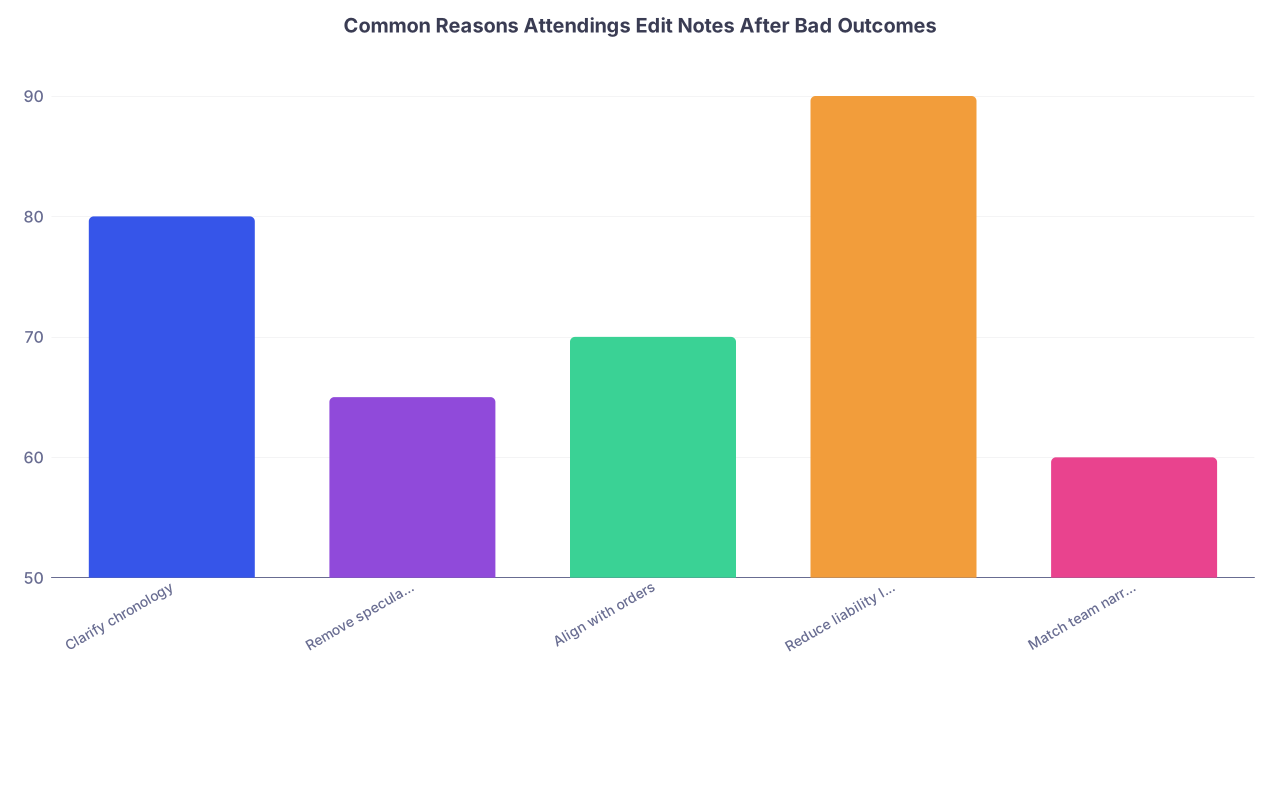
| Category | Value |
|---|---|
| Clarify chronology | 80 |
| Remove speculation | 65 |
| Align with orders | 70 |
| Reduce liability language | 90 |
| Match team narrative | 60 |
Let’s break down what’s actually driving that rewrite. I’ve seen all of these from the attending side, the resident side, and the “sitting in risk management’s office reviewing charts before a lawsuit” side.
1. Chronology is a legal weapon, not just a story
Timestamps are everything in a bad outcome. When was the first abnormal vital? When was it recognized? When was someone called? When was action taken?
Residents often write things like:
- “Patient decompensated this afternoon…”
- “We were notified of hypotension and responded quickly…”
- “Throughout the day, the patient became more tachycardic…”
That’s useless, and worse than useless in court. An attorney will line up:
- Nursing vitals
- Monitor trends
- Paging/call logs
- Medication administration times
- Rapid response/code blue timestamps
…and ask, “Doctor, your note says you responded quickly. The record shows a 52-minute gap between the first hypotensive reading and your documented evaluation. Were you lying then or are you lying now?”
So the attending rewrites:
- “At 14:32, RN notified team of BP 78/45 and HR 132. I evaluated patient at bedside at approximately 14:45…”
They’re not just being picky. They’re closing a future cross‑examination loop.
2. Emotional and judgmental language will destroy you later
Residents after a bad outcome write things like:
- “I missed the earlier signs of sepsis.”
- “We failed to escalate care in a timely fashion.”
- “This was likely preventable.”
- “There was a significant delay in intervention.”
Morally honest? Yes. Professionally suicidal in documentation? Also yes.
Your attending has either:
- Sat in a deposition where a plaintiff attorney read those lines back in a slow, theatrical voice, or
- Been warned, in explicit detail, by hospital counsel about what phrases spell trouble
So they change your note to:
- “Earlier exam did not demonstrate clear evidence of sepsis.”
- “Care was escalated when clinical status objectively worsened.”
- “In retrospect, earlier intervention might have altered the course, though this is uncertain.”
See the difference? Same story. Very different liability profile.
3. They’re aligning the note with the rest of the chart
Your note doesn’t exist in isolation. It has to line up with:
- Nursing narratives
- Cross‑cover notes
- Consultant notes
- Orders and labs
- Flowsheets and vitals
- Procedure logs
If your note says, “no respiratory distress” and the nurse documented “labored breathing, RR 28, using accessory muscles” fifteen minutes later, that contradiction is going to be ripped apart.
I’ve seen attendings call nurses after reading those conflicts and basically negotiate a shared story: “What exactly did you see? How was the patient at my evaluation vs. your later assessment?” Then the attending rewrites the note to make the timeline more coherent.
Is that always purely descriptive? No. Sometimes it’s narrative construction. And yes, that’s a slippery slope.
4. They’re pre‑answering the M&M and RCA questions
Every bad outcome triggers some version of:
- Morbidity & Mortality conference
- Root Cause Analysis (RCA)
- Quality review committee
Those groups ask very predictable questions:
- When should we reasonably have recognized the deterioration?
- Were standard protocols followed?
- Was supervision appropriate?
- Was communication adequate?
Your attending is writing with those questions in mind. That’s why you see phrases like:
- “Case discussed with attending at multiple time points; plan agreed upon.”
- “Given reassuring exam and vitals at 10:00, decision was made to continue close monitoring.”
- “At 14:30, new findings prompted escalation including STAT CT and ICU consult.”
That’s not random fluff. That’s a pre‑emptive defense of “we were watching” and “we weren’t asleep at the wheel.”
5. They’re protecting you as much as themselves
You think they’re throwing you under the bus. More often, they’re doing the opposite.
I’ve been in rooms with risk management and legal where the attending was told, “You will take responsibility in your note. The resident’s name will not be the target of this case.”
So the attending goes back and rewrites:
From your original:
“Resident was notified at 03:20, evaluated patient at 03:45, and decided to continue monitoring.”
To their version:
“I was notified by the resident at 03:20 about new hypotension. After reviewing the case and discussing options, the decision was made to continue close monitoring given stable mental status, urine output, and improving lactate.”
They’re absorbing the decision. Putting the final call on their shoulders where it belongs. Cleaning up language that makes you look like you were flying solo.
You won’t be told this. But it happens more than you think.
When Editing Crosses the Line: Ethically vs. Legally vs. Criminally Wrong
Let’s be blunt. Some “rewrites” are perfectly legitimate. Some are unethical. Some are outright fraudulent.
The problem is, on a residents’ Slack channel at 2 a.m., they all look the same.
Legitimate and ethical edits
These are fine. In fact, they’re good practice:
- Clarifying ambiguous timelines (“earlier today” → “around 09:00”)
- Removing speculation (“likely due to nursing delay” → “there was a delay; cause unclear”)
- Correcting objective factual errors (wrong drug dose, wrong time)
- Clarifying who made which decisions and when
This is documentation as professional, accurate record‑keeping.
Ethically gray edits
This is where many attendings live:
- Softening language to minimize perceived error: “significant delay” → “brief delay”
- Omitting contributory factors that are uncomfortable but relevant: “family concerns about nursing responsiveness” quietly vanish
- Emphasizing rare or unpredictable aspects to make the outcome seem less preventable
You won’t go to jail for this. But it erodes trust and transparency. And it sets a terrible hidden curriculum for trainees.
Unethical or potentially illegal alterations
This is where things get dangerous. Examples I’ve personally seen or heard recounted in painful detail:
- Back‑dating notes to make it appear an evaluation occurred earlier than it did
- Adding documentation of counseling or informed consent that never actually occurred
- Deleting or drastically altering resident notes after an adverse event to erase references to concerns, delays, or disagreements
- Coaching a resident to “change the note so it says we…” long after the fact, once everyone sees the outcome
Those cross over into falsification of the medical record. Depending on jurisdiction, that’s not just “bad form.” It can be:
- Grounds for licensure discipline
- A separate cause of action in a lawsuit (punitive damages)
- Reportable to credentialing bodies
Hospitals know this. Which is why modern EHRs track every edit, time, and user. Plaintiff attorneys can (and do) subpoena the full audit trail.

Your attending who has ever been deposed knows this. That’s partly why most won’t outright falsify. What they will do is re‑frame, soften, or “clarify” in ways that protect them but are still defensible as “interpretation.”
Your Role: What You Should and Should Not Do
You’re stuck in the middle of this mosh pit of ethics, law, and self‑protection. So how do you not get burned?
1. Write like your note will be read aloud in three rooms
Every note you write, especially after a bad outcome, may eventually be projected in:
- Courtroom
- M&M conference
- State medical board hearing
So write like you’re okay with that.
That means:
- Stick to objective facts and your clinical reasoning.
- Time‑stamp significant events as precisely as you reasonably can.
- Avoid guessing motives of others: “nurse delayed calling” is a landmine.
- Separate hindsight from real‑time: “In retrospect, X appears likely” vs. “At the time, working diagnosis was Y.”
2. Use factual, not self‑flagellating, language
Do not write your confession in the chart. That’s not courage; that’s naiveté.
Bad:
“I made a serious mistake by not transferring the patient earlier.”
Better:
“At the earlier assessment, patient was hemodynamically stable with no signs of shock; decision was made to continue monitoring on the floor. In retrospect, earlier transfer to higher level of care might have altered outcome, though this is uncertain.”
Same moral recognition. Far less legal damage.
3. Protect your integrity while recognizing power dynamics
If an attending rewrites your note and you feel uncomfortable, you have a few options—none perfect.
You can:
- Keep your original structure and let them add an attending addendum rather than overwriting your entire narrative.
- Document your own assessment and plan clearly under your name, and let their attestation say what they want.
- If something is changed that you believe is flatly untrue, you can add a brief, factual addendum under your signature documenting your recollection.
Do not start a note war in the chart. The chart is not your battleground; it’s the permanent record that outlives everyone’s contracts.
If something feels clearly fraudulent—like being told to back‑date a note or add documentation of consent that didn’t happen—you quietly document your concern outside the chart:
- Email to GME or a trusted faculty mentor
- Direct conversation with program leadership
- Use institutional compliance hotlines if it’s blatant
But understand: blowing this up publicly is not cost‑free. Choose your hills carefully.
4. Learn the phrases that make lawyers salivate—and avoid them
Here’s what plaintiffs’ attorneys love to see in charts:
- “error”
- “mistake”
- “delay”
- “preventable”
- “negligent”
- “should have”
- “missed diagnosis”
- “failure to”
Your job is not to pretend nothing went wrong. Your job is to describe what happened, not label it with legal conclusions.
So instead of “there was a significant delay in antibiotics,” say:
“Antibiotics were ordered at 11:20 and administered at 13:05, a 105‑minute interval. Cause of delay unclear from available documentation.”
You’ve been honest. You haven’t volunteered your own malpractice opinion in the chart.
What Actually Happens Behind Closed Doors After a Bad Outcome
You see the rewritten note. What you don’t see is the rest of the machinery.

| Step | Description |
|---|---|
| Step 1 | Adverse event |
| Step 2 | Immediate debrief |
| Step 3 | Attending reviews chart |
| Step 4 | Note edits or addendum |
| Step 5 | Risk management notified |
| Step 6 | Internal review or RCA |
| Step 7 | Possible M&M |
| Step 8 | Policy or education changes |
Here’s the usual choreography in a halfway functional hospital:
- Attending gets notified or is present for the bad outcome.
- There’s a “hot debrief” in the unit or at least a brief bedside discussion.
- Within 24 hours, risk management is alerted, usually automatically for deaths, codes, transfers to ICU, falls with injury, etc.
- The attending gets a quiet request: “Please make sure your note reflects your involvement and decision‑making.”
- If the case smells even slightly litigious—young patient, unexpected death, clear delay—legal may be looped in early.
- Notes suddenly become more… polished.
Meanwhile, you’re wondering why your attending is suddenly exquisitely interested in your documentation. It’s not about teaching. It’s about closing holes in the hull before the lawsuit torpedoes hit.
| Priority | Resident Focus | Attending Focus |
|---|---|---|
| Emotions | Guilt, fear, self‑blame | Liability, optics, defense |
| Time description | Vague (“earlier”, “later”) | Precise, defensible timestamps |
| Language | Honest, self‑critical | Neutral, non‑incriminating |
| Audience imagined | Team, future clinician | Lawyers, risk management, M&M |
| Goal | Tell what happened | Justify decisions as reasonable |
Once you see this difference, their behavior stops feeling random and starts feeling… predictable. Maybe not always admirable, but understandable.
Where Ethics and Law Actually Meet
The core ethical problem is this: the medical record is supposed to be a truthful, clinical tool, but it’s also the primary legal artifact in any malpractice case. Those two functions are in tension.
You are trained to:
- Recognize and admit errors
- Learn from bad outcomes
- Be transparent
The system quietly trains attendings to:
- Minimize admission of fault in the chart
- Emphasize complexity and unpredictability
- Protect themselves and the institution
That’s the hidden curriculum.
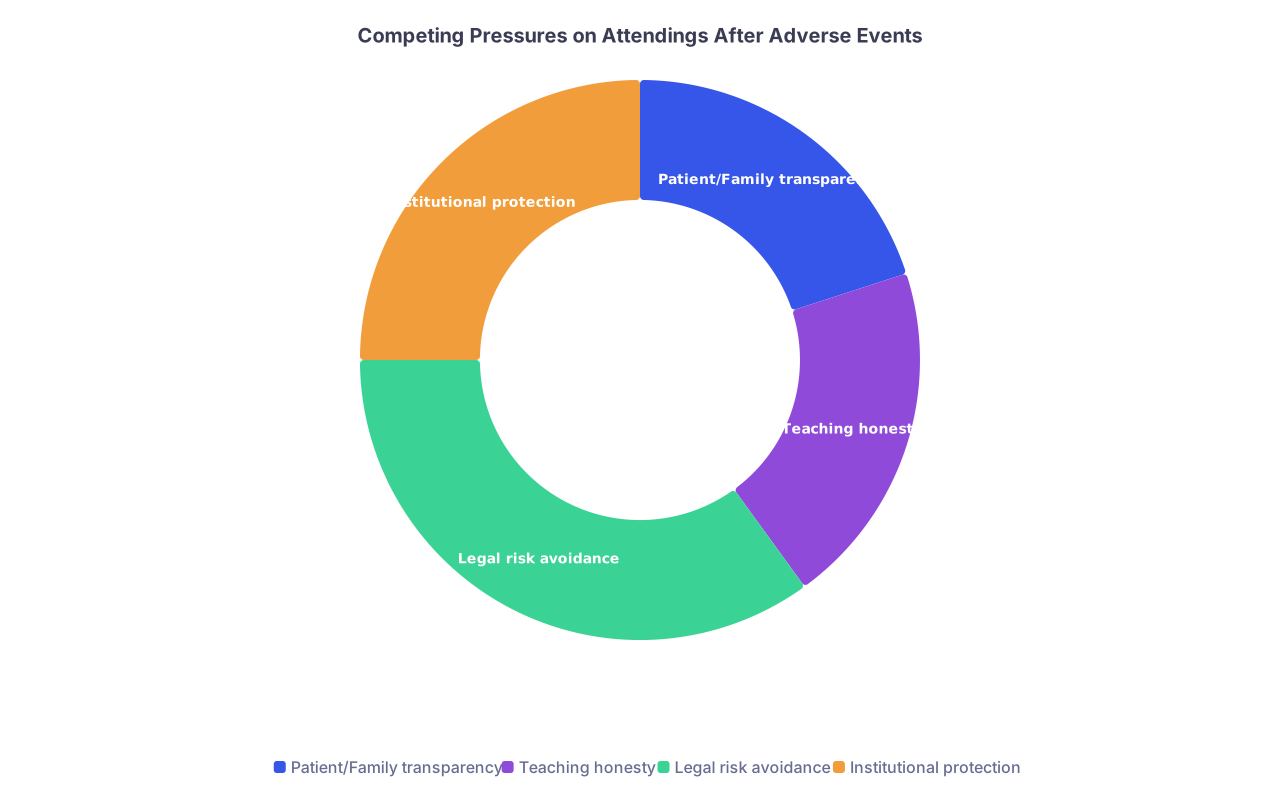
| Category | Value |
|---|---|
| Patient/Family transparency | 20 |
| Teaching honesty | 20 |
| Legal risk avoidance | 35 |
| Institutional protection | 25 |
An ethical attending tries to thread the needle:
- Has real, frank conversations with you and the team about what went wrong—offline, outside the chart.
- Documents the clinical reality without theatrical self‑incrimination or outright spin.
- Refuses to falsify but isn’t stupid about exposure.
The worst attendings either:
- Gaslight everyone and pretend nothing could have been done differently, while quietly airbrushing the chart, or
- Throw trainees under the bus in documentation to carve themselves out
You will see both. Keep your eyes open.