

You are on call. It is 10:47 p.m. A nurse pages: “Your patient in 6B needs a central line. Pressure is dropping. Family is at bedside asking what is happening.”
You rush in, explain “We need to put a bigger IV in your neck so we can give medications,” the patient mumbles “ok,” you scribble a quick note, click “consent obtained” in the EHR, and head to the procedure room.
If you recognize that scene, you are standing in the danger zone. Because this is exactly how residents end up in ethics complaints, quality reviews, and malpractice narratives that start with: “Consent was not properly obtained.”
Let me be blunt: procedural skill will not save you from a bad consent. Your best central line, lumbar puncture, paracentesis, chest tube, or bedside scope will not protect you if the patient (or family, or lawyer) later says, “No one told us that could happen,” and the chart backs them up.
This is where residents quietly sink themselves—through small, routine, “everyone does it this way” consent shortcuts.
Let us walk through the biggest, costliest consent mistakes residents make before procedures and how to never be the cautionary example at M&M.
1. Treating Consent as a Checkbox, Not a Conversation
The most common, and the most dangerous.
You know the pattern: “We need to do a procedure to help with X, there are risks like bleeding and infection, benefits include Y, alternatives are Z, do you agree?” Patient nods. Done in 45 seconds.
On paper, that sounds fine. In reality, it is often garbage.
Here is where people mess up:
- They talk at the patient instead of with them.
- They assume silence = understanding.
- They use jargon the patient will never admit they do not understand.
- They talk too fast because “I am late for sign-out.”
You have not obtained informed consent if the patient:
- Cannot explain back in their own words what is happening.
- Thinks the procedure is mandatory rather than optional.
- Does not understand what happens if they say no.
Do not make this mistake:
Stop and sit.
If you stand in the doorway or hover with your hand on the doorknob, you are broadcasting, “This is a formality.” Sit down. Even for 90 seconds.Use the “teach-back” test.
After explaining, say:
“Just so I know I explained it clearly, can you tell me in your own words what we are planning to do and why?”If they cannot, your consent is not informed. Go again, in simpler language.
Name the choice explicitly.
Use a line like:
“This is your decision. You can say yes, no, or ask more questions. My job is to explain, not to pressure you.”
That last sentence protects you ethically and legally. It also disarms families who later say they “felt forced.”
2. Confusing Signature With Understanding
The signed consent form looks comforting. You got the scribble on the line, the witness signature, the timestamp. But a signature is evidence of agreement, not evidence of understanding.
I have seen this play out in reviews:
- Chart: “Risks, benefits, alternatives discussed. Consent obtained.”
- Reality (from patient interview): “They gave me a paper to sign. I did not know I could refuse. They said it was just routine.”
You do not want that discrepancy attached to your name.
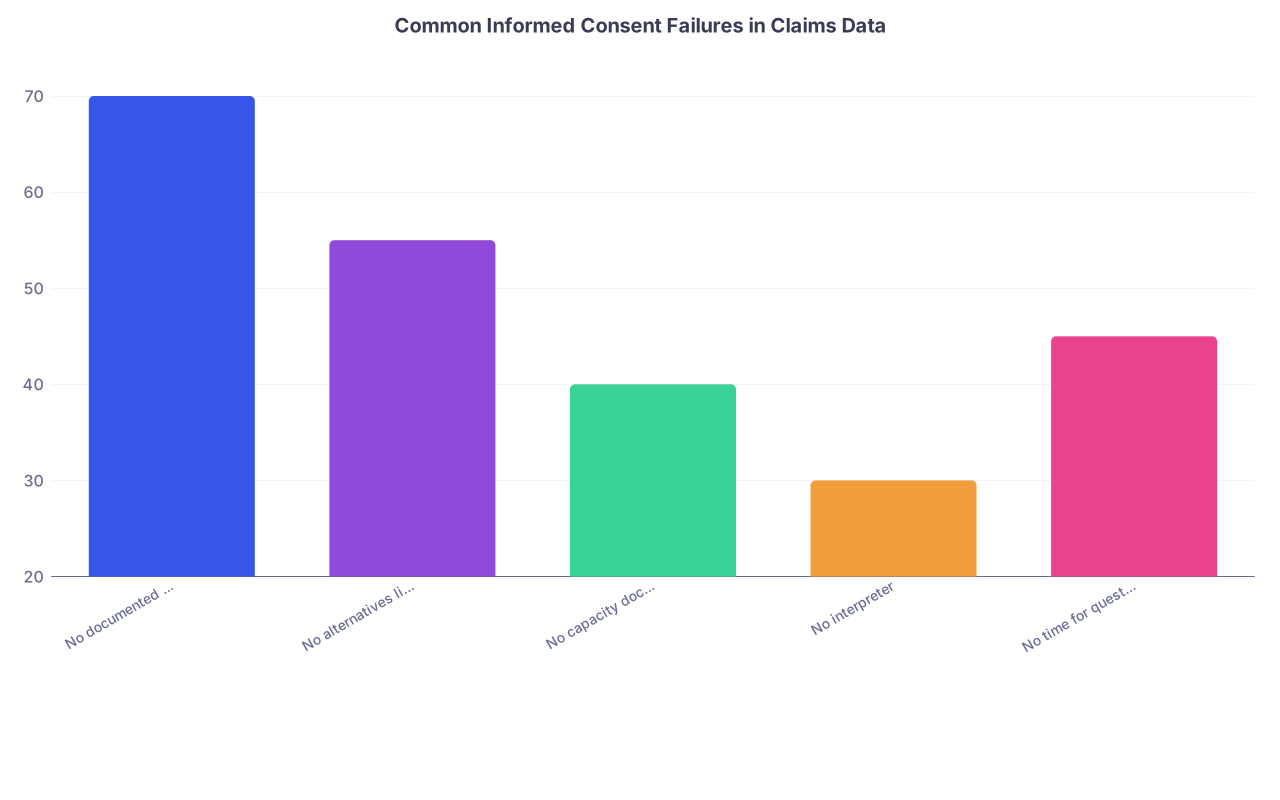
| Category | Value |
|---|---|
| No documented risks | 70 |
| No alternatives listed | 55 |
| No capacity documented | 40 |
| No interpreter | 30 |
| No time for questions | 45 |
Signs you are making this mistake:
- You are more focused on getting the form signed than having a dialogue.
- You routinely say “sign here” while already turning the page or walking away.
- You feel relieved by the signature, not by the patient’s comprehension.
How to fix it:
After they sign, pause and say: “Before I go, what questions do you still have?”
And do not accept “none” without at least a few seconds of silence. People often need that beat to realize what they want to ask.Document content, not just the act:
“Discussed risk of pneumothorax, bleeding, infection, arterial puncture, line malposition; discussed alternatives including peripheral access only and possible delay; patient verbalized understanding and chose to proceed.”
That sentence in the chart on the night something goes wrong is worth far more than any checkbox.
3. Failing to Assess Capacity Properly
You know “capacity” from ethics lectures. But real life is messier.
Common resident move:
Patient is intermittently confused, maybe on high-dose opioids, a bit hypoxic. They have a lucid moment, answer a few orientation questions, nod yes to the procedure. Resident: “They seem fine,” and proceeds.
Later, after a complication, the family says, “They were not in their right mind, we should have been asked.”
Here is the mistake: thinking capacity is all-or-nothing and equivalent to being “awake and oriented x3.” That is lazy thinking and it burns people.
Four basic capacity elements (that residents skip)
For a specific decision, the patient must be able to:
Understand the relevant information.
Not recite, but genuinely grasp the core: what, why, risks, alternatives.Appreciate how it applies to them.
“This could cause bleeding” is not enough. They must connect: “This risk could happen to me.”Reason about options.
They can weigh pros and cons in a basic way: “I want this because… I do not want that because…”Communicate a stable choice.
They must be able to say yes or no consistently over the time frame of the decision.
Do not make this mistake:
- Do not rely on “A&O x3” as your capacity assessment. It is necessary, not sufficient.
- Do not ignore waxing and waning delirium because “we caught them in a good moment.”
- Do not pressure a borderline-capacity patient in a high-stress moment.
Instead:
Ask a few focused questions:
“Can you tell me what you understand about your illness right now?”
“What do you think this procedure is for?”
“What worries you most about doing it or not doing it?”If capacity is questionable, document your reasoning:
“Patient oriented but unable to describe procedure or consequences, unable to weigh options; lacks capacity for this decision. Surrogate contacted.”
If you are ever in litigation or an ethics review, that paragraph may be what saves you.
4. Ignoring or Mishandling Surrogates and DNR/Goals of Care
Another frequent resident error: assuming that if a patient cannot decide, anyone who looks worried and is standing closest to the bed can give consent.
This is how you end up with:
- Estranged relatives authorizing aggressive procedures.
- Distant cousins overriding long-term partners.
- A procedure that conflicts with a clearly documented DNR or comfort-only plan.
| Pitfall | Better Practice |
|---|---|
| Asking “family” as a group | Identify the legally authorized decision maker |
| Ignoring prior directives | Check advance directives / POLST first |
| Letting most vocal person lead | Confirm relationship and decision authority |
| No documentation of hierarchy | Document who and why they are surrogate |
What residents do wrong:
- Do not check the chart for advance directives or prior goals-of-care notes.
- Do not clarify the legal surrogate hierarchy (which varies by jurisdiction).
- Let the loudest relative in the room decide.
Safer approach:
First, look for existing guidance.
- Advance directive
- POLST/MOLST
- Prior documented goals-of-care discussions
If there is a clear “no escalation” or comfort-focused plan, you must reconcile your procedure with that. A central line in a patient signed as DNR/DNI with “comfort care only” is a classic ethics landmine.
Then, identify the proper surrogate.
Ask: “Who is the person legally responsible for making medical decisions if your [mother/father/etc.] cannot?”Document the surrogate status.
“Spouse is next of kin and primary surrogate. Adult children present but defer to spouse. All agree on plan.”
If there is disagreement among family, hitting pause and involving the attending and ethics early protects you more than barreling ahead to “just get the line in.”
5. Glossing Over Material Risks (“Standard Risks Like Bleeding and Infection…”)
This one is subtle but costly.
Residents are trained to rattle off “bleeding, infection, damage to nearby structures, pain.” It sounds comprehensive. It is not.
The legal and ethical requirement is that you disclose material risks—the things a reasonable patient in that situation would want to know. That includes low-probability but high-impact complications.
For a central line, that means:
- Pneumothorax requiring chest tube.
- Arterial injury.
- Air embolism.
- Need for additional procedures if something goes wrong.
For a lumbar puncture:
- Post-dural puncture headache severe enough to require blood patch.
- Very rare but catastrophic events like herniation in a high-risk brain lesion scenario.
I have watched residents skip the scary stuff because “it will freak them out” or “attendings never go into that much detail.” That is not a defense.
Do not make this mistake:
- Do not sanitize your risk list to avoid an uncomfortable conversation.
- Do not hide behind “risks were discussed” without mentioning key high-impact ones.
Better script:
“I want to be upfront about a rare but serious risk. Most of the time this goes smoothly, but there is a small chance of [pneumothorax/serious bleeding/etc.], which might mean we need another procedure, like putting in a chest tube. If that happens, it could mean a longer hospital stay or even transfer to the ICU.”
Respect your patients enough to tell them the truth. That honesty is exactly what juries and ethics committees look for later.
6. Rushing Through Consent in Pseudo-Emergencies
Genuine emergencies (no time, life at risk, patient lacks capacity, no surrogate available) are a different legal category. You may proceed under implied consent to save life or prevent serious harm.
Residents screw up when they:
- Label things “emergent” that are not truly emergent (e.g., “pressure is trending down, might need pressors in a few hours, let us urgently get a central line”).
- Use “they were unstable” as a blanket excuse for minimal consent when there was, in fact, time.
- Never clarify in the chart whether this was emergent, semi-urgent, or elective.

| Step | Description |
|---|---|
| Step 1 | Need for procedure |
| Step 2 | Emergency - implied consent |
| Step 3 | Standard informed consent needed |
| Step 4 | Abbreviated but clear consent |
| Step 5 | Life or limb at immediate risk |
| Step 6 | Hours of buffer? |
Three buckets you should distinguish clearly:
True emergency
- No time for detailed discussion.
- Proceed to save life/limb.
- Document clearly: situation, lack of capacity/surrogate, and life-saving rationale.
Time-pressured but not immediate
- You have minutes to maybe an hour.
- You still must do real consent, just concise: 2–3 minutes, focused on what/why/major risks/alternatives including “do nothing.”
Semi-elective/urgent-but-not-critical
- Patient is sick but not crashing.
- There is no excuse for sloppy consent here.
Do not write:
“Consent obtained” in a crashing patient with no surrogate and no further explanation.
Instead:
“Patient hypotensive and obtunded, no surrogate reachable despite attempts (called listed numbers x2). Delay in central line placement felt likely to result in serious harm. Proceeded under implied consent for life-saving intervention.”
You either used implied consent or you did not. Be explicit.
7. Using Interpreters Incorrectly (or Not at All)
If you are getting consent for a procedure on a patient with limited English proficiency and you are not using a certified interpreter, you are taking a very dumb risk.
Common resident shortcuts:
- Using family as interpreter.
- Using “the Spanish-speaking nurse” who is not certified.
- Assuming “they speak enough English” because they nod along.
These all fall apart when something goes wrong and the family says, “We did not understand. No interpreter was used.”
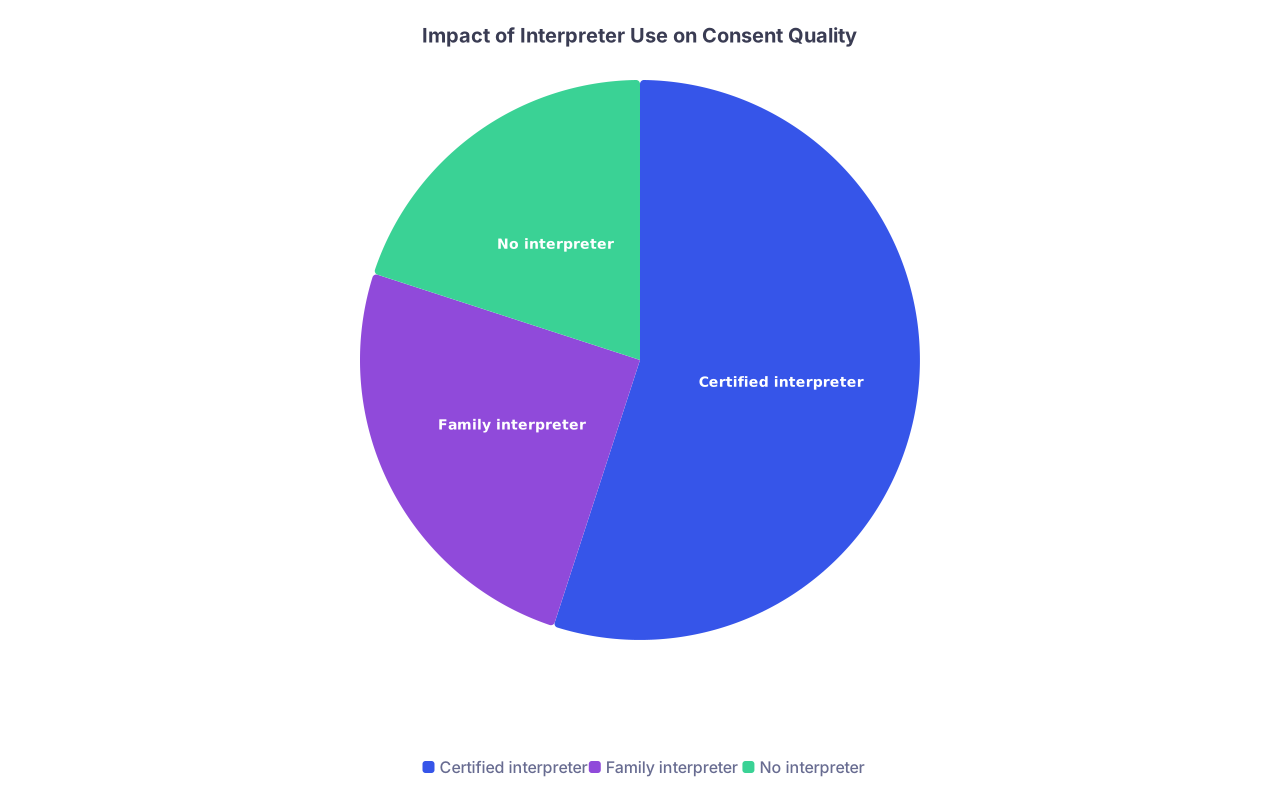
| Category | Value |
|---|---|
| Certified interpreter | 55 |
| Family interpreter | 25 |
| No interpreter | 20 |
Avoid these mistakes:
- Do not consent via family members unless it is a true life-or-death emergency and there is no alternative.
- Do not skip documenting interpreter ID or method (phone vs video vs in-person).
Basic safe pattern:
- Use hospital-certified interpreter (phone or video is fine).
- Speak to patient, not to interpreter.
- Confirm understanding with teach-back through the interpreter.
- Document: “Informed consent obtained with certified interpreter (ID ####, language X) present throughout discussion.”
This is low-hanging fruit. Failing here looks terrible in any review.
8. Overpromising Outcomes or Minimizing Uncertainty
Residents want to reassure. That instinct is human. It is also how they get in trouble.
Danger phrases I have actually heard:
- “This is a very routine procedure, nothing to worry about.”
- “Complications are extremely rare; I have never seen one.”
- “We will fix this problem with the procedure.”
When a complication happens after statements like that, it does not just feel like bad luck. It feels like betrayal.
Better approach: clear but balanced realism:
“This is a common procedure that we do often, and most of the time it goes smoothly. There is always some risk. I cannot promise there will be no complications, but we take steps to minimize them, and I will be doing this with supervision from my attending.”
Notice the difference: you are honest about frequency, you avoid guarantees, and you acknowledge your role and supervision.
Also: do not pretend your attending will be hands-on if they will not be. Misrepresenting supervision is a consent violation too.
9. Documenting Like a Robot: Vague, Copy-Pasted Consent Notes
You know the EHR macros:
- “Risks, benefits, alternatives discussed. Patient verbalized understanding and agreed to procedure.”
- “Informed consent obtained.”
If that is all your note says, you are hanging yourself out to dry.

Major documentation mistakes:
- No mention of specific risks discussed.
- No mention of alternatives, including “no procedure.”
- No indication of capacity assessment.
- No mention of interpreter use.
- No acknowledgement of questions asked or concerns raised.
What strong documentation looks like (for, say, paracentesis):
“Discussed paracentesis with patient for symptomatic relief of tense ascites. Explained procedure in lay terms, including ultrasound guidance and local anesthesia. Reviewed risks of bleeding, infection, bowel perforation (rare but serious), and fluid shift causing transient hypotension. Discussed alternatives: continued medical management alone, delaying procedure, or not proceeding. Patient able to describe back the purpose and main risks of the procedure, and expressed preference to proceed to improve breathing and comfort. Patient has decision-making capacity for this decision. No interpreter needed (primary language English). Questions answered. Informed consent obtained.”
If something goes wrong after a note like that, your ethics and professionalism are clear.
10. Not Knowing When to Call for Help (Attending, Ethics, Risk Management)
The last big mistake: residents try to “just handle it” when consent becomes messy.
Common traps:
- Family conflict about whether to proceed.
- A patient with partial capacity making choices the team thinks are irrational.
- A procedure that seems to conflict with stated goals of care.
- A patient who refuses life-saving intervention.
Residents often:
- Keep arguing with the patient or family.
- Keep revisiting the conversation hoping for a different answer.
- Document poorly, hoping it will all just work out.
Red flag scenarios where you should not go it alone:
- Surrogate disagreement (spouse says yes, adult child says no).
- Patient refuses but seems confused, depressed, or pressured.
- Attending is pushing for a procedure the family clearly does not understand or want.
- You feel uneasy but cannot fully articulate why.

| Step | Description |
|---|---|
| Step 1 | Consent conversation |
| Step 2 | Proceed with standard consent |
| Step 3 | Call attending |
| Step 4 | Consult ethics or risk |
| Step 5 | Simple or complex? |
| Step 6 | Still unresolved? |
Your safest move in those situations is:
- Call your attending and explicitly say, “I am uncomfortable proceeding without more support; here is why.”
- If still murky, ask for an ethics consult or risk management input.
No one will fault you for asking for help in a high-stakes consent issue. They will fault you for plowing ahead and then hiding behind “I was just the resident.”
FAQ (Exactly 3 Questions)
1. Do I really need to go into detail about rare complications for every bedside procedure?
You do not need a 20-minute lecture for a simple procedure, but you must cover material risks—especially low-frequency, high-severity ones that a reasonable person would want to know. For most common procedures, that means naming at least one or two of the serious but rare complications (pneumothorax for central line, bowel perforation for paracentesis, etc.) and what they might lead to. Be concise, not evasive.
2. What if the patient keeps saying, “Do whatever you think is best, doctor,” and will not engage?
You still have to make a good-faith effort. Clarify: “I want to respect what matters most to you. For example, are you more worried about possible complications or about staying in the hospital longer if we do not do this?” If after attempts at engagement they still delegate, document that they explicitly chose to defer decisions to the team after risks/benefits were explained and that they appeared to understand the basics.
3. How do I balance learning procedures as a resident with being honest about my experience during consent?
You cannot pretend you are more experienced than you are. Ethically and legally, the patient should know that a trainee will be performing or assisting. A fair and honest framing: “I am a resident physician and I will be the one doing the procedure under close supervision from my attending, who will be immediately available and involved as needed. We do this often as a team.” If your program’s culture discourages that level of honesty, that is a program problem, not a license to mislead patients.
Open one of your recent notes for a bedside procedure right now.
Scroll to your consent documentation.
Ask yourself: If something had gone wrong that night, would this note clearly show that the patient (or surrogate) actually understood the procedure, the real risks, the alternatives, and that you took capacity and language seriously?
If the answer is anything short of “yes, absolutely,” change your template today.


