

The idea that you must report every possibly impaired colleague is wrong—and dangerously oversimplified.
You do have a duty. But it’s not “see something, immediately destroy someone’s career.” The real standard is: protect patients, act in good faith, and use the right channels proportionate to the risk and the facts you actually have.
Let me walk you through what that really means in practice.
1. What the Law and Ethics Actually Require
You’re not crazy to be confused. A lot of lectures mash together “ethical duty,” “legal duty,” and “institutional policy” into one scary blur.
Here’s the clean version you actually need in your head:
- You have an ethical duty to protect patients from impaired colleagues.
- You often have a professional duty (Board / licensing body) to act if you reasonably believe a colleague’s impairment is affecting patient care.
- You usually do not have to leap straight to reporting to the state medical board the second you feel uneasy.
For physicians, typical sources of duty are:
- State medical practice acts and Board regulations
- AMA Code of Medical Ethics (e.g., Opinions 9.3.1–9.3.2 on physician health and impairment)
- Hospital bylaws and credentialing policies
- Residency or employer policies (GME manuals, employee handbooks)
Themes are consistent:
- If patient safety is at risk, you must act.
- “Suspect” does not mean “vague vibe.” It means a reasonable concern based on observable behavior or performance.
- You’re expected to escalate concerns internally first when appropriate, not automatically to external regulators.
So: no, you don’t have to report every colleague you vaguely suspect. You do have to act when there’s a reasonable belief of impairment affecting safe practice.
2. What Counts as “Impairment” You Should Worry About?
Impairment is not “they’re going through a rough time” or “they looked tired on nights.” Every intern looks half-dead on night float.
You’re looking for problems that could reasonably compromise safe care, such as:
Substance use on or affecting work:
- Smell of alcohol on breath during rounds
- Slurred speech, unsteady gait while on duty
- Recurrent “missing” during shifts, odd behavior around narcotics
Cognitive or neurologic issues:
- New confusion, memory problems, obvious disorientation
- Repeated serious documentation errors, wrong patient, wrong side, etc.
Severe, unmanaged mental illness:
- Profound change in behavior—paranoia, disorganized speech, extreme agitation
- Suicidality with ongoing patient care duties
Severe burnout or physical illness affecting performance:
- Falling asleep in procedures
- Recurrent critical clinical mistakes despite feedback
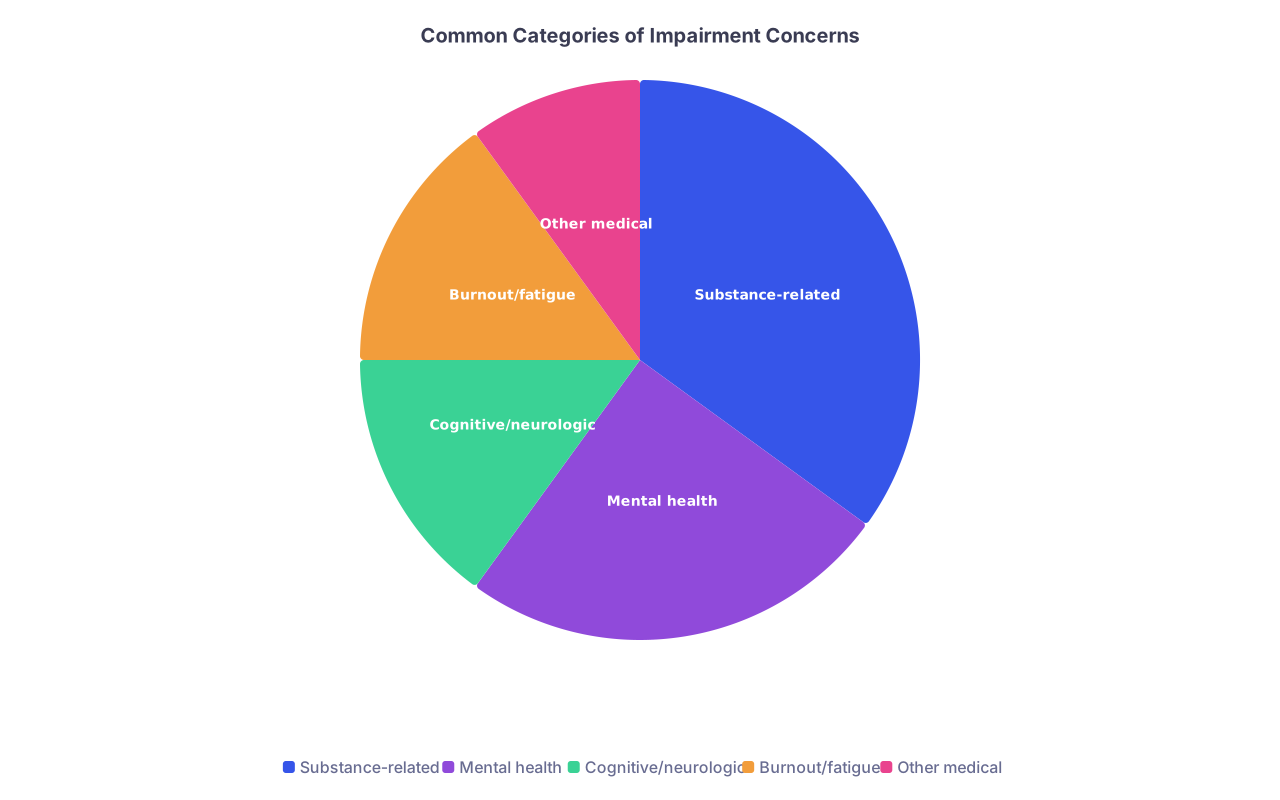
| Category | Value |
|---|---|
| Substance-related | 35 |
| Mental health | 25 |
| Cognitive/neurologic | 15 |
| Burnout/fatigue | 15 |
| Other medical | 10 |
What does not automatically equal “report them”:
- They’re awkward or socially off.
- They’re occasionally late.
- You just don’t like them.
- You disagree with their clinical judgment but it’s still within defensible standards.
You report risk, not personality.
3. The Core Question: “Do I Have to Report This?”
Use this decision framework. It’s how I’ve seen good programs teach it and how risk management people actually think.
Ask yourself four questions:
Is there a specific behavior or event, or just a feeling?
If you can’t describe anything concrete, pause. Keep an eye out, but don’t go report your gut alone.Could this behavior reasonably put patients at risk?
Actual or near-miss errors, unsafe orders, performance that scares nurses—that’s different than “they seemed off once.”Is this isolated or a pattern?
One sloppy note? Not reportable.
Three serious med errors in two weeks + obvious confusion? Now we’re in duty-to-act territory.Can this be addressed safely at a lower level first?
Sometimes yes: direct conversation, talking with a trusted senior, or using confidential wellness resources. Sometimes no: someone intoxicated on shift needs immediate escalation.

| Step | Description |
|---|---|
| Step 1 | Notice concerning behavior |
| Step 2 | Monitor and document |
| Step 3 | Contact supervisor or safety officer now |
| Step 4 | Consult trusted senior or policy |
| Step 5 | Use formal reporting channel |
| Step 6 | Specific and serious? |
| Step 7 | Immediate safety risk? |
| Step 8 | Pattern or repeated issues? |
Where do you go first?
- As a med student: clerkship director, course director, dean of students, or hospital reporting line.
- As a resident: program leadership (PD/APD), chief residents, or hospital peer review/physician health program.
- As faculty/attending: department leadership, medical staff office, credentialing/peer review, or directly to the physician health committee.
The point: the answer is rarely “do nothing” and rarely “immediately call the state board.” There are middle paths that are both ethical and safer for everyone.
4. Practical Scenarios and What You Should Actually Do
Let’s run through real-life examples. This is where people usually freeze.
Scenario 1: The “Maybe He’s Just Tired” Attending
You’re an intern. Your attending has started:
- Forgetting orders they placed
- Repeating questions in the same interview
- Writing confusing, contradictory notes
Nurses have quietly asked you, “Is Dr. X okay?”
Do you have to report them to the Board? Not yet.
What you should do:
- Document for yourself what you’re seeing—dates and examples. Not to “build a case,” but to be precise.
- Talk confidentially with your chief resident or PD: “I’m concerned about Dr. X. Here’s exactly what I’ve seen.”
- Let leadership handle escalation through established channels (peer review, physician health committee).
You’ve discharged your duty by raising a good-faith concern through appropriate internal channels. You’re not expected to diagnose early dementia.
Scenario 2: The Resident Who Smells Like Alcohol
You’re a co-resident. On a night shift, your colleague comes in, smells strongly of alcohol, is a bit too loud, and orders a high-risk medication incorrectly. Nurses are nervous.
Here, patient safety is at immediate risk.
You should:
- Take this seriously as an urgent issue, not “let’s see how it goes.”
- Call your chief resident, attending, or supervising physician right away.
- If your institution has a “chain of command” for safety concerns, use it. Many have a 24/7 administrator-on-call.
Do you have to call the state medical board personally? No. Your duty is to stop unsafe care and involve those with authority to remove the resident from duty and assess impairment.
If your supervisors blow this off repeatedly and the pattern continues, then yes, external reporting (board, ACGME, etc.) becomes more defensible.
Scenario 3: The Depressed Co-Resident
Your co-resident confides they’re deeply depressed, seeing a therapist, and thinking of starting medication. Their clinical performance is still solid, no errors, no safety issues.
You do not have to report them anywhere. They are doing exactly what we want—seeking help before impairment.
What you should do:
- Encourage continued professional treatment.
- Offer support and check-ins.
- Respect confidentiality unless they express active suicidal intent or you see clear safety issues.
Reporting them to leadership “just in case” would be harmful and unnecessary.
5. Legal and Professional Risk: What If I Get It Wrong?
Two things people quietly worry about:
- “What if I overreact and ruin their career?”
- “What if I underreact and someone gets hurt—and I’m blamed?”
You are not expected to be perfect. You are expected to:
- Act reasonably based on what you know.
- Use established channels.
- Document and report in good faith.
Here’s how risk generally plays out:
| Scenario | Main Risk to You | Main Risk to Patients |
|---|---|---|
| Overreporting | Relationship fallout, loss of trust, rare defamation claims if malicious | Unnecessary investigation, stigma |
| Underreporting | Moral distress, potential scrutiny after an adverse event | Ongoing unsafe care, preventable harm |
| Good-faith reporting via proper channels | Very low personal legal risk | Best chance of early, safe intervention |
Key legal concept: good-faith reporting. Most states give you legal protection when you report a colleague in good faith through appropriate channels, even if it turns out they weren’t impaired.
On the flip side, if:
- You witness clear impaired practice,
- Patients are harmed, and
- You clearly knew and did nothing,
you can be scrutinized or even sanctioned in extreme cases. It doesn’t happen often, but it’s not theoretical.
So your strategy:
- Avoid casual accusations.
- Avoid deliberate blindness.
- Move concerns through the right internal structures rather than lone-wolf crusades.
6. How to Actually Raise a Concern Without Being Reckless
The mechanics matter. Sloppy reporting creates enemies and chaos. Careful reporting protects patients and you.
Step 1: Write down specific facts
Not “Dr. Y is unsafe.”
Try: “On 1/6, Dr. Y mis-ordered 10x fentanyl dose, corrected by RN before administration. Speech slow, smelled of alcohol. On 1/7, arrived 2 hours late looking disheveled; nurse expressed concern.”
Concrete, neutral, chronological.
Step 2: Choose the right first person
Usually:
- Medical student → clerkship director / course director / student affairs dean
- Resident → chief resident, program director
- Attending → section chief / department chair / medical staff office
If one of these is the impaired person, pick another trusted leader or institutional reporting channel (compliance hotline, risk management).
Step 3: Use “I” statements and focus on safety
When you talk:
- “I’m concerned about patient safety because…”
- “Here are the specific events I’ve observed…”
- “I’m not diagnosing them, but I’m worried about impairment affecting care.”
You’re not there to label or judge, just to report facts and your safety concern.
Step 4: Let the system do its job
You do not need to:
- Investigate
- Confront the person yourself (unless you choose to and it’s clearly low risk)
- Announce anything to others
Once you’ve escalated appropriately, document for yourself (privately) that you did so. Then let peer review, physician health, and leadership handle it.
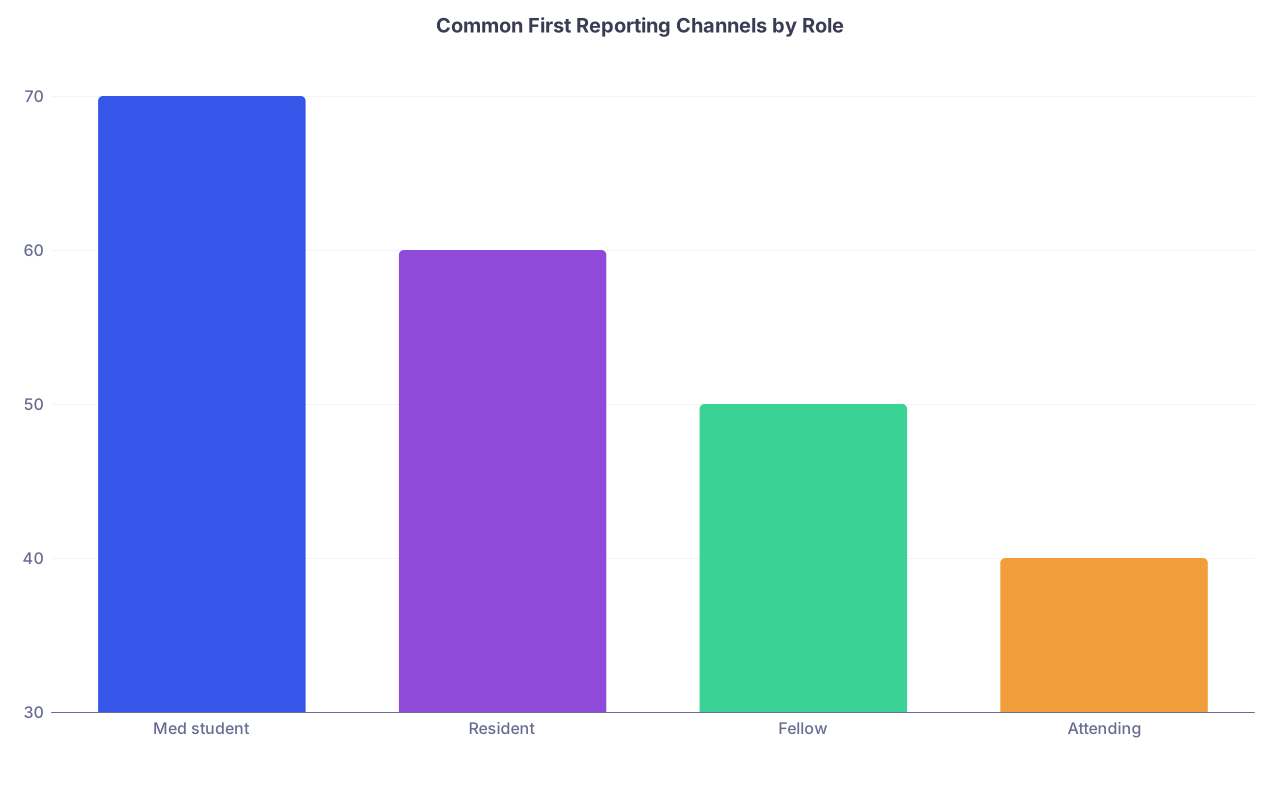
| Category | Value |
|---|---|
| Med student | 70 |
| Resident | 60 |
| Fellow | 50 |
| Attending | 40 |
(Values here represent approximate percentage of people who typically go to their direct educational/departmental leader first in survey data—pattern, not gospel.)
7. Protecting Yourself and Your Colleagues Long-Term
This isn’t just about one colleague. It’s about the culture you’re helping build.
A healthy reporting culture:
- Encourages early help-seeking before impairment
- Distinguishes between illness (which deserves support) and impaired practice (which triggers restriction + treatment)
- Protects confidentiality as much as possible
- Avoids automatic punitive responses to mental health treatment
As a trainee or junior physician, a few smart habits:
- Know your institution’s policy on impaired providers (there’s almost always a PDF somewhere).
- Learn who your physician health program or wellness officer is.
- Normalize your own help-seeking—mental health, fatigue, burnout. Colleagues notice.
And privately, decide what kind of colleague you want to be: the one who looks away, or the one who acts when it’s hard. There’s no way to do this work ethically and keep your hands completely clean.

FAQ: “Do I Have to Report Every Impaired Colleague I Suspect?”
Do I legally have to report every colleague I suspect might be impaired?
No. You’re not required to report every vague worry. Your obligation typically kicks in when you have a reasonable belief, based on specific observations, that a colleague’s impairment is affecting or could affect patient safety. At that point, you must act—usually by reporting through internal channels, not directly to the state board.What’s the difference between talking to them directly and formally reporting?
Talking directly is informal: “Hey, I’ve noticed you seem really off—are you okay?” That’s fine for mild, non-safety concerns or early burnout. Formal reporting means going to a supervisor, program leadership, or institutional channel to trigger evaluation or oversight. When there’s clear safety risk or a repeating pattern, skipping straight to leadership is more appropriate than a solo confrontation.Could I get in legal trouble for reporting someone who turns out not to be impaired?
Very unlikely if you report in good faith through proper channels. Most jurisdictions and institutions protect good-faith reporters. The real risk is making wild, defamatory claims publicly or on social media, or clearly acting out of malice. Stick to facts, focus on safety, and use official processes—you’re on solid ground.What if I’m wrong and I ruin their career?
You’re not the investigator, judge, and jury. Your role is to raise a reasonable concern, not to decide their fate. Competent institutions have processes—evaluation, confidential referral to physician health programs, temporary privilege modification. If you’re specific, honest, and measured, it’s unlikely a single report alone will “ruin” anyone. Ignoring a real problem, though, can ruin patients’ lives and your own peace of mind.Do I have to report a colleague who tells me they’re in therapy or on antidepressants?
No. Treatment alone is not impairment. In fact, ethical guidance strongly encourages physicians to seek care without automatic professional consequences. You only have a duty to act if their illness is actually compromising safe practice—errors, risky behavior, inability to perform duties—despite treatment.What if my supervisor dismisses my concern about an impaired colleague?
Document (for yourself) what you reported and when. If the concern is serious and ongoing, escalate to another layer: department chair, GME office, medical staff office, or institutional compliance/safety hotline. If you’ve gone up the chain and nothing changes while risk continues, external reporting (state board, accreditation body) may become ethically justified.Should I confront an impaired colleague directly before reporting?
It depends on severity and your relationship. If it’s mild concern and no immediate safety risk, a quiet, compassionate conversation can be helpful. If there’s obvious risk—apparent intoxication, serious repeated errors, suicidal statements—skip the solo confrontation and involve leadership immediately. You’re not a one-person intervention team; your priority is patient safety and your own safety.
Key takeaways: You don’t have to (and shouldn’t) report every uneasy feeling. You do have to act when specific, concerning behavior suggests impaired practice and patient risk—usually by using internal reporting channels and letting the system do its job. Focus on concrete observations, safety, and good-faith action, and you’ll be on the right side of both ethics and the law.


