

The fastest way to wreck a friendship and your career is to treat your friends like patients. Literally.
Physicians do this all the time. Quietly. Off the record. A quick script. A curbside opinion that somehow turns into “ongoing care.” And then they are shocked when it blows up—ethically, legally, or personally.
Let me walk you through the traps so you do not become that cautionary story people whisper about on rounds.
The Illusion of “Just a Quick Favor”
The most dangerous phrase in this whole topic is: “It’s just a quick favor.”
It never stays “quick.” And it is almost never “just a favor.”
Here is how it usually starts:
- A colleague texts: “Hey, can you send me something for my sinus infection? I know what I need.”
- A friend at dinner says: “You’re a doctor—should I be worried about this chest pain?”
- A family member asks: “Can you refill my antidepressant? My doctor is on vacation.”
You tell yourself:
- It is minor.
- I know them well.
- I will just do it this once.
You think you are being helpful. What you are actually doing is blurring three critical boundaries at once:
- Professional vs personal
- Formal care vs casual advice
- Ethical duty vs social obligation
Once those lines get fuzzy, every other mistake comes faster: inadequate documentation, poor assessment, missed red flags, prescribing outside proper channels.
The pattern is always the same: the more “off the record” it feels, the higher your risk.
The Ethical Red Flag You Keep Ignoring
Every major professional body has warned you about this already.
There is a reason the AMA Code of Medical Ethics, the GMC (in the UK), the CMPA (in Canada), and similar bodies all say essentially the same thing: avoid treating close friends, colleagues, or family except in very limited circumstances (emergency, no other care available, truly minor issues).
Why? Because you are not as objective as you think.
You underestimate:
- How much you over-reassure people you care about.
- How much they withhold from you because they want to seem “fine.”
- How much your own discomfort with awkward topics will distort your clinical judgment.
You overestimate:
- Your ability to separate personal knowledge from clinical evaluation.
- Your capacity to “keep it simple” and “not get involved.”
- How clear the boundaries will feel once you start.
You are not special. You are not the exception. You are human.
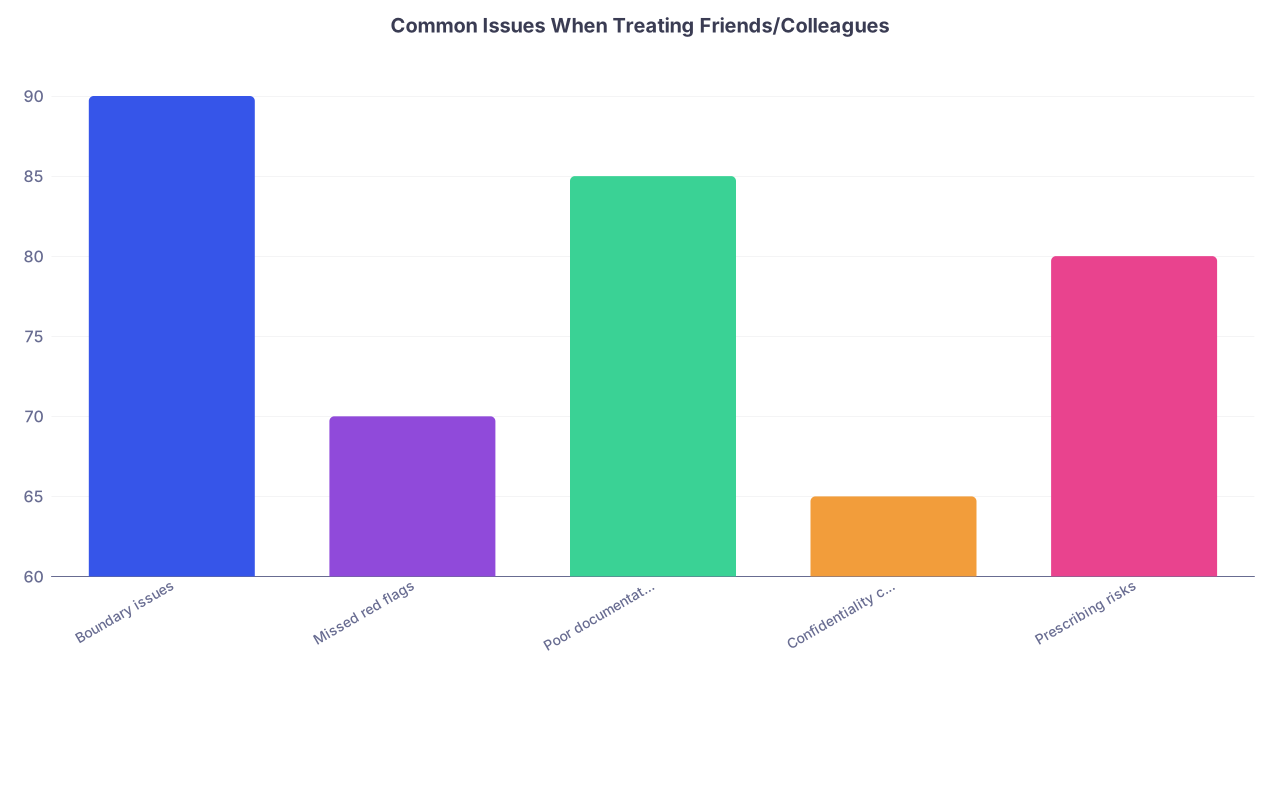
| Category | Value |
|---|---|
| Boundary issues | 90 |
| Missed red flags | 70 |
| Poor documentation | 85 |
| Confidentiality conflict | 65 |
| Prescribing risks | 80 |
These problems are not theoretical. They show up in complaints, board actions, lawsuits, and ugly personal conflicts.
If you remember only one rule, remember this: dual relationships—being both friend and doctor—are unethical not because regulators enjoy rules, but because divided loyalty is a clinical hazard.
The Assessment You Think You Did (But Did Not)
Another classic trap: the “pseudo-exam.”
You convince yourself you have “assessed” your friend. In reality you have gathered fragments:
- A half-story told over text.
- A quick “Here, let me take a listen” at a birthday party, with people around.
- A one-sided history, where they tell you what they think matters and skip the rest.
What does a real assessment require?
- A private, focused setting.
- A full, structured history.
- A documented exam.
- Access to past records when relevant.
- Time to think and safety-net properly.
That almost never happens when you treat friends or colleagues “informally.”
The dangers:
Anchoring on their self-diagnosis
“I just need something for my anxiety.”
“It is my usual migraine.”
“It is probably reflux.”And you go along, because arguing with a friend in distress feels harsh. But if this were a stranger in clinic saying “typical reflux” and then mentioning 20-pound weight loss, you would not just nod and send omeprazole.
Skipping the embarrassing questions
You do not ask your close friend detailed sexual history.
You soft-pedal substance use.
You avoid probing mental health, self-harm, trauma.They do not volunteer, you do not ask, and now you are managing half a patient.
Shortcutting safety-netting
You give vague follow-up: “Text me if it is worse.”
No explicit red flags.
No timeframe for reassessment.
No clear message: “If X happens, go to the ER. Do not wait for me.”
If this sounds familiar, that is the problem. You are not “sort of” their doctor. You either are, with all that entails, or you decline and direct them to proper care.
Documentation: The Career-Killing Blind Spot
If you remember nothing else, remember this: what is not documented might as well not have happened.
When you treat a friend or colleague informally:
- You often do not open a chart.
- You do not document the history, exam, risks discussed, or safety advice.
- You do not record medications prescribed or refilled.
Then, later, when something goes wrong—because eventually something will—there is:
- No evidence of your reasoning.
- No record of what they told you.
- No proof that you gave appropriate warnings or follow-up guidance.
Regulators love that scenario. Plaintiff attorneys love it even more.
| Aspect | Informal Treatment of Friend | Proper Clinical Care |
|---|---|---|
| Setting | Text / hallway / social | Clinic / office |
| Documentation | None or minimal | Full chart note |
| Privacy | Often compromised | Protected space |
| Follow-up plan | Vague (“let me know”) | Clear, documented |
| Records access | Typically absent | Integrated / requested |
If you cross the line from “general advice” into diagnosis, management, or prescribing, you need a chart. If there is no chart, you should not be doing it.
You cannot defend a clinical decision that lives only in your memory and a string of half-serious texts.
Prescribing for Friends: Where People Lose Their License
Prescribing is where casual “helping” becomes legally dangerous very quickly.
Common errors:
- Writing antibiotics for “sinus” or “bronchitis” on a texted complaint. Patient actually has early pneumonia or something entirely different.
- Refilling controlled substances (“My Adderall ran out; my psychiatrist is booked”) without proper assessment, records, PDMP check, or contract.
- Handing out benzodiazepines for “flight anxiety” or “just to sleep this week” to a friend with unspoken substance use issues.
- Sharing samples or leftover meds without documentation.
Many jurisdictions are explicit: do not prescribe to close friends or family except in narrow, time-limited, low-risk situations. Even then, caution.
The risks:
- Board discipline for prescribing outside professional standards.
- Allegations of diversion or unsafe controlled substance prescribing.
- Being held liable for side effects or interactions you did not properly assess.
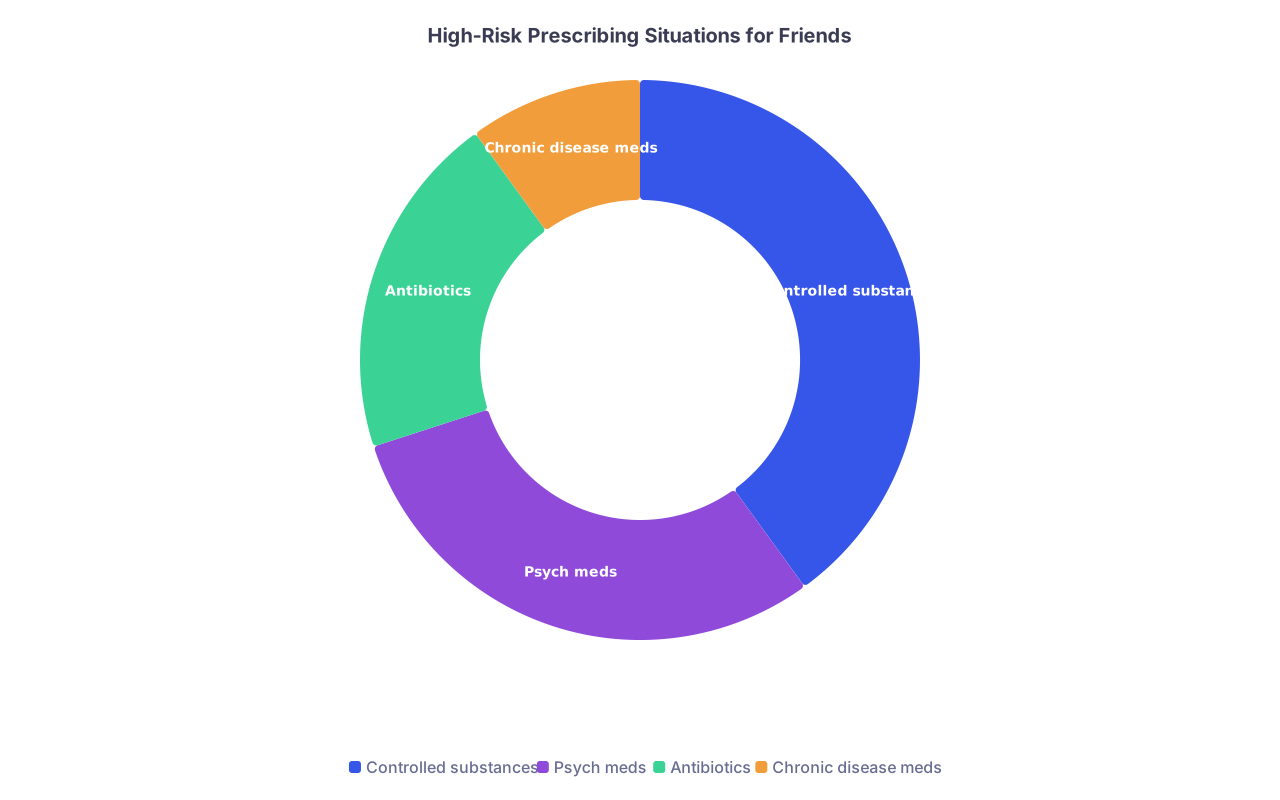
| Category | Value |
|---|---|
| Controlled substances | 40 |
| Psych meds | 30 |
| Antibiotics | 20 |
| Chronic disease meds | 10 |
If you are thinking, “But this is just an SSRI refill for a month, what is the harm?” you are missing half the picture:
- You may not know about recent dose changes or new diagnoses.
- You may not know about pregnancy, substance use, or suicidality.
- You may now own responsibility for monitoring and follow-up.
Once your name is on the prescription, you are not “just helping.” You are the prescriber of record. You are accountable.
Confidentiality Collisions: Friend vs Patient
Here is an underappreciated nightmare: when your obligation to your friend as a “patient” conflicts with your role in another sphere.
Classic examples:
- A colleague asks you about panic attacks but does not want occupational health to know. You then get pulled into discussions about their fitness for duty after an incident.
- A resident you are friends with tells you about self-harm thoughts and driving recklessly. Now personal loyalty clashes with duty to protect.
- A team member shares substance use details “just as a friend,” and then wants you to prescribe a sedative before a conference flight.
You cannot mix these roles without creating ethical landmines. If they are your patient, confidentiality applies, with narrow exceptions. If they are your friend, you do not have the same legal structure, but you also should not be practicing stealth medicine.
The worst situation is the gray zone: they think you are their doctor; you think you are just a friend offering “informal help.” No one is quite clear.
That gray zone is exactly where complaints originate. “My friend-doctor knew I was struggling and did nothing.” Or: “They breached my confidence by telling others.”
Keep this simple: do not occupy two roles at once. Either be their physician formally, with clear boundaries and documentation, or do not.
Power Dynamics with Colleagues: You Are Not on Equal Ground
Treating colleagues sounds harmless. You know they are medically literate. You assume they will understand limits.
Wrong. The dynamics are more twisted than you expect.
- Junior asking senior: The junior feels unable to say no. The senior feels flattered, then trapped.
- Peer-to-peer: Both pretend they are “just chatting,” while one is quietly hoping for real care and the other is not acknowledging that.
- Supervisory relationships: A resident treating a co-resident, or an attending informally managing a trainee. Now performance evaluations, hierarchy, and medical care are all tangled together.
I have seen attendings trying to both supervise and clinically treat residents they later have to remediate. It is ugly. It is also avoidable.

| Step | Description |
|---|---|
| Step 1 | Casual medical chat |
| Step 2 | Specific advice given |
| Step 3 | Diagnosis suggested |
| Step 4 | Prescription written |
| Step 5 | Ongoing informal follow up |
| Step 6 | Complication or complaint |
| Step 7 | Regulatory or legal review |
At every arrow, you have a chance to stop. Most people do not.
You protect yourself by having a rehearsed phrase ready:
- “I care about you too much to be your doctor.”
- “I am happy to help you find someone good, but I should not be the one treating you.”
- “We work together; I need to keep those roles separate.”
Say it early, not after you have already prescribed three times.
The “Emergency” Excuse: Slippery and Overused
There are legitimate exceptions where treating friends or colleagues is appropriate:
- Acute life-threatening emergency, no time or access to another clinician.
- Remote or extreme environments where you are the only available clinician.
- Short-term, low-risk interventions with clear handoff as soon as feasible.
But people abuse the word “emergency.”
Your friend forgetting to book their ADHD follow-up is not an emergency.
Your colleague running out of SSRIs because they ignored reminder messages is not an emergency.
Your partner needing antibiotics at 11 pm on a Sunday because “it is hard to get in” is not an emergency.
True emergency exceptions look like:
- You are at a remote cabin; someone is in anaphylaxis; you administer epinephrine.
- You are at a sports event; stranger collapses; you start ACLS.
- Disaster situation; you are the only clinician and treat whoever is in front of you, including a friend.
Those are not ethical gray zones. Those are clearly justified.
What you must not do is stretch “exception” into “lifestyle.”
Digital Boundaries: Texts, DMs, and Late-Night Cries for Help
Modern medicine adds another landmine: informal digital consultations.
You know the drill:
- Photos of rashes sent over WhatsApp.
- “Is this normal?” questions at 1:00 a.m.
- Instagram DMs from acquaintances asking for medical advice.
- Group chats where you become the unofficial medical hotline.
Here is what goes wrong:
- No proper consent or explanation of limits.
- No formal documentation, even when you end up giving real advice.
- No secure channel, no privacy guarantees.
- Messages scattered across personal devices you do not control or back up appropriately.
If you type “Start amoxicillin 500 mg TID for 7 days” in a text, you have just prescribed. You own that.
The safest pattern:
- Keep things general: education, not direct care. (“Chest pain can be serious; you need urgent evaluation.” Not “It is probably anxiety, just rest.”)
- Redirect: “This is not something I can safely manage over text. Please contact your doctor / urgent care / ER.”
- Reserve actual clinical care for proper channels with documentation.
If you regularly get these messages, that is a sign you need stronger boundaries, not better texting skills.
How to Say No Without Destroying the Relationship
The main reason physicians keep making these mistakes is social pressure. You do not want to seem uncaring. You do not want conflict at Thanksgiving. You do not want to look “difficult” at work.
So you cave.
You need scripts. Short, practiced responses that you can lean on under pressure.
Some that work:
- “Because I am a physician, the rules for me are strict. I am not allowed to treat close friends or colleagues except in emergencies. I can help you find someone good, though.”
- “If I start being your doctor, it will change our relationship in ways that are bad for both of us. I value our friendship too much.”
- “The safest and most ethical thing is for your care to be with a doctor who is not personally involved. Let me help you get an appointment.”
- “Even if it seems simple, if I misjudge something because I know you too well, that could really hurt you. I will not risk that.”
You are not rejecting the person. You are rejecting a bad setup.
Most people will respect that. The ones who do not are exactly the people who would put you in the worst situations as “their doctor” later.
When You Decide You Will Treat Them
Very occasionally, it may be appropriate to treat someone you know:
- Rural communities where everyone knows everyone.
- Healthcare workers seeking discreet care within institutional structures.
- Time-limited traveler issues when you are the only clinician present.
If you make that call, do it properly, or not at all:
- Formalize the role: “I will be your doctor for this issue. That means we need to treat this like a real visit.”
- Use proper clinical setting and privacy as much as possible.
- Create or use an appropriate medical record.
- Document thoroughly: history, exam, counseling, differential, plan, safety netting.
- Set clear boundaries: what you will and will not manage; when you will hand off to someone else.
And do not let a one-off emergency exception quietly morph into ongoing primary care by inertia. That is how people wake up three years later having “somehow” become their sibling’s main prescriber.
Bottom Line: The Three Mistakes You Cannot Afford
You avoid most disasters in this area by refusing to make three core mistakes:
- Treating a friend or colleague “casually” without deciding whether you are actually their doctor.
- Providing real care—diagnosis, prescriptions, ongoing advice—without documentation or proper setting.
- Letting social pressure override clear ethical and legal boundaries that exist for very good reason.
You can be a good friend and a competent physician at the same time.
You just cannot be both to the same person in the same moment.


