

You finish sign-out at 7:45 p.m., peel off your N95, and finally sit down. Your phone lights up with a group text: “Wild night in the ED. Anyone else see that VIP admission?” Someone drops initials. Another adds a bed number. Someone else sends a photo of an EKG. You barely think before you reply.
That is how people end up in front of a program director, an institutional compliance officer, and sometimes a state board. Not because they are malicious. Because they are casual.
HIPAA violations by trainees are rarely sinister. They are almost always careless, rushed, “everyone does it here” habits that feel harmless—until they are not. The worst ones are the ones you do not even recognize as violations.
Let me walk you through the traps that catch smart, decent trainees every year. If you avoid these, you avoid 90% of the trouble.
1. The Phone in Your Pocket: Messaging, Photos, and “Just for Learning”
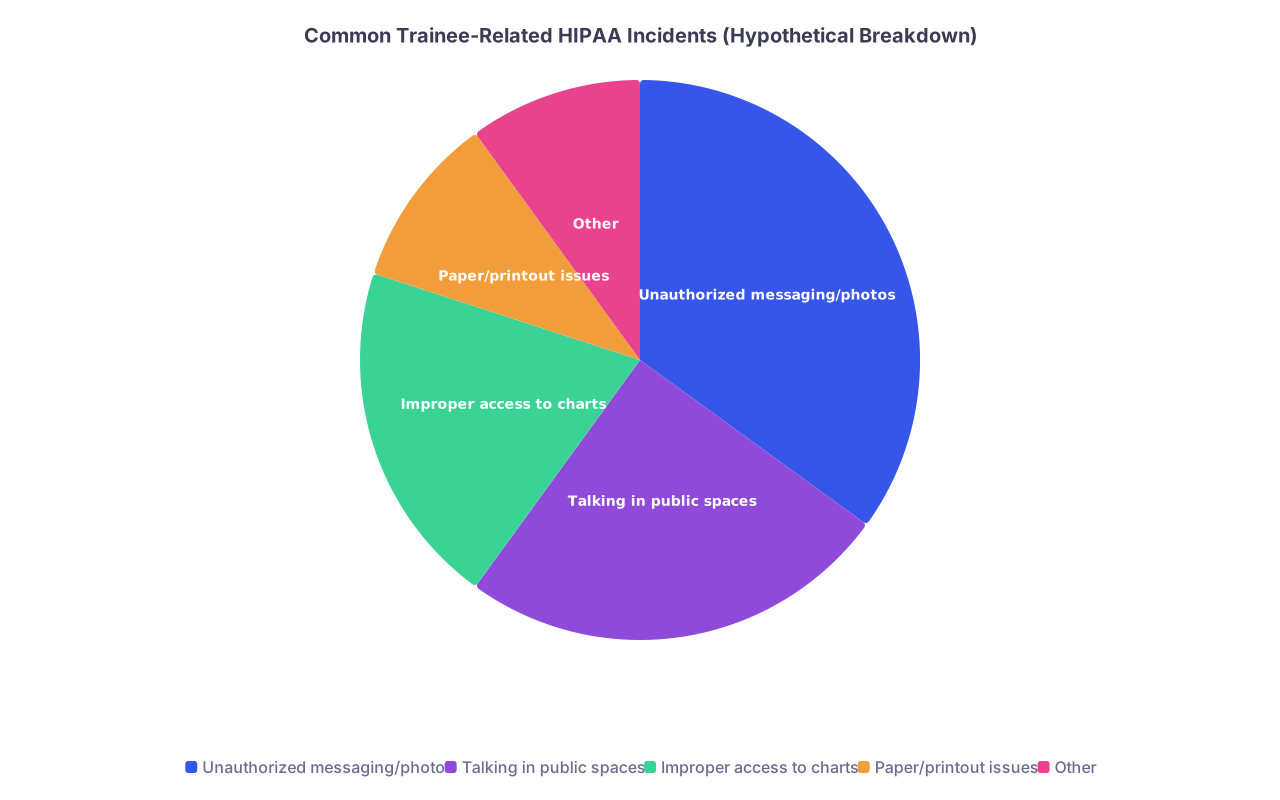
| Category | Value |
|---|---|
| Unauthorized messaging/photos | 35 |
| Talking in public spaces | 25 |
| Improper access to charts | 20 |
| Paper/printout issues | 10 |
| Other | 10 |
If you remember nothing else, remember this: your smartphone is the single highest-risk object you carry on service.
I have seen all of these:
- Intern screenshots a CT finding and texts it to a co-intern on standard iMessage.
- Student takes a photo of a unique rash “for studying later” and saves it in their camera roll.
- Resident sends a “teaching case” to a group chat with name cropped out but full face visible.
They thought: no name = no HIPAA problem.
Wrong.
The “No Name = Safe” Myth
HIPAA identifiers are not just names and MRNs. Faces, room numbers, unique injuries, timestamps, and even combinations like “43-year-old OB attending with twins in MICU” can be identifying in that institution.
Cropping out the name banner does not magically anonymize an image. That cute “interesting case” photo sitting in your personal iCloud backup is a violation if the patient did not give specific permission and the platform is not approved.
Do not make this mistake: if the image can be tied back to an actual person in your hospital by anyone who knows them or has access to census lists, it is not de-identified.
Unsafe Messaging Apps
Standard SMS, iMessage, WhatsApp, Signal—none of these are automatically “HIPAA compliant” just because they are encrypted. Compliance is not encryption alone. It is:
- Institutional control
- Audit ability
- Business associate agreements
- Data retention rules
Your hospital has an approved secure messaging platform (TigerConnect, Voalte, Epic Secure Chat, etc.). If you are discussing patient care or sending images, you use that. Full stop.
Do not:
- Send EKGs, rashes, CT slices, or lab screenshots over personal texting apps.
- Message your attending on WhatsApp about “the DKA in 5B now hypotensive,” even “just once.”
- Use your phone camera at the bedside unless you are following a policy and using an institution-controlled app.
“But I Asked the Patient…”
Another trap: “The patient said it was okay if I took a photo.” Verbal, vague “permission” is not the same as documented, specific consent for photography, storage, and use. Especially not for education outside the institution.
If there is no institutional workflow (consent form, photo taken on hospital device, stored in chart or secure server), you have no business using your personal phone camera.
If you are serious about not getting burned:
- Do not use your personal camera for clinical images.
- Do not store patient images in your photo gallery or cloud backups.
- Do not share patient images in any channel that is not explicitly hospital-approved.
Most trainees who get in trouble here thought they were “just being thorough” or “trying to learn.” Intent will not save you.
2. Talking Where They Can Hear You: Hallways, Elevators, Cafeterias

If you have ever discussed “the GI bleed in 420B who keeps pulling out his lines” within earshot of visitors, you have already brushed against a violation.
Here is the mistake: people think “we did not say the name” so it is fine. Again—wrong.
Combine a room number, a specialty, a distinctive condition (“the 26-year-old with a gunshot wound who was on the news”), the time of day, and a family member in the hallway, and suddenly you have a very real identification risk.
High-risk spots:
- Elevators
- Shuttle buses
- Cafeterias
- Starbucks in the hospital lobby
- Hallways outside patient rooms
- Waiting areas
You are on autopilot during pre-rounds, venting to a co-intern: “Did you see that drunk trauma who tried to punch me?” The person two feet away is their cousin.
HIPAA does not require you to practice medicine silently. It requires “reasonable safeguards.” That means:
- Use private spaces for detailed conversations.
- Lower your voice. Whisper is better than normal speaking tone in semi-public spots.
- Replace specific details with general ones if you must talk briefly: “our new MICU admission” not “the 19-year-old overdose in MICU bed 7 whose mom is a nurse here.”
The mistake is not recognizing that “inside the hospital” is not automatically “private.” If non-workforce members can overhear, you need to tighten your mouth.
3. Accessing Charts You Have No Legitimate Reason to See
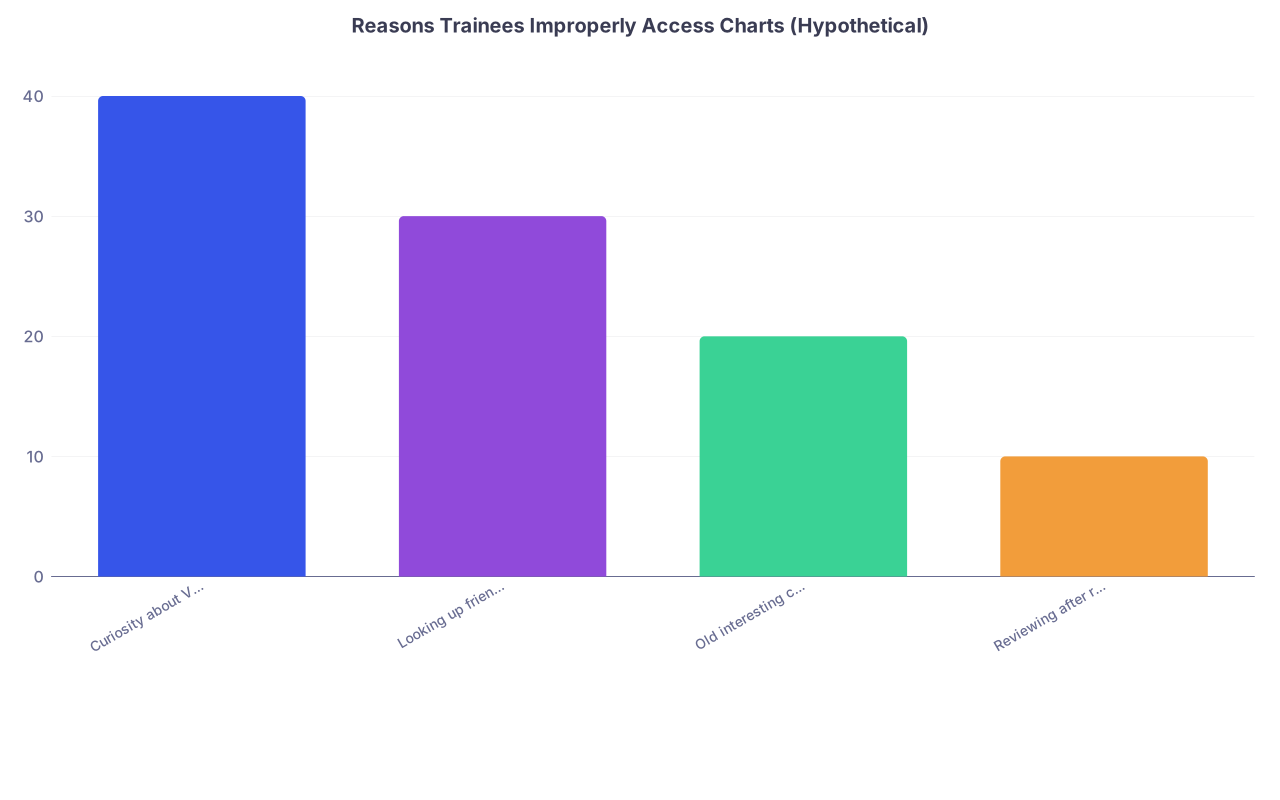
| Category | Value |
|---|---|
| Curiosity about VIP | 40 |
| Looking up friend/family | 30 |
| Old interesting case | 20 |
| Reviewing after rotation ended | 10 |
This one ends careers.
Every year someone looks up:
- Their ex who came into the ED.
- A celebrity admitted overnight.
- A co-resident’s partner who is in L&D.
- A newsworthy trauma case they heard about.
They poke around “just to see” labs or imaging. They never touch the patient. They never write a note. They think it is harmless curiosity.
Audits catch them. Audits always catch them.
Epic (and every serious EHR) logs exactly who opens each chart, when, and from what location. VIP charts are often flagged for extra auditing. Family members of employees are commonly monitored. Unusual access during off-service months is obvious in reports.
There is one rule you follow if you want to stay employed:
If you are not on the care team and you do not have a specific, legitimate, job-related reason to open that chart at that time, do not open it.
Not “I might be called later about this.” Not “I wanted to learn more about that condition.” Not “I was just curious.” Those are all illegitimate justifications from a HIPAA standpoint.
If you want to learn from an interesting case:
- Ask for a de-identified teaching case in conference.
- Review anonymized data provided by a supervising physician.
- Join structured case-based teaching sessions.
What you do not do is use the live production EHR as your personal textbook.
People lose hospital access and get reported to boards for this. I have seen graduating seniors delayed or derailed over a single “curiosity click.”
4. Printing, Sticky Notes, and “I’ll Toss This Later”

Everyone obsesses over EHR breaches and phones. Meanwhile, paper quietly causes a ridiculous number of violations.
Typical trainee mistakes:
- Leaving printed rounding lists at a café table across the street.
- Tossing labels, wristbands, or consult requests in regular trash.
- Forgetting a face sheet on the copier.
- Walking away from the resident workroom with patient lists lying open when housekeeping and transport walk through.
HIPAA protects PHI in any format. Paper is not exempt because it feels low-tech.
Watch for these traps:
Printed Lists Everywhere
Those census lists taped to computers? Your folded list in your white coat? If lost, that is a breach. Names, MRNs, diagnoses, room numbers—classic PHI.Improper Disposal
If it has a name, MRN, or any medical detail, it does not go in regular trash. It goes in shred bins or hospital-designated secure disposal. “I’ll shred it later” often becomes “I threw it out.”Sticky Notes and Scrap Paper
A quick note with “Mrs. Lopez 551 – CT at 1400, Cr 2.1”? That is PHI. Does not belong on your laptop lid, in your pocket for three months, or taped to the wall.
Practical way to avoid getting burned:
- Print the minimum you need, and destroy it the same day.
- Do a “paper sweep” whenever you leave a workspace: look for lists, printouts, labels.
- Do not bring printed lists off hospital campus unless there is a clear, approved reason (and you know the policy).
You will feel silly walking back to grab a single census sheet off a printer tray. Silly is better than fired.
5. Social Media: “De-Identified” Stories That Are Not

This is the landmine that keeps exploding despite a thousand warnings.
You see it every month:
- “Just had the most heartbreaking code on a 3-year-old with drowning in [city with one children’s hospital]…”
- “First delivery as an intern—twins at 24 weeks, mother is a nurse at our hospital and absolute rockstar.”
- “We had a mass casualty incident today… 15 victims from [specific event that was on the news]. I am so shaken.”
No names. Sometimes no ages. Still a problem.
Why? Because HIPAA cares about whether an individual can be reasonably identified. Not just by total strangers on the internet, but by the patient, their family, their employer, or anyone who knows they were involved in that event.
Combine:
- Your specialty and hospital (often in your bio)
- A unique clinical event
- Date or time frame
- Circumstances that were on the news
You have just described a real person.
Common rationalizations:
“I changed the age.”
Good. Not enough.“I waited a few days.”
Still not inherently safe.“Everyone posts about cases; it is part of wellness.”
Wrong. It is part of why people get reprimanded.
If you want to stay out of trouble:
- Do not post about active cases. Ever.
- Do not post about identifiable real-world events (local disasters, shootings, crashes) tied to your hospital role.
- Do not post clinical photos from your workplace, even without faces, unless your institution explicitly approves and you know the policy cold.
If you love “med Twitter” or Instagram:
- Talk about your feelings without clinical specifics.
- Use composite or fictionalized cases for teaching, clearly labeled as such.
- Share general reflections, not narrative case reports.
One angry family member who recognizes their story online is all it takes.
6. “Family and Friends Only”: Informal Updates That Cross the Line
Your mom texts: “Your uncle is in your hospital, do you know how he is doing?”
Your partner says: “My friend is in L&D, can you see if she delivered yet?”
Your best friend: “My roommate is in your ED, can you check if she is admitted?”
You want to help. You think, “I’m family,” or “They would want me to know.” That is how people end up in disciplinary hearings.
HIPAA does not give you a special exemption because you are related, because you are off duty, or because “everyone in the family already knows.” Your access to the EHR is for work. Not for curiosity. Not for family updates.
You may share information only if:
- You are involved in that patient’s care; and
- The disclosure is consistent with their preferences and hospital policies; or
- You have explicit documented permission / proxy / power of attorney and you are acting in that legal capacity, not in your role as hospital staff.
If you are not on that patient’s team:
- You do not open the chart.
- You do not call the nurse for an update “as a favor.”
- You do not text internal staff for info.
Tell family: “I cannot access or share information because of privacy laws. You should speak directly with the care team.” Then stop.
I have watched a resident get suspended for checking their own spouse’s labs without being on the team. They assumed marriage gave automatic permission. The law did not agree.
7. “Teaching” That Exposes More Than It Should
Teaching is not a HIPAA loophole.
Pitfalls:
- Presenting a detailed case at conference with full date of surgery, rare diagnosis, and demographic details that match the only such case in the region.
- Sharing your best “war stories” with medical students, including exact floor, bed, and timing.
- Sending a fully detailed case presentation to your personal email to work on at home.
Teaching is allowed under HIPAA, but you must still apply minimum necessary and de-identification principles. That means:
- Strip dates or shift them.
- Generalize ages (“40s” instead of “43”).
- Remove geographic and institutional identifiers where possible.
- Avoid extremely rare combinations of features that make someone uniquely recognizable.
Also: moving identifiable case material to personal cloud storage or personal email is a classic compliance problem. If you are working on a presentation, use your institution’s approved storage or VPN.
If your “amazing case” involves something that would be on the local news, be especially careful. Those are exactly the ones where a family member will realize you are talking about their relative.
8. Research and “Quality Projects” That Quietly Break Rules
| Activity | Common Hidden Risk |
|---|---|
| Retrospective chart review | No IRB or HIPAA waiver |
| Taking data home in Excel | PHI on personal device/cloud |
| Emailing datasets | Unencrypted email with identifiers |
| Sharing case logs | Including dates and MRNs |
| Student QI projects | No data-use approval from privacy |
You are asked to “pull some data” for a QI project. Or a fellow says, “Just grab all our COPD admissions from last year and we will present it at ATS.”
You log into the EHR, export, and save it to your laptop or Google Drive. Done.
And you have just created a significant HIPAA problem.
Safe research/QI use of PHI requires:
- IRB review or a documented QA/QI determination.
- Either a HIPAA authorization, waiver, or proper de-identification.
- Proper storage on institution-approved, secure systems.
You do not get to decide unilaterally that your spreadsheet is “fine because it’s just for QI.” You certainly do not get to email identifiable Excel files from your hospital email to your Gmail.
Major mistakes:
- Leaving MRNs or dates of birth in analytic datasets used on personal devices.
- Sharing “sample lines” of data with collaborators over regular email or messaging.
- Presenting case series with enough date and location detail to identify individuals.
Basic protections to avoid a mess:
- Ask: “Do we have IRB or privacy approval for this data pull?”
- Use only hospital-approved storage (shared drives, secure research environments).
- De-identify data before it leaves controlled systems whenever possible.
If your mentor’s answer is, “We don’t need IRB, this is just a resident project,” that is a red flag. Push back or involve the IRB / privacy office.
9. Overhearing, Gossip, and “Did You Hear About…”

| Step | Description |
|---|---|
| Step 1 | Hear dramatic case at work |
| Step 2 | Share story with friend |
| Step 3 | Friend repeats to someone connected |
| Step 4 | Patient or family recognize details |
| Step 5 | File complaint with hospital |
| Step 6 | Audit of chart access and disclosures |
| Step 7 | Disciplinary action for trainee |
One of the most underrated HIPAA risks is plain old gossip.
You hear about:
- A colleague’s mental health admission.
- A staff member’s miscarriage.
- A local politician’s surgery.
You tell your partner that night. Or you mention it to another resident: “Did you know Dr. X was in psych last month?” That is PHI. That is a disclosure. The fact that your listener is not a stranger but “someone you trust” does not matter legally.
Two specific categories that blow up fast:
Employee Health Information
When hospital staff become patients, their information is still protected. Sharing staff diagnoses, medications, or admissions outside of care duties can be a big problem.Substance Use and Mental Health
Extra-sensitive both legally and ethically. You do not get to become the unofficial channel for who is in rehab, who overdosed, or who attempted suicide.
The safe rule is simple:
- If it is not your patient, and you do not have a care-related reason to discuss them, you keep their situation to yourself.
- If someone volunteers their own health information to you, that is their story, not yours to repeat.
“I only told my spouse” is not a defense if it can be traced back and harms someone.
10. The Lazy Excuses That Will Not Protect You
I have heard every version of the same weak justifications:
“Everyone here does it.”
They might. The audit log does not care. The board does not care.“My senior told me it was fine.”
Your login, your responsibility.“I was just trying to help the patient.”
Intent does matter for disciplinary severity. It does not erase the violation.“It was only once.”
One time is enough.
You are a professional. That means you are expected to resist bad local culture when it conflicts with federal law and ethics. If your team routinely violates privacy, that is a reason to be more careful, not less.
Key Points to Walk Away With
Your curiosity, your phone, and your “teaching enthusiasm” are the biggest HIPAA risks. If you are not on the care team and not using an approved system, stop.
“No name” does not mean “no violation.” Combinations of details, images, dates, and locations can absolutely identify a patient.
Assume everything is auditable and traceable—because it is. Act like every chart you open and every story you share will be reviewed later with your name attached.


