

It is 4:45 p.m. You followed your senior resident into a cramped conference room for a “quick family update.” The patient is critically ill. The daughter looks exhausted. The son has his arms crossed. The attending starts talking, and you are standing in the corner, clutching your folded progress note, unsure what you are supposed to do.
Then someone asks you a direct question: “Doctor, will my father wake up again?”
You answer. And you answer wrong.
You do not just risk being “a little off.” You risk breaking trust that your team has spent days building. I have watched this happen. Families who were barely holding it together shut down after one careless student comment.
You are not powerless here. But you are dangerous if you do not understand the traps.
This is your field guide to the avoidable mistakes students make in family meetings that quietly (or loudly) damage trust.
1. Speaking Outside Your Lane
The biggest, most common, most dangerous mistake: you answer questions you are not qualified to answer.
It usually happens like this:
- The family asks a prognosis question in the hallway.
- Or asks, “So are we changing antibiotics?” while you happen to be in the room.
- Or asks about “what comes next” right after a family meeting as you are walking out.
And you, trying to be helpful and nice and not awkward, improvise.
Classic versions:
- “I think the cancer is stable.”
- “I am pretty sure they will be off the ventilator soon.”
- “We are going to send him to rehab after this.”
- “They will probably go home tomorrow.”
Then the attending comes in and says something completely different.
Trust dies in that gap.
How to avoid this mistake:
Memorize a safe default line.
Something like:- “That is an important question, and I do not want to mislead you. Let me confirm with Dr. Smith so we give you a clear, accurate answer.”
- “I am still a student, so I should not answer that one on my own. I will ask the team.”
Say it early in your rotation, even if you think you know the answer. It protects you and the patient.
Clarify your role at the start.
When introduced, make sure they know:- You are a medical student.
- You are part of the care team, but not a decision-maker.
This makes it less likely they take your words as final gospel.
Never wing prognosis or disposition.
If the question is about:- Prognosis
- Code status
- Major treatments (surgery, chemo, dialysis)
- Disposition (ICU vs ward, SNF vs home, hospice)
You do not answer. You defer to the attending/fellow/resident.
The law does not care that you “meant well.” Ethically, giving false reassurance is worse than saying “I do not know; I will find out.”
2. Over‑Sharing or Violating Confidentiality
Students routinely underestimate how easily they can cross confidentiality or privacy lines in family meetings.
I have heard:
- “His HIV is under good control” said casually, despite it never being discussed with that relative.
- “With his alcohol use, his liver is really damaged,” in front of a partner he explicitly did not want informed.
- “Given her past abortion…” in front of parents. Career-limiting move.
Sometimes the team has not clearly defined who is allowed access to what information. You assume that “family = OK to tell everything.” That is wrong. Legally and ethically.

Red-flag situations you must not step into:
- You are not sure if the patient wanted this particular person involved.
- The patient explicitly said “Do not tell my family about X.”
- There is visible family conflict (estranged spouse, new partner, step-children fighting).
- The patient lacks capacity and there is no clear healthcare proxy, but multiple relatives are present.
How to protect yourself and the patient:
Before the meeting, ask your team:
- “Who is the legal decision-maker here?”
- “Is there anything the patient does NOT want shared with family?”
- “Who are we allowed to discuss details with?”
Do not be the first to disclose sensitive diagnoses.
Let the attending handle:- HIV
- Substance use disorders
- Psychiatric diagnoses
- Pregnancy, abortions, STIs
- Genetic results with implications for relatives
If you are unsure, stop.
Say:- “I want to respect [patient’s] privacy. Let me check what has already been discussed with the team before I answer.”
You will never get in trouble for not over-sharing in a complex family situation. You will absolutely get in trouble for revealing something the patient kept private.
3. Giving False Reassurance or Vague Platitudes
Families are scared. You feel that. You want to make it better. So you grab for the nearest cliché:
- “He is strong, he will get through this.”
- “We are doing everything.”
- “It is going to be okay.”
- “She looks better today!” (She is not.)
This is emotional reflex, not clinical reasoning. It feels kind. It often is not.
Why this damages trust:
- When outcomes are bad, those lines feel like lies.
- They make it sound like you know the future when you do not.
- They can contradict the careful, nuanced uncertainty the attending just spent 20 minutes explaining.
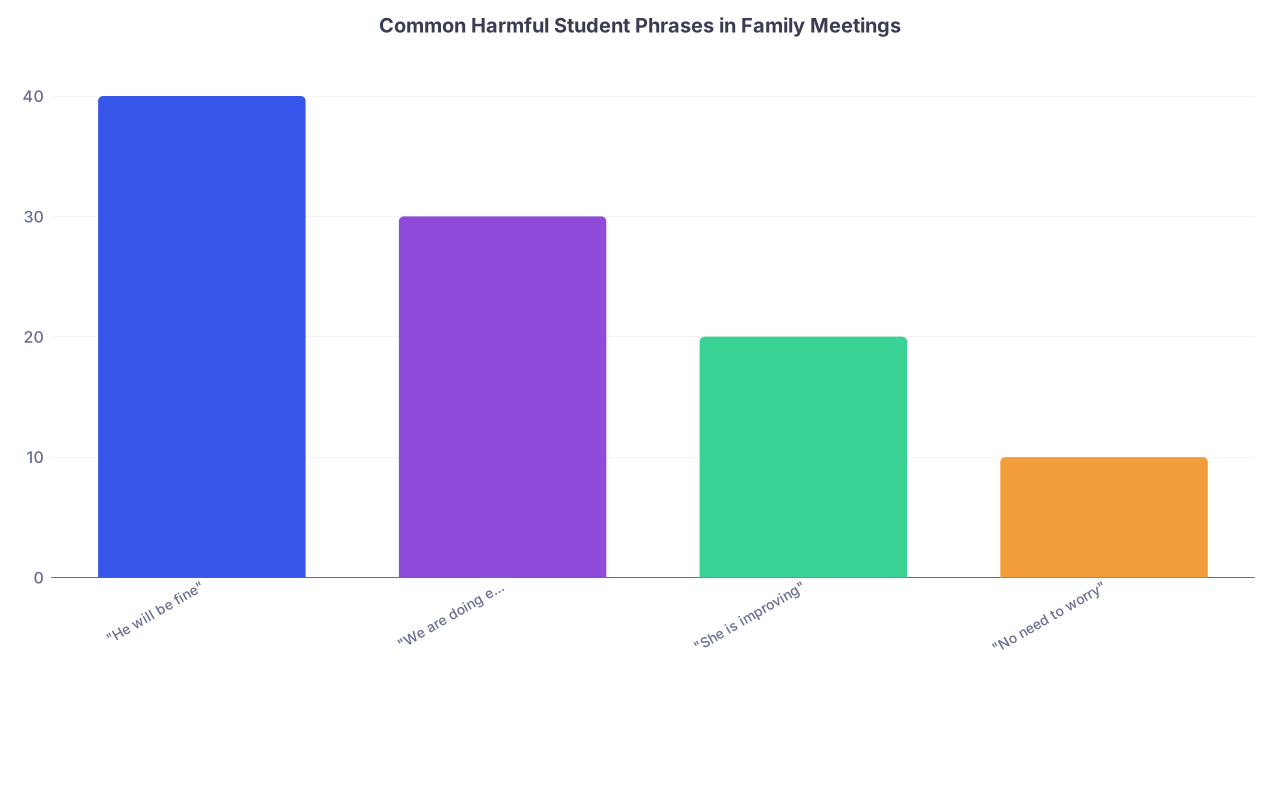
| Category | Value |
|---|---|
| "He will be fine" | 40 |
| "We are doing everything" | 30 |
| "She is improving" | 20 |
| "No need to worry" | 10 |
Better approaches that do not backfire:
Validate emotion without predicting outcomes:
- “This is really hard. It makes sense that you are scared.”
- “I can see how much you care about him.”
Be honest about uncertainty:
- “The team is watching her very closely. There are still things we do not know.”
- “We are monitoring how he responds over the next day or two.”
Align with the team’s message:
- If the attending said “We are worried he may not recover meaningful function,” do not later say “But miracles happen all the time.”
Never:
- Promise recovery.
- Promise comfort you cannot guarantee (“He will not suffer”).
- Promise timeframes (“He has a few months”).
You can support without lying. That balance is your ethical duty.
4. Ignoring Cultural and Language Barriers
Another frequent trust-killer: the student plows ahead in English with a family that clearly understands only fragments, or relies on the bilingual 13‑year‑old granddaughter to “interpret.”
I see:
- Students summarizing complex goals-of-care discussions in oversimplified, broken language.
- Using medical jargon because “they said they understood.”
- Turning to the most confident English speaker in the room, not necessarily the decision-maker.

Why this is not just sloppy, but unethical:
- Consent obtained through poor communication is not valid.
- Important nuances about values, religion, and cultural beliefs get lost or distorted.
- Families can appear to “agree” without actually understanding, then feel betrayed when reality diverges.
Avoid these specific mistakes:
Using family members as interpreters for serious conversations.
This is inappropriate for:- Code status
- Prognosis discussions
- Major treatment decisions
- New life‑changing diagnoses
Assuming basic conversational English = medical comprehension.
Someone can chat about the weather and not really grasp “multi‑organ failure and limited prognosis.”Speaking to the interpreter instead of the family.
Common and subtly dehumanizing.
How to do better:
Ask before the meeting:
- “Do we need a professional interpreter?”
Err on the side of yes.
- “Do we need a professional interpreter?”
When using an interpreter:
- Face and speak directly to the family member, not the interpreter.
- Use short sentences. Avoid jargon. Pause for interpretation.
- Check understanding with open‑ended questions, not “Do you understand?”
You do not control whether an interpreter is used. But you absolutely control whether you start unauthorized “side explanations” in a language you barely share.
5. Letting Your Body Language Betray You
You might say almost nothing in the whole meeting and still damage trust. Your posture, face, and side comments can completely undermine your attending.
Things I have actually seen students do:
- Eye‑roll when the attending repeats a prognosis explanation for the third time.
- Look visibly shocked when the attending says “I am worried your mom may not survive this hospitalization.”
- Whisper to another student during a key explanation.
- Check their phone in their pocket under the table.
Families see all of it. They are scanning faces for cues. When your nonverbal communication screams “This is bad,” “I disagree,” or “I am bored,” they remember that longer than they remember the actual words spoken.
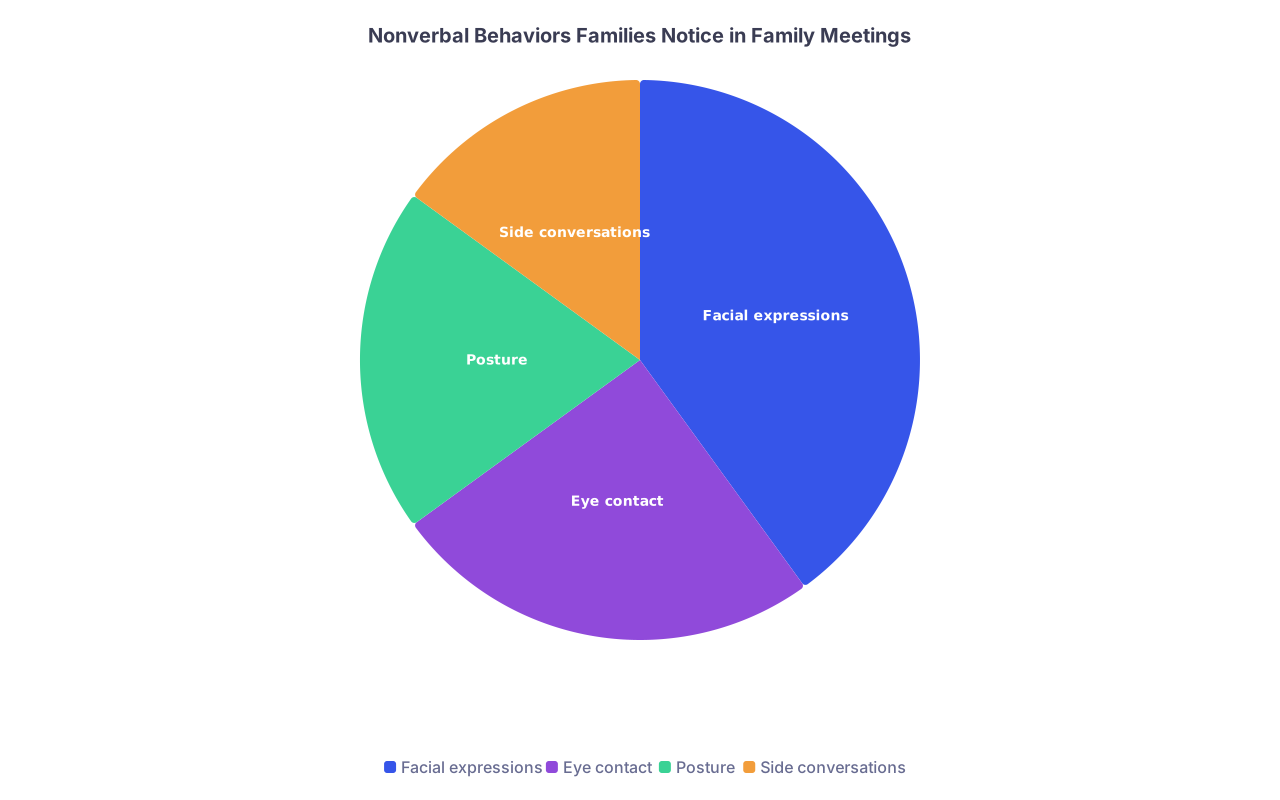
| Category | Value |
|---|---|
| Facial expressions | 40 |
| Eye contact | 25 |
| Posture | 20 |
| Side conversations | 15 |
Specific nonverbal mistakes to avoid:
- Inconsistent affect. Smiling or chuckling in a serious or grief‑filled moment because someone on the team made a side joke.
- Leaning away, arms crossed. Looks closed, disinterested, or judgmental.
- Staring at the monitor, the clock, or your notes instead of the speaker or the family.
- Visible surprise at a decision you should have heard in pre‑rounds (DNR change, hospice, etc.).
Safer nonverbal defaults:
- Neutral, calm facial expression.
- Slight forward lean when someone is speaking about something emotional.
- Hands resting on lap or table, not fidgeting, not folded aggressively.
- Phone silenced, out of sight. Always.
If you are not sure what to do: pick one family member to visually “anchor” to when they speak. Listen. That alone often improves your body language.
6. Arguing, Correcting, or “Clarifying” the Attending in Front of the Family
You notice the attending said “a 10% chance of survival,” but in your head, the last note said “15–20%.” Or you think they simplified something too much. You are itching to fix it.
So you jump in.
I watched a student say, right after an ICU attending:
- Attending: “We are worried he may not wake up in a way that lets him communicate again.”
- Student: “Well, sometimes people do better than expected…”
The family clung to the student’s comment. Weeks of careful expectation‑setting, torpedoed in one sentence.
Do not:
- Correct the attending’s numbers or wording in front of the family.
- Say, “Well, that is just one way to look at it.”
- Offer your “personal view” uninvited.
- Introduce new options the team has not agreed on (“What about ECMO?” when that is not on the table).
Ethically and practically:
- The team owes the family a unified, coherent message.
- If you undermine that coherence, you damage trust and make informed consent harder, not easier.
What you should do instead:
- Write a note to yourself.
- After the meeting, ask the attending privately:
- “I thought I saw in the chart that survival was estimated higher; can you help me understand what you chose to share?”
- “I almost said X; would that have been unhelpful?”
Every good attending will respect this. Some will thank you for catching things. But the right time is after, not in front of the family.
7. Making the Meeting About You (Emotionally or Academically)
Family meetings are not your learning sandbox. They are not your stage for “showing empathy” to impress eval writers. Families can smell performative behavior.
Things that cross the line:
Over‑sharing your own experiences:
“My grandfather died of cancer too, I know how you feel.”
No. You do not.Crying more than the family. Somehow making staff comfort you.
Asking medically detailed questions in front of the family that are clearly for your education, not their clarity:
- “Just to clarify, are we stopping the vasopressor because of receptor downregulation?”
- That is for the hallway, not the family.
Turning the discussion into a lecture:
- “So CPR success rates are actually much lower than on TV, like about 15%…”
You are there primarily to support the team and the patient/family, and to observe. It is okay to be human. It is not okay to center your own emotional or intellectual needs in their crisis.
Safer pattern:
During the meeting:
- Speak briefly, only when appropriate.
- Focus on their understanding, their questions, their emotions.
After the meeting:
- Debrief with your team.
- Process your emotions with a mentor, peer, or counselor. Not with the family.
8. Poor Preparation and Sloppy Details
Trust is not only about big moral principles. It is also about basic reliability. Families notice when the “student doctor”:
- Gets the patient’s age wrong.
- Misstates the cancer type or stage.
- Confuses “CT” and “MRI” when recounting what was done.
- Has to keep flipping through papers to answer simple timeline questions.
You might think, “I am just a student; they know that.” Does not matter. Every error adds to a subtle narrative: “These people are not fully on top of things.”
| Category | Example Error |
|---|---|
| Demographics | Wrong age or years of illness |
| Diagnosis | Wrong cancer stage/type |
| Timeline | Wrong day of surgery/admission |
| Treatments | Confusing meds or procedures |
| Code Status | Not knowing current decision |
What to do before a family meeting:
- Ask explicitly: “Can I review the chart for 5 minutes before we go in?”
- Know:
- Primary diagnosis in simple language.
- Key treatments done so far.
- Big “turning points” (ICU admission, surgery, complications).
- Current code status and surrogate decision-maker’s name.
If you are not going to speak at all, you still need this. Because families will corner you in the hallway. And your choices in that moment matter.
9. Not Disclosing Your Trainee Status Clearly
Some students like when families call them “Doctor.” It feels good. You worked hard. You start writing your name on the whiteboard as “Dr. [Last Name] (Student)” or mumble your role quickly: “I’m with the medical team,” hoping they do not probe further.
This is dishonest. Ethically wrong. And yes, potentially legally problematic.
The family has a right to know:
- Who is making decisions.
- Who is responsible for the plan.
- Who is still in training.
Avoid:
- Letting “Doctor” ride without correction.
- Using ambiguous self‑introductions: “I am part of the team,” full stop.
- Wearing long white coat in a way that implies you are an attending if you are not.
Clear, honest introductions:
- “I am [Name], a medical student working with Dr. Smith and the team. I help with your mom’s care and relay information to the team, but I do not make treatment decisions.”
- If they call you “doctor”:
- “I am actually a medical student, not a physician yet, but I am part of the care team and will make sure your questions get to the right people.”
Most families appreciate the honesty. Many will trust you more, not less.
10. Disappearing After Difficult Conversations
Last one is more subtle, but it matters.
After a hard family meeting—code status change, transition to hospice, clear “poor prognosis” talk—students often vanish. They are uncomfortable. They slip back to the workroom, scroll their phone, and wait for the next task.
Families see the abrupt emotional exit as: “They dumped this news and left.”
Even if you did not speak, you are part of that team in their eyes.
What you can do that builds trust instead:
- Stay in the room for a beat after the attending finishes, if the attending does.
- Offer small, contained support:
- “I will be just outside if you think of questions later. I can help get the team.”
- If culturally appropriate and you feel comfortable: offer tissues, water, or simply quiet presence.
You are not their counselor. You are not their savior. You are a consistent, respectful presence. That is enough.
FAQs (Exactly 5)
1. As a student, am I even allowed to speak in family meetings?
Yes, but cautiously. Your primary roles are to observe, support, and clarify small factual points when invited by the team. You should avoid discussing prognosis, code status, or major treatment decisions unless an attending explicitly asks you to contribute, and even then, stay in your lane.
2. What should I do if a family member corners me in the hallway with serious questions?
Do not improvise. A safe response: “That is a very important question, and I do not want to mislead you. I am a medical student; let me grab the senior doctor so you can get a clear answer.” Then actually do it. You can also jot the question down to ensure it is addressed in the next formal meeting.
3. Can I share my own similar life experience to build rapport, like a death in my family?
Generally, no. It often shifts the focus to you and assumes equivalence between their situation and yours. If you do reference your experience, it should be brief, clearly framed (“This is different from your situation, but…”), and only if it obviously helps them feel less isolated—not to process your own grief.
4. Is it ever okay to contradict the attending if I think they are wrong?
Not in front of the family. That undermines trust and creates confusion about who to believe. Instead, raise your concern privately after the meeting: “I was confused about X; could we clarify that?” or “I thought the plan was Y; did I misunderstand?” If there is a serious ethics concern, use your chain of command or ethics consult services.
5. How do I handle it when I become emotional during a family meeting?
Mild visible emotion (tearing up, softer voice) can be appropriate and human. When your emotion starts to compete with or overshadow the family’s, you need to step back. If you feel overwhelmed, ask quietly to be excused (“I am feeling faint; I need a moment”) and debrief with a mentor afterwards. Do not turn the family into your emotional support system.
Key points to walk away with:
- Do not speak beyond your training—especially about prognosis, code status, and major decisions.
- Protect confidentiality and clarity: use interpreters, avoid over‑sharing, and never contradict the team in front of the family.
- Your body language, honesty about your role, and small choices around presence either build trust or quietly erode it. Choose carefully.


