

It is 10:45 p.m. You are a PGY-2 on wards, finally home, half-asleep on the couch. Your phone lights up: text from a patient you gave your personal number to “just in case.”
“Hey doc, sorry so late. I did not know who else to talk to. Can I ask you something kind of personal?”
You are tired, flattered, and a little concerned. You start typing back.
Stop there. That is exactly how careers start to crack. Not with some dramatic affair or envelope of cash, but with a small, “kind” exception to a boundary that felt harmless in the moment.
This is what I want to protect you from.
Boundary violations are not just about sex or obvious misconduct. A surprising number of doctors get investigated, sued, or quietly pushed out because they drifted into grey zones: gifts, “friendly” texting, minor prescribing favors, little confidentiality slips. I have watched residents who were excellent clinicians become radioactive to hiring committees because of one avoidable boundary mistake.
Let us go through the big traps that can end your career early—and how to not be the cautionary tale other people whisper about at M&M.
1. The “I Was Just Being Nice” Trap
This is the most common story I hear when someone is sitting in front of a professionalism committee.
“I was just being nice.” “I didn’t want to be rude.” “I did not think it was a big deal.”
Classic early-career setup. You want to be liked. You want to be “that doctor” patients rave about. So you bend.
Common “nice” boundary slips:
- Giving your personal cell or social media handle to patients
- Accepting large or repeated gifts
- Agreeing to meet outside the clinical setting “just as friends”
- Oversharing personal details about your life to build “rapport”
- Letting visits turn into counseling sessions way outside your scope
Here is where it gets ugly: those “nice” gestures become the foundation of a later allegation.
- “They pursued a personal relationship with me.”
- “They confided in me about their own problems.”
- “They let me text them anytime about anything.”
Boards and hospitals do not care that your intention was benign. They look at the pattern and ask one question: Was the boundary clear and professional? If not, you lose.
How to avoid this mistake
- Keep contact channels professional only (clinic messaging systems, office numbers).
- Decline social media connections with patients across the board—no exceptions.
- Have a stock phrase ready:
“I need to keep our relationship professional so I can give you the best care. Let us keep communication through the clinic.” - If a patient starts confiding about you (“How are you doing, doctor?” “Are you married?”), gently redirect:
“Thank you for asking, but this time is for your health. Tell me more about…”
You are not rude for maintaining a boundary. You are competent.
2. The Slippery Slope to Emotional or Sexual Involvement
Let me be blunt: getting romantically or sexually involved with a current patient is one of the fastest ways to destroy your career and invite a board action that will follow you forever.
I have seen this play out almost always the same way:
- Boundary softening: longer visits, more self-disclosure, inside jokes, casual nicknames.
- Increased availability: replying to non-urgent messages late at night, “checking in” more than clinically needed.
- Personal channel shift: texts, social media, maybe coffee “to talk more.”
- Emotional entanglement: “We just connected; I forgot I was the doctor.”
- Board complaint: often after a conflict, breakup, or perceived abandonment.
By the way, “consent” here does not rescue you. Power differential kills that argument. Ethically and legally, you are the professional. You own the responsibility to keep it clean.
Red flags you are on the slope
- You look forward to seeing a particular patient more than is reasonable.
- You think about them outside work, not in a clinical context.
- You change your schedule to see them personally even when not necessary.
- You feel a little jolt of panic at the idea of someone reviewing your messages with them.
- You tell yourself, “I am not doing anything wrong; we are just friends.”
That internal debate is the siren. You already know.
The hard rule that protects your license
- No romantic or sexual relationship with current patients. Period.
- With former patients, many boards still consider any relationship unethical for a defined period (sometimes years), especially in psychiatry, oncology, OB/GYN, and other long-term or vulnerable specialties.
- Even if technically allowed after a cooling-off period, it is radioactive legally. Once someone has been your patient, they can later argue that the power imbalance persisted.
If you find yourself attracted to a patient:
- Transfer their care to a colleague early.
- Document clearly and neutrally why (“patient requested transfer” or “fit with another provider”).
- Discuss with a trusted senior physician or ethics office—not your co-resident gossip circle.
- Do not “stay friends.” Make a clean, documented, professional separation.
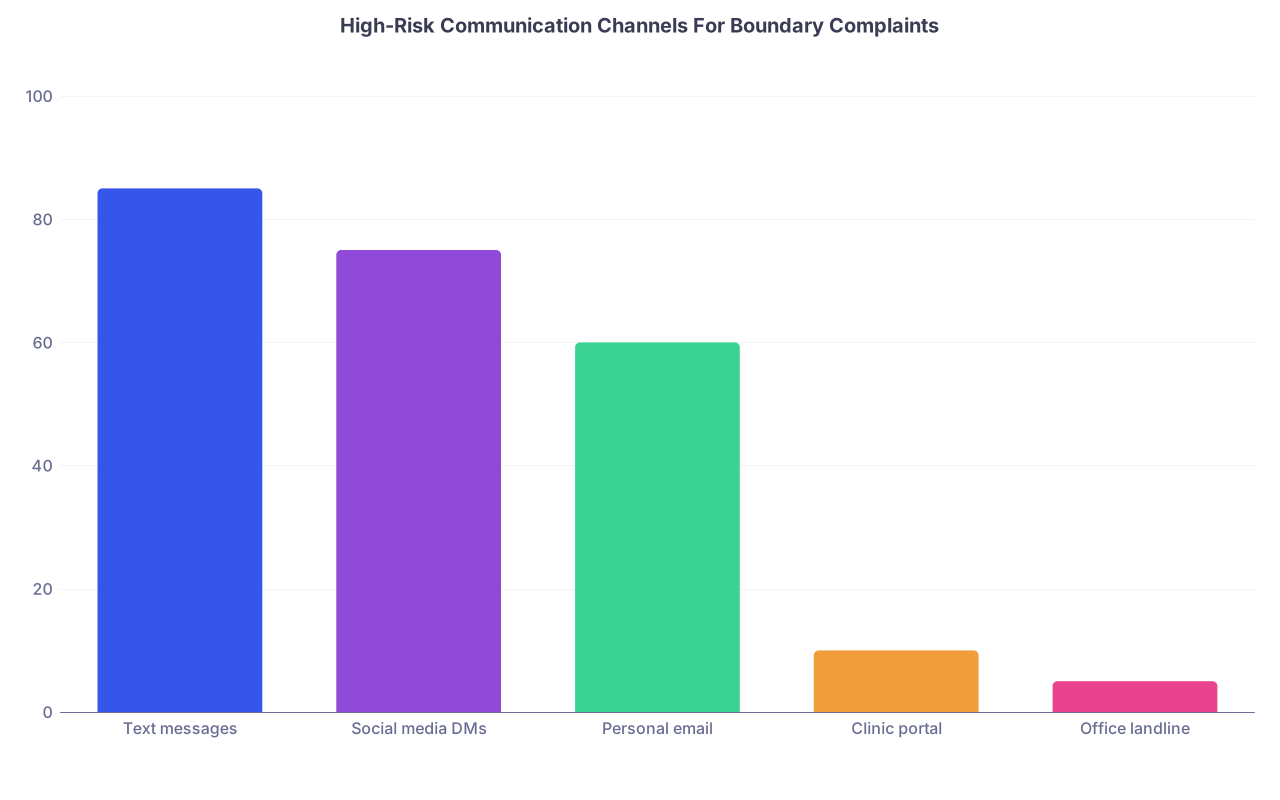
3. Digital Boundaries: Texts, DMs, and Late-Night Messages
Electronic communication is one of the biggest modern career-killers because it leaves a perfect, screen-shotted record.
The mistake pattern:
- Resident gives personal number for convenience.
- Patient starts texting about symptoms.
- That turns into texting about stress, work, relationships.
- Boundaries erode; tone gets informal.
- Something ambiguous gets sent (“You can always talk to me” at 1:30 a.m.).
- Months later: complaint filed with full text threads attached.
You cannot explain your tone to a medical board. They read it in silence, out of context, and with a risk-averse lens.
| Category | Value |
|---|---|
| Text messages | 85 |
| Social media DMs | 75 |
| Personal email | 60 |
| Clinic portal | 10 |
| Office landline | 5 |
Yes, I am opinionated about this: texting and DMs with patients from your personal accounts are malpractice for your future.
Rules that keep you out of trouble
- Zero clinical care via personal text, WhatsApp, or social media. None.
- No adding patients on Instagram, Facebook, TikTok, LinkedIn. If your institution demands professional social media, keep it public, generic, and do not interact privately.
- Use only approved, logged channels (EHR messaging, clinic phone system).
- Never send anything you would be uncomfortable having printed in front of:
- Your program director
- A jury
- A state licensing board
If a patient somehow gets your personal number (call forwarding, hospital directory) and texts you:
- Reply exactly once, redirecting:
“For your safety and privacy I cannot communicate about care on this line. Please call the clinic at [number] or send a message through the patient portal.” - Document the interaction in the chart.
- If it persists, loop in risk management or your supervisor early.
4. Favor Prescribing and “Just This Once” Medication Requests
Here is another quiet career killer: prescribing controlled substances or “favors” outside proper boundaries.
It often starts with:
- A colleague’s friend asking for antibiotics.
- A family member wanting ADHD meds.
- A long-term patient asking if you can also prescribe for their spouse.
- A patient begging: “Please, I am out of my Xanax and my doctor is away.”
You want to help. You do not want to be the “unsympathetic” doctor. So you override your discomfort.
Then:
- A complaint lands about overprescribing or diversion.
- Pharmacy reports concerning patterns.
- Your name appears in a narcotics review program.
- Board investigates. Every informal prescription is now inspected.
Prescribing for yourself, close friends, or family is explicitly restricted or prohibited in many jurisdictions, especially for controlled substances. Even when legal, it is often a bad idea and a red flag in credentialing reviews.
High-risk prescribing mistakes
- Refilling controlled substances for someone you have never formally evaluated.
- Prescribing outside your specialty without full assessment “as a favor.”
- Prescribing for yourself (benzos, stimulants, opioids, sleep meds) outside formal care.
- Using hospital privileges to help out non-patients (e.g., printing scripts for neighbors).
| Situation | High-Risk Choice | Safer Alternative |
|---|---|---|
| Friend wants antibiotics | Call in script “as a favor” | Advise clinic/urgent care visit |
| Family needs ADHD meds | Start meds yourself | Refer to another clinician |
| Patient out of opioids early | Refill without review | In-person/telehealth assessment + contract |
| Staff member asks for benzos | Quick prescription | Direct to employee health/PCP |
| Personal insomnia | Self-prescribe hypnotic | See your own physician |
How to keep your license intact
- Know your state and institutional policies on self-prescribing and family prescribing.
- Say this sentence often: “I cannot safely prescribe without a proper evaluation in the medical record.”
- Use formal visits, proper documentation, and appropriate monitoring for any controlled substance.
- If you feel you are being emotionally pressured, that is your signal to slow down, not speed up.
Boards are far less forgiving about prescribing issues than you think. It is seen as a systems-level risk, not just a personal mistake.
5. Confidentiality Blunders: Social, Educational, and “Anonymous” Stories
HIPAA violations do not always look like hackers or lost laptops. Many look like you at dinner complaining about a “crazy case” with just enough detail for someone to recognize themselves.
Classic mistakes:
- Talking about patients in elevators, cafeterias, rideshares, or public spaces.
- Posting “de-identified” stories on social media with unique details (age, rare condition, timing, location).
- Using patient photos or radiology images in teaching without proper authorization.
- Sharing patient details with family members who are not on the HIPAA release because “they are clearly involved.”
Once a patient or their family recognizes the story, you are exposed. If it hits the media or administration, your job is on the line.
Social media: where smart people do stupid things
You think, “I changed the age and did not use a name, so it is fine.” Then:
- The patient’s relative sees your post.
- Or a nurse recognizes the case timeline.
- Or the community knows there was only one 23-year-old with that rare diagnosis this week.
Suddenly your “anonymous story” is a confidentiality breach.
Simple rule: if there is any realistic chance someone could recognize the patient or themselves, do not share it publicly. Teaching cases belong in educational settings with proper de-identification and permissions, not in your Instagram caption.
Safe practices
- No clinical conversations where strangers can overhear.
- No patient stories on personal social media. None. Not even “inspiring” ones.
- Use proper channels and consents for photos, media, or case reports.
- When discussing cases in teaching, scrub or change identifiable details to the point the actual patient would not recognize themselves.
And if you do slip? Report it early to your institution’s privacy or compliance office. Self-reporting, with a corrective plan, often protects you more than hiding it.
6. Dual Relationships and Role Confusion
You live in a small town. Or you train where you grew up. Or your community is tight-knit. You will absolutely run into situations where patients are also:
- Coworkers
- Friends of friends
- Religious community members
- Neighbors
- Teachers of your children
- Your Uber driver
This is where dual relationships become real. You are both physician and something else.
Boundary mistakes in dual relationships:
- Becoming the unofficial clinician for your social group.
- Treating people you supervise or are supervised by.
- Using your medical role to influence non-medical interactions (e.g., “Remember I treated your child” to get favors).
- Letting personal conflicts bleed into clinical decisions.
In small communities some dual relationships are unavoidable. What you cannot do is pretend that does not change the risk.
Strategies that prevent disaster
- When possible, avoid being the primary clinician for people you have close non-medical ties to.
- If you must see them (rural settings, limited access), document the dual role and your rationale.
- Be hyper-transparent: explain clearly how privacy and professional standards will apply, and what you will not discuss socially.
- Set strict documentation and referral thresholds—refer out early for anything sensitive or potentially conflict-laden.

| Step | Description |
|---|---|
| Step 1 | Notice boundary concern |
| Step 2 | Transfer care to colleague |
| Step 3 | Document and consider referral |
| Step 4 | Redirect to clinic systems and document |
| Step 5 | Review policy and formalize visit |
| Step 6 | Consult supervisor or ethics |
| Step 7 | Is there emotional or romantic involvement? |
| Step 8 | Is there a dual role or social tie? |
| Step 9 | Is communication outside approved channels? |
| Step 10 | Is prescribing involved? |
The key move: you act early, not after months of blurred lines.
7. Documentation and “Invisible” Boundary Problems
A boundary problem without documentation looks much worse than a properly documented, uncomfortable situation.
Look at this difference:
- Scenario A: No notes. Lots of informal conversations. Late-night calls. No record of clinical reasoning.
- Scenario B: Clear notes explaining counseling, options discussed, patient decisions, plan, and reasons for follow-up.
In an ethics review, Scenario A screams “cover-up” or “sloppy at best.” Scenario B may still be messy, but at least looks like medicine, not chaos.
Common documentation mistakes tied to boundary issues:
- Not documenting nonstandard interactions (after-hours phone calls, unplanned encounters).
- Leaving out sensitive topics because they feel awkward to write (“discussed sexual side effects”; “patient made personal remarks”).
- Letting visits drift far beyond the billed service (e.g., extensive psychotherapy-level counseling in a 99213 with no note of it).
When boundaries are questioned later, your note is your only ally. Or your biggest enemy.
How to document protectively (without being paranoid)
- If anything about the interaction felt off, document it neutrally:
- “Patient requested to discuss non-medical personal matters; redirected to focus on treatment.”
- “Declined patient request for social media contact; advised using clinic messaging.”
- “Patient expressed feelings of attachment; normalized and discussed professional roles.”
- Capture the clinical rationale for your decisions, especially if they were emotionally charged.
- If you declined a request (medication, note, referral), say so and why.
You are not writing for today’s visit. You are writing for Future You, sitting in a deposition five years from now.
FAQs
1. What if my specialty basically requires close, long-term relationships (psychiatry, oncology, palliative care)? How do I avoid boundary problems without being cold?
You can be deeply empathic and present without being enmeshed. The trick is not to strip out warmth, it is to strip out ambiguity. You:
- Show care and concern, but you keep conversations clearly focused on the patient’s world, not yours.
- Acknowledge powerful emotions (“It makes sense you feel attached; we have been through a lot together”) and then explicitly reinforce the professional frame (“My role is to help you as your physician, not as a friend or family member”).
- Use structured boundaries: clear session times, no off-the-record chats, consistent communication channels.
- Get regular supervision or consultation to process your own feelings about complex patients, so you are not unconsciously using them to meet your emotional needs.
Most clinicians who get into serious trouble were not “too caring.” They were using the relationship to fill their own gaps and did not admit it early enough.
2. A patient asked me out / flirted / made a sexual comment. If I shut it down, can that still come back to hurt me?
It can hurt you more if you ignore it than if you address it correctly. The safest route:
- Respond clearly but respectfully in the moment:
“I want to be very clear: I am your physician, and our relationship needs to stay professional so I can take good care of you.” - Immediately redirect to clinical topics.
- Document the incident in factual, nonjudgmental language:
- “Patient made flirtatious remark; reminded patient of professional boundaries and continued visit.”
- If it recurs or feels unsafe, discuss with your supervisor, program director, or risk management. Consider chaperones or transferring care.
Boards and administrators usually punish ambiguity or participation, not a documented, professional response to a patient crossing a line.
3. How do I know when a boundary issue is serious enough to involve my program director, ethics, or legal—not just handle it myself?
Use this rule: if you would be anxious seeing the interaction on paper in front of a licensing board, you escalate.
Red flags that warrant higher-level input:
- Anything romantic, sexual, or suggestive—no matter who initiated it.
- Persistent communication on personal channels despite redirection.
- Requests for inappropriate medications, falsified notes, or “favors” that make you uncomfortable.
- Dual relationships that you cannot cleanly restructure (e.g., you are both their direct supervisor and physician).
- Any situation where you feel pressure to do something you would not want publicly known.
Your next step today: pick one patient relationship that feels even slightly “grey” and write down, in one sentence, what about it makes you uneasy. Then decide a concrete move—document more clearly, redirect communication, transfer care, or talk to a supervisor—and put that step on your calendar for this week.


