

30–40% of formal complaints about doctors are primarily about communication, not clinical errors.
That single number undercuts a comforting myth: that if you “know your stuff,” you will not get complained about. The data say otherwise. For many physicians, the problem is not the medicine. It is how the medicine is delivered.
The ethical question underneath your title is blunt: if medicine is supposed to respect autonomy, dignity, and justice, do communication skills programs actually change behavior enough to reduce harm, conflict, and complaints? Or are they just check‑the‑box CME theater?
Let us walk through what the evidence actually shows.
1. What Patients Complain About: The Base Rates
Before evaluating communication training, you need a baseline. What are people actually complaining about?
Across multiple health systems:
- Roughly 60–70% of complaints involve relational or communication issues (not just technical care).
- Only 10–20% of complaints are about purely technical competence.
- The rest cluster around systems (delays, access, billing) where communication usually exacerbates frustration.
A large UK analysis of >59,000 complaints to the NHS found that:
- 34% related directly to staff–patient communication (tone, listening, explanations).
- 29% related to respect and dignity (being ignored, rushed, or dismissed).
- Less than a third were driven mainly by “clinical” factors.
Similar patterns show up in Australian, Canadian, and US datasets: patient dissatisfaction is dominated by “how I was treated” rather than “what treatment I got.”
So if you are looking for levers to reduce complaints, communication is not marginal. It is central.
2. What Counts as a “Communication Skills Program”?
The phrase “communication skills program” covers a messy array of interventions. You cannot talk about impact on complaints without slicing the interventions more precisely.
Most structured programs fall into a few buckets:
Short workshops (4–8 hours)
- Often single‑day CME.
- Focus on generic skills: open questions, empathy statements, summarizing.
- Mixed evidence on durable effects; many studies show immediate gains, fade at 3–6 months.
Longitudinal curricula (20–40+ hours)
- Spread over weeks or months.
- Include practice, feedback, sometimes simulated patients.
- More likely to show sustained behavior change.
Targeted programs
- Breaking bad news (SPIKES), serious illness conversations.
- Informed consent quality.
- De‑escalation of conflict or complaints handling.
Remedial or high‑risk physician programs
- Aimed at clinicians with repeated complaints / low patient satisfaction.
- Often mandated by regulators or institutions.
- Data here are particularly relevant if your outcome is “complaints.”
Content tends to include:
- Listening and eliciting concerns.
- Structuring consultations.
- Explaining risks, benefits, and uncertainty.
- Shared decision‑making.
- Managing emotions – both patient and physician.
- Dealing with conflict and anger.
Now to the core question: do these actually move the needle on formal complaints?
3. From Training to Behavior to Complaints: The Causal Chain
You cannot just ask, “does training reduce complaints?” without unpacking the intermediate steps. The realistic chain looks like:
- Training → improved measured skills (simulated or real encounters).
- Skills → improved patient‑reported experience (satisfaction, trust, feeling heard).
- Experience → reduced complaints, grievances, litigation risk.
The evidence is strongest at step 1, weaker but decent at step 2, and thinnest (though not zero) at step 3.
3.1 Step 1: Do Programs Improve Communication Behaviors?
On aggregate, yes – especially if they are more than a one‑off lecture.
Meta‑analyses of physician communication training (family medicine, oncology, internal medicine) consistently show:
- Moderate improvements in observable communication behaviors (coded from audio/video recordings).
- Effect sizes typically in the 0.3–0.6 SD range for skills like empathy statements, checking understanding, and agenda setting.
One example: a randomized trial of oncologist communication training (about 30 hours total, with role‑play, feedback, and video review) showed:
- A 2–3 fold increase in empathic responses to patient cues.
- A significant reduction in blocking behaviors (interrupting, changing subject).
So, as far as skills acquisition goes, the data are clear: well‑designed programs change what clinicians do in the room.
3.2 Step 2: Do Patients Perceive a Difference?
Patients do not care about your codable skill frequency; they care about feeling heard, respected, and informed.
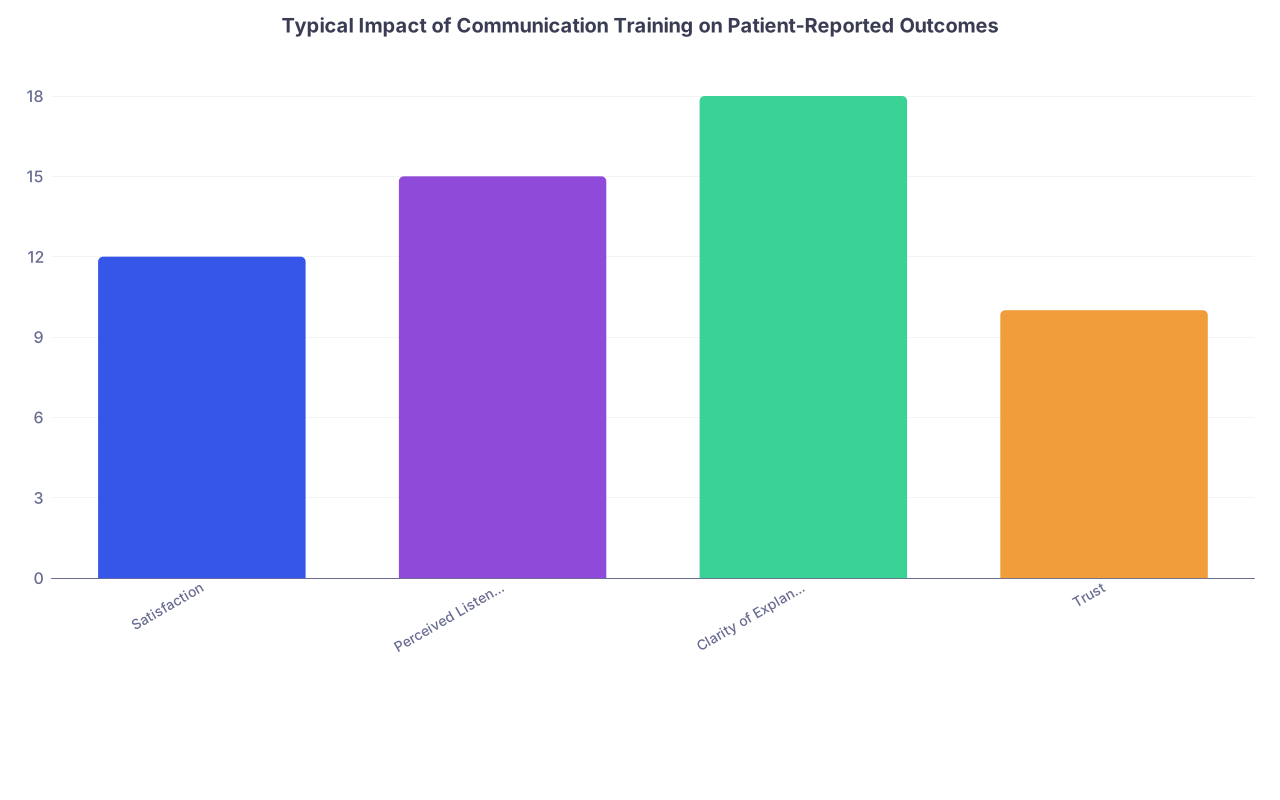
Patient‑reported outcomes after communication training usually show:
- Improved satisfaction scores (small to moderate effects).
- Better ratings of clinician listening and explanations.
- Sometimes lower reported anxiety and higher trust.
| Category | Value |
|---|---|
| Satisfaction | 12 |
| Perceived Listening | 15 |
| Clarity of Explanation | 18 |
| Trust | 10 |
Values are indicative percentage improvements drawn from multiple trials (not a single study), but the pattern holds: double‑digit relative gains on relational metrics in many settings.
So the first two steps of the chain – training → behavior → patient experience – are supported.
The hard part is step 3: complaints.
4. Do Communication Skills Programs Reduce Complaints?
Here the evidence thins out significantly, but there are still some meaningful data points, especially among high‑risk clinicians and in medico‑legal datasets.
4.1 Overall Complaint Volume: Weak Direct Evidence
Most communication training trials are not powered or designed to detect differences in rare events like formal complaints or lawsuits. Complaints per doctor per year are usually low (often <1), so you need large samples and long follow‑up.
This is why you see many studies stop at satisfaction or observed skills and never even mention complaint rates.
That said, a few lines of evidence matter:
- Practices and departments with higher patient experience scores consistently show lower complaint volumes and medico‑legal claims, even after adjusting for case mix.
- Communication failures are a contributing factor in a majority of malpractice claims. Fixing that factor should, in theory, reduce risk.
But theory is not enough. You want numbers.
4.2 High‑Risk Physician Programs: Stronger Signals
The most telling data come from “remedial” programs where physicians with high complaint rates are sent (or required) to undergo intensive communication and professionalism training.
One widely cited example is the Patient–Physician Communication (PPC) program in North America, targeting physicians with high complaint rates. Reported data show:
- Pre‑intervention: complaint rates several times higher than peers (e.g., 3–5 complaints per 1000 encounters).
- Post‑intervention: estimated 30–60% reduction in complaint rates over 2–3 years of follow‑up.
- Not every participant improved; a minority remained high‑risk and triggered further action.
The effect sizes are not trivial. A high‑risk physician generating, say, 4 complaints/year who drops to 2–3 complaints/year is not suddenly a saint, but the institutional and medico‑legal impact is substantial.
Similarly, some UK and Australian programs focused on doctors referred for communication / behavior concerns show:
- Clear drops in substantiated complaints post‑training.
- Improved collegial feedback and patient satisfaction where measured.
Is this perfect causal proof? No. But it is a consistent pattern: targeted, intensive communication‑and‑professionalism programs do appear to reduce complaints among the worst offenders.
4.3 Population‑Level Training: Indirect Evidence
What about mandatory communication training for all trainees or all staff?
Here the data are more indirect:
- Institutions that systematically invest in relationship‑centered care and communication training often report downward trends in complaints and claims. But these are usually part of multi‑component quality initiatives, so isolating the effect of communication is hard.
- Some longitudinal datasets show that as patient experience scores rise, complaint rates fall, time‑lagged. Communication training is typically one of the main interventions driving those experience scores.
For example, a large hospital that introduced:
- Structured communication training (especially around informed consent and expectations).
- Standardized pre‑operative conversations.
- Improved documentation of discussions.
Reported:
- A 20–30% reduction in surgery‑related complaints and medico‑legal notifications over several years.
Was that entirely the training? No – there were parallel safety and system changes. But communication training was not irrelevant. It was one of the main “active ingredients” when you looked at complaint narratives.
5. Where Training Has the Biggest Ethical Payoff
From an ethics and risk perspective, not all communication failures are equal. The data show high‑yield zones where training seems particularly potent in reducing complaints.
5.1 Informed Consent and Expectation Management
Many complaints and lawsuits do not hinge on the underlying complication. They hinge on the sentence: “No one told me this could happen.”
Programs that tighten up how informed consent is obtained show:
- More explicit discussion of risks and alternatives.
- Better checking of understanding (teach‑back).
- More realistic framing of benefits and likely outcomes.
The downstream effect:
- Lower rates of complaints claiming “I was not informed.”
- Stronger defense position when complications occur (ethically and legally).
This is especially powerful in surgery, oncology, and procedures with known, serious risks.
5.2 Breaking Bad News and Serious Illness Conversations
Poorly delivered bad news creates a disproportionate share of formal grievances. Not always immediately – sometimes months later, when families process what happened.
Structured training programs (SPIKES and variants) have shown:
- Clear improvement in clinician confidence and skill.
- Better patient/family ratings of compassion, clarity, and honesty.
These interactions are exactly where ethics, law, and communication collide:
- Autonomy: understanding prognosis and options.
- Non‑maleficence: avoiding avoidable psychological harm.
- Justice: transparent explanation when resources or options are limited.
Complaint metrics here often show fewer allegations of “being misled” or “no one was honest with us.”
5.3 Managing Conflict and Early Complaints
There is a separate category of training: de‑escalation and complaint handling.
Programs teaching clinicians and front‑line staff how to:
- Listen actively to anger without becoming defensive.
- Validate emotions while clarifying facts.
- Offer realistic remedies or next steps.
- Know when and how to involve mediators or patient‑relations.
Hospitals implementing such training with parallel process changes often see:
- A shift from formal complaints to informal resolutions.
- Lower escalation to legal counsel or ombudsman.
Ethically, this is about respect and responsiveness. Legally, it is about resolving issues early before they formalize into something with a letterhead.
6. Where the Evidence Is Weak or Overhyped
You will hear sweeping claims that “communication skills training reduces malpractice risk by 70%.” The data do not support numbers that clean or that large.
Main limitations in the literature:
- Small numbers of events. Complaints and lawsuits are rare per physician; you need large cohorts over years to detect real effects.
- Confounding. Communication training is frequently bundled with other quality or culture initiatives.
- Selection bias. The most motivated clinicians self‑select into voluntary programs and may have declining complaint trends anyway.
- Short follow‑up. Many studies stop at 6–12 months, while complaint trajectories may stretch over several years.
The ethical risk is obvious: if institutions believe “we did a two‑hour workshop, so our complaint risk is reduced,” they are deluding themselves. The data do not back that.
The programs that show serious downstream effects share characteristics: intensity, practice with feedback, longitudinal reinforcement, and often targeting of higher‑risk clinicians or high‑stakes scenarios.
7. What Actually Works: Design Features That Matter
When you look across studies and institutions, certain features correlate with better outcomes (including reduced complaints where measured):
- Duration and repetition. More than 8 hours, spread over time, with refreshers. A single seminar does not rewire consultation habits.
- Behavioral practice. Role‑play, simulated patients, video review. Passive lectures do little.
- Specificity. Programs focused on informed consent, bad news, or conflict management are more likely to affect complaints than ultra‑generic “communication” lectures.
- Feedback. Individualized data on patient complaints, satisfaction, or observed behavior, not just generic advice.
- Targeting high‑risk groups. Focusing on physicians with outlier complaint profiles shows the clearest payoff in reducing complaints.
Here is a simplified comparison:
| Program Type | Typical Hours | Practice/Feedback | Evidence of Complaint Reduction |
|---|---|---|---|
| One-off CME lecture | 1–3 | No | Minimal to none |
| Basic workshop series | 6–12 | Some role-play | Indirect (better satisfaction) |
| Longitudinal curriculum | 20–40+ | Yes | Likely indirect reduction |
| Targeted consent/bad news | 8–16 | Yes | Fewer specific complaint types |
| Remedial high-risk program | 20–40+ | Intensive | Clear reduction for many |
If your main institutional goal is to reduce complaints and ethical conflicts, the smart money is on targeted, high‑intensity programs for:
- High‑risk clinicians (multiple complaints, low satisfaction, peer concerns).
- High‑risk clinical situations (procedures, oncology, ICU, end‑of‑life).
8. Ethical and Legal Implications: Beyond Risk Management
Framing communication training purely as a way to “cut complaints” is ethically shallow. But the risk data do intersect with core bioethical principles.
8.1 Respect for Autonomy
Poor communication is the most common way autonomy is undermined in modern medicine. Patients cannot make meaningful choices if they:
- Do not understand risks, benefits, or alternatives.
- Feel rushed, dismissed, or pressured.
- Are excluded from weighing what matters to them.
Complaint data are full of autonomy failures: “I had no idea,” “No one asked me,” “They decided without me.” Communication training that raises the quality of explanation and shared decision‑making is directly supportive of autonomy.
8.2 Non‑maleficence and Beneficence
The harm from communication failure is not only emotional. It can be clinical:
- Non‑adherence because the rationale was never clear.
- Delayed follow‑up because instructions were confusing.
- Misunderstanding of red‑flag symptoms.
These often show up in complaints as: “I called and they did not listen” or “they told me it was nothing.” Ethically, it is avoidable harm. Training that sharpens listening and safety‑netting is not just “soft skills.” It is harm reduction.
8.3 Justice and Fairness
Complaint and malpractice data consistently show unequal burdens:
- Certain specialties (surgery, OB/GYN, emergency medicine) receive more complaints.
- Minority and marginalized patients often report worse communication and respect.
Structured communication training that includes bias awareness and equitable engagement is a partial corrective. Not sufficient, but necessary. From a justice perspective, improving communication is not optional; it is part of addressing structural inequities in how care is delivered and experienced.
9. Practical Takeaways: If You Actually Want Fewer Complaints
Let me be direct. If an organization wants to seriously reduce complaints through communication programs, the data push toward a few hard‑nosed choices rather than vague “everyone do a webinar” exercises.
Here is a simple, data‑aligned strategy:
Map your complaint data.
- Identify high‑complaint specialties, units, and individuals.
- Categorize by themes: communication, consent, delays, attitude, clinical disputes.
Invest where complaints cluster.
- For units with high rates of consent‑related complaints, run focused consent and expectation training, not generic “communication.”
- For individuals with repeated complaints about rudeness or not listening, consider remedial, intensive communication/professionalism programs with follow‑up.
Measure before and after.
- Track complaint rates, patient experience scores, and staff feedback for at least 2–3 years after implementation.
- Do not expect an immediate, massive drop. Look for trends and subcategories (e.g., fewer complaints about being misinformed).
Integrate with ethics and systems.
- Align training with your informed consent policies, serious incident disclosure processes, and ethics consultation service.
- Training alone cannot fix systems that force 7‑minute appointments or no continuity of care.
And for you as an individual clinician, the message is simpler: high‑quality communication training is one of the few interventions that clearly improves both your ethical practice and your complaint risk profile. Especially if you practice in a high‑stakes field.
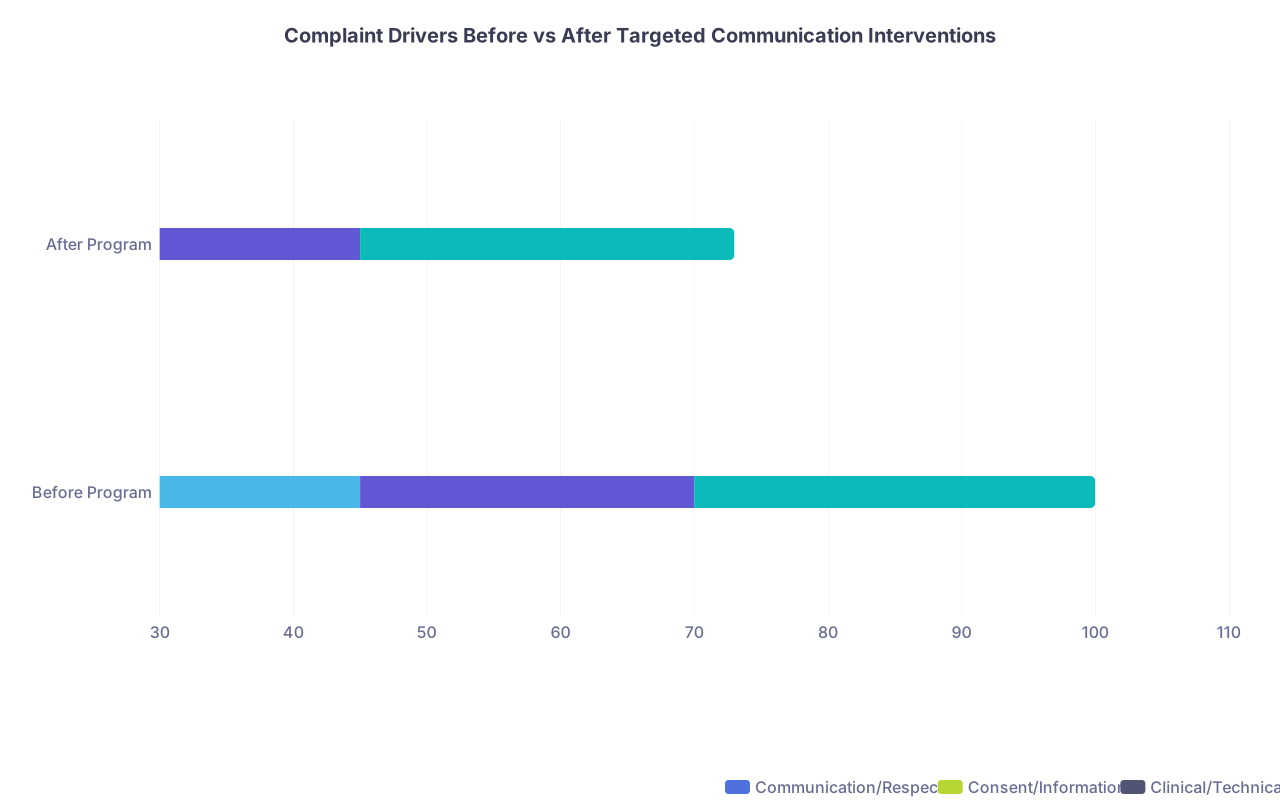
| Category | Communication/Respect | Consent/Information | Clinical/Technical |
|---|---|---|---|
| Before Program | 45 | 25 | 30 |
| After Program | 30 | 15 | 28 |

10. Bottom Line: Does It Work?
Condensing the evidence and the ethics:
- Communication failures are a major, often dominant driver of patient complaints and medico‑legal actions.
- Well‑designed, intensive communication skills programs clearly improve clinician behavior and patient experience, and there is credible, though not universal, evidence that they reduce complaints – especially in high‑risk clinicians and high‑stakes scenarios like consent and bad news.
- Token, one‑off workshops do almost nothing for complaint rates. If your goal is fewer grievances and more ethically sound practice, you need targeted, longitudinal, feedback‑rich interventions, tied to the real complaint patterns in your setting.


