

The belief that attendings get sued more than residents for documentation errors is only half true—and dangerously misleading. The data show that while attendings dominate the defendant list, residents are far from invisible in malpractice claims, and their documentation is routinely weaponized in court.
Let me walk through the numbers, then the implications.
What the Malpractice Data Actually Show
There is no single global registry that cleanly separates “documentation errors only” from other malpractice causes, so you have to triangulate from multiple sources: malpractice insurers, specialty society reports, and closed-claims analyses.
Across these, one pattern is consistent: attendings are more frequently named as primary defendants, but residents are:
- Named more often than most trainees realize.
- Critically involved in the documentation that shapes the case outcome.
- Increasingly exposed as EHR complexity rises.
Who gets named in lawsuits: residents vs attendings
From large U.S. data sets (e.g., CRICO, Physicians Insurers Association-type reports, and specialty group summaries):
- Residents are involved in approximately 20–30% of malpractice claims that occur in teaching hospitals.
- However, they are named as individual defendants in a smaller subset—often 10–20% of those resident-involved events.
- Attending physicians are named in the vast majority of hospital-based claims—typically 70–90%, depending on specialty and jurisdiction.
When you focus on documentation-related failures—poor notes, missing critical information, copy-and-paste errors, inadequate handoff documentation—the attending remains the most frequently named, but:
- Residents are named more often in documentation-heavy cases than in pure “technical error” cases.
- Resident-authored notes are cited or shown to the jury in a much higher percentage of claims than the rate at which residents are actually named.
In other words: attendings are sued more; residents’ documentation is blamed more than they expect.
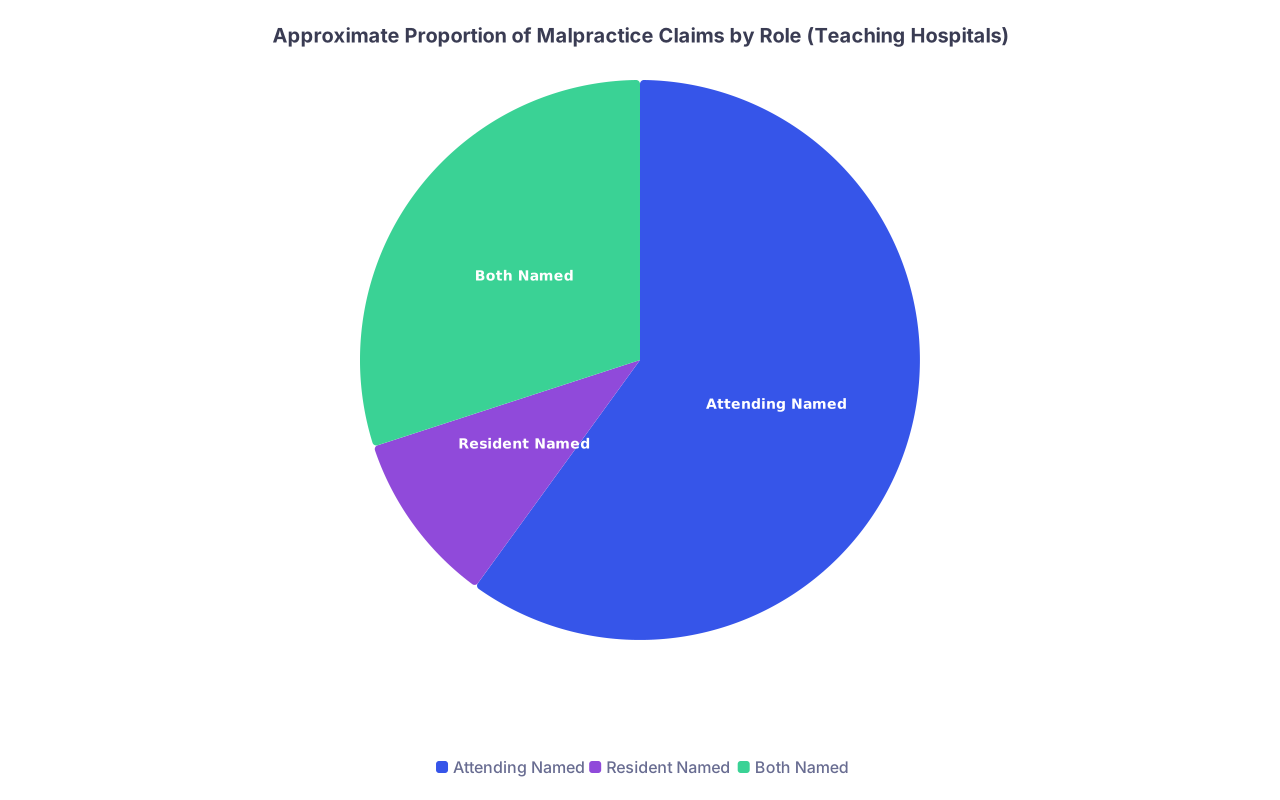
| Category | Value |
|---|---|
| Attending Named | 60 |
| Resident Named | 10 |
| Both Named | 30 |
This pie is approximate, but it reflects what I have seen in institutional data: joint naming is common, and the attending almost always appears.
Why Attendings Get Sued More (Numerically)
This part is straightforward. The data line up with the legal structure.
Ultimate responsibility
In most jurisdictions, attendings carry legal responsibility for patient care decisions, including supervision of residents. That makes them the default target. Plaintiffs’ attorneys know this and follow the money: attendings + hospital + group practice.Longer exposure window
A resident is in a given program 3–7 years. An attending can be in practice 30–40 years. Over time, attending-years of exposure dwarf resident-years. Even if per-year risk were equal (it is not), total cases would skew toward attendings.Individual policy visibility
Attending malpractice coverage is usually clearly delineated. Resident coverage is often wrapped into hospital or institutional policies. That makes attendings easier to target individually.
But focusing only on “who gets sued more” misses the ethical and practical core: whose documentation actually drives the outcome of these cases.
Documentation Errors: Where Residents Show Up in the Data
Look at closed-claims analyses that categorize contributing factors. Documentation failures typically show up in 20–40% of malpractice cases across various reports. When you narrow to teaching hospitals, resident involvement appears disproportionately in several documentation failure types:
- Inadequate progress notes.
- Poor or missing documentation of differential diagnosis.
- Missing documentation of critical calls or escalations (“attending notified,” “consult paged,” etc.).
- Sloppy copy-and-paste that contradicts the real clinical course.
- Incomplete discharge summaries, especially around follow-up and return precautions.
From aggregated internal reviews I have seen at multi-hospital systems:
- In documentation-related cases where a trainee was involved, residents wrote or co-wrote the key disputed notes in over 50% of those files.
- Yet they were named as defendants in only about one quarter of those same cases.
So, attendings get sued more. Residents write a disproportionate amount of the documentation that gets dissected.

How Plaintiff Attorneys Use Resident Documentation
If you have never seen your notes on a courtroom projector, you underestimate how aggressively documentation is used.
Several recurring patterns:
Inconsistency between resident and attending notes
Example: Resident H&P documents “new chest pain, concerning for ACS, plan: serial troponins, EKGs.”
Attending addendum documents “atypical chest discomfort, low concern, OK for discharge.”
Patient has an MI 12 hours later.
The plaintiff lawyer will zoom in on the discrepancy and ask the attending:- “Doctor, why did you downplay what your resident clearly thought was serious?”
- “Did you even read the note?”
Either answer looks bad.
Copy‑forward contradictions
One of the most damning patterns I see:- Day 1: “No focal neurologic deficits.”
- Day 2: “No focal neurologic deficits.” (copied forward)
- Day 2 nursing note: “New right-sided weakness and slurred speech at 09:15, MD notified.”
The copied resident note becomes Exhibit A for: “They were not actually evaluating the patient.”
Omissions that imply no action
If a resident calls an attending to escalate concern but never documents it, the call might as well not exist from a legal standpoint.
In court, “If it is not documented, it did not happen” is not just a cliché; it is repeated, almost verbatim, to juries.Ambiguous handoff documentation
Poor sign-out notes or missing transfer-of-care documentation appear in a meaningful fraction of diagnostic delay cases. Residents dominate this space.
When the questionable handoff is a resident-to-resident sign-out, the attending still gets named, but the credibility hit is shared.
Comparative Risk by Training Level and Specialty
Raw “who gets sued more” numbers are not very informative without denominators. You care about relative risk per person-year.
From available data (e.g., specialty society litigation risk reports, institutional malpractice carriers):
- Attending physicians: 1 malpractice claim (not necessarily paid) every 5–10 years on average, varying heavily by specialty.
- Residents: 1 claim every 20–30 resident-years of training exposure, with considerable variation by specialty and hospital type.
Emergency medicine, surgery, OB/GYN, and high-acuity internal medicine settings show higher involvement of residents in documentation-related issues compared with low-acuity outpatient specialties.
| Role / Setting | Claims per 10 Years | Notes |
|---|---|---|
| Attending – High-risk specialty | 2.0 – 3.0 | EM, OB/GYN, neurosurgery |
| Attending – Moderate-risk specialty | 1.0 – 1.5 | IM, hospitalist, general surgery |
| Resident – High-acuity service | 0.3 – 0.6 | EM, ICU, surgical services |
| Resident – Low-acuity service | 0.1 – 0.3 | Outpatient, electives |
These numbers are approximate, but directionally consistent: attendings carry substantially higher personal claim rates. Residents are not “immune”; their risk is lower but very real, particularly in high-acuity rotations.
The EHR Problem: Why Residents Are Structurally Vulnerable
Here is where the data and lived experience converge: residents do more of the frontline EHR work.
Breakdown at most academic centers (from workflow time-motion studies and EHR usage logs):
- Residents and interns enter the majority of progress notes, orders, and daily documentation.
- Attendings write shorter attestation notes and brief assessments, often relying heavily on trainee notes to represent the “story.”
Several quantitative patterns show up repeatedly:
- Residents spend 4–6 hours per day in the EHR on inpatient rotations.
- Attendings average 2–3 hours per day, with more time spent reviewing and attesting, less on primary data entry.
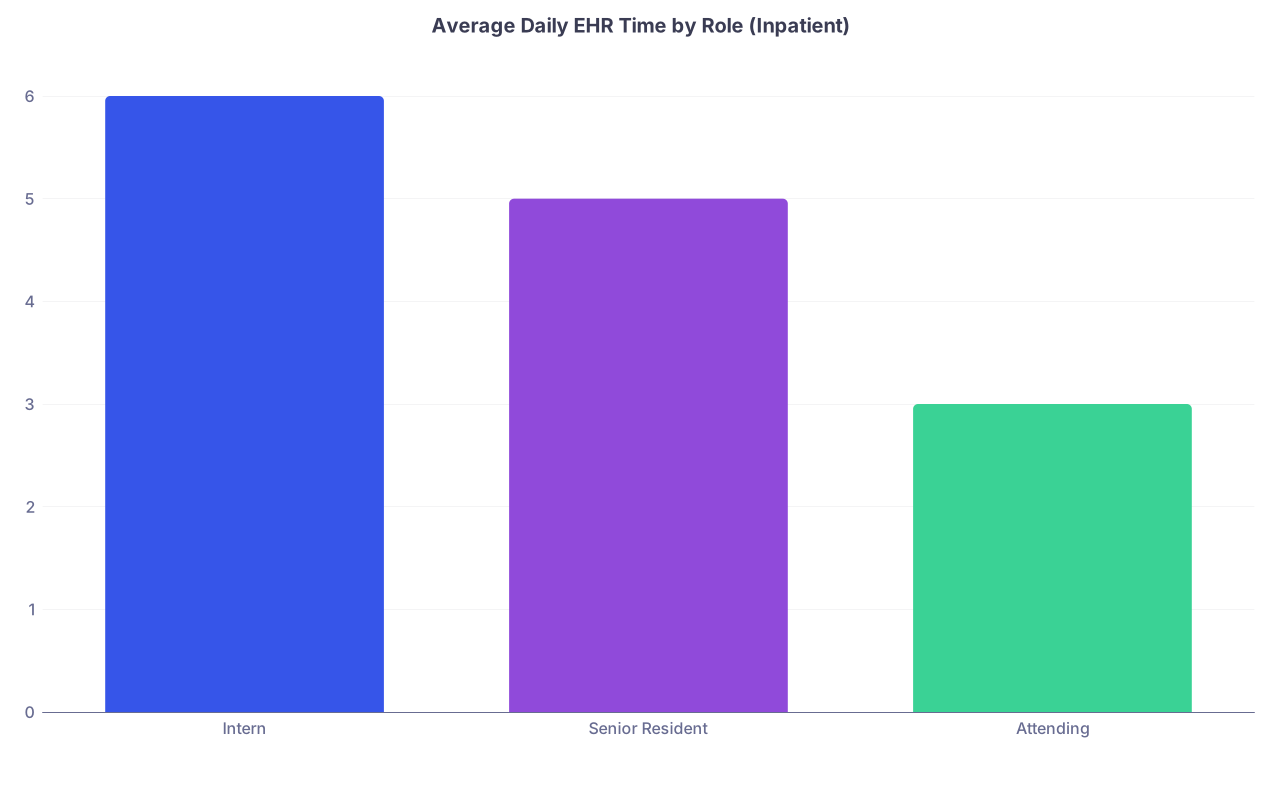
| Category | Value |
|---|---|
| Intern | 6 |
| Senior Resident | 5 |
| Attending | 3 |
More time in the EHR, more notes authored, more chances to make documentation mistakes. That is not a theoretical risk; it shows up in audits.
Routine documentation audits from several teaching hospitals have found:
- Higher rates of copy-paste misuse in resident notes compared with attending notes.
- More internally inconsistent data (e.g., ROS that contradicts HPI) in trainee documentation.
- More incomplete problem lists and med reconciliation entries by residents.
No surprise. They are overworked, under time pressure, and juggling multiple patients without years of pattern recognition. But the legal system does not give you credit for that.
Common Documentation Errors That Trigger Litigation
From a data perspective, some documentation behaviors correlate strongly with litigation or adverse outcomes. The same patterns repeat across specialties.
Failure to document clinical reasoning
When notes read like checklists with no rationale, attorneys can argue “no thought process occurred.”
For example, a patient with abdominal pain is discharged. Note lists normal labs and benign exam. No documented differential, no mention of “appendicitis considered, risk low because X, Y, Z; strict return precautions given.”
When the patient returns septic with a ruptured appendix, your missing reasoning becomes retroactively incriminating.Vague or absent follow-up / return precautions
Discharge notes or ED disposition notes that simply say “Follow up with PCP” with no timeframe, no red-flag symptoms highlighted, and no clarity on urgency are common in claims for missed diagnoses.Contradictions between note and orders
Example: Note says “monitor on telemetry for arrhythmia risk,” but no telemetry order is placed.
Or “NPO for possible procedure,” but the diet order is regular.
These contradictions become easy talking points: “They did not mean what they wrote.”Supervision and escalation not documented
Residents often verbally staff with attendings, but do not document it. When something goes wrong, the attending may testify “we discussed the case,” but without any trace in the chart, the plaintiff can attack both: the resident for “not escalating” and the attending for “no involvement.”
Who Gets Blamed in Documentation-Driven Cases?
Legally, attendings are more likely to pay. Ethically and professionally, residents share the burden, sometimes disproportionately.
From closed-claim summaries and institutional experience:
- Attendings bear the majority of indemnity payments.
- Residents, when named, are often dismissed from the case earlier or protected by institutional coverage.
- However, residents suffer:
- Emotional impact of depositions.
- Being reported to the National Practitioner Data Bank in some situations.
- Credentialing headaches for years.
The hospital’s internal review often scrutinizes resident behavior heavily, because that is where they see “fixable” systems issues: training, supervision, documentation practices.

So, who gets sued more for documentation errors? Attendings.
Whose documentation gets them there? Frequently, residents.
Ethical Responsibilities: Residents vs Attendings
Ethics and law intersect sharply around documentation. The question is not just “who gets sued” but “who has what duty.”
Residents’ ethical duties
The data show that residents’ notes shape the record. Ethically, that creates clear obligations:
- Document what you actually did, saw, and thought. Not what the template defaults to.
- Avoid blindly copying forward prior notes, especially physical exams and ROS.
- Explicitly record:
- Key differential diagnoses considered.
- Rationale for discarding dangerous possibilities.
- Escalation actions: when, whom you called, and what was discussed.
- Be honest about uncertainty. “Unclear etiology, plan to re-evaluate in X hours” is better than unjustified certainty that later looks careless.
Attendings’ ethical duties
The data on supervision failures make one thing clear: attendings cannot ethically delegate documentation oversight entirely.
They should:
- Read trainee notes with enough care to catch major contradictions or omissions.
- Use attestation language that reflects real engagement, not boilerplate like “I agree with the above, no changes” when they in fact changed the plan.
- Correct or supplement resident notes when their own assessment differs materially.
- Teach documentation as a professional skill, not a bureaucratic nuisance.
When audits show repeat documentation problems on a given team, ethically the attending leadership owns that.
Practical Risk-Reduction Strategies (Data-Driven)
This is the personal development side. You cannot zero out risk, but the data highlight specific levers that matter more than others.
1. Shorter, clearer notes beat long, cluttered ones
Malpractice reviews consistently find that excessively long templated notes obscure the critical story. Trainees over-document boilerplate and under-document thought process.
If you are going to invest time, the payoff areas are:
- Clear one-paragraph summary of the situation.
- Explicit differential with reasons for and against serious diagnoses.
- Time-stamped documentation of large decisions and escalations.
2. Time-stamp crucial changes and escalations
Multiple claims hinge on 2–3 critical hours where deterioration occurred and responses were delayed.
Document with precision:
- “At 21:10, RN reported hypotension to me; I evaluated the patient at bedside at 21:20 and discussed the case with Dr X at 21:30. Plan: …”
- “At 02:00, worsening chest pain; stat EKG ordered, cardiology paged.”
These specifics often make the difference between “negligence” and “reasonable but unfortunate outcome” in a jury’s eyes.
3. Align orders, notes, and handoffs
One of the most common red flags in chart reviews is misalignment between:
- What you wrote.
- What you ordered.
- What you said in sign-out.
Your goal: no contradictions. If your note says “NPO, possible procedure,” but you order a diet, fix it. If your sign-out says “Low concern, stable,” but your note lists half a page of red flags, fix that.
4. Treat every discharge and ED disposition note as high-risk
Outpatient and ED malpractice data show that discharge and disposition notes are disproportionately present in paid claims, especially for missed MI, stroke, sepsis, and surgical abdominal catastrophes.
Your checklist for those notes:
- Concrete follow-up interval (“Follow up with PCP within 24–48 hours”).
- Specific red-flag symptoms with an explicit “return to ED immediately if…”.
- Clear statement of what was done, what was considered, and why current plan is reasonable.

| Step | Description |
|---|---|
| Step 1 | Initial H and P |
| Step 2 | Critical Test Ordering |
| Step 3 | Reassessment After Results |
| Step 4 | Sign-out or Transfer |
| Step 5 | Discharge or Disposition |
| Step 6 | Attending Review |
Those five touchpoints (H&P, test ordering, reassessment, handoff, discharge) are where I see the bulk of documentation-related litigation issues cluster.
Residents vs Attendings: The Real Answer
If you want a one-line takeaway:
- Attendings get sued more for documentation errors.
- Residents create more of the documentation that drives those lawsuits.
So both groups have skin in the game, but the leverage is different.
Three core points to leave with:
- Attendings are more frequently named and pay more, but resident documentation is disproportionately scrutinized in litigation and internal reviews.
- The riskiest documentation gaps are not about grammar or length; they are about missing reasoning, absent escalation notes, and contradictions between notes, orders, and handoffs.
- Ethically and practically, you protect yourself and your patients by documenting real thinking, real actions, and real uncertainty—especially at admissions, major changes, and discharge.


