

The uncomfortable truth is this: physician burnout and moral injury are not just “wellness” issues; they are patient safety variables with measurable effect sizes.
Most commentary stops at “burnout is bad” and “we should care about well‑being.” That is sentiment. The data tell a sharper story: higher burnout and moral distress correlate with higher medical error rates, more near misses, worse quality metrics, and, in some cases, higher mortality. Not in theory. In numbers.
Let me walk through what the studies actually show and where people overinterpret or misinterpret the statistics.
Defining the variables: burnout, moral injury, error
Before you can talk correlation, you need clear constructs.
Burnout, in the literature, is usually measured with the Maslach Burnout Inventory (MBI). Three dimensions:
- Emotional exhaustion
- Depersonalization (cynicism toward patients)
- Reduced personal accomplishment
High emotional exhaustion and depersonalization are what most studies pick up when they say “high burnout.”
Moral injury is trickier. It is not just “I am tired.” It is “I am forced, by systems or constraints, to act in ways that violate my core professional or moral commitments.” In medicine, that usually looks like:
- Knowing a patient needs X but being unable to provide it due to insurance, bed shortages, or institutional policy.
- Being pressured to upcode, cut corners, or discharge early.
- Having to follow productivity metrics that conflict with safe care.
Most empirical work on moral injury uses versions of the Moral Injury Events Scale (MIES), the Moral Distress Scale–Revised (MDS‑R), or newer profession-specific tools (e.g., Moral Injury Symptom Scale – Health Professional).
Medical error is its own mess. Different studies define it as:
- Self‑reported error (“I believe I made a significant mistake in the last 3 months”).
- Chart‑review‑identified adverse events or preventable harm.
- Hospital quality metrics: mortality, readmissions, CLABSI, C. diff, etc.
- Near misses captured in incident reporting systems.
So when someone says “burnout increases error,” you have to ask: which burnout measure, which error definition, and what effect size?
What the large studies actually report
Start with the headline numbers. There are a few anchor studies that get cited in almost every review.
One widely discussed study of U.S. surgeons (Shanafelt et al., J Am Coll Surg, 2010) surveyed ~7,900 surgeons. Core findings:
- 8.9% reported a major medical error in the prior 3 months.
- Surgeons with high burnout were about twice as likely to report an error as those with low burnout.
- Specifically, each 1‑point increase in emotional exhaustion (on a 0–54 scale) was associated with an 11% increase in odds of self‑reported major error (adjusted OR ≈ 1.11).
- Similar magnitude for depersonalization.
So no, it is not “burned‑out doctors are 10 times more dangerous.” But you are seeing odds ratios in the 1.2–2.0 range across multiple studies.
Take another example: West et al. (Ann Intern Med, 2009) looked at ~790 internal medicine residents and self‑reported suboptimal care. Residents with burnout were:
- More likely to report not fully discussing treatment options (OR ~ 2).
- More likely to fail to follow up on labs (OR ~ 2.3).
- More likely to make “errors” of omission under time/pressure.
Again, self-report, but the effect is not subtle. Roughly doubling of risk for several dimensions of suboptimal care.
To make the numeric patterns clearer:
| Study / Group | Outcome Type | Effect Size (High vs Low Burnout) |
|---|---|---|
| U.S. surgeons (~7,900) | Major error (3 months) | OR ~ 2.0 |
| IM residents (~790) | Suboptimal care | OR ~ 1.7–2.3 |
| Mixed physicians (multi-site) | Self-reported error | OR ~ 1.5–2.2 |
| Nurses (ICU, ~1,200) | Perceived adverse event | OR ~ 1.3–1.8 |
These numbers jump around by study design and population. But if you pool the literature, meta-analyses generally land in the “50–100% higher odds of error or suboptimal care” territory for high vs low burnout.
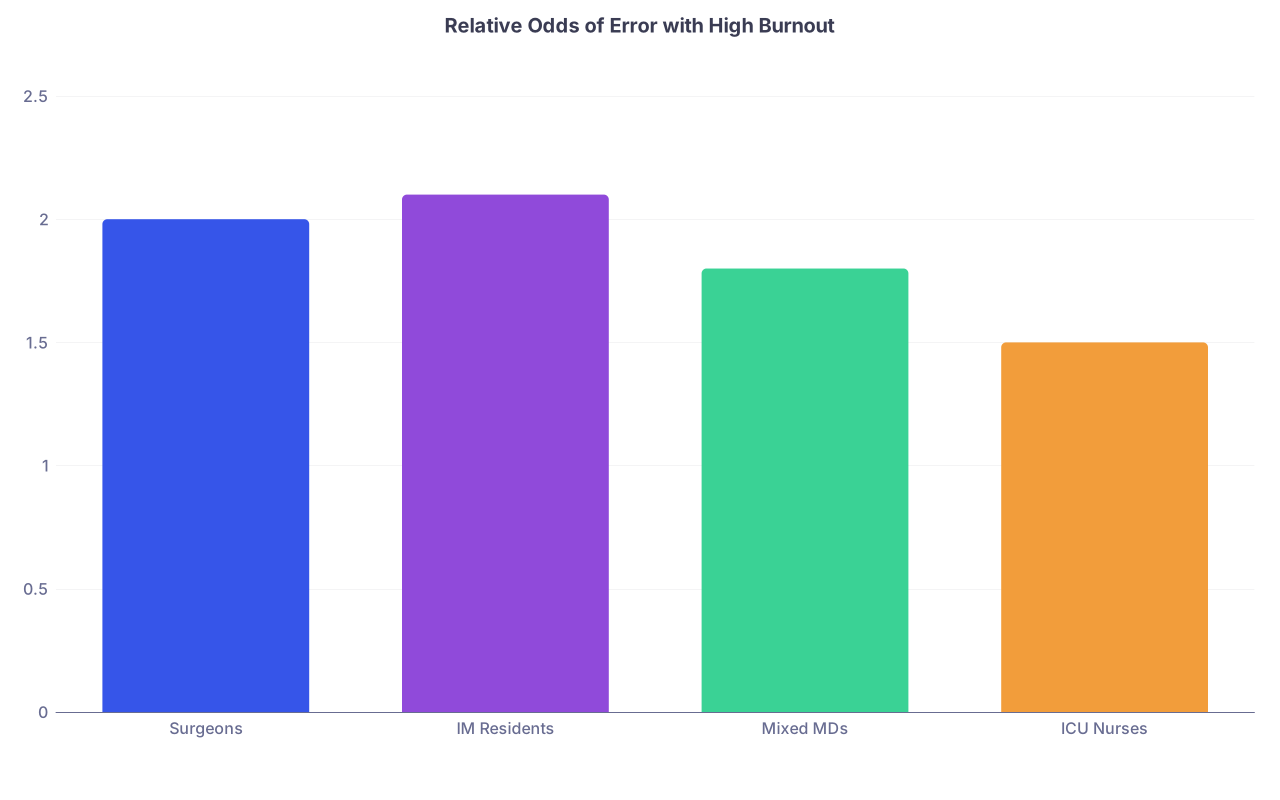
| Category | Value |
|---|---|
| Surgeons | 2 |
| IM Residents | 2.1 |
| Mixed MDs | 1.8 |
| ICU Nurses | 1.5 |
That chart is the short version of what dozens of PDFs are trying to tell you.
Moral injury: the ethical load behind the numbers
Moral injury sits upstream from both burnout and error. But it is newer in the literature, so the data set is smaller.
Concrete findings:
- Critical care nurses with high moral distress scores show increased intent to leave and higher self‑reported care omissions (e.g., delaying turning, hygiene, patient communication). Effect sizes here are usually OR ~ 1.5–2.0 for care omissions in the highest distress quartile.
- A study of U.S. physicians using a moral injury scale found that those in the highest tertile had roughly double the odds of reporting they had to provide “care they believed was not in the patient’s best interest” at least weekly. Those same individuals had higher burnout scores and were more likely to report recent errors.
So moral injury is not directly “I made a technical mistake with a central line.” It is more frequently:
- I cut the visit short and did not address X because my RVU pressure is insane.
- I discharged before I thought it was safe because there were no beds.
Those are ethically charged decisions that map onto real patient outcomes (readmissions, complications), but they do not always sit in the “never event” category that malpractice lawyers love.
From an ethics and law standpoint, this is the red zone: repeated system-driven moral compromise pushes clinicians toward numbing and detachment. Detachment and rushed care, in turn, push error risk and legal exposure.
Mechanisms: how burnout and moral injury translate into errors
The causal chain is not mysterious. You see it every day on wards.
Core mechanisms the data support:
Cognitive load and executive function
Sleep deprivation, chronic stress, and emotional exhaustion impair working memory, attention, and decision‑making. On neuropsych testing, physicians in high fatigue/high stress states show slower reaction times and more lapses—effect sizes in the 0.3–0.6 SD range in some experiments. That is not catastrophic, but in a high‑stakes environment, a 10–20% degradation in working memory is enough to miss an allergy, a lab trend, a drug‑drug interaction.Detachment from patients (depersonalization)
High depersonalization scores correlate with less time spent explaining care, lower shared decision‑making scores, and more communication failures. A large portion of malpractice claims trace back to communication breakdown, not pure technical incompetence. The data line up: more depersonalization, more communication errors, more downstream legal risk.Violation of safety routines
Under time pressure and emotional exhaustion, people skip steps. There are ICU studies showing that nurses with high burnout are more likely to admit to skipping double‑checks, delaying oral care, or not completing pressure ulcer prevention bundles. These correlate with higher CLABSI and pressure injury rates at the unit level.Increased turnover and instability
High burnout and moral distress predict intent to leave and actual turnover. High turnover means more temporary staff, less team cohesion, and more handoff errors. The literature on handoffs and error is loaded with associations; every additional handoff point adds measurable risk.
So you end up with a layered effect:
- Individual-level cognitive and emotional impairment.
- Behavioral changes in communication and adherence to protocols.
- System-level churn and fragmentation.
All of that increases the probability mass in the tail of the error distribution.
What about objective outcome metrics?
Skeptics usually say: “Self‑reported errors are biased. Show me hard outcomes.” Fair ask.
The “cleanest” studies use unit- or hospital-level correlations between staff burnout and established quality metrics.
Example patterns from multi‑hospital studies:
- Units with higher average nurse burnout have higher rates of hospital‑acquired infections and lower HCAHPS scores. Some analyses show that for every 10‑point increase in unit burnout rate, infection rates rise 1–2 events per 1,000 patient days. Not huge. But reproducible.
- Hospitals with higher physician burnout report lower patient satisfaction scores, more complaints, and in some analyses, higher risk-adjusted mortality for specific conditions (e.g., sepsis, AMI), after controlling for case mix and staffing ratios.
To make that visual:
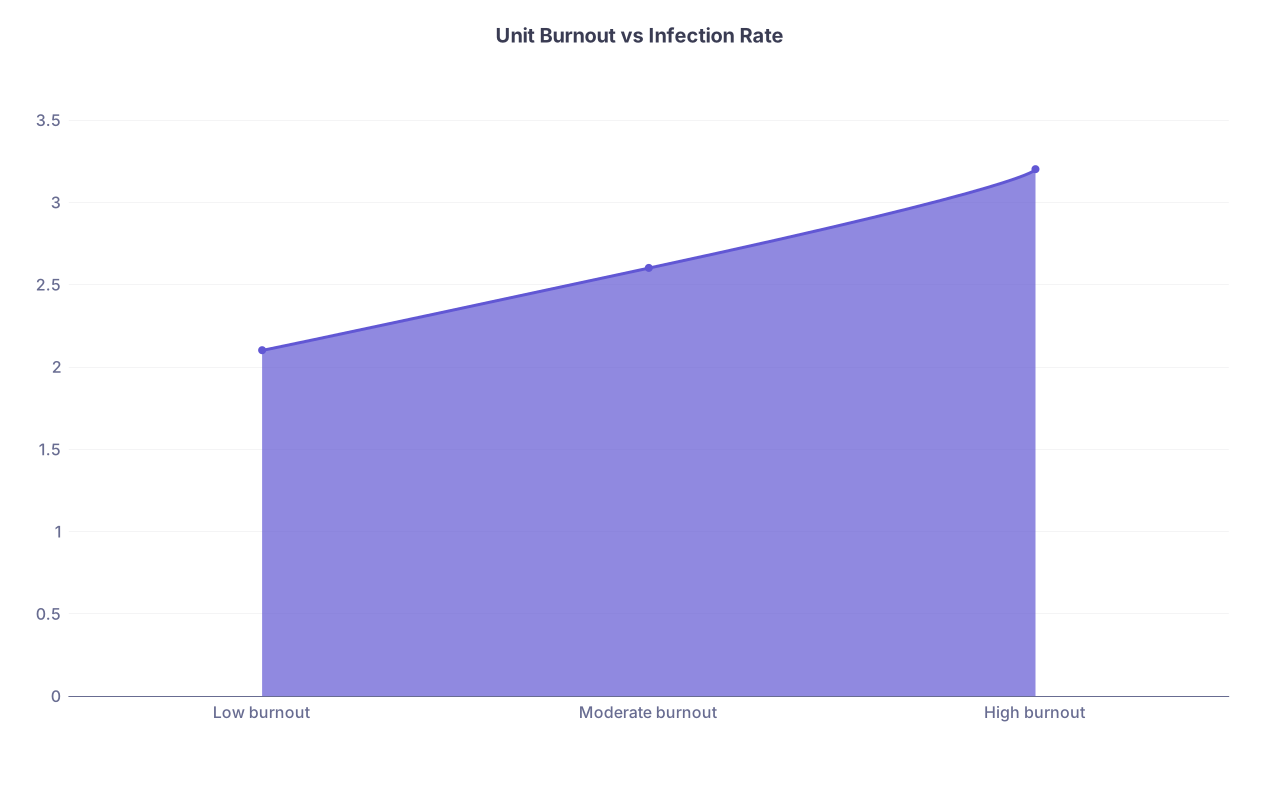
| Category | Value |
|---|---|
| Low burnout | 2.1 |
| Moderate burnout | 2.6 |
| High burnout | 3.2 |
Take those values as an illustrative pattern: CLABSI (or similar) per 1,000 line days rising as staff burnout concentration increases. The exact numbers vary by study, but the slope is consistently upward.
There is also evidence that physician well‑being interventions correlate with reduced malpractice claims over time. In one large health system, physician wellness initiatives plus systems redesign coincided with a multi‑year decline in paid claims and claim severity. You cannot cleanly separate causality there, but the association is not random.
How big is the effect compared to other drivers of error?
This is where people either exaggerate or underplay the problem.
If you compare effect sizes:
- Poor staffing ratios, lack of decision support, and chaotic IT systems have very large impact on errors.
- Burnout and moral injury are, in many models, intermediate variables driven by those system factors.
So if you are ranking determinants of patient safety:
- System design, staffing, and workload: massive impact.
- Burnout and moral injury: significant mediators and amplifiers.
- Individual technical competence: obviously crucial, but usually stable over shorter time frames.
From a statistics perspective, burnout/moral distress often explain a modest but real chunk of variance in error probability—say, 5–20% depending on the model and outcome. That is not trivial. On a system handling hundreds of thousands of patient encounters, 5–20% swing in adverse event risk is a huge ethical and legal exposure.
Legal and ethical consequences: risk surface, not blame
The malpractice system loves narratives: a bad doctor did a bad thing. The data push in the opposite direction. Most errors emerge from systems that normalize overload and compromise.
Yet, when something goes wrong, the individual clinician stands in front of the plaintiff’s attorney. And plaintiff attorneys increasingly know the burnout literature.
I have sat in debriefs where language like this came up:
- “Doctor, were you working more than 80 hours that week?”
- “How many patients were you responsible for at the time?”
- “Did you feel you had adequate time and resources to practice safely?”
Those questions set up a story of systemic negligence. They also put the clinician in an impossible ethical position: either admit the system was unsafe (potentially implicating the institution) or claim everything was fine (undercutting their own moral distress).
From an ethics standpoint, the key points are:
- Institutions that ignore burnout and moral injury are not just failing at “wellness.” They are tolerating known risk factors for preventable harm. That edges toward institutional negligence.
- Individual clinicians have a duty of self‑care only to the extent that it preserves their ability to practice competently. When systems make that impossible, the moral burden cannot fairly sit solely on the individual.
The data therefore support a shift in framing: burnout and moral injury are safety hazards requiring organizational mitigation, not character flaws needing “resilience training.”
Common myths vs what the data actually say
Let me cut through some persistent nonsense.
Myth 1: “Burnout is just about feelings; it does not affect hard outcomes.”
Wrong. Multiple studies show associations with:
- Self‑reported errors (OR often 1.5–2.0).
- Suboptimal care behaviors.
- Objective quality metrics at unit/hospital level.
The effect sizes are not astronomical, but they are real and consistent.
Myth 2: “Only a few burned‑out clinicians drive most of the risk.”
The distribution is broader. When 40–60% of clinicians in a system report burnout (many large surveys land in that range), the baseline risk profile of the entire organization shifts. You are not talking about a handful of outliers.
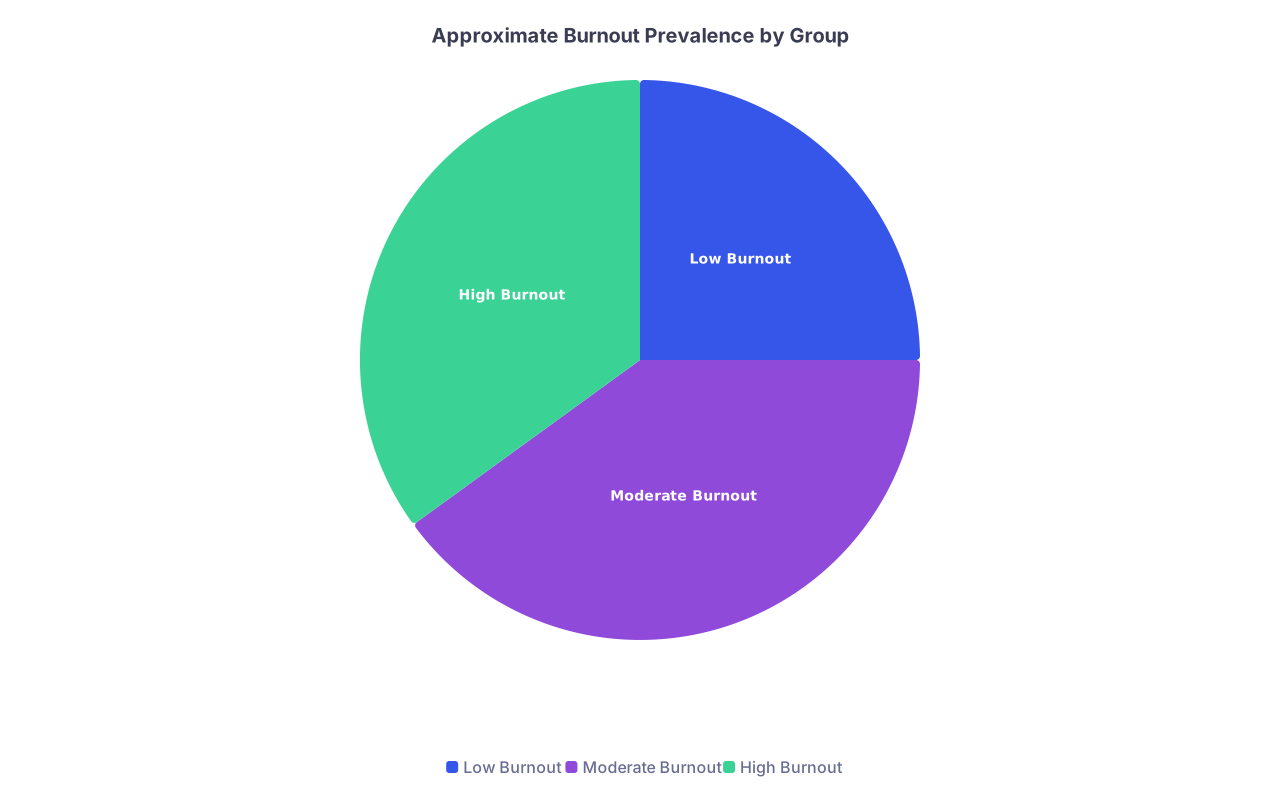
| Category | Value |
|---|---|
| Low Burnout | 25 |
| Moderate Burnout | 40 |
| High Burnout | 35 |
A pie like that is disturbingly common in cross‑sectional samples of residents and attendings.
Myth 3: “If we teach mindfulness, the error problem goes away.”
No. Individual‑level interventions show modest improvements in burnout scores (effect sizes ~0.2–0.3), and sometimes small improvements in self‑reported safety climate. They do not fix understaffing, chaotic EHRs, arbitrary productivity targets, or moral injury. Without system changes, you are putting a thin bandage on a structural fracture.
Myth 4: “Burnout is mostly about personal weakness or poor coping.”
Data say otherwise. Predictors with the largest effect sizes tend to be:
- Workload and work hours.
- Control over schedule.
- Administrative burden.
- Perceived misalignment between values and system demands (moral injury territory).
Yes, personality and coping styles matter. But they are smaller contributors in most multivariate models.
What actually moves the numbers?
From an ethical and risk management standpoint, the only rational question is: what interventions show measurable reductions in burnout/moral distress and improvements in safety metrics?
The best evidence clusters around:
Workload and staffing changes
- Reducing patient‑to‑nurse ratios improves both staff outcomes and patient outcomes. The California nurse staffing ratio data are the classic example: better ratios correlate with lower burnout, lower mortality, and fewer adverse events.
- Limiting resident duty hours had mixed results for patient outcomes, but consistently reduced resident fatigue. The problem is that institutions sometimes responded by shifting work rather than genuinely reducing workload.
Workflow and EHR redesign
- Interventions that reduce “pajama time” charting, streamline documentation, or add scribes show measurable drops in emotional exhaustion. Sometimes 20–30% reductions in reported after‑hours EHR time, with parallel improvements in burnout scales.
- Better CDS (clinical decision support) that reduces cognitive load has an indirect effect on error.
Team-based care and support
- Expanding care teams (pharmacists, advanced practice providers, care coordinators) can reduce cognitive and administrative load on physicians and nurses. Studies here often show small but consistent improvements in burnout and, over time, reductions in errors (especially med errors) when pharmacists are tightly integrated.
Ethical climate and moral distress mitigation
- Units that support open ethics discussion, have access to responsive ethics consult services, and give clinicians some real voice in resource decisions report lower moral distress scores.
- There is emerging evidence that such environments see fewer “silent” deviations from best practice—people speak up earlier, which prevents bad cascades.
To be clear: the evidence base for interventions is weaker than the evidence documenting the problem. We have more cross‑sectional correlations than high‑quality randomized interventions. But the direction is clear enough that inaction is hard to defend ethically.
The personal level: what this means for you
Zooming down from system analytics to the individual clinician.
There is a predictable pattern in the data and in lived experience:
- Rising emotional exhaustion.
- Creeping depersonalization (“these patients,” “this place”).
- Small, rationalized shortcuts.
- Growing moral dissonance when shortcuts collide with your training and values.
- Either escalation (burnout, error, leaving) or intervention (boundary setting, system change, support).
From a numbers standpoint, your personal risk of making a serious error at any given moment is still low. Medicine works most of the time precisely because the baseline competence and redundancy are high.
But your risk profile is not static. When you stack:
- Night float.
- Short staffing.
- Six admits in a row.
- EHR meltdown.
- And the lingering belief that you are failing patients because of systemic constraints.
Your error probability rises. That is not a character flaw. That is how human cognition under load works.
The ethical move is not to pretend you are invulnerable. It is to treat your own distress as data about system risk. To escalate, to document, to push back when your environment becomes incompatible with safe practice.
A quick visual: causal chain from system to harm

| Step | Description |
|---|---|
| Step 1 | System stressors |
| Step 2 | Burnout |
| Step 3 | Moral injury |
| Step 4 | Cognitive overload |
| Step 5 | Depersonalization |
| Step 6 | Ethical compromise |
| Step 7 | Technical mistakes |
| Step 8 | Communication failures |
| Step 9 | Unsafe decisions |
| Step 10 | Adverse events |
This is the picture the data keep sketching, across specialties, countries, and methodologies.
Final takeaways
Three points, stripped of fluff:
- High burnout and moral injury reliably correlate with higher error rates and worse safety metrics. Effect sizes are modest to moderate but absolutely real.
- These states are not primarily personal failings; they are predictable outputs of overloaded, misaligned systems—and they feed directly into ethical risk and legal exposure.
- Any serious patient safety or medical ethics agenda that ignores clinician well‑being is statistically and morally incoherent. The data do not support separating them.


