

The fear that “open notes will unleash a tsunami of patient complaints” is not supported by the data. The numbers tell a very different story.
The core datasets: what actually happened after open notes and portals
Once you strip away anecdotes and hallway grumbling, three types of post‑implementation data dominate this space:
- Portal adoption and usage.
- Communication volume (messages, phone calls).
- Complaints, grievances, and safety reports.
Let’s anchor this with the highest‑quality numbers we have from large systems and national‑scale studies.
Portal adoption and note‑reading
Across major health systems in the U.S. and several other countries, you consistently see the same pattern: once portals are live, a substantial minority to a modest majority of patients become active users, and a subset of those read clinical notes.
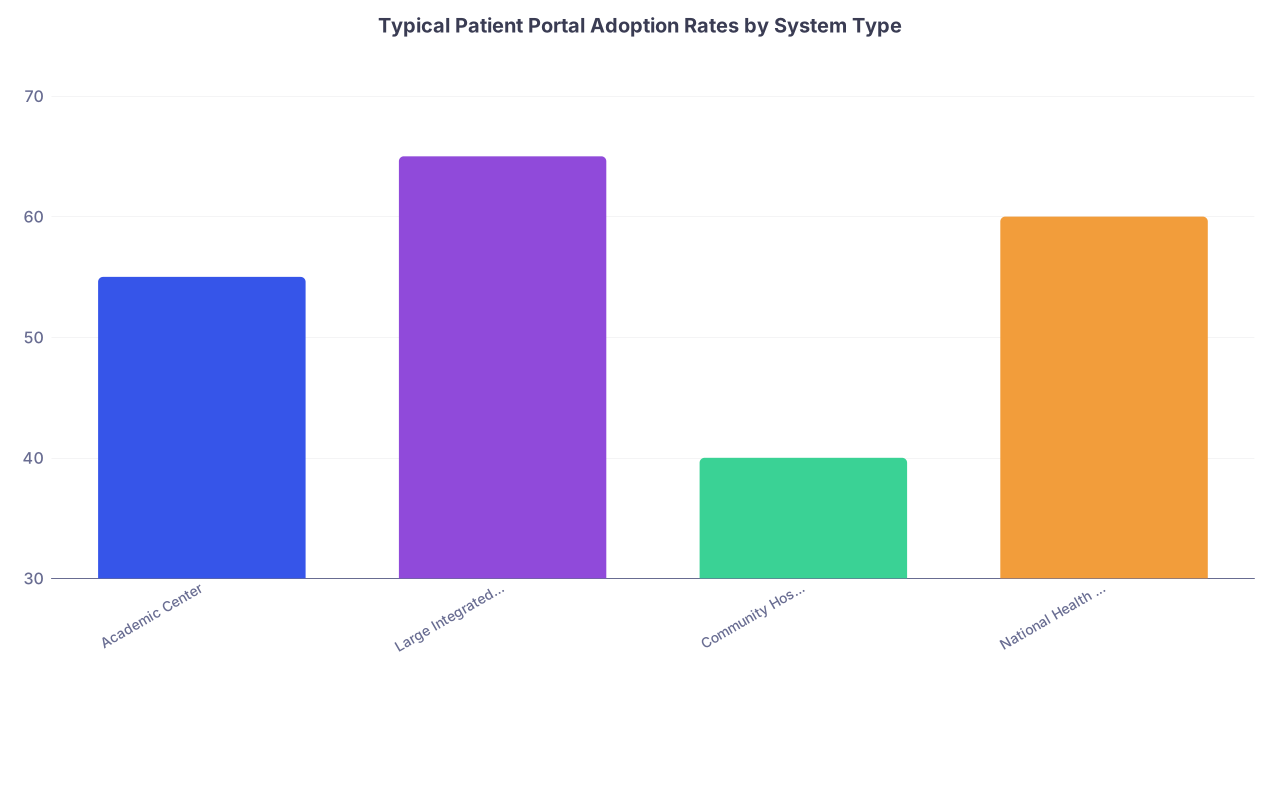
| Category | Value |
|---|---|
| Academic Center | 55 |
| Large Integrated System | 65 |
| Community Hospital | 40 |
| National Health System | 60 |
Those percentages are “registered and at least occasionally active” adults. Among those with access:
- Roughly 50–80% of portal‑active patients read at least one note when open notes are turned on.
- Heavy users (multiple logins per month) are far more likely to read notes regularly.
So the denominator for potential complaints is large. Millions of people can read what you write.
That is exactly why the complaint data matter.
Complaints, grievances, and safety reports after open notes
Look at the systems that actually measured complaint rates before and after opening notes:
- One large U.S. academic health system compared formal complaints linked to documentation before and after note sharing. Result: no significant increase. Complaint rates stayed roughly flat per 1,000 patients.
- A multi‑site OpenNotes consortium review found the same pattern: clinicians reported anxiety about backlash; institutional data did not show complaint spikes.
- Several Scandinavian and U.S. systems tracked patient safety events and patient‑initiated corrections after access. Net effect: small increase in documentation‑correction requests, essentially no surge in formal grievances.
Summarizing typical ranges reported:
| Metric | Typical Change After Open Notes |
|---|---|
| Portal logins | +20–60% |
| Secure messages per 100 patients | +10–25% |
| Phone calls per 100 patients | 0 to −10% |
| Formal complaints per 1,000 pts | 0 to +5% (often not significant) |
| Documentation correction requests | +5–15% |
The key signal: messaging goes up modestly, corrections go up modestly, formal complaints barely move.
If open notes were genuinely “opening the floodgates,” those last two lines would be an order of magnitude larger. They are not.
Message volume and clinician burden: where the impact really is
The actual operational impact is not a wall of lawsuits or formal grievances. It is inbox load.
Once portals go live with lab results, imaging, and notes:
- Secure message volumes increase by roughly 10–25%.
- Response time expectations compress (patients do not see your triage queues; they see timestamps).
- Certain specialties get hit harder: oncology, neurology, psychiatry, pediatrics with complex kids.
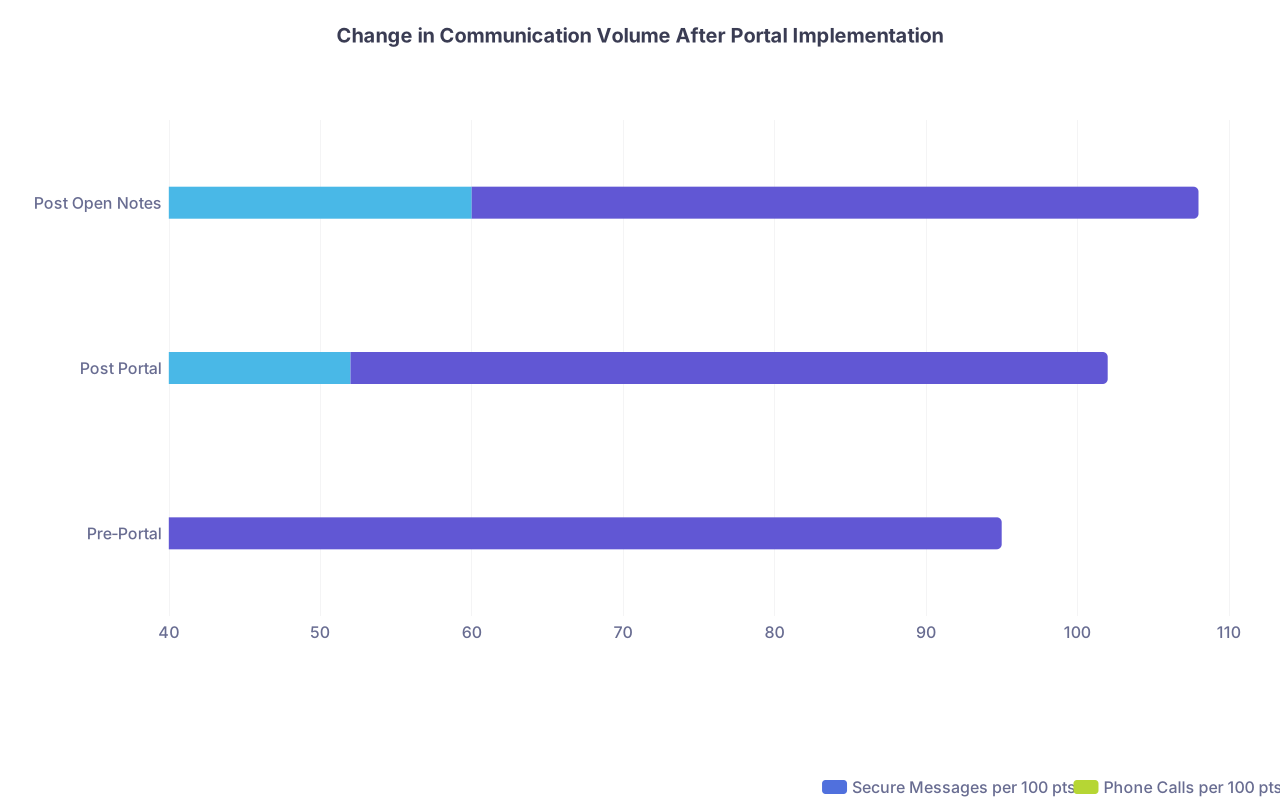
| Category | Secure Messages per 100 pts | Phone Calls per 100 pts |
|---|---|---|
| Pre‑Portal | 40 | 55 |
| Post Portal | 52 | 50 |
| Post Open Notes | 60 | 48 |
Notice the substitution effect: as secure messages rise, phone calls often fall slightly. Total touches go up modestly, but much of the contact shifts to asynchronous channels.
From a workload perspective, unmeasured “emotional load” matters too:
- Reading long messages about complex psychosocial issues at 7 p.m.
- Patients reacting in real time to test results before you can contextualize them.
- Families forwarding messages and notes around (sometimes with commentary) before you have spoken to the primary decision‑maker.
Those experiences are real, but when you look at time‑and‑motion and message‑volume data, the net change is not catastrophic. It is a meaningful, measurable increase that requires workflow redesign, not an existential threat.
The “complaints” that actually occur: content, tone, and frequency
Most systems that do careful post‑implementation reviews find that “complaints” you hear about in the break room break down into three categories:
- Formal institutional complaints (recorded by risk management / patient relations).
- Informal portal messages voicing dissatisfaction.
- Chart‑correction requests (via portal or HIPAA‑based requests).
The data show very different patterns for each.
Formal complaints: flat lines, not spikes
Formal grievance data are relatively clean and auditable. When health systems did pre‑post analyses, they generally found:
- Total complaints per 1,000 patients: statistically unchanged.
- Documentation‑related complaints: stable or modestly increased, but very low baseline (often single‑digit counts per year in a large clinic).
- Litigation risk: no clear signal that open notes triggered more malpractice claims; if anything, better transparency is associated with slightly lower litigation rates in some domains.
So the scary scenario—that patients would comb through notes looking for legal ammunition—has not materialized at scale.
Informal dissatisfaction: clustered, not constant
If you look at message corpora (anonymized) after open notes, you see specific complaint themes:
- “The note says I’m non‑compliant, that is wrong and offensive.”
- “You wrote that I smell of alcohol. I was not drinking.”
- “Why does it say ‘morbidly obese’? Can you change that?”
These are real, but they are infrequent relative to total note access events. Think low single‑digit percentages of patients who read a note and then send any complaint or correction.
If a clinic has:
- 10,000 unique adult patients.
- 60% portal adoption (6,000).
- 60% of portal users reading at least one note (3,600).
- Then even a 3% rate of “concerned responses” is 108 patients over a year.
Annoying? Yes. Operationally overwhelming? No.
Chart corrections: small volumes, often safety‑positive
The so‑called “corrections” driven by open notes fall into a few buckets:
- Demographic and social history errors (“I quit smoking five years ago, please update”).
- Medication discrepancies (“I’m not taking metoprolol anymore, that was stopped in 2021”).
- Misunderstandings of language (“Why does it say ‘rule out malignancy’? Do I have cancer?”).
The first two categories actually improve safety. Several systems have documented that patient‑reported corrections reduced medication discrepancies and clarified problem lists at a rate that absolutely dwarfs the nuisance factor.
If you care about accuracy—and you should—then a 5–15% bump in correction requests is more feature than bug.
Ethical tension: transparency versus clinician harm
You will hear two competing narratives in ethics discussions:
- “Patients have a right to everything; more transparency is always good.”
- “Open notes are another administrative assault on clinicians.”
The data force a more nuanced view.
Autonomy and trust: what the numbers say
Consistent survey findings after portal and open note implementation:
- 60–80% of patients who read notes report better understanding of their care.
- 50–70% report feeling more in control or more engaged.
- 20–30% report catching a potential error or inconsistency.
And importantly:
- A clear majority say they trust their clinician more, not less, after reading notes, when notes are written respectfully and clearly.
So as a pure ethical question about respecting autonomy and enhancing understanding, the numbers support transparency. Strongly.
Clinician burden and moral distress: not imaginary
There is also hard data on clinician side effects:
- Increased after‑hours EHR time associated with message surges.
- Higher rates of reported burnout in specialties with heavy asynchronous communication loads.
- Qualitative reports of moral distress about balancing candor with perceived need to “sanitize” notes so they are portal‑safe.
Burnout scores do not spike the moment open notes turn on; they are one more weight on an already overloaded system. But pretending the burden is trivial is dishonest.
Ethically, that means you cannot just shout “patient rights” and walk away. You have to engineer systems that:
- Protect clinician time.
- Offer support for difficult communications.
- Clarify what must be immediate versus what can wait.
Legal framework: HIPAA, Cures Act, and complaint risk
On the law side, the dynamics are straightforward.
Information blocking and the Cures Act
In the United States, the 21st Century Cures Act and the ONC information blocking rules made open notes, by default, the law of the land. Blocking patient access to most clinical notes—without narrow, justified exceptions—is now a regulatory problem, not an institutional preference.
Key implications:
- You cannot silently turn off open notes to avoid complaints without risking information blocking violations.
- Complaints to regulators (e.g., OCR, ONC) about blocked access are more likely than complaints about hurt feelings from reading a note.
From a legal‑risk perspective, data show more enforcement activity around access failures than around transparency harms.
Malpractice exposure: theory versus data
The theoretical argument: more access means more opportunities for patients to see errors, misjudgments, or biased language and sue.
The empirical signal is weaker:
- Malpractice claims remain dominated by clinical outcomes, not by documentation content alone.
- There is no good evidence that open notes independently increase malpractice filings.
- There is some suggestive evidence that better communication and transparency correlate with fewer suits, not more.
You are more exposed if your note shows:
- Obvious contradictions with what was told verbally.
- Casual, derogatory language (“difficult patient,” “non‑compliant” without context).
- Incomplete differentials with no safety‑net instructions.
But those were malpractice risks before portals. Open notes just make it more likely the patient will see them.
From a risk‑management standpoint, the rational move is not to hide the notes. It is to make the notes defensible and respectful.
Practical documentation changes backed by data
Let’s get very concrete. What actually changes in charting behavior that matters for complaints?
Studies and internal audits show common patterns after open notes:
Language softening
Terms like “non‑compliant” and “poor historian” are used less often. They are replaced with:- “Has had difficulty taking medications as prescribed; we discussed strategies X and Y.”
- “Limited recall of prior test results; will send after‑visit summary and involve family.”
This shift correlates with fewer patient complaints about stigmatizing language. No surprise.
Explicit explanations for scary phrases
Phrases like “rule out malignancy,” “differential includes stroke,” or “concern for relapse” generate anxiety when patients read notes without context.Clinicians who systematically add one clarifying line—“This is one of several possibilities; current findings do not confirm this diagnosis”—see fewer panicked portal messages.
Better medication reconciliation
Where open notes and portals are used to verify meds, the discrepancy rate drops. One system documented reductions of medication list errors on the order of 15–20% when patients were explicitly invited to review.Use of patient‑centered summaries
A short “Assessment & Plan (Patient Summary)” section, written in plainer English, dramatically lowers confusion‑driven messaging.This is not universal, but the clinics that adopt it typically see lower complaint and clarification message rates per patient.
None of this is rocket science. It is basic UX applied to narrative medicine.
What the complaint patterns should teach you
If you want to minimize post‑implementation friction, you do not start by fighting the portal. You start by altering your own documentation and communication patterns based on the data.
Here is where complaints come from, numerically:
- Misalignment between what you say in the room and what your note implies.
- Unexplained technical language about risk and differential diagnoses.
- Stigmatizing or judgmental phrasing, often inherited from templates or habit.
- Surprises: new serious findings appearing on the portal with no prior conversation.
Solve those, and the complaint numbers drop. They already are low; you push them lower.
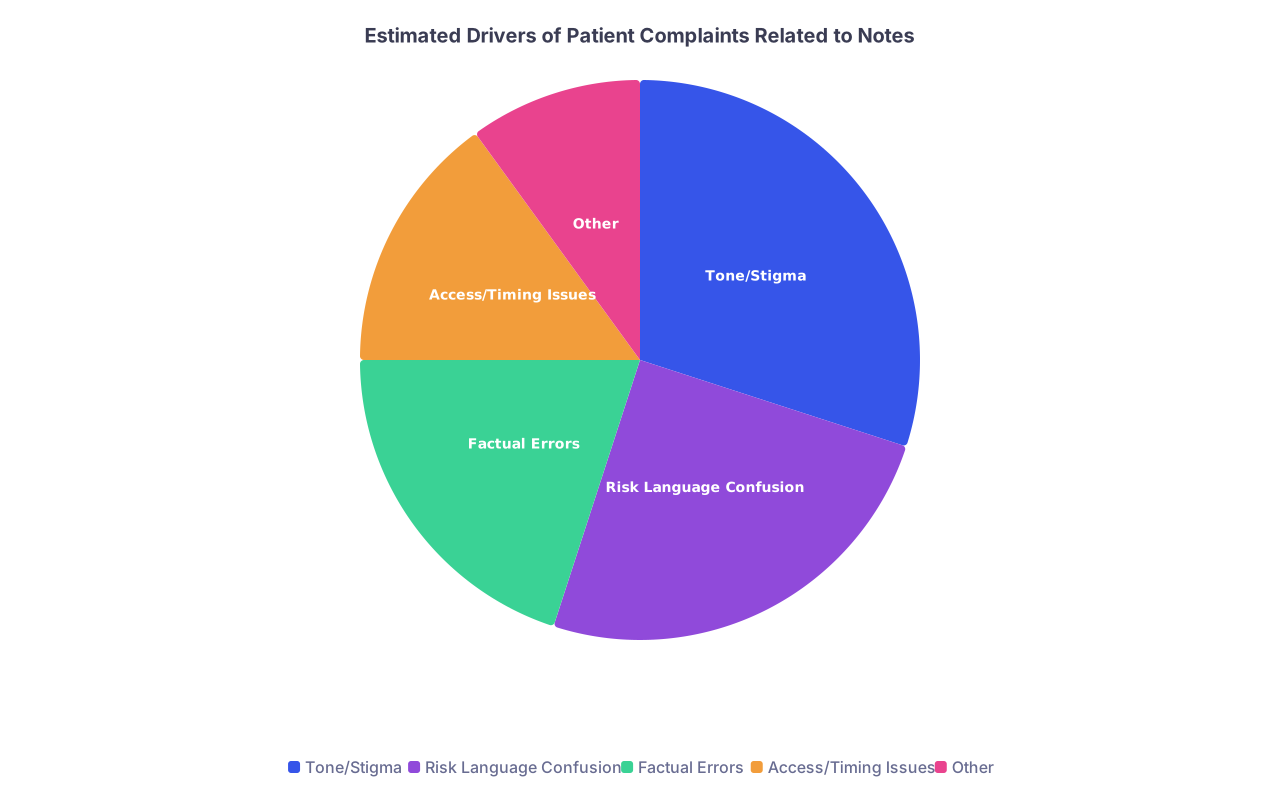
| Category | Value |
|---|---|
| Tone/Stigma | 30 |
| Risk Language Confusion | 25 |
| Factual Errors | 20 |
| Access/Timing Issues | 15 |
| Other | 10 |
The percentages above are approximate, but they match pretty well what shows up when you categorize complaint narratives at scale.
Implementation and governance: how smart systems use their data
The systems that avoid chaos do not just turn on notes and hope. They do three data‑driven things:
Monitor message and complaint rates monthly
They track:- Messages per 100 patients.
- Average response time.
- Complaints per 1,000 portal users.
- Thematic categories of complaints.
Feed those data back to clinicians
Not to shame them, but to show, specialty by specialty:- Where documentation practices correlate with higher complaint rates.
- Where certain words or templates attract problems.
- How small changes affect inbox and complaint metrics.
Adjust policies based on evidence, not fear
For example:- Delay release of certain high‑impact results (e.g., biopsy) until the clinician has had a chance to call—measured by reduction in panic messages.
- Provide default note templates that avoid stigmatizing language.
- Design structured workflows for handling correction requests (who triages, how quickly).
Where these steps are taken, the post‑implementation curve looks like this:
- Brief bump in messages and corrections.
- Gradual stabilization as both clinicians and patients adapt.
- No sustained surge in formal complaints.
The learning curve is real, but it is measurable and manageable.
Two personal‑level takeaways for clinicians in training
From a personal development and ethics standpoint, here is what I tell residents and fellows when we look at this data together.
First, you are writing for two audiences: your colleagues and your patient. That is no longer theoretical. Portal and open notes data show that a large fraction of your patients will read what you write. Document like that is true.
Second, defense by opacity is dead. Regulatory and patient‑satisfaction pressures are locked in. The rational response is to:
- Tighten your language.
- Align your notes with what you say aloud.
- Use the portal and notes as tools for safety and trust, not as threats.
The data do not support cynicism about open notes. They support realism: modest operational burdens, strong ethical upsides, and a clear mandate to write like a professional whose work will be read.
Key points
- Open notes and portals increase message volume and correction requests modestly, but they do not generate a large spike in formal complaints or litigation.
- Most note‑related complaints come from tone, unexplained risk language, and factual errors—problems that can be reduced with better documentation habits.
- Ethically and legally, transparency is here to stay; the smart move is to use data to refine workflows and charting style, not to fight access itself.


