

It’s 6:45 pm. You’re the med student or junior resident who got stuck late. The team’s already thinned out, your attending is “reachable by phone,” and you’re the one still on the floor when the son pulls you aside in the hallway.
“Doctor… please. Don’t tell my mom it’s cancer. She can’t handle it. Just tell her it’s an infection or something.”
Your stomach drops. Your brain instantly starts flipping through every ethics lecture you half-remember, every horror story from older residents, and every question that might be on some future board exam.
If I say yes, am I violating the law?
If I say no, am I blowing up the therapeutic relationship?
Can I get sued for this either way?
Is there some magical “correct answer” that everyone else knows but no one ever told me?
Let’s walk through this like someone who’s anxious and tired and very aware that they’re at the bottom of the hierarchy—because that’s usually when this actually happens.
First: Are You Legally Allowed To Hide a Diagnosis?
Let me rip off the Band-Aid: in almost all adult patients with decision-making capacity, you are not allowed to withhold a serious diagnosis just because the family asks.
Legally and ethically, the starting point is:
- The patient has the right to know their diagnosis.
- The patient has the right not to know, but that has to be the patient’s choice, not the family’s.
There are a few narrow exceptions. They’re not as broad as people think.
| Scenario | Withholding Info Possibly Justified? |
|---|---|
| Adult with capacity, family says “Don’t tell” | Generally no |
| Adult says “I don’t want to know details” | Yes, if documented |
| Patient lacks capacity, family is legal surrogate | Yes, within best-interest decisions |
| Therapeutic privilege (rare, extreme harm risk) | Maybe, but attending-level call |
| Minor child, parents request staged disclosure | Sometimes, with safeguards |
What you’re terrified of (and I was too) is this trap:
Family: “Please, don’t tell her.”
You: “Okay…” (because you panic and cave)
Later: patient finds out, feels betrayed, complains, maybe sues.
Chart shows you knew, you avoided telling, you deferred to family.
Who looks bad?
Not the family. You.
Legally, your duty is to the patient. Not the son. Not the spouse. Not the super-involved sibling who “always makes the medical decisions.” Unless they actually are the legal surrogate and the patient lacks capacity.
So in the default scenario—alert adult patient, new serious diagnosis, family doesn’t want them told—the law and ethics both lean heavily toward disclosure to the patient, or at least offering disclosure in a way the patient can choose how much to hear.
You’re not crazy for feeling trapped. It is a trap. Just not the one you think: the real danger is letting the family overrule the patient’s autonomy because you’re scared to push back.
What About Culture, “She’s Very Fragile,” and “In Our Country We Don’t Tell”?
Here’s where things get messy and where a lot of students freeze.
Family says:
- “In our culture, we don’t say ‘cancer.’”
- “She’ll give up if she hears that word.”
- “Her blood pressure will skyrocket, she’ll have a stroke.”
- “She always told us to make the decisions, she doesn’t want details.”
This sounds reasonable and compassionate. And maybe it is in some ways. But it still doesn’t erase the patient’s rights.
Here’s the key: patients can choose a more family-centered or “paternalistic” model—if they’re given a chance. You can respect culture without trampling autonomy, but you can’t just assume the family is right.
One ethically solid move that attendings use (and you can echo) is something like:
“Different families and cultures handle serious news in different ways. Some people want every detail; others prefer their family to handle most of the information and decisions. I’d like to ask your mom how she prefers we talk about her health. Then we can figure out the best way to support her—and you.”
Now you’re doing two things:
- You’re signaling to the family: I’m not ignoring you.
- You’re still keeping the decision with the patient.
If the patient then says, clearly and with capacity:
“I don’t want to know the details. Just tell my son and he’ll handle it.”
That is ethically and legally valid. But you document that clearly. Because otherwise, on paper, it may look like you just went along with the family behind the patient’s back.
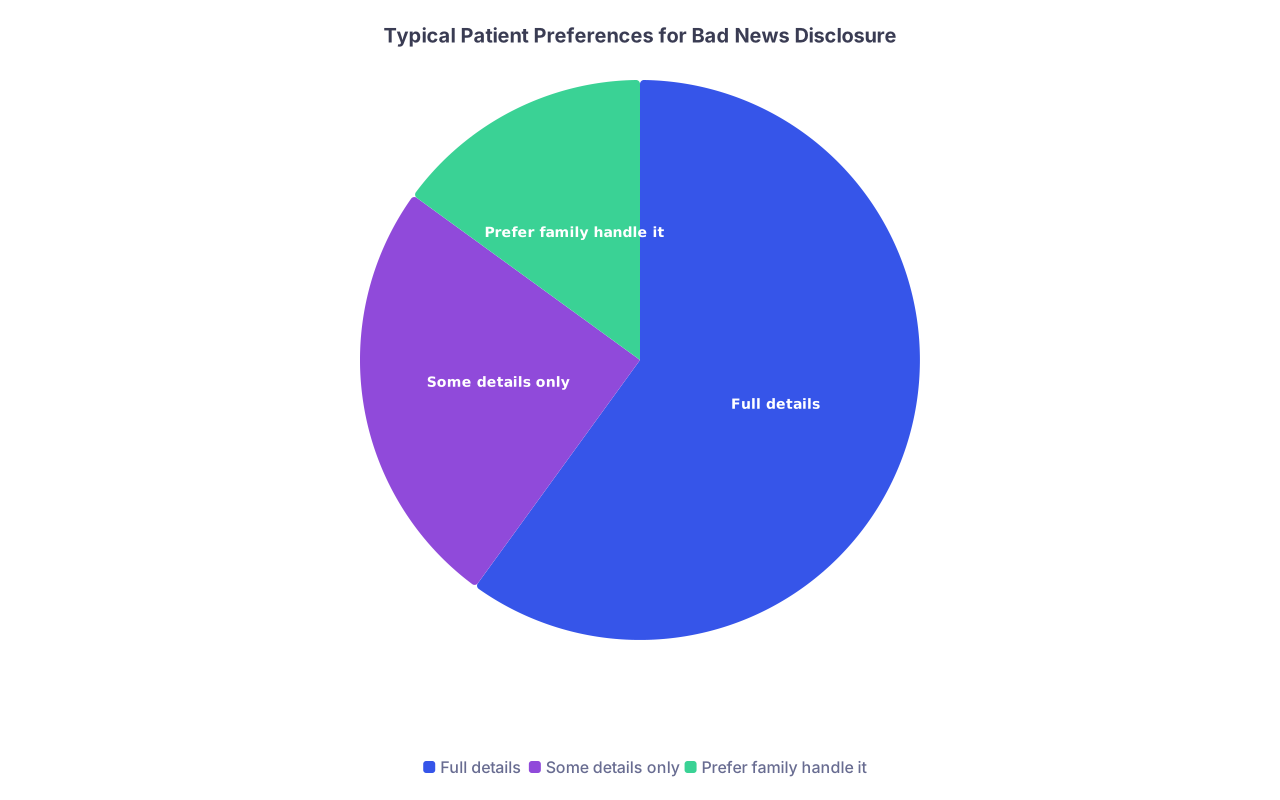
| Category | Value |
|---|---|
| Full details | 60 |
| Some details only | 25 |
| Prefer family handle it | 15 |
Are there truly cultural contexts where no one tells the patient directly? Yes. But you’re not practicing in a theoretical anthropology seminar; you’re practicing under specific state laws, institutional policies, and ethical guidelines that prioritize patient autonomy.
The line is this: you can adapt how you disclose, not whether disclosure is offered.
What If I’m Just a Student or Intern and the Family Corners Me?
Here’s the part nobody tells you: you’re allowed to set boundaries, and you’re allowed to punt to your attending. In fact, you should.
You’re imagining this is some high-stakes moment where everyone expects you to deliver the one perfect ethics answer or be exposed as a fraud.
Reality: as a med student or PGY-1, the “ethically correct” move is usually:
Don’t agree to hide anything.
Never say “Okay, I won’t tell her” or “We’ll keep this between us.” That sentence will haunt you.Acknowledge their fear without making promises.
Example:
“I can see you’re really worried about how she’ll react. That makes sense—this is a lot.”
That buys you time without committing to anything unethical.Name your role and defer up the chain.
“I’m still in training, so I’m not the one who makes final decisions about what gets shared or how. What I can do is make sure your concerns are heard by the attending, and we can talk together about a plan.”Loop in the team immediately.
Page your resident. Text your attending. Document the conversation briefly: “Family expressed request that diagnosis not be disclosed to patient; will discuss with attending and plan for disclosure approach.”
What you’re scared of: looking weak or incompetent.
What your attending wants: to be told early when there’s family drama around disclosure so they can manage it at their level, not find out after a disaster.
If an attending ever tells you, “Just don’t tell her, don’t document it,” that’s not you being undertrained—that’s them being reckless. Do not own their bad ethics with your notes or your words. Ask them, calmly:
“For my understanding, how would you like me to document our communication plan with the patient?”
That often forces people to reconsider if they’re about to do something indefensible on paper.
Does “Therapeutic Privilege” Mean I Can Keep Quiet?
You’ve probably heard this phrase once, somewhere: therapeutic privilege. And a part of you wonders if this is the magic legal out.
Short version: it almost never applies to the kind of scenario you’re afraid of.
Therapeutic privilege is the idea that in rare circumstances, a physician may withhold certain information if disclosure would cause such severe, immediate harm that it undermines the purpose of care (e.g., patient with active suicidal intent where certain info might trigger self-harm right now).
That is:
- Attending-level decision
- Extreme situations only
- Usually involving acute, demonstrable risk of serious harm
Not: “She’ll be sad” or “He won’t be able to sleep” or “She’ll give up.”
There’s a big difference between:
- Tailoring how you say it (gentle language, stepwise disclosure, family present),
versus - Actively lying or omitting the core truth.
If you’re wondering, “Is this therapeutic privilege?” it almost certainly isn’t. And the fact that you’re asking means you should not be making that call solo anyway.
What If the Patient Themselves Says, “Don’t Tell Me”?
This one feels slightly less scary but still confusing.
Here’s what’s usually reasonable:
You: “Some people want all the details about what we’ve found and what it means. Others prefer we share less detail and focus on what we’re doing next. How do you usually prefer to get information about your health?”
Patient: “I don’t want to know if it’s something bad. Just tell my daughter and she’ll handle it.”
If the patient is:
- Alert
- Understands the situation in broad strokes
- Not being coerced
- Clearly delegating information and decision-making
That’s okay. They’re allowed to choose not to know. That’s still exercising autonomy.
“Discussed general nature of serious findings. Patient expressed wish not to receive detailed diagnostic/prognostic information and requested that medical team communicate details and decisions through daughter [Name]. Patient demonstrates understanding that serious condition may be present and that daughter will be primary recipient of medical information.”
That’s very different from never asking the patient, then hiding behind “well, the family says she doesn’t want to know.”
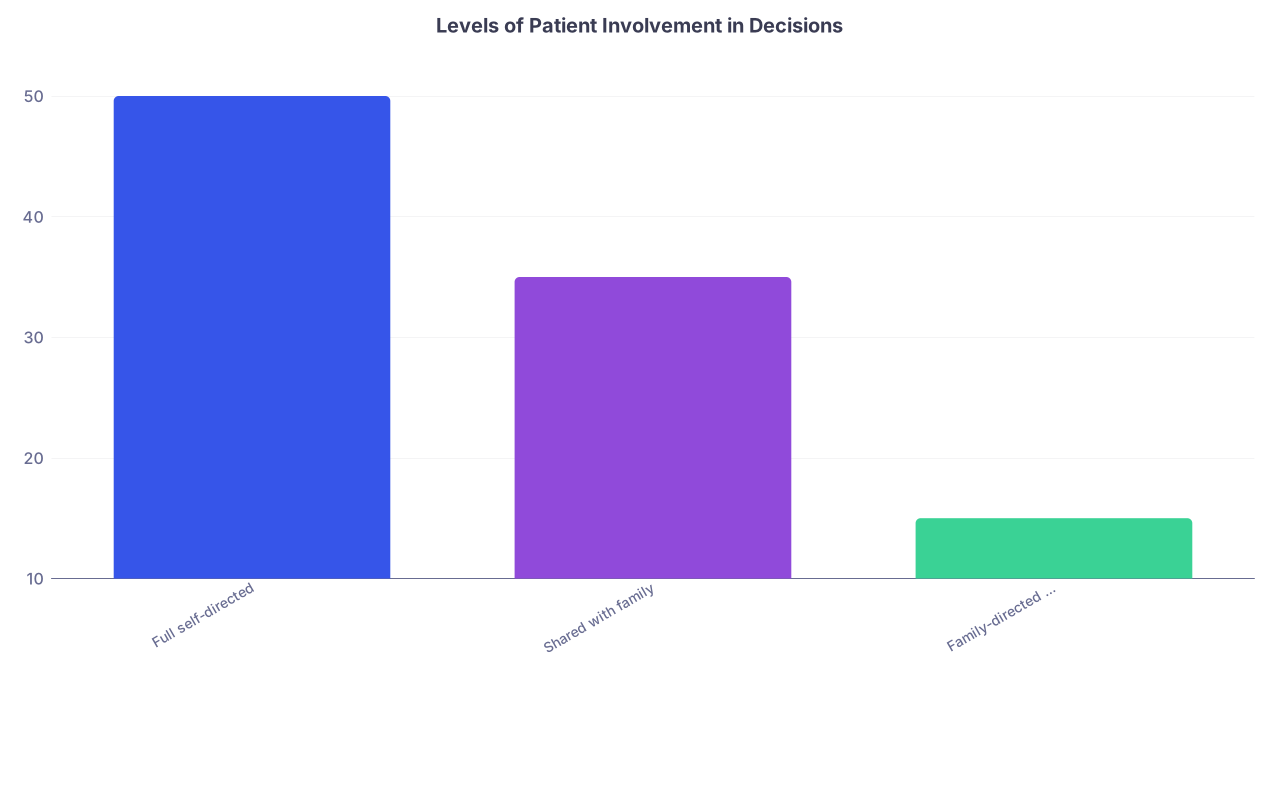
| Category | Value |
|---|---|
| Full self-directed | 50 |
| Shared with family | 35 |
| Family-directed by choice | 15 |
What If I’m Forced to Speak in Front of the Patient After the Family’s Request?
Worst-case nightmare: you walk into the room with the family and patient, and someone says, “Doctor, what did the scan show?” while the son is giving you death-stare “REMEMBER WHAT WE SAID” eyes.
You feel the floor disappear.
Here’s the move that usually saves you:
Pause and broaden the question.
“There’s a lot of information from the scan, and I want to make sure I explain it in a way that works for you.”Ask the patient about preferences, in front of everyone.
“Some people want all the details directly; some prefer their family to hear more of it and help filter. How do you prefer we talk about your results?”
Now one of three things happens:
Patient says, “Just tell me, I want to know.”
Then you’re ethically clear to speak honestly (ideally gently, and probably as part of a team, not alone if it’s something huge).Patient says, “Tell my son, I don’t want the details.”
Then you say, “Okay, I’ll talk with him in more detail, and we’ll keep you updated on the plan.” You’ve honored their choice.Patient says something ambivalent like, “I don’t know, whatever you think is best.”
Then you can say, “Why don’t I explain the basics to all of you together, and we can decide how much more detail you’d like beyond that?”
The key is: don’t get bullied into silent complicity. Ask the patient directly how much they want to know. That alone protects you a lot.
How Do I Actually Say “No” To the Family Without Blowing Everything Up?
You’re scared that pushing back will destroy trust.
Most of the time, if you do it well, it actually builds trust—because they see you’re trying to protect the patient, not just follow rules.
Something like:
“I hear that you’re afraid hearing the word ‘cancer’ will break her. You care about her and you’re trying to protect her, and that comes through very clearly. My responsibility, though, is first to her as a person who has the right to understand what’s happening to her body. What we can do is choose how and how much we tell her, and who’s in the room, and how we support her afterward. But I can’t ethically promise not to tell her anything about her condition.”
You’re not saying “you’re wrong.” You’re saying, “I see your love, but I still have a duty I can’t ignore.”
Will some families still get mad? Yes. You can’t fix all of that. But anger doesn’t necessarily mean you did the wrong thing. Sometimes it just means you didn’t collude with denial.

So What’s the Safest Play for Me, Personally?
Let me be blunt about self-preservation:
Never promise secrecy to family about core diagnoses or plans.
You can’t keep that promise and stay within ethical/ legal lines if the patient wants to know.Always bring it back to the patient’s preferences.
“I need to ask her how she wants us to talk about her health.”Escalate early.
These are attending-level problems. You are not the hero here. You’re the one smart enough to not die on this hill.Document facts, not drama.
“Family requested limitation of information to patient; will discuss with attending and plan for communication with patient.”
Don’t editorialize; just record reality.Use ethics consults when things get ugly.
If your gut is screaming, “This is wrong,” get the ethics committee involved. That’s literally what they’re for. It also protects you from being the lone dissenter.

| Step | Description |
|---|---|
| Step 1 | Family asks you to hide diagnosis |
| Step 2 | Do not agree or promise |
| Step 3 | Express empathy for their concern |
| Step 4 | Clarify your role and duty to patient |
| Step 5 | Assess patient capacity and preferences |
| Step 6 | Plan honest but sensitive disclosure |
| Step 7 | Document and share details with family |
| Step 8 | Work with legal surrogate on best interest |
| Step 9 | Loop in attending and possibly ethics |
What About Being Evaluated? Could I Get “In Trouble” for Pushing Back?
You’re worried some attending is going to label you “difficult” if you raise ethics concerns. That fear is real. There are attendings who hate being challenged.
But here’s the uncomfortable truth: in the ethics vs. evaluation tradeoff, you can recover from one bad eval. You can’t easily recover from documented unethical behavior attached to your name—especially if a complaint or legal case later drags your note or your words into the spotlight.
If you phrase your concern as:
“I just want to make sure we’re aligned with hospital policy and patient autonomy. Can we talk about how we’re documenting her wishes around information sharing?”
You don’t sound rebellious. You sound thoughtful. Most decent attendings respect that. The bad ones… well, nothing you do will fully protect you from them anyway.
Pick the hill you’re willing to die on. “I didn’t lie to a capacitated adult about their own body” is a better hill than “My attending didn’t get annoyed with me.”

Bottom Line: What Do I Hold Onto When I’m Panicking?
When your brain is spiraling and the family is staring at you, strip it back to a few anchors:
Your duty is to the patient, not the family.
Start from their autonomy. Offer information. Ask what they want to know. Adjust how, not whether, you tell them.You don’t have to solve it alone.
Don’t promise secrecy. Buy time. Bring in the attending and document. This is not supposed to be your solo battle.It’s okay to feel sick to your stomach about this.
That discomfort is actually a good sign. It means your moral compass is working. Medicine would be a lot scarier if you didn’t feel uneasy when asked to lie.
You’re not failing because this scenario terrifies you. You’d be failing if it didn’t.


