

Most ICU conflicts over “nonbeneficial treatment” are not about ethics; they are about people avoiding hard conversations until everyone is cornered.
Let me break this down specifically. You are in the ICU. A patient with metastatic cancer, multiorgan failure, on high-dose vasopressors and maximal ventilator support. The oncologist has said, quietly, “There is nothing more to offer.” The chart screams poor prognosis. And the family says: “Do everything. Don’t stop anything. Add dialysis if his kidneys fail.”
That is the real case behind the abstract phrase “requests for nonbeneficial treatments.”
This article is about how you, as a clinician, actually handle that. Not in theory. In practice, at 3 a.m., on a Friday, when the attending is on home call and the nurse is asking, “So… are we starting CRRT or not?”
1. Start with a precise vocabulary: “futility” is a trap
The fastest way to escalate conflict in the ICU is to announce, “Further treatment is futile.” Lawyers, administrators, and families all hear that word differently. It is vague, emotionally loaded, and legally dangerous.
Break it down instead into specific, defensible categories.

1.1 The four useful categories
Think in four buckets. This distinction is what ethics committees actually use when cases get ugly.
Physiologic futility (true medical impossibility)
The intervention cannot achieve the immediate physiologic goal, no matter what.- Defibrillation on asystole that has persisted for 30 minutes with good CPR and no reversible causes.
- CPR in a patient with complete cardiac rupture on echo.
- Dialysis when there is no vascular access possible and attempts have failed.
Here, you are not “withholding care”; you are refusing to do something physiologically impossible. Ethically and legally, you are on the firmest ground.
Quantitative futility (extremely low likelihood of benefit)
The intervention might possibly do what it is supposed to do, but the chance is so vanishingly small that almost no rational person would accept it if fully informed.
Typically: survival rates in the 0–1% range, often with severe disability.Classic example: Prolonged CPR in a multi–organ failure, anoxic brain injury patient with no brainstem reflexes and repeated PEA arrests.
Qualitative futility (benefit is not a “benefit” in any meaningful sense)
The intervention may keep the heart beating, but the resulting condition is one most people would consider worse than death.- Continuing ECMO in a patient with devastating, irreversible neurologic injury and no meaningful consciousness expected.
- Prolonged ventilation with no prospect of interaction, awareness, or comfort despite maximal palliative measures.
Goal discordance (the real workhorse category)
The requested intervention might work physiologically, but it does not match the patient’s values or stated goals once those are honestly explored.- The family demands a tracheostomy and PEG, but the patient’s advance directive clearly rejects long-term life support with severe disability.
- The patient had repeatedly said, “I never want to live in a nursing home,” yet the family pushes for every intervention knowing the only discharge options are LTACH or nursing home.
Most bedside fights get labeled “futility” but are actually mixtures of quantitative futility, poor communication, and goal discordance.
2. Ethical and legal ground rules you cannot ignore
If you do not understand the legal floor you are standing on, you will either over-treat out of fear or under-communicate out of misplaced confidence.
2.1 There is no legal duty to provide non–standard, medically inappropriate care
Across most jurisdictions (US, UK, EU, Canada), clinicians are not legally required to provide treatments that are:
- Not medically indicated
- Outside the standard of care
- Purely harmful or physiologically impossible
Autonomy gives patients the right to refuse offered treatments, not the right to command any treatment they want. Ethically: no obligation to provide interventions that offer no reasonable chance of benefit or impose disproportionate burden.
The nuance: what counts as “no reasonable chance” or “disproportionate” is where conflict lives. You cannot just declare something “futile” because you find it distasteful or costly.
2.2 But you also cannot unilaterally withhold everything you personally disagree with
You are bound by:
- Professional standards (specialty society guidelines, institutional policies)
- Local law (state/provincial statutes, case law)
- Contractual obligations (hospital policies, insurance agreements)
Unilateral “I will not offer this because I think it is wrong” without institutional backing is how you end up in court or front-page news.
Many US states have statutes or case law on “medically inappropriate” or “potentially inappropriate” treatment (Texas Advance Directives Act is the most famous example). Some countries require a second opinion or ethics review before withdrawing certain life-support modalities over objection.
Know your institution’s policy. Not theoretically. Actually read it once.
3. A stepwise, practical framework for handling requests
Here is the framework I teach residents and fellows, and that ethics committees quietly hope you will follow before calling them. Think of it as a timeline, not just a checklist.

| Step | Description |
|---|---|
| Step 1 | Identify Request |
| Step 2 | Clarify Clinical Facts |
| Step 3 | Assess Prognosis and Goals |
| Step 4 | High Quality Family Meeting |
| Step 5 | Document and Implement Plan |
| Step 6 | Second Opinion and Ethics Consult |
| Step 7 | Institutional Policy Pathway |
| Step 8 | Agreement Achieved |
| Step 9 | Still Conflict |
Step 1: Clarify exactly what is being requested
Vague statements like “Do everything” are useless. Translate them into specific interventions.
You should know:
- Are they asking for CPR if arrest occurs?
- Are they insisting on dialysis, ECMO, ongoing vasopressors, new chemotherapy, surgery?
- Are they rejecting any limits on escalation?
Script I use:
“When you say ‘do everything,’ sometimes families mean everything that can help, and sometimes they mean never allow the heart to stop, even if nothing is working. Let me list the main things we could do and see which ones you actually want for her.”
You are trying to avoid a situation where you think they demanded dialysis, and they thought they were just asking you not to “abandon” their father.
Step 2: Be precise about prognosis and trajectory
Nonbeneficial treatment is a prognostic concept. If you are wrong about prognosis, everything downstream is garbage.
You need:
- Clear diagnosis and underlying disease trajectory (multi–organ failure in septic shock vs COPD exacerbation in a previously stable patient).
- Short-term prognosis: survival to ICU discharge, to hospital discharge.
- Long-term prognosis: 6-month, 1-year survival, functional outcomes.
Use actual data when you have it. Not vague “very sick.” Pull up relevant scores and studies if needed, but do not worship them.
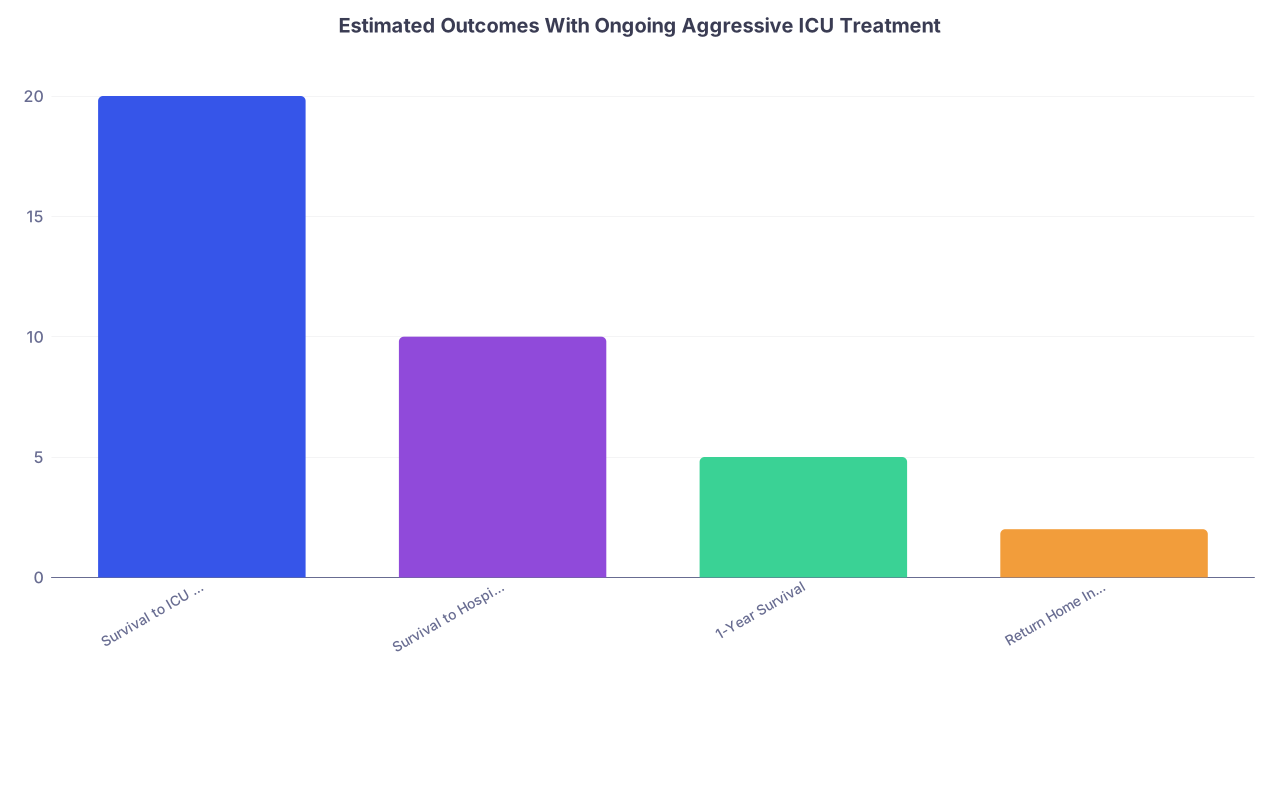
| Category | Value |
|---|---|
| Survival to ICU Discharge | 20 |
| Survival to Hospital Discharge | 10 |
| 1-Year Survival | 5 |
| Return Home Independently | 2 |
Then you translate.
“Patients like your mother, with this level of organ failure and this much time on the ventilator, have about a 1 in 10 chance of leaving the hospital alive. Of those, only a small fraction ever walk independently again. I wish that number were higher. It is not.”
You owe them specificity. “Poor prognosis” is an abdication.
4. The core skill: high-quality goals-of-care meeting
Most “requests for nonbeneficial treatment” collapse once there has been a single, honest, structured conversation that links facts → values → recommendations.

Here is the specific structure I use.
4.1 Set the stage like a professional, not like a rushed intern
- Right place: quiet room, chairs, tissues, no monitors beeping.
- Right people: surrogate decision maker, key family members, bedside nurse if possible, maybe social worker or palliative care if available.
- Right time: not two minutes before shift change; give it at least 30–45 minutes.
You start with a clear agenda:
“Today I want to explain what is happening medically, talk about what we should expect in the coming days, learn more about who your father is and what he would want in a situation like this, and then make some decisions together about the kind of medical care that makes sense from here.”
You are framing this as shared decision making, not as the physician vs the family.
4.2 Anchor in the patient’s story, not the family’s distress
Too many clinicians skip straight from facts to DNR orders. That is why families push back.
Ask:
- “What was she like before this hospitalization?”
- “What would she say about living with severe disability, nursing home care, ventilators?”
- “Has she ever told you what she would want if she were this sick?”
You are establishing a substituted judgment standard: decisions based on what the patient would have wanted, not what the family wants for themselves.
If there is an advance directive or POLST, this is when you physically put it on the table and read the relevant portions out loud.
4.3 Deliver the medical reality in plain, non-technical language
No hedging.
Bad version: “I am concerned things are not going the right way; she is critically ill.”
Better:
“Despite everything we are doing—maximal antibiotics, strong medications to support blood pressure, the ventilator—her liver and kidneys are shutting down and her lungs are not improving. From everything we know, she is not going to recover to a condition where she can wake up, talk with you, or live independently again.”
Silence after this is important. Let them react.
4.4 Link goals to treatments explicitly
Ask:
- “Given what you have told me about her, and what we know medically, what do you think she would say about continuing these intensive treatments?”
- “If we cannot get her back to the life she valued, would she want us to keep her body alive in the ICU with machines, or would she want us to focus on comfort?”
Then you make a clear recommendation. Not multiple-choice, not a menu.
“Based on how she lived her life, what she wrote in her directive, and what we know medically, I recommend that we do not escalate with dialysis or CPR if her heart stops. Instead, I recommend we shift our focus to making sure she is comfortable, allow natural death, and prepare all of you for what that will look like.”
Families often need permission to choose the path that aligns with the patient’s values. Your recommendation, grounded in those values, is part of your duty—not “presenting options neutrally” and walking away.
5. When families still insist: distinguish the reasons
Sometimes, even after an excellent family meeting, the answer is still: “No. We want everything.”
Do not lump all refusals together. The reasons matter.
| Driver | What it looks like | Primary Strategy |
|---|---|---|
| Misunderstanding | “So you’re saying there is still a chance?” after you said 1% | Re-explain with numbers, visuals, repetition |
| Mistrust | “You just want his bed for someone else” | Bring in second opinion; transparency; continuity |
| Guilt | “I was not there for her before; I can’t stop now” | Normalize feelings, chaplain/social work, allow symbolic acts |
| Religious belief | “Only God decides when he dies” | Respect belief, frame withdrawal as letting God act, involve chaplain |
| Family conflict | Siblings disagree; one insists on “everything” | Clarify surrogate hierarchy; possibly limit to legal surrogate |
5.1 Misunderstanding or denial
If every time you say “She is dying,” they respond with “So another week of antibiotics could help?” you have a comprehension problem, not a value conflict.
You reframe:
“I may have been unclear. There is no treatment that will reverse what is happening. Antibiotics, dialysis, chest compressions—none of these will make her wake up or get better. They might make her die more slowly and more uncomfortably. There is no path here that gets her back.”
Sometimes drawing a simple timeline on paper helps:
Hospital admission → ICU → escalation of supports → now: no path to recovery.
5.2 Mistrust
You know this one: “You are giving up too early.” “If she were younger / richer / a VIP, you would try harder.”
The fix is not to argue ethics. The fix is:
- Transparency: show them the imaging, the labs over time, the trajectory.
- Continuity: have the same attending or fellow meet with them repeatedly.
- Second opinion: another intensivist, relevant specialist (e.g., neurologist for brain injury), maybe even outside institution consult if realistic.
You can say:
“Another ICU specialist has independently reviewed everything and agrees with the prognosis. We can invite them to join our next meeting so you can hear it directly.”
That one step dissolves a lot of suspicion.
5.3 Religious and cultural beliefs
The classic line: “Only God can decide when he dies. We cannot give up.”
You do not win this argument by saying, “Continuing vasopressors is not a commandment.” You work with their framework.
Lines that actually work:
“I respect your faith deeply. From a medical standpoint, we have reached the point where these machines are no longer helping his body heal. Stopping them is not causing his death; his disease is. Some families in your situation feel that allowing a natural death is a way of placing him in God’s hands instead of our machines. Does that fit with how you see things?”
Bring chaplaincy, ideally from their own tradition. A trusted religious leader telling them, “It is not against our faith to allow a natural death,” changes everything.
6. When you still disagree: appropriate limits and conflict resolution
At this point, you have:
- Clarified the request
- Delivered a precise prognosis
- Held at least one serious goals-of-care meeting
- Explored misunderstanding, mistrust, guilt, and religious dynamics
And the surrogate still demands, for example, full code, dialysis, escalating vasopressors, and no ceiling on care.
Now you are in the “potentially inappropriate” zone—where your duty to the patient and your duty not to cause harm may justify limiting treatments over family objections.

| Step | Description |
|---|---|
| Step 1 | Ongoing Disagreement |
| Step 2 | Request Second Opinion |
| Step 3 | Formal Ethics Consult |
| Step 4 | Institutional Review Committee |
| Step 5 | Propose Time Limited Trial or Nonescalation |
| Step 6 | Continue Current Plan |
| Step 7 | Implement Plan and Reassess |
| Step 8 | Consider Transfer per Policy |
| Step 9 | Committee Supports Limitation |
| Step 10 | Family Accepts |
6.1 Use second opinions early, not as a last-ditch move
A second intensivist or specialist opinion accomplishes three things:
- Confirms you are not missing a reversible factor.
- Establishes that this is not just “Dr X being pessimistic.”
- Provides institutional backing when you say no to certain interventions.
Document clearly: “Second opinion by Dr ___, critical care, concurs that further escalation is medically inappropriate and unlikely to achieve meaningful benefit.”
6.2 Ethics consultation: not window dressing
Ethics consults are not just for show. They:
- Provide an external, documented analysis of the ethical justifications for limiting treatment.
- Ensure that patient values, surrogate legitimacy, and cultural issues have been seriously evaluated.
- Help craft specific language and options for the family.
You do not outsource the decision to ethics. You use ethics to ensure due process and transparency.
6.3 Time-limited trials: powerful but misused
Everyone loves to offer “time-limited trials” of intensive care. Often as a way to avoid saying “no.”
Used correctly, a time-limited trial has:
- Specific goals: e.g., improved oxygenation, dropping lactate, awakening, decreased pressor need.
- Specific duration: 48–72 hours, sometimes up to 7 days for selected pathologies.
- Clear “if–then” plan: “If we see X, we will continue; if we do not, we will stop Y and not escalate further.”
Write this down. Read it out to the family. They sign or verbally agree, and you document that.
Example:
“We can try dialysis for 72 hours to see if his blood chemistry and level of alertness improve. If his kidney numbers keep worsening, his blood pressure remains dependent on maximum medication doses, and he does not regain the ability to follow commands, we will stop dialysis and not start chest compressions or shocks if his heart stops. Instead, we will focus on keeping him comfortable.”
Do not offer time-limited trials when there is truly zero chance of benefit (true physiologic futility). That just prolongs suffering to avoid a hard conversation.
7. Knowing when to say “no” and stand by it
There are cases where you ethically and professionally should refuse further escalation, even if the family continues to demand it.
Criteria that usually justify this:
- The intervention is physiologically futile (e.g., CPR with no perfusing rhythm, catastrophic structural heart rupture).
- The intervention is quantitatively futile with near-zero survival and profound suffering, and this assessment is supported by multiple specialists and/or guidelines.
- The intervention would only prolong dying with no possibility of consciousness, interaction, or relief of suffering, and all reasonable efforts have been made to understand and honor the patient’s values.
At that point, your responsibility is to:
- Clearly explain what you will not do and why.
- Intensify comfort-focused and family-supportive care.
- Offer transfer to another willing facility if policy requires or allows.
- Ensure safety of staff if emotions escalate (security involvement is sometimes necessary).
The language you use matters:
Bad:
“We are pulling the plug because there is nothing more to do.”
Better:
“We are going to stop the machines that are no longer helping her body heal. Her disease is what is causing her death. Our focus will be on making sure she is not in pain and that you have time with her. We will not perform chest compressions, shocks, or other procedures that would only cause more suffering without changing the outcome.”
You are not “killing” the patient. You are refusing to perform invasive, harmful procedures that cannot achieve meaningful benefit.
8. Documentation: your shield and your service to the patient
Every serious ICU ethics case is a documentation case. If it is not written down, you did not do it. And if your note is vague, it will not protect you.

Your notes should include:
- Medical facts: diagnoses, organ failures, prognostic assessments, relevant scores or literature if unusual.
- Family meeting details: who was present, what was said about prognosis, what values and preferences were expressed, any advance directives reviewed.
- Recommendations given: exact recommendations and the rationale.
- Family response: agreement, hesitation, continued insistence, specific phrases if significant (“we don’t care about quality of life, just quantity”).
- Consults obtained: second opinions, ethics, palliative, chaplain, social work.
- Decisions made: code status, limits on escalation (no new vasopressors, no dialysis, no CPR, or conversely, specific time-limited trial).
Avoid hedging language like “appears to be” when you are actually certain. Ambiguous notes get interpreted against you.
9. Personal development: protecting your own moral core
Let me be blunt. Cases like this burn people out. Watching weeks of nonbeneficial ICU treatments corrodes clinicians. You are not a robot. You are a human being repeatedly exposed to situations where you feel complicit in suffering.
You will hear colleagues say things like:
- “We’re torturing this patient.”
- “This is a slow-motion code.”
- “If I were in that bed, I’d want you to pull everything.”
You have to protect against three common personal failures:
- Cynical detachment: “Families are always unreasonable; I just follow orders.”
- Self-righteousness: “I am the only one who understands ethics here; everyone else is weak.”
- Emotional collapse: moral distress turning into burnout, depression, or leaving the ICU entirely.
What actually helps:
- Debriefing after the worst cases. Not performative Schwartz Rounds. Actual, small-team debriefs: “That was awful. Here’s what we tried. Here’s what we’ll do differently next time.”
- Ethics education that uses your own real cases instead of abstract trolley problems.
- Peer support: that one colleague you can say the unsayable to (“I feel like I’m torturing this guy”) without being judged.
- Clear institutional policies that back you when you say “no,” so you are not individually responsible for carrying the moral weight.
You will not fix the entire system. But you can refuse to be the person who silently lets nonbeneficial, harmful care roll on for weeks because “the family wants it” and no one has the courage to sit down and have the necessary conversation.
10. Three things to remember the next time you face this
Do not hide behind jargon like “futility.” Be specific about prognosis, outcomes, and how interventions link (or fail to link) to the patient’s own values.
High-quality, structured family meetings are the real treatment. Most conflicts soften when you connect facts → patient story → clear recommendation, documented and revisited.
There are ethical and legal limits. You are not obligated to perform physiologically or qualitatively nonbeneficial treatments once due process—second opinions, ethics input, honest communication—has been followed. Standing by those limits, while maximizing compassion and comfort, is part of your job.


