

The usual teaching on “motivational interviewing is patient-centered” is dangerously incomplete. You can absolutely coerce someone while using perfect motivational interviewing (MI) techniques.
Let me break this down specifically.
1. What Motivational Interviewing Actually Is – And What It Is Not
First, strip away the buzzwords.
Motivational interviewing is a structured style of conversation to strengthen a person’s own motivation and commitment to change, using:
- Collaborative stance (partnership, not hierarchy)
- Evocation (drawing out the patient’s ideas, not inserting yours)
- Acceptance (respecting autonomy, worth, and potential)
- Compassion (acting in the person’s best interests as they define them)
On the ground, that looks like:
- Open questions: “What concerns do you have about your diabetes right now?”
- Reflective listening: “You are exhausted by all these meds and appointments.”
- Affirmations: “You have kept showing up despite that. That is not trivial.”
- Summaries: “So on one hand, you want to be around for your grandkids, and on the other, you hate feeling micromanaged by doctors.”
Notice what is missing:
No requirement that the patient end up doing what you think is best. MI is about aligning care with the patient’s own values. Not about “getting them to yes”.
Now the hard truth: clinicians routinely deploy MI as a technique to increase adherence to their preferred plan. The label is “MI-consistent,” but the ethical core is gutted. That is where the line toward coercion starts.
2. Coercion in Healthcare: The Forms Nobody Thinks They’re Using
Coercion is not just physical restraint or court-ordered treatment. Most clinicians will never tie someone to a bed. But almost all will at some point lean on subtler forms that still undermine autonomy.
In clinical ethics, coercion involves:
- Using a threat or undue pressure
- That the patient reasonably perceives as tied to their decision
- Such that it significantly undermines the voluntariness of consent or refusal
You see this more often than people admit:
- “If you leave AMA, your insurance might not cover this stay.” (Usually false or at least misleading.)
- “If you don’t come to appointments, we may need to dismiss you from the practice.”
- “If you keep refusing meds, I might have to consider you a danger to yourself.”
And the really insidious one, especially in primary care and addiction medicine:
- “Help me understand what it would take for you to agree to start Suboxone today.” (said with clear implication that “no” is not acceptable)
Some pressure is inevitable. Patients know you are the expert. They know there are consequences to certain choices. The ethical question is not: “Is there any influence?” There is always influence. The question is: “Has the influence crossed into manipulation or coercion that overrides true choice?”
MI lives in that tension: purposely influencing while claiming to honor autonomy. That is where you need very sharp boundaries.
3. The Structural Problem: MI Was Imported as a Compliance Tool
Look at how MI is marketed to health systems and you immediately see the conflict.
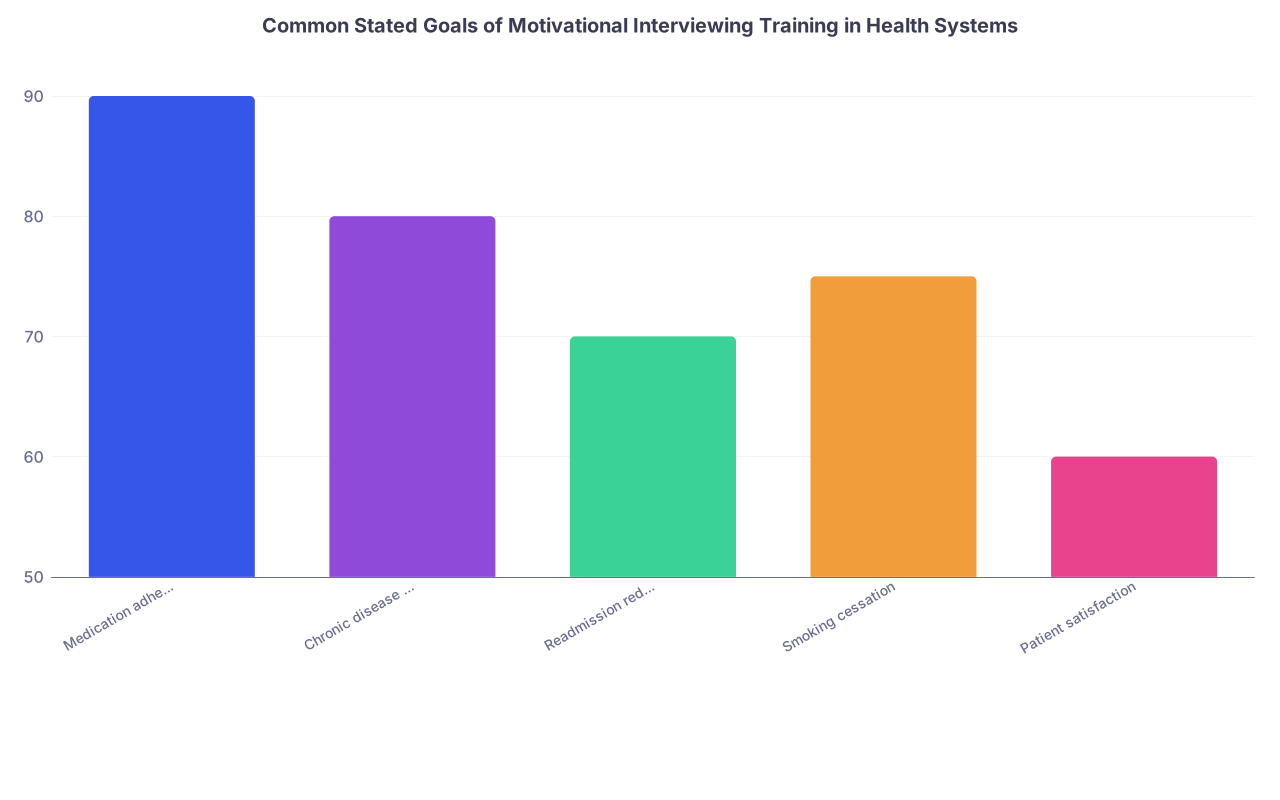
| Category | Value |
|---|---|
| Medication adherence | 90 |
| Chronic disease control | 80 |
| Readmission reduction | 70 |
| Smoking cessation | 75 |
| Patient satisfaction | 60 |
Most hospitals do not fund MI training because they suddenly discovered humanism. They fund it because:
- It improves HbA1c and blood pressure
- It reduces readmissions and ED use
- It looks good on a quality dashboard
So the hidden script many clinicians internalize is:
“I use MI to get my patients to accept evidence-based care.”
Clinically understandable. Ethically hazardous.
Classic MI, as developed in addiction counseling, was about helping people explore ambivalence on their terms. If that exploration led to “I am not ready to change,” the conversation was still considered successful. In many clinical settings today, that outcome is quietly treated as failure.
That mission drift is where MI gets weaponized. The same reflective skills, the same empathic summaries, but all subtly steering toward one “correct” conclusion.
4. The Fine Line: Four Axes Where MI Turns Into Coercion
There are four main axes where “motivational interviewing” can slide into something ethically problematic. I am going to make this concrete.
4.1 Who defines the goal?
This is the core.
Ethical MI: Goal is co-created or patient-defined.
Coercive MI: Goal is pre-selected by clinician/system; MI is used to sell it.
Example:
- Ethical: “You mentioned wanting to avoid another hospitalization. Given that, would it be helpful to talk about medication options, lifestyle, or something else first?”
- Coercive: “We really want to keep you out of the hospital, and this medication is the best way to do that. Let us talk about what is getting in the way of you agreeing today.”
Same topic. Different ownership. When the endpoint is fixed in your mind, you are not doing true MI. You are doing persuasion with nicer language.
4.2 How much uncertainty do you allow?
Ethical MI explicitly allows “no” and “not now” as legitimate.
Coercive MI keeps the appearance of choice while signaling that refusal is irrational or unacceptable.
Look at phrases like:
- “What would it take for you to get on board with this plan?”
- “I am worried that you are not taking this seriously enough.”
- “Most patients in your situation choose to start treatment.”
Those are not neutral. They load the dice. A patient who hears them may feel that choosing otherwise is being foolish, childish, or irresponsible. The social pressure is intentional.
In contrast, true MI includes statements clinicians find very uncomfortable:
- “Given everything we have talked about, it sounds like you may not want to start the medication right now, even knowing the risks. Is that right?”
- “If you decided not to make any changes for now, how would you want us to work together going forward?”
That is the sound of genuine autonomy. And yes, sometimes it makes quality metrics worse.
4.3 What consequences are implied or invoked?
Here is where legal and ethical issues really converge.
If you link the patient’s decision to consequences that you control or influence—discharge, documentation, reporting—your “motivational” stance is no longer neutral.
Obvious red flags:
- “If you keep refusing labs, I have to document that you are noncompliant, which might hurt you later.”
- “If you do not agree to this safety plan, I will have to involve psychiatry / social work / child protective services.”
Sometimes those consequences are real obligations (mandatory reporting, duty to warn, etc.). Sometimes they are exaggerated to produce fear.
The ethical test is simple:
Would a reasonable patient feel intimidated or cornered by what you just said?
If the answer is yes, you have slid into coercion territory, even if the words are technically accurate. MI cannot “clean” that.
4.4 How transparent are you about your agenda?
You always have an agenda. Safety, guideline-concordant care, risk management. Pretending otherwise is dishonest.
Ethical influencing requires stating your agenda openly:
- “My job is to lay out what I see as the safest options and why. Your job is to decide what fits your life, even if that is not what I would pick.”
Coercive MI often hides the agenda behind “I just want what is best for you,” when in fact the real priorities are hospital policy, risk, cost, or metrics.
If you are not honest with yourself about which one is guiding you in that conversation, you are at high risk of using MI as a manipulation tool.
5. Legal and Ethical Frameworks: Where MI Sits in Law and Policy
Let us anchor this in actual doctrine, not vibes.
5.1 Autonomy and informed consent
Legally, valid consent requires:
- Capacity
- Disclosure of material information
- Understanding
- Voluntariness
MI can support the last two very well. It improves understanding and aligns discussions with the patient’s values.
But voluntariness is fragile.
If you are:
- Overstating benefits
- Downplaying burdens or alternatives
- Implying that treatment refusal will jeopardize care, insurance, or future access
- Conflating disagreement with lack of capacity
…then your “consent” is on shaky ground. In some jurisdictions, heavy-handed persuasion has been challenged as undermining voluntariness, especially in psychiatry and end-of-life care.
What courts and ethics committees look for is a pattern: was the patient given a real option to say no without being punished, belittled, or threatened? MI that is aligned with this is defensible. MI that is a script for pressuring someone off the fence is not.
5.2 Beneficence vs. respect for autonomy
Ethics committees hear this one constantly in different clothing.
The clinician says: “But if I do not push, they will die / lose their kidney / relapse.”
The ethicist replies: “Your obligation to promote benefit does not cancel their right to choose what they consider a life worth living.”
MI is often pitched as the perfect compromise:
“I am still respecting autonomy, but I am helping them get to the ‘right’ decision.”
That is seductive. And sometimes true. But you need to own the conflict: the more emotionally skillful you become at drawing out change talk, the more power you have to shape the outcome. That is influence. Potentially strong influence.
The ethical key: Are you prepared to use the same MI skills to support a well-informed decision you personally disagree with?
If not, you are not practicing ethically neutral MI. You are practicing value-imposing counseling.
5.3 High-risk areas: psychiatry, addiction, and capacity
These specialties are the pressure cookers where this stuff gets exposed.
- In psychiatry, you often combine MI techniques with the authority to involuntarily hospitalize. Patients know that. Subtle “concerns” about safety can feel like veiled threats.
- In addiction treatment, MI is routinely used in the context of probation, family ultimatums, or court mandates. “You are free to choose” rings hollow when the visit is literally a condition of staying out of jail or keeping custody.
- In geriatrics and neurology, MI-like conversations about “what matters most” happen alongside capacity evaluations. A patient may reasonably fear that expressing certain preferences (refusing feeding tubes, declining rehab) will trigger a finding that they “lack insight.”
You cannot fix these asymmetries with nicer language. You have to be extraordinarily explicit about what is and is not voluntary, what the real risks are, and where your legal duties kick in.

| Step | Description |
|---|---|
| Step 1 | Discuss treatment |
| Step 2 | High coercion risk |
| Step 3 | Moderate coercion risk |
| Step 4 | Lower coercion risk |
| Step 5 | Real option to say no? |
| Step 6 | Consequences threatened or implied? |
| Step 7 | Clinician agenda disclosed? |
The diagram is simplistic. Real life is not. But if you are living in the C/F boxes routinely while calling it MI, you have an ethics problem.
6. Concrete Clinical Scenarios: Where the Line Gets Crossed
Let me give you three very real-world cases and dissect them.
6.1 The “noncompliant” diabetic patient
A 52-year-old with poorly controlled type 2 diabetes keeps missing appointments and rarely takes insulin. HbA1c is 11.5. You are frustrated.
You say:
- “You have to meet me halfway here. If you are not going to take this seriously, I cannot help you.”
- “Most people who ignore their diabetes end up on dialysis or losing a limb. Is that what you want?”
Then you “pivot” into MI:
- “On a scale from 1 to 10, how important is it for you to follow the insulin plan?”
- “What would it take to move you from a 3 to a 6?”
This is not clean MI. You started with shame and fear, you framed refusal as childish, and you signaled that continued care might be contingent on “cooperation.” The “MI” that follows is happening in the shadow of that threat.
Contrast a less coercive approach:
- “You have been juggling a lot and insulin has not been a priority. I am worried about the risks, but I also know scare tactics do not work. Would you be open to talking about what living well with diabetes looks like to you, even if that does not involve perfect control?”
Different feel entirely. Still honest about risk. No punitive undertone.
6.2 Involuntary hospitalization on the table
A 28-year-old with severe depression and passive suicidal thoughts. You are on the fence about involuntary admission. They seem ambivalent but deny active intent.
You say:
- “I want us to agree on a plan voluntarily. If we cannot, I may have to consider hospitalizing you against your wishes.”
- “What would you need to feel okay about going in voluntarily tonight?”
That first sentence is not MI. It is a conditional threat, even if legally accurate. Once spoken, every “choice” that follows is influenced by fear of losing agency.
The ethical version is more transparent:
- “The law allows me to hospitalize someone against their will only if I believe they are at imminent risk of serious harm to themselves or others. Right now, I am not sure you meet that threshold. But I am worried. If we stay outpatient, I want to understand what safety looks like in your life.”
Then, if you are truly undecided:
- “Here is my strong recommendation and why. You can say no. If at any point I come to believe you are at immediate risk, I will tell you directly that this is shifting into an involuntary situation. We are not there at this moment.”
Now, if they agree to admission after that, your use of MI-style exploration of ambivalence is anchored in clearer boundaries.
6.3 Pediatric vaccine refusal
Parents decline vaccines for their 2‑year‑old. You deeply disagree. You also know your practice is under pressure about vaccination rates.
Many clinicians slide into what I would call cosmetically empathetic coercion:
- “Of course you want what is best for your child. Most loving parents choose to vaccinate. Help me understand what is holding you back.”
- “I have to be honest. If you continue to refuse, I may not be the right doctor for your family, because I cannot give your child the best care this way.”
The second line crosses into coercion. You are tying access to primary care—a basic good—to a specific medical decision not mandated by law. Ethically controversial, at best.
A less coercive, still firm approach:
- “We disagree strongly here. I believe vaccines are a critical part of safe care. Some practices discharge families for continued refusal. Our current policy is that we continue care but revisit this conversation periodically and ensure you understand the risks you are accepting on your child’s behalf. If that does not work for you, I can help you find another clinician.”
You are still setting boundaries, but you are not wielding your power to force a choice in the moment.
7. Guardrails: How to Use MI Without Slipping Into Coercion
You are not going to fix systemic incentives. But you can practice differently. Let’s be practical.
7.1 Say your agenda out loud
Literally. Out loud.
- “My job is to lay out the options, risks, and my recommendation. I prefer that you accept treatment because I think it lowers your risk. But it is your decision.”
Then prove you mean it by:
- Accurately stating alternatives, including doing nothing
- Naming that some reasonable people pick differently
- Not punishing or shaming the patient if they do
7.2 Explicitly name refusal as an option
You have to override patients’ assumption that “no” is not allowed.
Sample language:
- “You can agree, disagree, or say you want more time. All of those are real options here.”
- “If you decide not to pursue this, I will still be your clinician and we will keep working together.”
Notice how rare you have actually heard that sentence spoken.
7.3 Distinguish education, persuasion, and manipulation
Education: “Here is what we know about this treatment. Here are the numbers and side effects.”
Persuasion: “Given your goals, I think this is your best option and here is why.”
Manipulation: “If you cared about your family / your future, you would choose this.”
MI can support education and, carefully, persuasion. It is misused when it becomes a clever way to trigger guilt, fear, or obligation.
As a mental habit: after a strong reflection or summary, ask yourself, “Did I just neutrally capture their perspective, or did I subtly reframe it toward my preferred conclusion?”

7.4 Document your respect for autonomy, not just your recommendations
From a medico-legal standpoint, charting only your advice and the risks is not enough. Show your respect for choice.
Better documentation looks like:
- “Discussed benefits and risks of anticoagulation, including bleeding risk and stroke risk with and without treatment. Patient articulated priority of ‘avoiding being on blood thinners even if that means higher stroke risk.’ Demonstrated understanding by explaining tradeoffs in own words. Declined anticoagulation at this time. Plan to revisit.”
That last sentence shows ongoing partnership without framing them as “noncompliant.”
7.5 Learn to tolerate moral distress without converting it into pressure
A lot of coercive behavior is moral distress leaking out sideways.
You watch someone choose what you consider a self-destructive path. You feel responsible. Powerless. So you push harder. Dress it up as “motivational interviewing.” Feel slightly better because at least you “tried.”
It is more honest to name what you are feeling (to yourself; sometimes to the patient):
- “I feel anxious because I have seen what this disease can do and I do not want that for you. At the same time, I know this is your choice, and I will keep caring for you regardless.”
You are allowed to be human. You are not allowed to convert your distress into subtle threats.
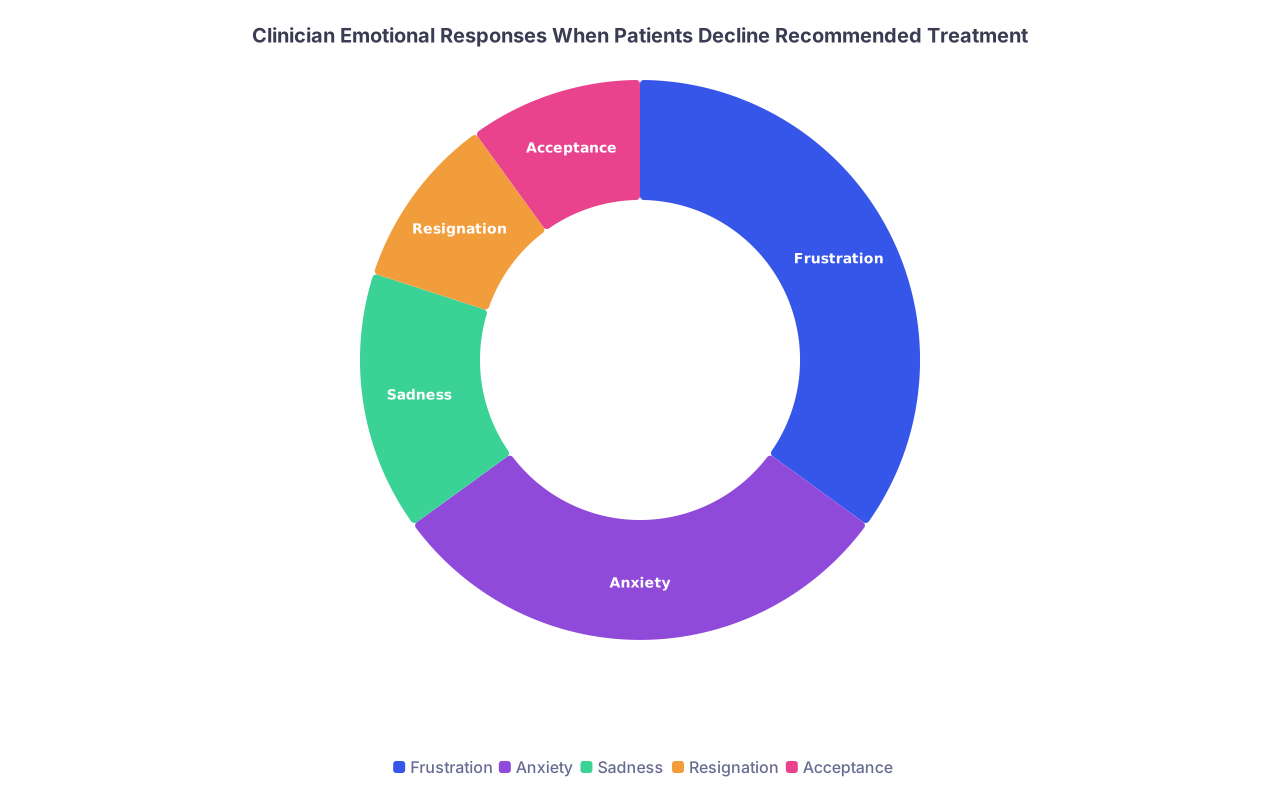
| Category | Value |
|---|---|
| Frustration | 35 |
| Anxiety | 30 |
| Sadness | 15 |
| Resignation | 10 |
| Acceptance | 10 |
Those emotions are normal. The question is what you do with them.
7.6 Build a personal “red flag” list
You will not catch yourself every time. But there are phrases that should trigger your own internal alarm.
Examples:
- “If you really understood, you would…”
- “I cannot in good conscience let you…”
- “You are making me consider…” (calling psych, CPS, admin, etc.)
When you hear yourself thinking or saying those, pause. Step back. Ask: “Am I using my power or my clinical judgment right now?”

8. System-Level Pressures You Cannot Ignore
You do not work in a vacuum. Your hospital, insurer, or government is measuring you.
| Domain | Metric Example | How It Pressures Conversations |
|---|---|---|
| Diabetes care | % with HbA1c < 8.0 | Push harder for meds, diet adherence |
| Mental health | 30-day readmission rates | Discourage early discharge refusals |
| Preventive care | Childhood vaccination rates | Threaten dismissal for refusal |
| Substance use | Treatment engagement at 30 days | Lean on patients to accept rehab/meds |
You get the idea.
When your performance evaluation, bonus, or job security is tied to these numbers, MI quickly becomes a compliance tool. You start thinking in cohorts, not individuals.
You will not fix that alone, but you can:
- Name the conflict explicitly in team discussions (“We are under pressure to hit these metrics. Let’s be honest about how that shapes our conversations.”)
- Push back on policies that link continued care to specific treatments, except where safety or legal requirements absolutely demand it
- Advocate for metrics that include documented respect for informed refusal, not just uptake of interventions
If you are in a leadership role and pushing MI training, be honest about the goals. If the primary aim is metric improvement, call it what it is: structured persuasive communication. Do not pretend it is pure autonomy support.

The ethical use of MI requires awareness at all three nodes, not just better clinician skills.


