

It’s 2:10 a.m. You just ran a code on a demented, bedbound nursing home patient whose MOLST you haven’t seen, whose daughter is “on the way,” and whose primary team wrote “DNR – confirm with family” in the note and then went home. The ICU fellow is asking you, “What’s the code status? Are we intubating or not?” The nurse is looking at you. Respiratory is literally holding the tube.
That scenario? That’s where the ethics committee expects you to already know the playbook.
And nobody ever actually taught it to you.
I sit on these committees. I hear the closed‑door conversations. I see how cases get discussed after the fact. Residents get judged on their “ethical judgment” based on decisions they made half-asleep, with zero formal teaching and a pile of conflicting notes in the chart.
Let me walk you through what they assume you know, what actually gets held against you, and how to stop looking ethically “immature” in those rooms.
1. The Hidden Rulebook: What Ethicists Assume You Already Know
Ethics committees do not operate like M&M. They’re slower, more legalistic, and much less forgiving of “I was just following orders.”
They expect you to understand four quiet rules from day one.
Rule 1: Capacity isn’t all-or-nothing — and you’re supposed to call it
Here’s the ugly truth: most capacity assessments in the hospital are not done by psychiatry or neurology. They’re done by you. Informally. In the hallway. And then ethics reviews your choice later like it was a formal evaluation.
Ethics committees expect you to know:
Capacity is decision-specific and time-specific.
A delirious patient might be able to refuse a blood draw but not refuse life-saving surgery. They expect you to say exactly that in your note.There are four elements, and you should be able to document them:
- Can the patient communicate a choice?
- Can they understand the relevant information?
- Can they appreciate the situation and consequences?
- Can they reason about options?
Not a single ethics committee in the country thinks “patient lacks capacity” without explanation is acceptable documentation from a resident. But that is exactly what fills charts every night.
If you instead write:
“Patient unable to explain risks/benefits or consequences of refusing antibiotics; believes we are poisoning him; lacks capacity for this decision at this time” – that lands very differently when they review it later.
Rule 2: Surrogates have an order — and “whoever is loudest” isn’t it
I’ve seen so many residents get trapped by this one.
Family screaming at the bedside, threatening lawsuits, insisting on “full everything” or “no heroics,” and nobody has bothered to check who actually has legal authority.
Ethics committees expect you to know there’s a legally recognized hierarchy for surrogates in most states. It varies by state, but it usually follows this general pattern:
| Rank | Surrogate Type |
|---|---|
| 1 | Court-appointed guardian |
| 2 | Health care proxy/POA |
| 3 | Spouse or domestic partner |
| 4 | Adult children |
| 5 | Parents |
| 6 | Adult siblings |
What ethics committees actually say behind closed doors:
“Why was the resident negotiating code status with the niece when a health care proxy was documented and reachable?”
Your defense of “She was at the bedside” does not fly in that room.
Rule 3: “Doing everything” is not a clinical plan
Program directors may forgive vague language. Ethics committees do not. If your note says, “Family wants everything,” they expect you to know that means absolutely nothing clinically or ethically.
The standard: You translate vague emotional language into concrete, reversible, procedure-based decisions.
“Everything” becomes:
- Intubation Y/N
- Pressors Y/N
- Dialysis Y/N
- Chest compressions Y/N
- Tube feeding Y/N
If your notes never break it down like this, your decision making looks sloppy to them, even if your heart was in the right place.
2. The Landmines: Where Residents Get Burned in Ethics Reviews
You want the real list, not the polished CME version. These are the patterns that make ethics committees and risk management flinch when they read the chart.

Landmine 1: “We’ll sort out code status later”
Ethics committees will never say this in public, but here’s the starting assumption:
If a patient has been in the hospital more than 24–48 hours and has no documented goals-of-care or code status conversation by anyone, the team is ethically underperforming.
They know you’re busy. They know the list is long. But they also know:
- The sickest 10% of your list will generate 90% of the ethics trouble.
- Most bad cases start with: “We hadn’t had a formal goals-of-care conversation yet.”
You do not need a perfect 45-minute palliative consult on day one. They’re expecting at least one short, honest, documented conversation with high-risk patients.
Something like:
“Discussed with patient and daughter: patient would not want prolonged life support if poor chance of meaningful recovery; prefers comfort-focused care if prognosis poor. Will revisit when more prognostic info available.”
That one paragraph can completely change how your actions look three weeks later when the ethics consult gets called.
Landmine 2: Passive futility
Here’s what happens constantly.
A patient is clearly dying. Everyone knows it. But nobody writes it clearly. So the team stalls. They don’t escalate, but they also don’t explicitly say, “We’re shifting to comfort-focused care.”
From an ethics perspective, this looks like stealth rationing or slow abandonment. You quietly stop offering aggressive interventions, but you also don’t frame it as a principled, patient-centered decision.
Ethics committees expect you to at least do one of the following:
- Explicitly say, “Further escalation is medically inappropriate because it will not achieve the patient’s goals. We recommend comfort-focused care,” and document that.
- Or, if you’re not ready to say “inappropriate,” say, “Further escalation unlikely to achieve goal of recovery to [X]. We recommend focusing on comfort and time with family.”
They do not like the vague “continue supportive care” when in reality the plan is “wait for them to die.”
Landmine 3: The dark art of “informed” consent
No one trains you honestly on consent. You’re just handed the form.
Ethics committees assume you understand:
- Consent is invalid if the patient has no real choice or no real understanding.
- The sentence, “We can do X, or you can die,” is not consent. It’s coercion dressed up as counseling.
Real consent means:
- You named reasonable alternatives (including “no procedure and comfort care only”).
- You discussed risks and benefits in language the patient can actually repeat back.
- You checked that they can tell you, in their own words, what they’re agreeing to.
What blows up later? A resident note like, “Risk/benefits explained, patient agrees,” and then a family member later saying, “Dad never knew he might end up vent-dependent and in a nursing home.”
They will absolutely read your note and decide whether they believe you.
3. Capacity, Refusals, and “Bad Decisions” — What They Expect You To Do
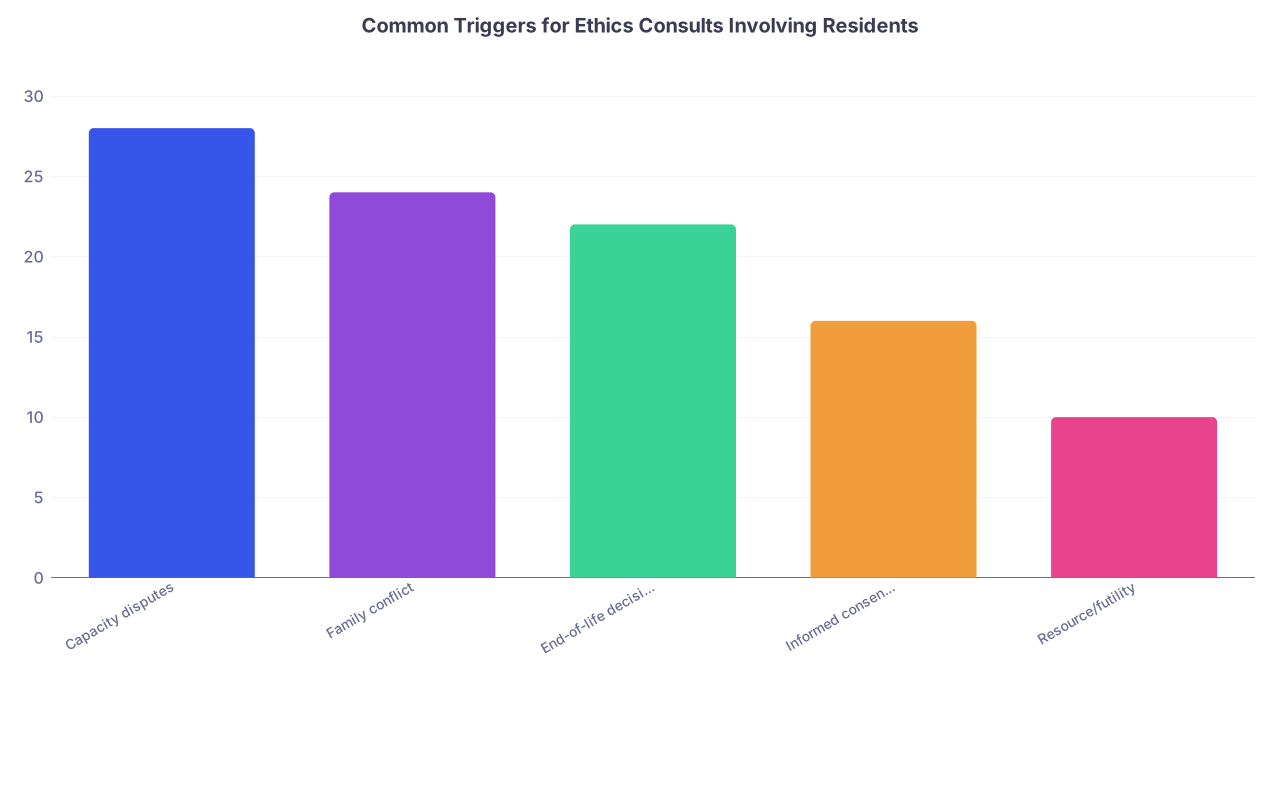
| Category | Value |
|---|---|
| Capacity disputes | 28 |
| Family conflict | 24 |
| End-of-life decisions | 22 |
| Informed consent issues | 16 |
| Resource/futility | 10 |
Here’s the tension: they want you to respect autonomy, but they also expect you to intervene when choices look bad. And they grade you on how you walk that line.
When a patient refuses “obviously needed” care
You know the case. Hypoxic COPD patient on 4L O2, pulling off the cannula, insisting on going home to “smoke and be left alone.” You’re thinking: this is insane.
Ethics committees break it down into a series of questions — and they expect you to too:
Does the patient have capacity for this decision right now?
If yes: ugly truth – they can make an unwise choice. Capacity ≠ agreeable.Did you optimize reversible barriers first?
Pain, hypoxia, delirium, language, hearing… If you didn’t treat those, your capacity call looks sloppy.Did you clearly document the patient’s values and reasoning?
“Understands risk of death; states he prioritizes being at home and smoke freedom over living longer in hospital.”
Here’s what committees hate:
“Patient refusing care” with no exploration, no values, no reasoning, no capacity comment. It looks like you were annoyed, not ethically engaged.
What they secretly expect you to write
They may never say this out loud, but a note like this calms them down:
“Patient alert and oriented x3, able to state diagnosis (COPD, pneumonia), proposed treatment (oxygen, antibiotics), risks of leaving (death, respiratory failure), and alternatives. States he understands he may die if he leaves, but prioritizes going home and avoiding further hospitalization. Reasoning is consistent with longstanding values per chart and prior notes. In my judgment, patient has capacity for this decision at this time.”
When things go bad, this is the difference between “resident abandoned a vulnerable patient” and “resident respected an informed, capacity-competent refusal.”
4. Documentation: The Only Voice You Have in the Ethics Room
I’m going to be blunt. In ethics reviews, your note is you. If it’s thin, you look thoughtless. If it’s careful, you look like someone we can trust with hard cases.

The three sentences that change everything
When you’re in the gray zone — code status, capacity, refusing care, shifting to comfort — three elements in your note make ethics committees back off:
Capacity statement
- “In my judgment, patient has / lacks capacity for this decision at this time because…”
Values/goals statement
- “Patient states their primary goal is ___, and would/would not accept ___ to achieve that.”
Shared decision / surrogate involvement
- “Discussed with [legally appropriate surrogate] acting as decision maker; they state patient would have chosen ___ based on prior conversations.”
You do not need a novel. You need those three concepts clearly, in your words.
What makes you look bad on paper
Patterns ethics committees mock behind closed doors:
- Copy-pasted “risks/benefits explained” for every procedure, with no tailoring.
- “Family wants everything” with no details.
- “Patient lacks capacity” with zero explanation.
- “Poor prognosis” with no actual prognosis estimate or functional outcome discussion.
They know attendings are guilty of this too. But residents are easier targets. And frankly, they expect residents to be better at this now than many of their older colleagues.
5. Conflict with Families: What Ethics Committees Think You Should Do First
By the time ethics is called, the family is usually furious, the team is exhausted, and everyone’s dug in. Most of those cases could have been cooled down much earlier.

| Step | Description |
|---|---|
| Step 1 | Identify Value Conflict |
| Step 2 | Clarify Medical Reality |
| Step 3 | Family Meeting with Attending |
| Step 4 | Involve Palliative Care |
| Step 5 | Second Opinion or Senior Consult |
| Step 6 | Call Ethics Consult |
Here’s your unofficial checklist before you trigger an ethics consult.
Step 1: Name the conflict out loud
Ethics folks love hearing that someone said it plainly:
“Mrs. Smith, I’m hearing that you want us to keep doing everything possible, and we’re worried that what we’re doing is only making his dying process longer and harder. That’s the conflict we’re stuck in.”
If that sentence never got said until ethics arrived, they’re annoyed.
Step 2: Separate can from should
Families often ask: “Can’t you dialyze? Can’t you intubate?”
But the real question is: “Should we?”
Ethics committees expect you to clearly distinguish these:
- “Medically, we can do X.”
- “But based on your dad’s condition and his goals, our recommendation is that we should not.”
If you never make a recommendation because you’re afraid of upsetting them, it looks like you dumped the decision entirely on a distressed surrogate. Ethically lazy.
Step 3: Bring in palliative care early, not as a last resort
There’s an unwritten rule in many hospitals: by the time ethics is there, palliative should have already been involved.
If they see a case where the first actual goals-of-care consult was with ethics instead of palliative, they immediately start asking: “Why wasn’t palliative called a week ago when the first intubation happened?”
Know this: calling palliative early almost always protects you in the later ethics conversation.
6. “Futility,” Resource Limits, and the Stuff Nobody Wants to Say Out Loud
Here’s the messiest part. Residents are never explicitly taught how resource constraints factor into decisions. But ethics committees talk about it all the time.
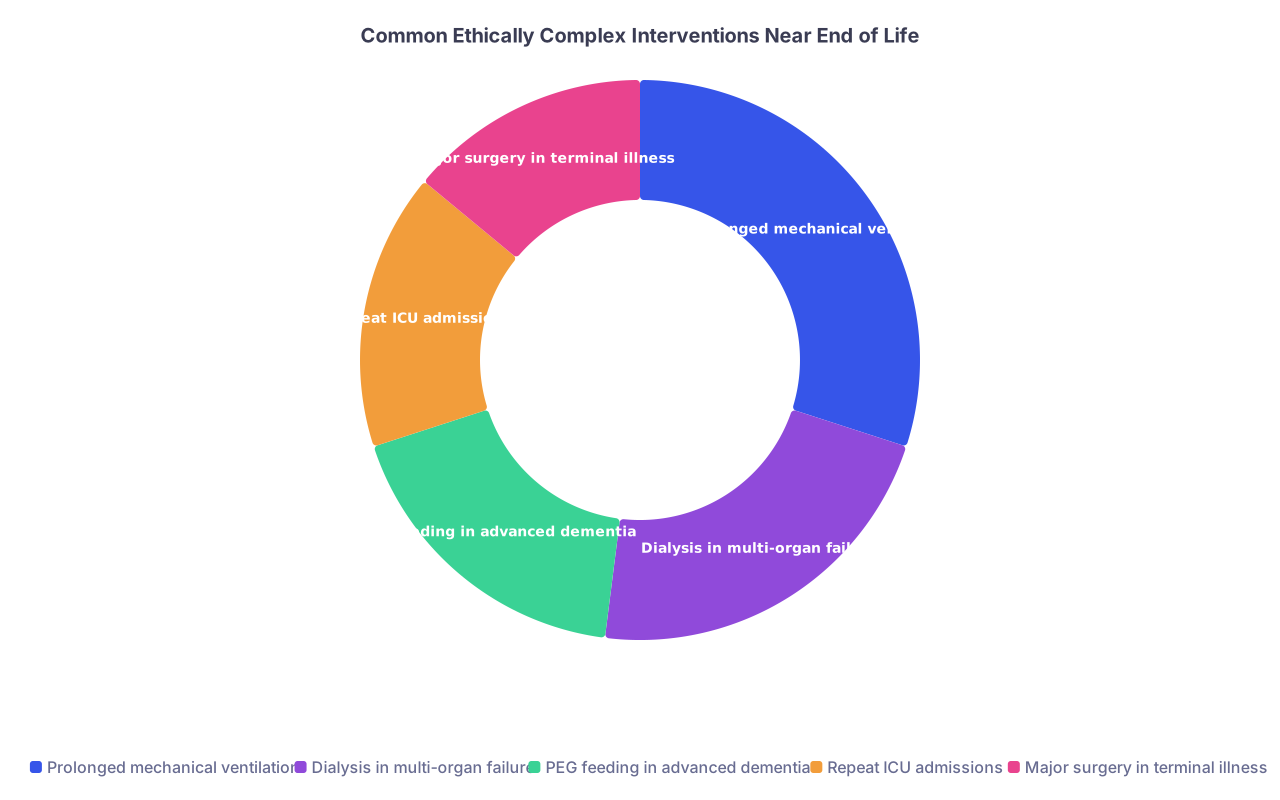
| Category | Value |
|---|---|
| Prolonged mechanical ventilation | 30 |
| Dialysis in multi-organ failure | 22 |
| PEG feeding in advanced dementia | 18 |
| Repeat ICU admissions | 16 |
| Major surgery in terminal illness | 14 |
The word “futility” is radioactive — use it carefully
Ethics committees cringe when they see “futile” in resident notes. Why? Because it’s almost never defined.
Better language:
- “Intervention is non-beneficial given patient’s goals and prognosis.”
- “Intervention is unlikely to achieve the goal of meaningful recovery/function.”
- “Risks and burdens of this intervention far outweigh any likely benefit.”
They expect you to frame this in terms of patient-centered benefit, not abstract resource protection. Even though in private, they’re absolutely thinking about ICU bed use, staffing, and cost.
When you’re pressured to offer something you think is wrong
This is where ethics committees actually side with residents more often than you think.
If an attending or a family is pushing for a procedure that you (and most reasonable clinicians) think is harmful, committees want to see that you:
- Raised your concerns with your senior / attending.
- Documented your concerns professionally.
- Did not lie to the patient/surrogate about likely outcomes just to get them to agree.
They’re harsh on deception. If you sugarcoat prognosis to get consent for something you don’t believe in, and it blows up, you look complicit.
Better note:
“Explained to patient’s son that CPR in this context is extremely unlikely to restore meaningful recovery and may only prolong dying; recommended DNR status. Son requests more time to consider. Will revisit tomorrow; team available for further questions.”
That reads like an ethically engaged resident, not a passive order taker.
7. Practical Moves: How to Look Ethically Solid Tomorrow
Let’s be practical. You’re post‑call half the time. You don’t have two hours for every ethics issue. So what actually changes your footprint?

Here’s what ethics committees quietly love seeing from residents:
- A capacity line in any note where a patient refuses, accepts high-risk treatment, or wants to leave AMA.
- A values/goals sentence in your admission H&P for any seriously ill patient.
- An early, documented, honest conversation about what “full code” actually means in that patient’s specific context.
- Clear notation of who the surrogate actually is and how you verified it (POA paperwork, chart, prior discussions, etc.).
- Use of phrases like: “Based on patient’s previously expressed wishes…” rather than “Family wants…”
You’re not expected to sound like a philosophy professor. You’re expected to sound like a clinician who understands that medicine is applied ethics, not just physiology.
FAQ (4 Questions)
1. When should I call an ethics consult as a resident?
Call when there’s a persistent value conflict that’s not resolving despite clear communication, palliative care involvement (if appropriate), and attending-level discussions. Common triggers: a surrogate demanding treatments you and the team believe are harmful or non-beneficial, serious disagreement within the team about what’s appropriate, or concern that a vulnerable patient is being coerced or denied needed care for non-clinical reasons.
2. Do I need a psych consult for every capacity determination?
No. Ethics committees expect primary teams to handle most routine capacity assessments. You should call psych if there’s a complex psychiatric overlay, severe cognitive disorder where formal testing matters, or if there’s substantial disagreement among clinicians or family. But for a typical “leave AMA” or “refuse procedure” scenario, they expect you to document a basic capacity assessment yourself.
3. What if the legal surrogate is making a choice that seems clearly against the patient’s values?
This is exactly when you slow down and document. Clarify and write what the surrogate says the patient would have wanted. If it’s wildly inconsistent with prior documented wishes or known values, involve your attending, social work, and likely palliative care. If still unresolved, that’s a legitimate reason for an ethics consult — you’re questioning whether the surrogate is using substituted judgment or imposing their own wishes.
4. Can I get in trouble for recommending comfort-focused care?
Ethics committees are far more troubled by teams that avoid making a recommendation than by those who clearly and compassionately recommend comfort when appropriate. You protect yourself by: documenting prognosis in plain language, tying your recommendation to the patient’s stated or documented values, and involving the attending and, ideally, palliative care. A well-documented, patient-centered recommendation for comfort care is viewed as ethical courage, not liability.
If you remember nothing else:
First, your ethics “grade” is your documentation — write your reasoning, not just your orders. Second, explicitly link decisions to capacity, values, and the right surrogate, or you’ll look lost later. Third, make specific recommendations in hard conversations; ethics committees respect residents who don’t hide behind vagueness when the decisions actually matter.


