

The way faculty judge whether they can trust you with end-of-life decisions has almost nothing to do with how beautifully you can talk about “autonomy” and “beneficence.” It’s about whether, under pressure, you act like a clinician they’d want at the bedside when things get ugly.
Let me walk you through how they actually decide that.
They’re not waiting for some big exam or ethics OSCE. They’re watching you in dozens of small, very real moments: the 2 a.m. DNR discussion you almost-but-not-quite botch, the family meeting you quietly attend and either help or derail, the way you respond when an attending asks, “So… what do you think we should do?” and the room goes silent.
You’re being graded on trust long before anyone tells you that end-of-life care is “entrustable.”
What “Trustworthy” Really Means to Faculty in EOL Care
Here’s the first behind-the-scenes truth: when attendings talk about whether they “trust” you in end-of-life decisions, they’re not evaluating your moral character in some abstract way. They’re asking a much more practical set of questions:
Will this trainee:
- Panic?
- Sugarcoat?
- Avoid?
- Or stand in the fire with the patient and family, and tell the truth without breaking them?
And they’re asking something else they rarely say out loud:
If this were my parent in that bed, would I let this student or resident be the one talking to them?
Trust, for end-of-life decisions, breaks down into a few concrete domains. Faculty don’t label them like this, but they absolutely think in these buckets:
| Domain | What Faculty Look For |
|---|---|
| Clinical maturity | Recognizing when cure is unlikely, not chasing fantasies |
| Communication under stress | Clear, honest, not evasive, no jargon shields |
| Emotional steadiness | Present, composed, not robotic or hysterical |
| Ethical backbone | Not folding to inappropriate demands |
| System savvy | Knowing when to call ethics, palliative, risk management |
They don’t have a rubric in front of them. But I’ve sat in enough eval meetings to know these exact themes repeat. Different words, same categories.
If you’re strong in three or four of those, they’ll start letting you take more responsibility in goals-of-care discussions. If you’re weak in two or more, they keep you away from the hard conversations, no matter how good your Step scores look.
The First Filter: Can You Even See That the Patient Is Dying?
This is the part medical school absolutely fails to teach well.
Before anyone can trust you with end-of-life conversations, they’re watching: do you recognize when a case has shifted from curative to palliative goals? Not just intellectually, but in your behavior and your recommendations.
I’ve seen this play out on rounds so many times it’s almost scripted.
Elderly patient, multi-organ failure, day 10 in the MICU. Norepi, vent, rising lactate, kidneys shot. The attending says, “What’s the plan?”
The junior says, “We could add another pressor, maybe try dialysis, and talk to cardiology about…”
You just failed the first filter. You didn’t even notice this is a dying person, not a salvageable one.
Faculty start to distrust you when:
- You reflexively add interventions without asking whether they align with prognosis or goals.
- You never say the words “I’m worried we’re prolonging dying, not improving survival or function.”
- You avoid prognostic language like it’s radioactive.
On the other hand, you immediately gain points when you start to think and speak like a clinician who understands mortality:
“I’m worried that despite maximal support, her trajectory is worsening. I think we need to step back and talk with the family about what she would have wanted, and whether continuing full support is consistent with that.”
You don’t need to lead that talk as a student. You just need to show you see the issue. That’s the early trust test.
Here’s the quiet pattern: students and interns who never recognize when things are non-survivable get mentally tagged as unsafe for end-of-life decisions. No one puts that in your evaluation form. But they absolutely say it to each other in conference rooms.
How You Talk About Death When You Think No One Is Listening
Faculty judge you hardest when you think you’re “off stage.”
I’ve had colleagues decide whether to ever let a resident lead a family meeting based entirely on three minutes of hallway conversation after seeing a dying patient. Not just content, but tone.
There are a few instant red flags.
First, the detached, dehumanizing commentary. The “circling the drain,” “train wreck,” “bed blocker” jokes that students parrot because they think that’s how residents talk. Trust me: attendings hear that, file it away, and it matters.
Second, the performative empathy. The student who’s syrupy sweet in front of the family and then, five minutes later at the workstation, rolls their eyes and says, “They just don’t get it, they’re so unrealistic.” Without any curiosity about why the family is where they are.
Faculty don’t expect you to be Zen about death. They do expect a baseline respect for suffering and grief, even when families frustrate you.
Here’s what gets you labeled as trustworthy:
You say things like, “That was hard. They’re really scared. I’m not sure they fully understand how bad things are yet,” instead of, “That family is so difficult.”
You ask, “How do you usually explain this kind of prognosis to families?” instead of preaching about what you would have done.
That subtle shift—from judgment to curiosity—is what signals to faculty that, when it’s your turn in the chair, you won’t blow up an already fragile situation.
The Moment of Truth: When an Attending Lets You Speak First
There’s a specific test most trainees don’t realize is a test.
You walk into a patient’s room with your attending. The patient is sick, things are worsening, the family is gathered. Everyone knows something serious is up, even if they can’t name it.
Your attending looks at you and says, “Why don’t you start by updating them on where things stand?”
That’s not about efficiency. That’s an entrustment probe.
They’re asking:
- Will you be honest?
- Will you be clear?
- Will you avoid euphemisms?
- Will you over-promise?
If you respond with, “So… things have been a little up and down, but we’re doing everything we can,” you’ve just told your attending they cannot trust you. Because “everything we can” implies something they often know is not true. And it vaguely suggests hope where there might not be any.
Trustworthy trainees do a few very specific things in that moment:
They name the situation plainly. “Things have gotten worse.” “His lungs are failing despite the treatments.” “The infection is not improving the way we hoped.”
They locate uncertainty, instead of pretending it doesn’t exist. “We can’t predict the exact timing, but we’re worried he may not survive this hospitalization.”
They don’t commit the system to interventions they haven’t cleared with the team. You never say, “We’ll keep doing everything,” or “We’ll try anything we can,” because you’ve just rewired expectations and boxed your attending in ethically and legally.
And critically, they pause. They let the family—or the patient—react before barreling into the next paragraph of medical monologue.
Attendings watch how you handle that silence. If you start nervously filling it with more words, more jargon, more reassurance, it screams, “Not ready yet.”
Hidden Legal/Ethical Radar: Are You a Liability?
End-of-life decisions sit right on the border of ethics and law, and the attendings know it. Faculty are quietly, always, running a risk calculation about you.
They ask themselves three things:
- Will this trainee say something that could be construed as promising a cure, a time frame, or an outcome we cannot deliver?
- Will this trainee pressure the patient or family in one direction to “end the suffering,” in a way that sounds like we’re steering toward death as the default?
- Will this trainee document the conversation accurately—or at all?
Goodwill doesn’t protect you here. Precision does.
I saw a PGY-2 get effectively benched from serious end-of-life talks for a year because of one progress note. His note said, “Family agrees to withdraw care tomorrow.” What the family had actually said: “We’ll think overnight about whether we want to continue the machines.”
Risk management saw that note. The attending had to clean up the mess. Education chiefs had a quiet chat. That resident’s freedom evaporated.
Here’s what faculty listen for in your wording:
You say “continue life support” or “continue intensive treatments,” not “keep him alive.” Because you know the difference between biology and treatment.
You say “focus on comfort” or “shift the focus to comfort,” not “stop care” or “give up.” Because you understand that palliative care is care.
You describe decisions as shared and evolving: “We can decide together whether to continue X,” not, “We’re going to stop X,” unless you’re talking about clear medical futility where treatment is non-beneficial, and your attending is backing you.
Faculty also notice whether you respect legal boundaries around capacity and surrogates. If you start discussing withdrawal of life support with a confused patient at 3 a.m. without involving the surrogate or attending, that is a flashing red light for everyone.
How You Handle Family Conflict and Unrealistic Expectations
Nothing exposes your real judgment like a case where the family is out of sync with reality.
Picture this: 45-year-old, metastatic cancer, multi-organ failure. Oncology has already said there are no more disease-directed options. The ICU team is recommending comfort-focused care. The family says, “We want everything.”
This is where residents often tank their trust score.
Faculty are not impressed when you:
- Argue with the family about “quality of life.”
- Make moral pronouncements about “what’s right.”
- Imply that continuing full code is selfish.
- Or worse, try to corner the family into a decision in a single meeting.
They’re watching for something more subtle: do you show respect for grief while holding the medical line?
The trustworthy trainee says, privately to the team, “They’re not ready yet. We need to keep being honest about the prognosis, but also give them space. Maybe involve palliative or chaplaincy.”
In the room, they say things like: “I hear that you want everything that might help. What we’re worried about is that the treatments we’re doing now are not helping his organs recover, and may be causing more suffering. We want to talk with you about what he would consider acceptable.”
They never frame it as “us versus you.” They frame it as “all of us trying to honor what he would have wanted.”
Faculty also notice if you bring your own anger or bias into the mix. The resident who says, “This family is ridiculous, they’re making us torture him,” gets mentally flagged as not yet stable enough for the hardest cases. You may feel that. But if you can’t contain it or process it appropriately, your judgment can’t be trusted.
Documentation: The Quiet Test You Didn’t Realize You Were Failing
Here’s a secret: many faculty decide your trustworthiness for end-of-life work by reading your notes after a single family meeting.
Not the HPI. The goals-of-care note.
They look for:
- Did you capture who was present (including surrogates)?
- Did you document the clinical situation in accessible language?
- Did you record what was actually decided versus vaguely hinting at it?
- Did you quote key phrases that matter legally? (e.g., “He would not want to live on machines,” “She said she never wanted to be a burden.”)
If your note says, “GOC discussed, family understands,” you’ve just told faculty three things:
You were lazy. You probably weren’t really present for the conversation. And you don’t grasp how legally and ethically significant this documentation is.
I’ve seen attendings bluntly say in eval meetings: “I can’t trust her yet with big conversations. Her documentation is dangerously vague.”
Trustworthy notes sound like this:
“Discussed with patient’s daughter (health care proxy) and son. Reviewed that despite maximal vasopressor and ventilator support, patient’s kidneys and lungs are failing and prognosis for meaningful recovery is extremely poor. Daughter states patient previously said he would not want to be kept alive on machines without chance of recovery. Family requests transition to DNR and comfort-focused care, including withdrawal of vasopressors and mechanical ventilation, with focus on comfort medications. All questions addressed, family aware of likely near-term death after extubation.”
That kind of note makes attendings exhale. It shows clinical understanding, ethical clarity, and legal awareness. That’s trust.
The “Ethics Reflex”: Do You Know When You’re Out of Your Depth?
Ironically, one of the strongest signals you’re trustworthy is that you do not try to handle everything yourself.
Faculty are attuned to what I call your “ethics reflex.” When you face a messed-up situation—conflict between teams, unclear surrogate, prior DNR in the chart but full code in the order set—do you try to bulldoze through it alone, or do you say, “We should loop in ethics/palliative/attending before going further”?
The untrustworthy trainee has a hero complex: “I’ll fix this family. I had a great ethics course. I’ve got this.”
The trustworthy trainee knows where the landmines are. They say, “I’m happy to be in the room and support, but this decision crosses into territory I shouldn’t handle solo.”
In the background, faculty are relieved to hear that. Because nothing terrifies them more than a junior trainee freelancing in ethically charged territory, then disappearing, leaving them with a furious family and a chart full of ambiguous documentation.
What You Can Start Doing Tomorrow
Let me boil it down to behaviors, not theory.
You become someone faculty trust with end-of-life decisions when you consistently:
Name prognosis out loud on rounds, even if it’s uncomfortable.
“I’m worried she’s dying” is a phrase you’re allowed to say.Use plain, honest language with patients and families, without hiding behind “we’ll see” when you already know the trajectory.
Show emotional steadiness. You can be affected. You cannot fall apart in the room.
Treat grieving, angry families as human beings in pain, not adversaries or obstacles.
Avoid promising anything you cannot control: outcomes, time frames, miracles.
Document like a clinician who understands that these notes may be read in a courtroom or years later by another team.
Ask for backup early when cases go sideways. That’s maturity, not weakness.
You don’t need to be a palliative fellow to pass these tests. You just need to stop thinking of end-of-life as an academic exercise and start acting like a professional who understands what’s really at stake—for the patient, the family, and yes, the institution.
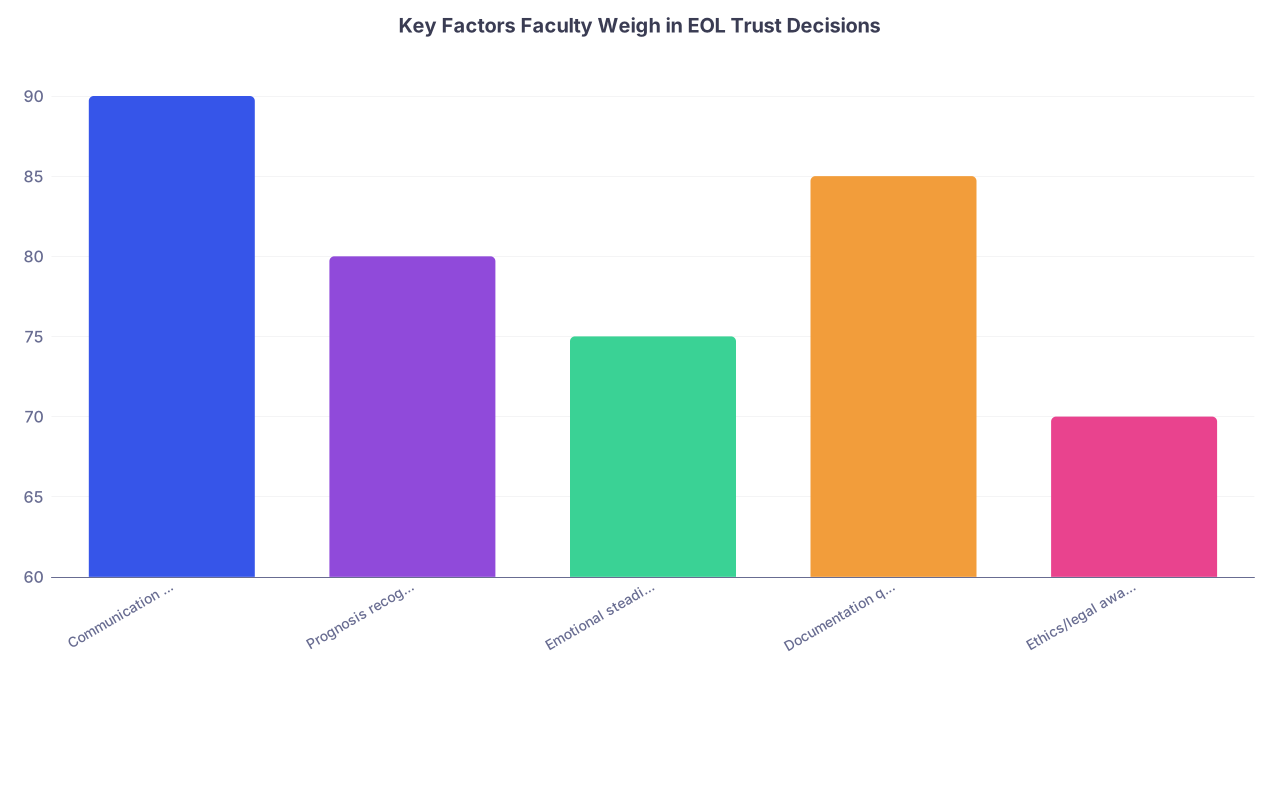
| Category | Value |
|---|---|
| Communication clarity | 90 |
| Prognosis recognition | 80 |
| Emotional steadiness | 75 |
| Documentation quality | 85 |
| Ethics/legal awareness | 70 |

| Step | Description |
|---|---|
| Step 1 | Early clerkship - Observe only |
| Step 2 | Offer your prognosis thoughts on rounds |
| Step 3 | Speak first in low risk updates |
| Step 4 | Help lead family meetings with attending present |
| Step 5 | Document full goals of care discussions |
| Step 6 | Lead complex meetings with indirect supervision |


The Bottom Line
Three core truths to walk away with:
- Faculty decide if you’re trustworthy in end-of-life care by watching how you actually behave—in rooms, in hallways, and in your notes—not by your ethics exam scores.
- Your language, your ability to recognize when someone is truly dying, and your documentation are the biggest levers of trust, and they’re under your control right now.
- Knowing when to ask for help—and saying, “This is beyond my level, but I want to learn”—builds more trust than pretending you’re already ready to handle everything alone.


