

It’s 03:17. The code blue just ended. The patient is dead. The room smells like epi and sweat and plastic. RT is breaking down the vent, housekeeping is hovering, and someone is asking you, “Can you finish the note so we can move the body?”
This is where people ruin their careers.
Not during the code. Not during the ACLS confusion. In the documentation that follows.
I’ve sat in morbidity and mortality conferences, root cause analyses, risk management meetings, and, yes, legal reviews where we pull up notes from this exact moment. And I’ve watched good clinicians look absolutely stunned as a lawyer or regulator reads their own words back to them and says:
“Doctor, help me understand what you meant by… this.”
Let’s prevent you from ever being that person.
Why Documentation After an Unexpected Death Is a Legal and Ethical Minefield
You’re exhausted, emotionally flooded, replaying every decision. That’s exactly when your documentation becomes more dangerous.
After a code or unexpected death, your note does three things simultaneously:
- Clinically: It tells the story for the next team, the chart, and quality review.
- Legally: It becomes a frozen, permanent record that lawyers, regulators, and licensing boards will dissect line by line.
- Ethically: It is your honest accounting of what happened and why.
When those three do not line up—when your note looks self-serving, altered, contradictory, or misleading—you are in trouble. Even if your actual medical care was reasonable.
So the goal is simple: do not create red flags that make normal bad outcomes look like negligence, deception, or cover‑up.
Let me walk you through the most common (and most dangerous) mistakes I’ve seen.
Red Flag #1: Late Notes That Pretend They’re Timely
This is the big one. Almost every serious case review shows this pattern somewhere.
You finish the shift, go home, shower, and suddenly remember, “I never documented the hypotension at 19:30.” So you log in from home at 08:00 and type:
19:30 – Patient hypotensive, BP 70/40. Discussed with attending, plan made to titrate pressor.
But you don’t mark it as late, don’t clarify timing, and the system quietly stamps the creation time as 08:02.
That chart now looks falsified.
Red flags to avoid:
- Backdated notes that do not clearly indicate they were written later.
- Adding events with specific times that you obviously didn’t chart contemporaneously, and not saying it’s a late entry.
- Editing old notes (changing wording, removing statements) after an adverse event without a transparent addendum.
What to do instead:
- Use explicit late-entry language. Example:
- “Late entry, written on 01/08/2026 at 08:02 for events that occurred on 01/07/2026 at approximately 19:30.”
- Use addenda, not stealth edits, when clarifying after the fact.
- Never change a previously signed note to remove unfavorable facts. You can add clarification, not erase history.
The mistake to avoid: trying to make the record look like you documented everything in real time when you didn’t. Lawyers live for those inconsistencies.
Red Flag #2: Obvious Copy-Paste Garbage After a Catastrophe
You coded the patient for 40 minutes. Multiple rounds of epi. Shocks. Airway challenges. Massive transfusion. You’re exhausted.
Then your daily progress note—or some autopopulated template—from earlier in the day or previous day says:
Patient resting comfortably, no acute distress. Plan: continue to monitor.
And it’s timestamped after the code and death.
This looks terrible.
This is how plaintiffs’ attorneys argue: “Doctor, can you explain why your note at 14:05 describes the patient as ‘no acute distress’ when, in fact, the patient had just died at 13:40?”
Red flags:
- Copy‑forward physical exams that say “no acute distress, breathing comfortably” after cardiac arrest.
- Autopopulated vitals that don’t match the code documentation.
- Template text that implies stability, comfort, or adequate monitoring when the patient was crashing or deceased.
- “Continue current management” for a patient who just died.
How to avoid this:
- Stop blind copy-paste after a serious deterioration. Start a fresh note, or ruthlessly edit every line that auto-populates.
- If you use a progress note after the event, make it explicitly about the event and aftermath:
- “Patient experienced cardiac arrest at approximately 13:02; extensive resuscitation attempted; time of death pronounced at 13:40.”
- Don’t let irrelevant template text remain. If it’s not true, delete it.
The ethical piece: your documentation should actually reflect reality. If anyone reading the note can tell you just clicked “copy prior note” and barely looked, you’ve just undermined your own credibility.
Red Flag #3: Defensive, Blaming, or Emotional Language
Here’s where people think they’re “protecting themselves” and instead paint a bullseye on their back.
I’ve seen notes that say things like:
- “Nurse failed to notify me of hypotension until it was too late.”
- “Family unreasonably refused recommended interventions, causing poor outcome.”
- “Patient was noncompliant and essentially brought this on themselves.”
- “Due to being extremely busy and short-staffed, care was delayed.”
You just gave the lawyer a narrative: conflict, blame, system failure, and your own admission of delay.
Red flags:
- Anything that sounds like finger-pointing at nurses, RT, previous shift, EMS, or the family.
- Documenting your anger, frustration, or moral judgment.
- Writing about staffing issues, system failures, or your workload in a way that suggests you knew it was unsafe and kept going anyway.
What to do instead:
- Stick to objective, factual descriptions:
- “Hypotension noted at approximately 19:30; I was notified at approximately 19:50; vasopressors escalated at 19:55.”
- Save system-level concerns and moral distress for incident reports, debriefings, and formal channels — not the clinical note.
- Never write anything you wouldn’t want read aloud in court or at an M&M with the nurse/family in the room.
You’re allowed to be upset. Just don’t document your anger like it’s part of the medical record.
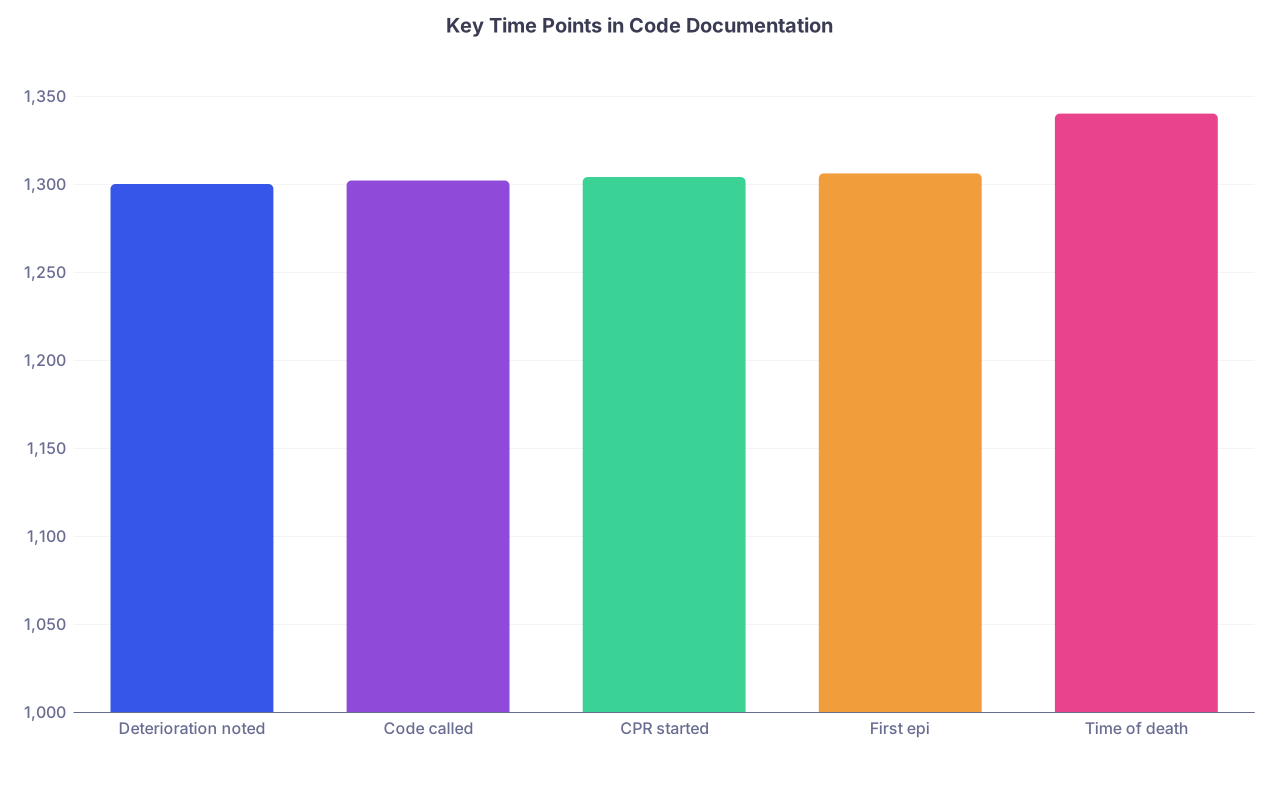
Red Flag #4: Missing or Confusing Code Timeline
After a bad outcome, reviewers go straight to the timeline. They look for:
- When did signs of deterioration start?
- When was the response?
- When did the code start?
- What was done, in what order, and by whom?
- When was the time of death?
- How long was the code?
If your documentation is vague or contradictory, it can look like care was chaotic, delayed, or poorly directed—even if it wasn’t.
Red flags:
- No clear start time for the arrest or code blue.
- No documented time of death.
- Different team members’ notes with wildly different times for the same events.
- Charted interventions that would have been physically impossible in the order written.
- “All ACLS done per protocol” and nothing else. That sentence should almost never exist.
What you actually want:
- A simple, credible, not-overly-detailed, consistent timeline. Example:
- “Approximately 13:02 – patient noted unresponsive, pulseless; code blue activated.
13:04 – CPR initiated.
13:05 – first rhythm check PEA.
13:06 – epinephrine 1 mg IV given.
…
13:40 – despite ongoing resuscitation efforts, no ROSC achieved; time of death pronounced at 13:40.”
- “Approximately 13:02 – patient noted unresponsive, pulseless; code blue activated.
| Category | Value |
|---|---|
| Deterioration noted | 1300 |
| Code called | 1302 |
| CPR started | 1304 |
| First epi | 1306 |
| Time of death | 1340 |
You don’t need second-by-second ACLS detail, but you need enough for a reviewer to follow the flow and believe it.
The mistake to avoid: vague, hand‑wavy descriptions like “patient coded, ACLS given, no response.”
Red Flag #5: Hiding or Minimizing Bad Facts
You missed something earlier in the shift. Or there was a delay in labs. Or you didn’t come to bedside as fast as you wish you had. That’s painful. It’s tempting to “soften” the record.
That temptation ruins people.
Red flags:
- Omitting clearly relevant negative events (e.g., a delay in response, missed abnormal lab, discrepancy in vitals).
- Re-writing the story to make yourself look more proactive than you were.
- Changing “nurse notified me at 01:20” to “patient noted stable at 01:20” the next day.
- “Fluffing” your actions: adding assessments you didn’t actually do or conversations you didn’t actually have.
Here’s the uncomfortable truth: a clean, honest record with a missed finding is usually defensible if your overall care was reasonable. A record that looks like it’s been manipulated is not.
How to do it ethically:
- Say what happened. Briefly. Without editorializing.
- “Potassium of 6.8 resulted at 22:15; result was not seen until approximately 23:45; treatment initiated at 23:50.”
- If clarification is needed later, use an addendum that clearly states:
- “Addendum 01/09/2026 09:10: After chart review and discussion with nursing, I understand that the lab result became available at 22:15 but was first seen by me at approximately 23:45. Treatment began at 23:50.”
Do not try to erase the mistake in the chart. That’s where people cross from error into dishonesty.
Red Flag #6: Inconsistent Stories Between Clinicians
Nothing raises suspicion faster than three different notes telling three different stories.
Example:
- Resident note: “Code called at approximately 19:10, ROSC at 19:25, death pronounced at 19:40 after re-arrest.”
- Nursing note: “Code blue initiated at 18:55, no ROSC throughout, time of death 19:30.”
- Attending note: “Patient found asystolic at 19:20, code initiated, time of death 19:40.”
This looks sloppy at best, dishonest at worst.
Red flags:
- Major discrepancies in:
- Time of arrest
- Duration of code
- Presence or absence of ROSC
- Who was present and when
- Contradictory statements like “family present during resuscitation” in one note and “family notified of death by phone” in another.
What you should do:
- After an unexpected death, have a quick team huddle that includes:
- Approximate arrest time
- Time code initiated
- Time of death
- Whether there was any ROSC and for how long
- Everyone writes their note based on the same shared anchor points, acknowledging approximations.

| Step | Description |
|---|---|
| Step 1 | Code ends |
| Step 2 | Brief team huddle |
| Step 3 | Agree on key times |
| Step 4 | Physician note |
| Step 5 | Nursing note |
| Step 6 | RT and other notes |
| Step 7 | Consistent record |
Does this take two minutes? Yes. Does it save you months of agony later? Also yes.
Red Flag #7: Sloppy or Missing Death Pronouncement Details
This part gets overlooked constantly. And then coroners, medical examiners, and lawyers get interested.
Your death note isn’t just “patient died”. It needs a few specific elements.
Red flags:
- No clear time of death.
- No statement of the assessment used to declare death.
- No mention of family notification attempts.
- No disposition of the body (e.g., medical examiner vs standard morgue).
- No comment on whether the death was expected vs unexpected.
You don’t need to write an essay. You need a clean, structured note that covers:
- Who you are and that you were called to evaluate for possible death.
- Objective findings: no heart sounds, no spontaneous respirations, no response to stimuli, fixed and dilated pupils, etc.
- Time of death (and whether that is the time of last observed vital activity vs time of pronouncement, depending on your local norms).
- That family was notified (or attempts were made and how).
- Any involvement of medical examiner/coroner or organ donation services.
| Element | Why It Matters |
|---|---|
| Time of death | Legal, billing, timeline |
| Objective exam findings | Shows real assessment |
| ID of patient & setting | Confirms correct person |
| Family notification | Ethical, communication trail |
| ME/coroner involvement | Legal, cause-of-death issues |
Skipping this or writing a one-liner invites unnecessary scrutiny.
Red Flag #8: Mixing Incident Reporting and the Medical Record
You absolutely should report adverse events, near misses, and system problems. Just not inside the medical record.
Bad move examples:
- “Incident report filed regarding nurse failure to respond appropriately.”
- “Risk management notified about potential malpractice.”
- “Per hospital policy, event reported to administration for review.”
You just advertised to any future lawyer that there’s a separate cache of internal documents and analyses to subpoena.
Proper separation:
- Clinical note:
- Factual, patient-centered, no reference to internal incident reporting systems.
- Incident report:
- Separate system, protected when possible, used for QI, safety, and system improvement.
- Ethics/quality/risk:
- Handled via appropriate internal channels, not in the chart.
The mistake to avoid: turning the chart into a running commentary on risk and blame.
Red Flag #9: Over-Explaining or Speculating in the Chart
After an unexpected death, people sometimes try to “explain away” what happened. They start guessing:
- “Suspect that the patient’s underlying undiagnosed cardiac condition caused sudden arrhythmia.”
- “Most likely this was a rare and unpredictable reaction to medication.”
- “Unclear cause, but given comorbidities, death was probably unavoidable.”
If you don’t know, don’t guess. Especially about causation and inevitability.
Red flags:
- Speculation about exact cause of death without clear diagnostic support.
- Statements implying that nothing could have changed the outcome, when that’s exactly what an investigation might be assessing.
- Pathophysiology essays that exceed what you could reasonably know in the moment.
Better approach:
- Stick to what you actually observed and knew at the time.
- If cause of death is unclear, say that:
- “Cause of arrest unclear at this time; differential includes [brief list]. Case referred to medical examiner for further evaluation.”
- Save deeper analysis for M&M, root cause analysis, or formal review, not the progress note.
You’re not writing a defense closing argument. You’re writing a clinical record.
Red Flag #10: No Informed Discussion With Family Documented
This is ethically huge and legally crucial in unexpected deaths. Most complaints and lawsuits start not with the bad outcome, but with the family’s belief that they were misled, not informed, or dismissed.
Red flags:
- No documentation of any goals‑of‑care or code status discussion before the event, even if the patient was high risk.
- For an unexpected rapid decline: no record of explaining status, options, and prognosis to family (if present) before or during the code.
- After death: no note about how, when, and to whom the news was communicated.
You’re not writing a transcript, but you need a clear trail:
- “Spoke with daughter, Jane Doe, at bedside at approximately 12:45 regarding patient’s critical status and risk of deterioration; discussed full code measures and potential outcomes.”
- “After unsuccessful resuscitation and pronouncement at 13:40, I met with wife, Mary Smith, and son, John Smith, in family room to explain events leading to death, resuscitative efforts, and next steps. Questions were answered.”

From an ethics standpoint, this is basic respect. From a legal standpoint, it’s documented evidence that you communicated honestly.
Putting It All Together: A Brief Mental Checklist
Right after a code or unexpected death, before you start typing, pause and run through a quick mental checklist:
Timeline
- Do I have a coherent story of deterioration → code → death with approximate times?
Reality check
- Does every line I’m about to copy‑forward actually match what happened after the event?
Honesty vs spin
- Am I omitting or rephrasing something mainly to protect myself rather than to convey clinical reality?
Tone
- Is my language factual and neutral, or does it sound defensive, blaming, or emotional?
Consistency
- Have I aligned key times and events with the team’s shared understanding?
Family
- Have I accurately documented communication with family before and after the death?
Late entries/addenda
- If I’m documenting later, am I clearly labeling this as a late entry or addendum?
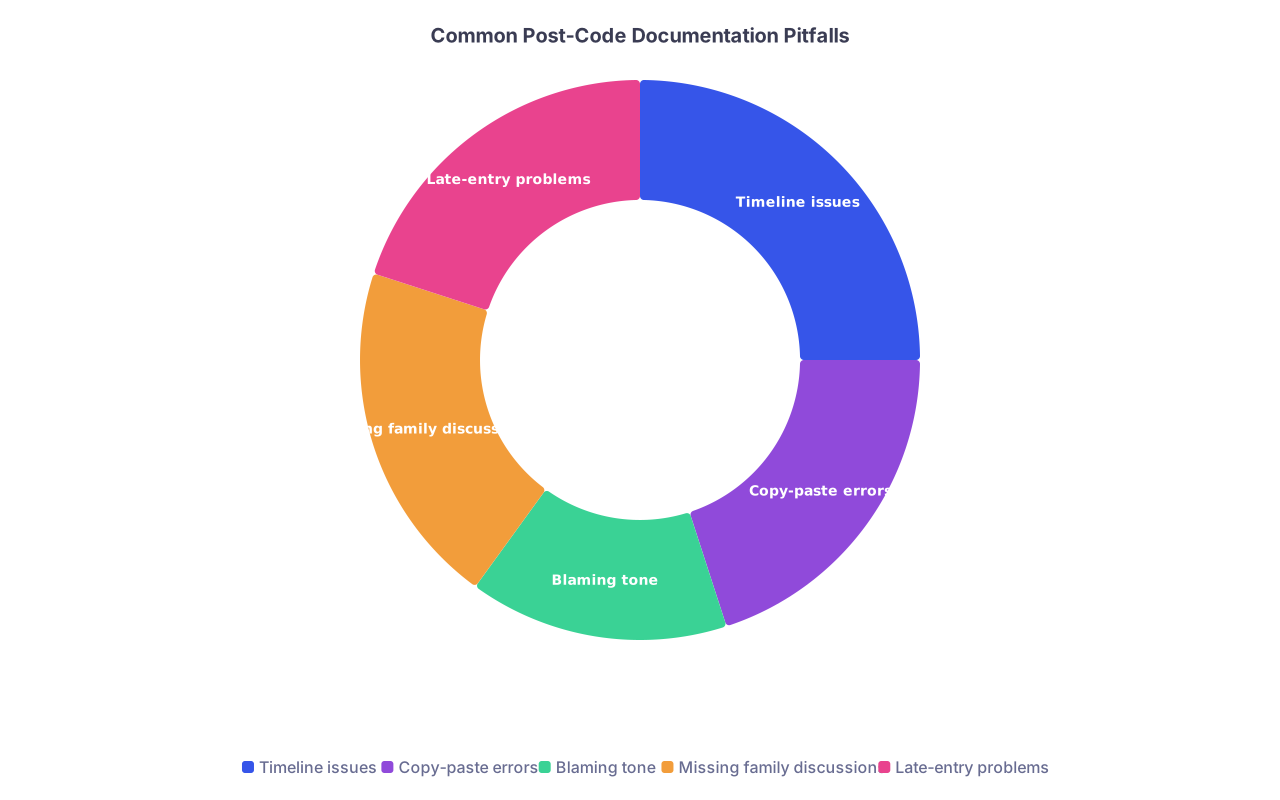
| Category | Value |
|---|---|
| Timeline issues | 25 |
| Copy-paste errors | 20 |
| Blaming tone | 15 |
| Missing family discussions | 20 |
| Late-entry problems | 20 |
If you can honestly answer those, you’re already ahead of most.
FAQ (Exactly 3 Questions)
1. If I realize hours later that I forgot to document something important, should I still add it?
Yes, but never pretend it was written earlier. Use a clearly labeled late entry or addendum with both the time you’re writing and the time of the events you’re describing. Hiding the timing of documentation is far more dangerous than admitting you’re clarifying after the fact.
2. Should I mention staffing issues, high workload, or system failures in my note?
No. Keep the clinical note focused on the patient’s condition, what happened, and what you did. Report staffing or system problems through formal incident reporting or safety channels, not the medical record. Blending those creates legal risk and muddies the chart.
3. How detailed does my post-code documentation need to be?
Enough to tell a clear, honest story without turning into a novel. Key times, major interventions, response (or lack of it), time and method of death pronouncement, and family communication. If you find yourself writing long justifications or speculative explanations, you’re drifting into red-flag territory. Keep it factual, concise, and real.
Key points to remember:
- Do not let your documentation look falsified, copy‑pasted, or defensive. That’s what gets scrutinized.
- Be honest, clear, and consistent about timelines, actions, and communication—especially with family.
- Use late entries and addenda transparently, and keep blame, speculation, and incident-report material out of the chart.
That’s how you protect your patients, and yourself.


