

You are post-call in clinic, already running 40 minutes behind. The next chart pops up: 58-year-old with poorly controlled diabetes, A1c 10.9, has missed three appointments, refuses insulin, “lost” the glucometer again. You feel the familiar mix of frustration and dread. Part of you wants to say, “If you won’t do your part, why should I keep trying?”
This is exactly where people make some of the worst ethical and legal errors of their careers.
Nonadherence (or more accurately, nonconcordance) is where good intentions collide with bias, burnout, and bad documentation. And it is where physicians and trainees get into trouble—ethically, professionally, and sometimes legally.
Let me walk you through the big mistakes I have seen repeatedly—and how to avoid joining that list.
Mistake #1: Treating “Nonadherent” as a Moral Failing
The first ethical error happens before you even walk into the room: deciding this patient is “the problem.”
Common mental shortcuts:
- “They just do not care about their health.”
- “If they would just follow instructions, we would not be here.”
- “They are wasting my time and clinic resources.”
This is not just unkind. It is ethically lazy.
Why this is dangerous
- It smuggles in blame instead of analysis
Once you label someone “noncompliant,” you stop asking why. You:
- Stop exploring financial barriers
- Stop considering health literacy or language gaps
- Stop checking for side effects
- Stop asking about depression, trauma, or substance use
Ethically, you are obligated to examine capacity, context, and constraints, not default to judgment.
I have seen charts that practically sabotage the next clinician:
- “Noncompliant with everything. Unmotivated.”
- “Does not care about health. Refuses to change.”
That kind of language:
- Biases every reader
- Reduces the chance anyone else will invest effort
- Can look very bad in a legal setting when the patient later has a bad outcome
Replace moral judgment with descriptive facts.
| Bad Phrase | Better Phrase |
|---|---|
| Noncompliant patient | Patient reports difficulty following regimen |
| Does not care about health | Patient states other priorities more important now |
| Refuses treatment | Patient declines X after discussion of Y and Z |
| Unmotivated | Patient expresses ambivalence about behavior change |
How to avoid this mistake
- Describe behaviors, not character.
- Ask at least one “why” before you label anything:
- “Tell me what makes this hard.”
- “Walk me through what happened last week with your meds.”
- Assume there is a barrier you have not uncovered yet. You will be right more often than you think.
Mistake #2: Ignoring Capacity and Voluntariness
A massive ethical and legal error: treating every refusal or missed dose as if it is an informed, autonomous choice.
Sometimes it is. Often it is not.
Two questions you must not skip
Can they understand and reason about this decision? (Capacity)
You cannot ethically call someone “nonadherent” if they:- Do not understand risks and benefits
- Cannot remember instructions 10 minutes later
- Are delirious, psychotic, severely intoxicated, or severely demented
Is their choice truly voluntary? (Coercion / constraints)
The “choice” may be constrained by:- No money for meds or transportation
- Abusive partner controlling access to care
- Cultural or religious pressures
- Cognitive limitations with no support system
Skipping capacity and voluntariness is not just sloppy. It can be negligence.
When you must formally assess and document
Do not make this mistake: shrugging and moving on when:
- Someone with schizophrenia stops taking antipsychotics and is deteriorating
- An older adult with known cognitive decline keeps “forgetting” meds
- A patient with severe depression is failing to follow a life-sustaining regimen
In those situations, you must:
- Assess capacity specific to the decision at hand
- Document your assessment
- Involve family/surrogates when appropriate and legally allowed
- Consider higher level of care if needed (e.g., hospitalization, guardianship in extreme cases)
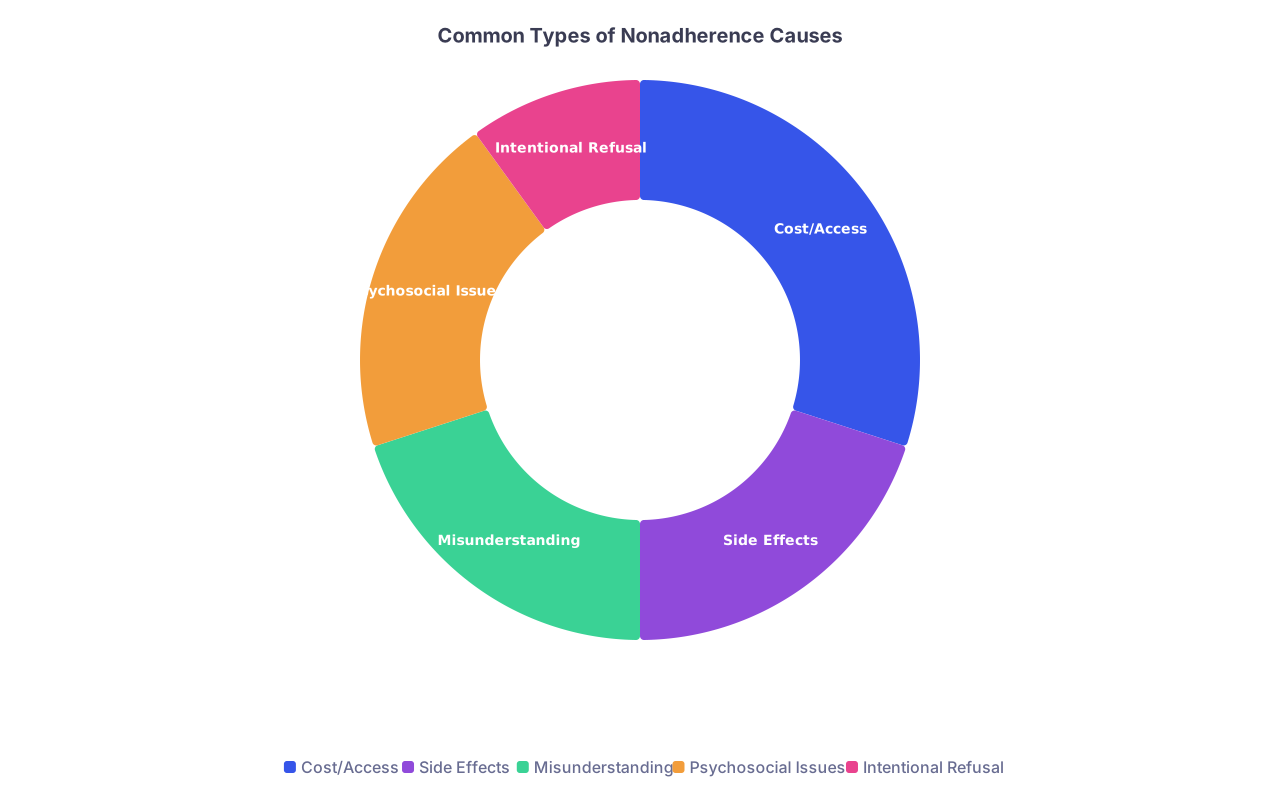
| Category | Value |
|---|---|
| Cost/Access | 30 |
| Side Effects | 20 |
| Misunderstanding | 20 |
| Psychosocial Issues | 20 |
| Intentional Refusal | 10 |
Notice “intentional refusal” is actually the minority. Treat everything like voluntary refusal and you will be ethically wrong most of the time.
Mistake #3: Presenting a Single “Right” Plan and Calling Refusal “Nonadherence”
Another trap: you present one plan, the one you like most. You frame it as the only reasonable path. The patient hesitates or says no. You label them nonadherent.
Ethically, that is backwards.
Autonomy is not “agree with the doctor or else”
You are obligated to:
- Present reasonable options, not your favorite one only
- Explain:
- Benefits
- Risks
- Alternatives (including doing nothing)
- Clarify what is strongly recommended versus optional
Then, if the patient refuses, you can truthfully say:
- You disclosed options
- They understood
- They made an informed choice
Without that, you have not earned the word “nonadherence.” You have just documented your own failure at informed consent.
How this goes wrong in real life
Classic example: statin refusal.
Bad version:
- “You need to start a statin. It will lower your risk.”
- Patient: “I do not want more meds.”
- Note: “Noncompliant, refuses statin.”
Better version:
- You discuss:
- Absolute risk reduction for MI/stroke
- Common side effects (myalgias, lab monitoring)
- Alternatives: lifestyle only, lower-intensity dosing, re-evaluation later
- Patient verbalizes understanding and still declines
- Note: “After reviewing benefits, risks, and alternatives, patient declines statin therapy at this time. Plan to revisit in 3 months; will focus on BP control and smoking cessation meanwhile.”
That is ethically sound refusal, not “noncompliance.”
Mistake #4: Using Threats or Coercion to “Force” Adherence
This one is ugly, and I have heard it more than I care to admit:
- “If you do not do this, I will discharge you from the practice.”
- “If you keep missing dialysis, I am going to note in your chart that you are noncompliant and hard to work with.”
- “If you will not follow instructions, I cannot be your doctor anymore.”
There are narrow situations where ending the relationship is appropriate. But using the threat of abandonment as a behavior-modification tool is ethically wrong.
Coercion vs. firm boundaries
You are allowed to:
- Set clear, fair, safety-related boundaries:
- No-shows
- Offensive behavior
- Medication agreements for controlled substances
- Enforce them consistently and with notice
- Offer referrals if you must terminate the relationship
You are not allowed to:
- Weaponize termination to force a specific clinical decision
- Abandon a high-risk patient with no arrangement for continuity of care
- “Firing” people because they are sick, poor, traumatised, or difficult

| Step | Description |
|---|---|
| Step 1 | Identify concern |
| Step 2 | Consider duty to warn/report |
| Step 3 | Assess capacity and barriers |
| Step 4 | Discuss options and risks |
| Step 5 | Respect refusal, document |
| Step 6 | Address misunderstanding or constraints |
| Step 7 | Plan follow up / safety net |
| Step 8 | Immediate risk to others? |
| Step 9 | Patient understands and refuses? |
If you find yourself using fear of abandonment to get adherence, you have already crossed an ethical line.
Mistake #5: Failing to Distinguish Personal Frustration from Professional Duty
You will feel frustrated. This is unavoidable.
The mistake is turning that frustration into:
- Shorter visits
- Less effort
- Subtle hostility
- Withholding of information or options
Ethically, you still owe:
- Standard of care
- Respect
- Honest communication
- Reasonable follow-up and safety planning
Even if you are tired of having the same conversation.
The quiet discrimination problem
I have seen clinicians unconsciously do this:
- Spend 20 minutes on a new, engaged patient
- Spend 4 minutes on the “noncompliant frequent flyer”
- Cut corners on explanations
- Avoid discussing advanced options or referrals (“They will not follow through anyway”)
That is not just burnout. That is discrimination based on anticipated adherence. Ethically indefensible.
You need to recognize the moment when your internal narrative shifts from:
- “This is hard”
to - “This person is not worth my full effort.”
That is the red flag.
Mistake #6: Terrible Documentation Around Nonadherence
If you remember only one medicolegal point, remember this: nonadherence is not a shield unless you documented the process correctly.
Huge errors:
- Writing “noncompliant” without:
- What was recommended
- What the patient understood
- What alternatives were offered
- What follow-up was planned
- No mention of efforts to address barriers
- No record of shared decision-making
When something goes wrong—a stroke, MI, suicide, DKA—those gaps look damning.
What proper documentation should include
When a patient declines or does not follow a plan, your note should cover:
The clinical recommendation
- “Recommended initiation of basal insulin 10 units nightly for A1c 10.9 with fasting sugars 250–300.”
The information discussed
- “Discussed risks of uncontrolled diabetes (retinopathy, nephropathy, neuropathy, cardiovascular events) and benefits of insulin in reducing these risks.”
The patient’s perspective
- “Patient expresses strong fear of needles and concern about hypoglycemia; reports prior bad experience with insulin in family member.”
Capacity / understanding
- “Patient able to repeat back risks and benefits accurately and state reasons for declining.”
Alternatives and negotiated plan
- “Offered alternative of starting GLP-1 agonist, patient open to considering if cost affordable; will pursue prior authorization. Agreed to increase metformin dose and check home sugars 3 times per week.”
Follow-up and safety net
- “Plan follow-up in 4 weeks; instructed to seek urgent care for symptoms of hyperglycemia or infection.”
That kind of note:
- Honors autonomy
- Shows you tried to mitigate risk
- Makes “nonadherence” one part of a larger documented story
Mistake #7: Forgetting Harm Reduction Exists
A common error: all-or-nothing thinking.
- “If they will not stop drinking, there is nothing I can do.”
- “If he keeps using IV drugs, my job is done until he is ‘ready to quit.’”
- “If she refuses to lose weight, no point in talking about her diabetes.”
Morally lazy. Clinically harmful.
Harm reduction is ethically legitimate and often the only realistic path.
Examples of harm reduction you should not withhold
- Patient continues IV drug use:
- Offer hepatitis and HIV screening
- Vaccinate for hepatitis A/B
- Refer to syringe service programs if legal locally
- Discuss safer injection practices
- Patient will not stop smoking:
- Talk about nicotine replacement even if they are “not ready to quit”
- Discuss smoking outside to protect children in the home
- Patient with uncontrolled diabetes refuses insulin:
- Tighten oral regimen
- Focus on foot care, vaccinations, BP and statin optimization
Refusing to engage unless full adherence is guaranteed is an ethical failure. You cannot demand perfection as the price of help.
Mistake #8: Ignoring the Risk to Others
Sometimes nonadherence is not just about self-harm. It affects third parties. This is where legal and ethical duties change.
Common high-risk scenarios:
- Person with active TB refusing isolation or treatment
- Patient with uncontrolled epilepsy who continues to drive against advice
- Parent refusing critical treatment for a minor
- Patient with severe psychiatric illness making credible threats to others and refusing meds
Here you must balance:
- Respect for autonomy
with - Duty to protect others (public health, duty to warn, child protection)
The mistake: pretending this is just “their choice”
In these scenarios, doing nothing can be ethically worse than taking action.
You may be obligated to:
- Notify public health authorities (communicable disease)
- Report to licensing authority (unsafe driving in some jurisdictions)
- Contact child protective services (medical neglect of minors)
- Notify potential victims or law enforcement in credible threat situations (Tarasoff-type duties where applicable)
The error is usually the opposite—either:
- Over-reporting due to fear, or
- Under-reporting due to avoidance
Know your local laws. When in doubt, discuss with risk management or ethics committee. Do not improvise out of fear or exhaustion.
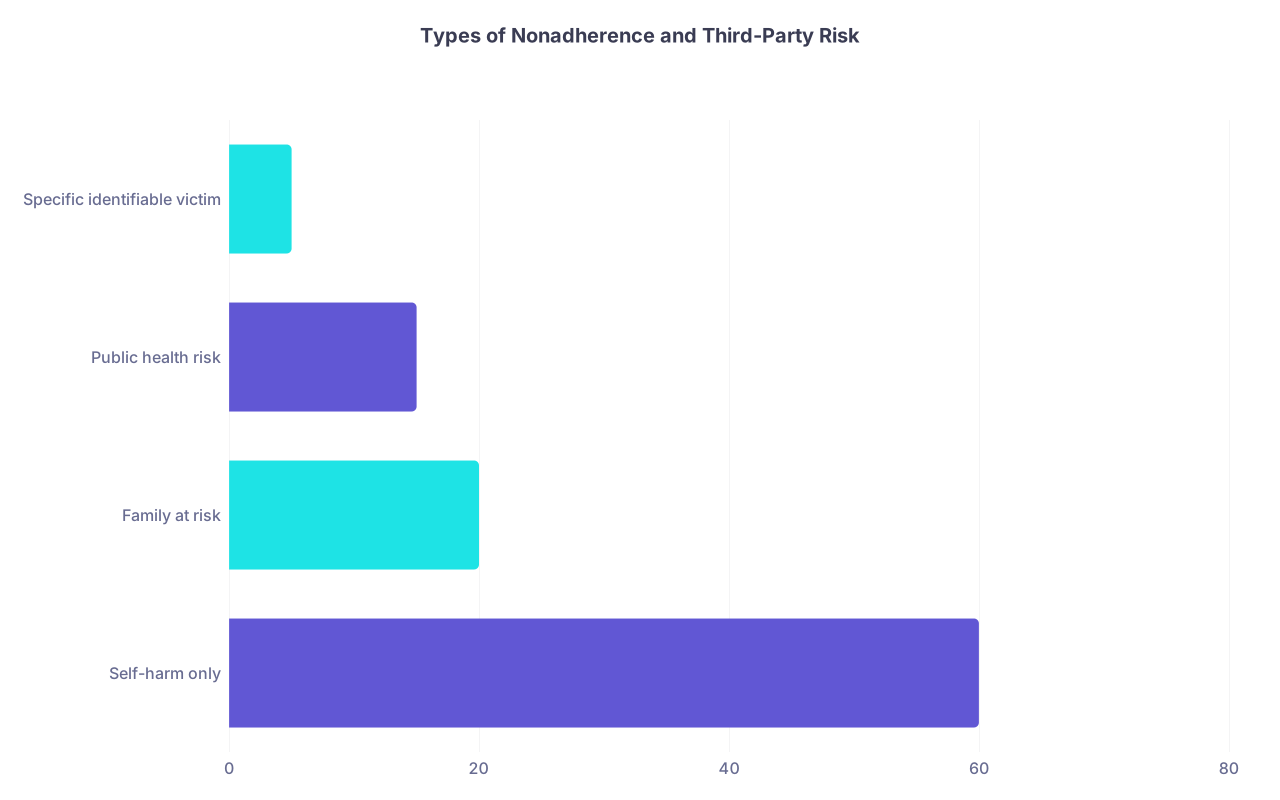
| Category | Value |
|---|---|
| Self-harm only | 60 |
| Family at risk | 20 |
| Public health risk | 15 |
| Specific identifiable victim | 5 |
Most nonadherence involves self-harm only. But you must recognize when you have crossed into the other categories.
Mistake #9: Taking Nonadherence Personally (and Letting It Shape Your Identity)
Last one, and it is quieter but destructive.
There is a point in training where repeated nonadherence starts to feel like a referendum on you:
- “If I were a better communicator, they would have changed.”
- “If I were more persuasive, he would not have relapsed.”
- “Maybe I am just bad at this.”
The predictable reaction:
- Cynicism
- Emotional withdrawal
- Overcontrolling behavior to “force” good outcomes
Ethically, that leads you straight into paternalism or emotional abandonment.
You are responsible for:
- Clear communication
- Respectful engagement
- Reasonable options
- Appropriate follow-up
You are not ethically required to guarantee behavior change. That standard will burn you out and push you toward coercive practices.
Practical, Ethically Safer Approaches
To avoid the big errors, build a few habits:
Replace “noncompliant” with a short descriptive clause
- “Has not been taking X as prescribed due to Y.”
Ask about barriers before explaining again
- “On a scale of 1–10, how confident are you that you can do this?”
Use shared decision-making language
- “Here are our options.”
- “Given what matters most to you, which of these seems possible?”
Document refusals like informed consent discussions
- That protects both the patient and you.
Use harm reduction criteria
- If they will not accept ideal care, ask: “What is the next best, realistic, safer option?”
Know the specific triggers for mandatory reporting where you practice
- Write them down. Keep them handy. Do not guess.

| Step | Description |
|---|---|
| Step 1 | Notice nonadherence |
| Step 2 | Check capacity and understanding |
| Step 3 | Explore barriers and context |
| Step 4 | Offer options and negotiate plan |
| Step 5 | Document discussion and decision |
| Step 6 | Arrange follow up and safety net |
| Step 7 | Continue therapeutic relationship |
| Step 8 | Consult legal or ethics, consider reporting |
| Step 9 | Risk to others? |
FAQ (exactly 4 questions)
1. Is it ever ethically acceptable to dismiss a chronically nonadherent patient from your practice?
Yes, but only under limited conditions. You must ensure it is not retaliation for protected decisions (e.g., refusing a specific treatment after informed consent), and not based on discriminatory factors like disability, race, or socioeconomic status. You also must provide adequate notice, emergency coverage, and reasonable referral options. If dismissal is primarily driven by your frustration rather than safety, clinic policy, or repeated boundary violations (abuse, dangerous behavior), you are on shaky ethical ground.
2. How do I handle a patient who refuses a clearly life-saving treatment (like chemotherapy or CABG) but appears to have capacity?
You respect their refusal, but you do not stop there. Confirm capacity carefully, document the process in detail, and ensure they can articulate their reasoning and understanding of consequences. Offer second opinions, palliative or supportive care, and clear instructions on when to seek urgent help. Your obligation is to make sure the decision is informed and voluntary, not to force the “right” choice.
3. What if family members are pushing for adherence, but the patient keeps refusing?
Your primary obligation is to the patient, assuming they have capacity. You can involve family for support if the patient agrees, but you do not collude with family to override the patient’s autonomy. Make sure the patient is not being coerced, and document any pressure you observe. Clarify to the family, respectfully, that the patient has the right to make choices they disagree with, and your role is to support informed decision-making, not to enforce family preferences.
4. Can I ever shorten visits or limit services for patients who repeatedly do not follow plans, just to manage my time better?
You can structure care differently—group visits, more frequent but shorter check-ins, team-based care—but you cannot ethically provide a consistently lower standard of care solely because someone is labeled “nonadherent.” System-level adjustments are acceptable; punitive withholding of time or options is not. If workload is unsustainable, address it as a system and staffing issue, not by quietly rationing effort away from the most complex patients.
Key points to remember:
- Stop using “noncompliant” as a moral shortcut; describe behaviors and barriers instead.
- Treat nonadherence as a signal to assess capacity, context, and options—not as an excuse to disengage.
- Document refusals and negotiated plans as carefully as you document consents; your ethics and your legal protection depend on it.


