

The fastest way to turn a routine complication into a lawsuit is not the complication itself. It’s your chart.
I’ve seen near-miss cases that should have died in a lawyer’s inbox come roaring back to life because the documentation was sloppy, defensive, or flat-out contradictory. The medicine was defensible. The notes weren’t.
If you think “I’m a good clinician, so I’m safe,” you’re making a dangerous mistake. Malpractice lawyers feast on charting errors, not clinical nuance. Your chart is their evidence manual.
Let’s go through the charting mistakes that quietly convert standard complications into “This looks like negligence” for a jury.
1. The Fantasy Chart vs. What Actually Happened
The first and biggest mistake: writing the chart you wish had happened instead of what actually happened.
This shows up in a few classic ways:
- Documenting perfect monitoring that clearly never occurred
- Copy-pasting a normal exam on a crashing patient
- Backfilling notes so the timeline magically aligns with a “good story”
The plaintiff attorney’s loveliest phrase? “This record is not credible.”
Here’s how it typically blows up:
A post-op patient codes unexpectedly at 04:30. The code is chaotic (as they usually are). The nurse is busy doing compressions and meds. Notes get entered at 06:00. Then, 10:00 rolls around and suddenly a “beautiful” progress note appears, time-stamped, describing:
- “Patient seen and examined at 03:30”
- “Discussed risks including death and aspiration extensively at bedside”
- “Vital signs stable, no complaints”
Problem: the flow sheet shows abnormal vitals at 03:15. No nursing note of a physician visit. Family swears they never saw a doctor that night.
Now you have two battles:
- Was the medicine appropriate?
- Is the chart trustworthy?
You never want #2 on the table. Once a jury doubts your chart, they’ll happily assume the worst about your care.
How to avoid this:
- Do not document encounters that didn’t happen. Ever.
- If you’re reconstructing events after the fact, label it: “Late entry” or “Addendum,” with real time and date.
- If you’re unsure of exact times, say “approx.” and stick to defensible estimates consistent with other data.
- Never “clean up” the chart to make care look smoother, faster, or more thorough than it was.
You’re better off writing: “Code called at 04:30, chart completed after event based on recall and available data,” than pretending you’ve been meticulously typing mid-crisis. No one believes that.
2. The “Everything Is Fine” Copy-Paste That Buries Red Flags
Another repeat offender: mindless copy-forward.
EHRs made this too easy. And too dangerous.
Typical anatomy of a copy-paste disaster:
Day 1:
“Abdomen soft, non-tender. Vitals stable. No distress.”
Day 2: same note.
Day 3: same note.
Day 4: now the patient is in the ICU with a perforated bowel.
Plaintiff exhibit A: Four days of notes showing “soft, non-tender” while the nursing notes mention increased pain, low-grade fevers, poor appetite, borderline vitals. A radiology report warning “early obstruction not excluded.” All ignored in your beautifully cloned note.
Here’s what the lawyer will say:
“The chart suggests Dr. X wasn’t even looking at the patient, just copying yesterday. They ignored obvious warning signs. This is not a complication. This is neglect.”
You just turned a bad outcome into “They didn’t care.”
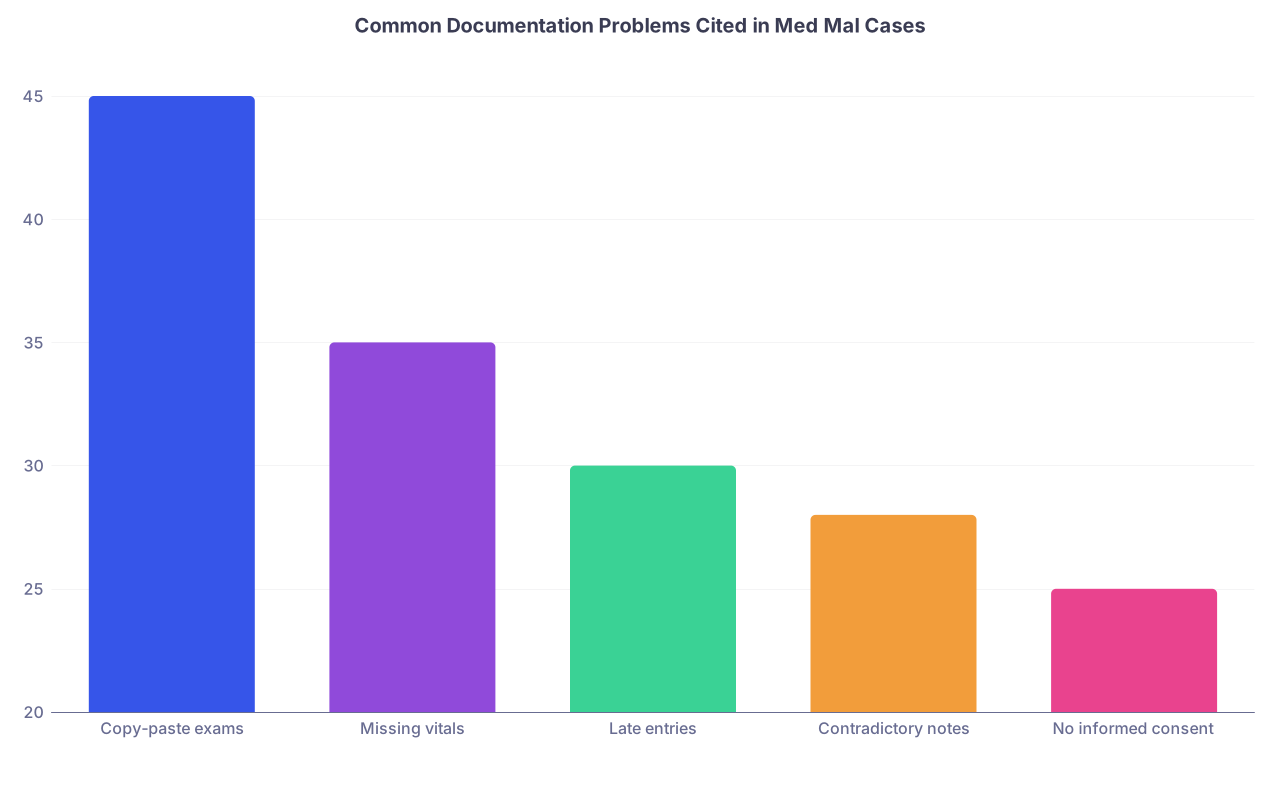
| Category | Value |
|---|---|
| Copy-paste exams | 45 |
| Missing vitals | 35 |
| Late entries | 30 |
| Contradictory notes | 28 |
| No informed consent | 25 |
How to avoid this:
- Never copy-forward an exam you didn’t actually repeat. If you didn’t check the abdomen today, don’t pretend you did.
- If the exam is unchanged, say “Exam repeated, unchanged from prior day: [then summarize briefly].”
- Read your own note before signing. Out loud in your head. Does it still fit this patient today?
- When the clinical picture changes even slightly (increasing pain, new lab abnormality, nursing concern), your note must reflect you saw and processed that.
Copy-paste isn’t inherently evil. Blind copy-paste is. And juries don’t like lazy.
3. The Vanishing Differential and the “Single Track” Note
A routine complication often remains legally routine if your chart shows you:
- Recognized risk
- Considered reasonable alternatives
- Monitored appropriately
- Responded to new data
The mistake? Documenting as if you had no differential diagnosis and no contingency thinking.
Example:
Chest pain in the ED. You believe it’s GERD. It probably is. But your note reads like GERD is the only thing that exists in medicine. No mention of ACS, PE, aortic issues, nothing.
But later, the patient has an MI. Now the question becomes:
“You didn’t even think about MI, did you?”
You might have. But your chart testifies against you.
Subtle but deadly gaps:
- No mention of risks you considered and ruled out
- No clear reasoning: “Why I think it’s X and not Y”
- No plan if patient worsens: return precautions, follow-up, what would trigger re-evaluation
A reasonable, defendable note lays out your thinking. Not in a textbook lecture, just enough so someone reading later goes, “Okay, they weren’t asleep at the wheel.”
How to avoid this:
- For high-risk complaints (chest pain, headache, SOB, abdominal pain, neuro changes), explicitly list at least the major “can’t miss” that you considered.
- Briefly tie it to the findings: “Low suspicion for PE given normal vitals, no risk factors, PERC negative.”
- Document explicit return precautions: “Advised to return immediately for [list key red flags].”
- Document patient understanding: “Patient verbalized understanding and agrees with plan.”
It’s not about defensive medicine. It’s about defensive documentation of reasonable medicine.
4. Informed Consent That Exists Only as a Form
Do not rely on that generic consent form alone to save you. It probably won’t.
Most hospitals use boilerplate language: “Risks include bleeding, infection, death, anesthesia risks, etc.” That’s fine for legal baseline. Terrible for nuance.
What turns a complication into a lawsuit is the perception of surprise and betrayal: “No one told us this could happen.”
The mistake:
You assume the signed form proves you discussed the risk. The family assumes the form was shoved at them in the hallway while they were terrified and desperate.
If the chart doesn’t document a specific, actual discussion, you’re exposed.
The worst pattern:
- High-risk procedure (e.g., central line, ERCP, high-risk OB, spine surgery)
- Generic consent form only
- No specific mention in the note of major relevant risks
- Bad but known complication occurs
- Family: “We would never have agreed if we knew this could happen.”
Guess who wins that narrative in front of a jury?
How to avoid this:
Your consent note doesn’t need to be a novel. But it must prove that a real conversation happened.
Something like:
“Discussed procedure, alternatives, and risks including bleeding, infection, damage to nearby structures, need for re-operation, failure to improve, and risk of death. All questions answered. Patient (and spouse) expressed understanding and consented.”
If it’s a particularly relevant risk for that patient (e.g., stroke risk, nerve damage, loss of function), name it explicitly.
And document if they ask questions. That human detail helps:
“Patient asked specifically about risk of prolonged recovery; explained expected timeline vs complications.”
5. Timing Lies and Retroactive Magic
Backdating is the landmine you must never step on. Even if “everyone does it.”
I’ve watched cases go from hard to prove → slam dunk for the plaintiff because a provider tried to “fix” the timeline after the fact.
Scenario:
Nurse calls you at 01:00 about deteriorating vitals. You don’t see the patient until 03:00 when it’s frankly bad. You then write, “Patient seen at 01:10…” to cover the delay.
Bad idea. The audit trail will bury you. EHRs track creation and modification times. Plaintiffs will get that metadata. They almost always do now.
Once you’re caught massaging times, every word in that note becomes suspect.

| Step | Description |
|---|---|
| Step 1 | Routine complication |
| Step 2 | Poor documentation |
| Step 3 | Chart contradictions |
| Step 4 | Lawyer questions credibility |
| Step 5 | Jury doubts provider |
| Step 6 | Routine complication seen as negligence |
Better approach:
If you’re documenting late, say so:
“Late entry 08:15 for events at approx 01:00–03:00. Called by RN at 01:00 for hypotension; evaluated patient at bedside approx 01:20…”
Is it ideal? No. Is it honest? Yes. And honesty is much easier to defend than fiction.
Never alter prior notes to match your new version of events. If you must correct something, use a properly labeled addendum. Never delete, overwrite, or “disappear” earlier content. That looks like concealment, even if it’s innocent.
6. Ignoring Nursing Documentation and Team Conflicts
Juries love nurses. You should assume that every time you write a note.
One of the fastest ways to supercharge a simple complication into a negligence case is letting your note blatantly contradict repeated nursing concerns without addressing them.
Common pattern:
- Multiple nursing notes: “Patient complaining of increasing pain,” “Page MD,” “Concerned about decreased urine output,” etc.
- Your progress note: “No complaints. Pain controlled. Stable.”
Plaintiff lawyer’s narrative: “Nurses saw it. They begged for attention. The doctor ignored them.”
Even if that’s absolutely not what happened, your chart says otherwise.
How to avoid this:
- Read nursing notes, or at least acknowledge major concerns they documented.
- If you disagree with nursing assessment, you still need to document that you heard it and why you see it differently:
“RN concerned about increased pain; evaluated at bedside, pain appears consistent with post-op course, abdomen exam benign, will continue to monitor with low threshold for imaging.” - Do not use your note to attack or undermine nursing in the chart. That shows division, not safety.
If there is a serious disagreement about care, escalate through appropriate channels. Don’t resolve it with passive-aggressive documentation.
7. The Angry, Defensive, or Blaming Note
Do not use the chart as your emotional punching bag. Ever.
I’ve read charts where a physician clearly documented angry. It’s a goldmine for a plaintiff.
Red flags in documentation:
- “Patient refused to follow medical advice despite repeated attempts.” (with a snide tone)
- “Difficult family, demanding unnecessary tests.”
- “Noncompliant.” (with zero attempt at understanding why)
- “Patient argumentative and rude.”
You’re building a story where you look irritated and dismissive. Then something goes wrong. The story writes itself: “They didn’t care.”
A better way to document conflict:
Focus on behavior and facts, not judgment or emotion.
Instead of:
“Noncompliant diabetic, refuses to follow recommendations.”
Use:
“Discussed importance of medication adherence and diet for glycemic control. Patient reports difficulty affording medication and admits inconsistent use. Provided options including [X]. Patient currently declines adjustment but agrees to follow-up in [timeframe].”
- Document that you explained specific risks of leaving.
- Document what they verbalized back.
- Document that you offered alternatives and follow-up.
- Avoid venting. You’re not writing for catharsis; you’re building a legal document.
And do not ever chart your annoyance with nursing, consultants, or other services. That discord plays terribly in court.
8. Missing, Vague, or Contradictory Follow-up Plans
A bad outcome after discharge is risky. A bad outcome after discharge when your note doesn’t show a clear follow-up plan is worse.
Classic mistake:
“Discharge home. Follow up with PCP.” That’s it.
No timeframe. No urgency. No red flags. No indication you cared what happened after they walked out.
If they come back septic, stroked, or in heart failure, the chart leaves a huge hole for the plaintiff: “They were sent out without clear instruction or appreciation of risk.”
| Situation | Weak Documentation | Strong Documentation |
|---|---|---|
| Chest pain workup negative | "Discharge home, f/u PCP." | "Discharge home. Follow up with PCP within 48–72 hours. Return immediately for recurring chest pain, SOB, syncope, or new symptoms. Patient verbalized understanding." |
| New diabetes diagnosis | "Follow up clinic." | "Follow up with endocrinology within 2 weeks and PCP within 1 week. Provided written instructions on glucose monitoring and hypoglycemia signs. Patient able to repeat plan back accurately." |
| Post-op discharge | "Discharge per protocol." | "Discharge home with wound care instructions and pain control plan. Follow up with surgery clinic in 7–10 days. Advised to call or present to ED for fever, worsening pain, redness, drainage, or inability to tolerate PO." |
How to avoid this:
- Put clear timeframes: “within 24 hours,” “1 week,” “ASAP,” not just “follow up.”
- Name specific red flag symptoms that should trigger ED return.
- Document that the patient (or family) understood. Even a single line: “Patient repeated back plan correctly.”
That one sentence has saved people in court. It shows you didn’t just mumble instructions at the door.
9. The “No Change” Note in a Clearly Changing Patient
Stability is nice in medicine. It’s rare.
The mistake: documenting “no change” when absolutely everything is changing except your note.
- Worsening labs, dropping Hgb, rising creatinine, trending tachycardia
- Repeated nursing escalation
- New imaging suggestions
- Your progress note: “No acute events. Continue current management.”
Later, the patient crashes. The plaintiff will show a clear deterioration in the objective data contrasted with your frozen-in-time narrative. It looks like you weren’t paying attention.
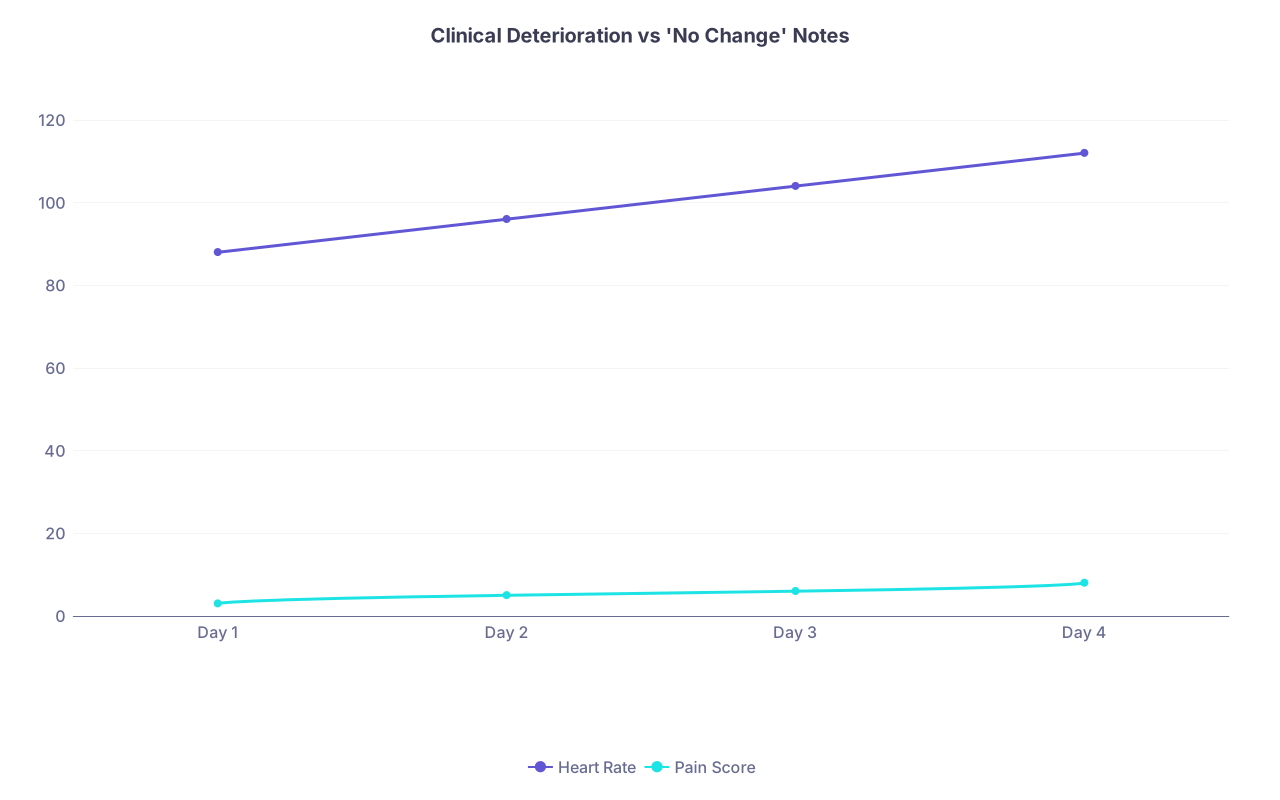
| Category | Heart Rate | Pain Score |
|---|---|---|
| Day 1 | 88 | 3 |
| Day 2 | 96 | 5 |
| Day 3 | 104 | 6 |
| Day 4 | 112 | 8 |
That sort of graphic (often literally made by plaintiff experts) is devastating.
How to avoid this:
- Your note must reflect trends. Not just a snapshot.
- If labs are borderline but explainable, say that:
“Hgb trending down from 11 to 9.2 over 48 hours, likely dilutional/post-op; abdomen soft, no signs of bleeding. Will repeat labs at [time] and monitor closely.” - If pain is worsening, acknowledge and explain why your threshold for further workup is reasonable.
You’re allowed to observe and monitor. You’re not allowed to look oblivious.
10. Charting for Yourself, Not for the Future You in Court
The last big mistake is conceptual: writing notes only for present-day clinical communication, not realizing you’re also speaking to:
- A future chart reviewer
- A risk management committee
- A retained expert
- Twelve people on a jury who’ve never been in a hospital outside visiting grandma
Your future self might need this note to defend what you did on the worst day of your career.
You’re not writing fiction or PR. You’re building a contemporaneous record that:
- Shows you noticed the problem
- Shows you thought about plausible dangers
- Shows you discussed realistic risks with the patient/family
- Shows you responded proportionately to changes
- Shows you treated other team members and the patient with respect

When routine complications do happen—and they will—you want the chart to tell a story that looks like:
“This was a known risk. It was discussed. The team monitored and responded reasonably. The outcome is tragic, but the care was within the standard.”
Not:
“No one looked. No one listened. And then they tried to clean it up afterward.”
11. Practical Habits That Keep You Out of the Crosshairs
A few high-yield habits will prevent 80% of charting disasters:
- Pause 10 seconds before signing a note and ask: “If something goes wrong tomorrow, does this note show clear thinking, communication, and a reasonable plan?”
- Label late entries and addenda honestly. Do not adjust timestamps to make yourself look quicker or smarter.
- Avoid judgmental language about patients or colleagues. Stick to observed behavior and concrete facts.
- When nursing or family raises concern, document your response, not your irritation.
- For high-risk scenarios (discharges after concerning symptoms, borderline lab abnormalities, high-risk procedures), add one or two extra sentences explaining your reasoning and follow-up plan. It pays off later.

You cannot control every complication. You can control how defensible your care looks on paper.
12. The Bottom Line
Three core truths to keep front of mind:
- Lawsuits explode not just from bad outcomes, but from charts that look careless, dishonest, or indifferent.
- Honest, timely, clear documentation of your reasoning, risk discussions, and responses to change will convert many “this looks awful” cases into “this was a known risk managed reasonably.”
- Never sacrifice chart integrity to make yourself look better in the short term. The metadata, the nurses, and the family will all testify against that version later.
Do the medicine as well as you can. Then give your future self the only real protection you control: a chart that tells the truth, clearly and completely enough to withstand scrutiny.


