
The way most clinicians “reflect” at year’s end is useless for moral distress. Vague gratitude lists and generic resolutions will not touch the cases that still wake you at 3 a.m.
You need structure. Time-bounded reviews. Specific prompts tied to specific weeks and events. A template that treats your moral life like your clinical life: systematic, documented, and revisited.
That is what this end‑of‑year reflection is for.
Below is a chronological, step‑by‑step template you can run in a single long sitting (2–3 hours) or spread over several evenings. I will walk you from “zoomed out” to “zoomed in,” and then forward into next year with concrete changes.
Use this once a year. Then reuse the same structure next year so you can actually see growth instead of just feeling vaguely different.
Step 1 (Week 1 of Your Reflection): Build the Year’s Moral Timeline
At this point you should resist the urge to dive straight into “the worst case.” Start with the map, not the incident.
1.1 Reconstruct the year in quarters
Take 20–30 minutes. Divide a blank page (or document) into four sections:
- Q1: Jan–Mar
- Q2: Apr–Jun
- Q3: Jul–Sep
- Q4: Oct–Dec
Under each, list:
- Rotations / settings (ICU, clinic, ED, OR, night float, etc.)
- Major role changes (new attending, chief year, fellowship start, new institution)
- Big policy or system shifts (new EMR, staffing cuts, triage protocols, COVID surges, new abortion law in your state, etc.)
You are building context. Moral distress is rarely free‑floating; it clusters around certain environments and transitions.
1.2 Add “moral heat points” to the timeline
Next 20 minutes. Go back through each quarter and ask:
- When did I leave a shift and feel angry, ashamed, or numb?
- When did I say “we should not be doing this” or “this feels wrong”?
- When did I feel forced to act against my values or training?
For each quarter, try to identify:
- 1–3 specific cases
- 1–2 ongoing patterns (e.g., “boarding in ED,” “unsafe staffing,” “pressure to upcode,” “coercive family decisions”)
Mark each on your timeline with 3 quick fragments:
- What happened?
- Who was involved? (roles, not names: resident, charge nurse, risk management, family)
- How did I feel in the 24 hours after?
You are not doing deep analysis yet. Just pinning flags on the map.
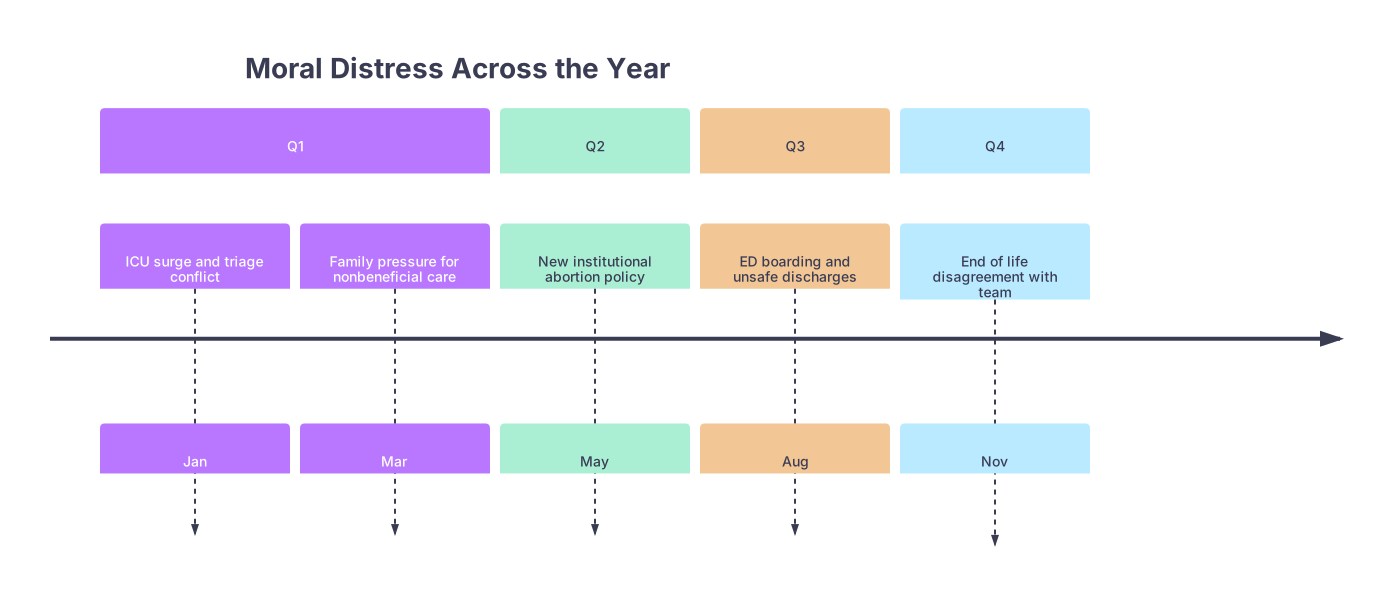
| Period | Event |
|---|---|
| Q1 - ICU surge and triage conflict | Jan |
| Q1 - Family pressure for nonbeneficial care | Mar |
| Q2 - New institutional abortion policy | May |
| Q3 - ED boarding and unsafe discharges | Aug |
| Q4 - End of life disagreement with team | Nov |
Step 2 (Same Week): Choose Your Top Three Moral Events
At this point you should avoid the trap of trying to process everything. You will burn out on your own reflection.
2.1 Triage your moral events
Look over your timeline and rate each event (quick gut ratings, 1–5):
- Distress intensity (how much it hurt)
- Residual impact now (how much it still lives in your head/body)
- Frequency (one‑off vs pattern)
You can jot this as three small numbers next to each event, like “4/5/2.”
Then choose:
- 2 single incidents
- 1 recurring pattern
These three will be the focus of your end‑of‑year reflection.
2.2 Set containers in your calendar
This reflection will sink if it is not scheduled.
On your calendar over the next 1–2 weeks, block:
- 60–75 minutes for Incident 1
- 60–75 minutes for Incident 2
- 60–90 minutes for the Pattern
Name each block plainly: “Moral Reflection – ICU Futility Case,” “Moral Reflection – Abortion Law Shift,” etc. Do not call it “wellness.” Call it what it is.
You now have a plan, not an intention.
Step 3 (Day‑By‑Day Template for Each Incident)
At this point you should work one incident at a time. Do not multitask your own ethics.
For each incident block (60–75 minutes), follow this structure:
3.1 First 10 minutes: Clinician‑style case write‑up
Write it like a consultation note, but for moral distress.
- Context: Setting, role, who else was on (intern, fellow, charge nurse, consultant).
- Presenting problem: The moral conflict in one sentence.
- “I believed further chemotherapy was harmful; the family and oncology team insisted on continuing.”
- Key facts: Bulleted, not prose. What an outside clinician would need to understand the case.
- Your actions: What you actually did and said, not what you wish you had done.
- Outcome: What happened clinically and interpersonally.
No analysis yet. Just a concise, factual reconstruction.
3.2 Next 15–20 minutes: Moral diagnosis
Now ask, very directly:
What exactly was the moral question?
Examples:- Balancing autonomy vs beneficence
- Truth‑telling vs preserving hope
- Fair resource allocation vs individual advocacy
- Professional integrity vs institutional policy
Which principles or values felt in conflict for you?
- Autonomy, beneficence, nonmaleficence, justice
- Professional honesty, fidelity, respect, compassion, fairness, solidarity
What type of moral experience was this?
Use simple labels; they help your brain organize experience:- Moral distress (you knew the right thing but could not do it)
- Moral uncertainty (you were not sure what was right)
- Moral residue (the lingering distress now)
- Moral injury (perceived betrayal of what is right by authority or system)
I am explicit about labeling because over time you will see patterns: some systems breed moral uncertainty, others raw moral injury.
| Type | Core Feature |
|---|---|
| Moral distress | Blocked from doing right |
| Moral uncertainty | Unsure what is right |
| Moral residue | Lingering emotional burden |
| Moral injury | Betrayal of moral expectations |
3.3 Next 15–20 minutes: Emotional and bodily inventory
This is the piece clinicians like to skip. Do not.
Answer these in short phrases, not essays:
- During the event, what did you feel? (angry, complicit, helpless, disgusted, numb, etc.)
- Where did you feel it in your body? (chest tightness, jaw clenching, stomach, headache)
- In the 72 hours after, how did it show up?
- Sleep changes, irritability, rumination, avoidance of certain staff or units, over‑documenting.
Then ask:
- What emotion is still there now when you recall it?
- If you imagine telling this story to a trainee, what part would make your voice catch or your jaw clench?
You are naming what your nervous system learned from this event. That matters for growth.
3.4 Next 15–20 minutes: Moral growth extraction
Now you mine the incident for learning instead of just reliving it.
Answer these:
What did this incident reveal about my core moral commitments as a clinician?
Example: “I care more about honest prognosis than I realized; I am not okay participating in what feels like false hope.”Where was I proud of myself?
Even small things: “I documented clearly,” “I spoke up once even though it was uncomfortable,” “I sat with the family instead of fleeing.”Where did I fall short of my own standards?
Concrete, not self‑loathing. “I avoided calling ethics because I was afraid of being seen as difficult.”What skill or support was missing that might have changed my actions?
- Communication skills (e.g., conflict with senior staff, goals of care)
- Knowledge (legal standards, institutional policy)
- Structural support (rapid ethics consult, backup from leadership)
- Personal capacity (too fatigued, burned out to engage fully)
Given all constraints, what would ‘slightly better’ have looked like?
Not perfection. One or two behaviorally specific changes you could imagine making next time.
Write those “slightly better” actions as micro‑commitments:
- “Next time I will say explicitly to the attending, ‘I am concerned this plan is causing harm.’”
- “Next time I will request an ethics consult instead of just complaining at the nurses’ station.”
That is moral growth: one increment at a time, grounded in reality.
Step 4 (Different Day): Analyze the Recurring Pattern
At this point you should step back from incidents and challenge the environment itself.
Use your 60–90 minute block for the pattern.
4.1 Describe the pattern like a syndrome
Give it a nickname. You are more likely to recognize it later if it has a name.
Examples:
- “Futility Fridays in ICU”
- “ED Discharge to Nowhere”
- “Policy vs Patient in Reproductive Care”
- “Insurance‑Driven Overtreatment”
Then:
- Where does it occur? (unit, service, time of day/week)
- Who are the repeat players? (roles: hospitalist, case management, legal, family surrogates)
- Rough frequency? (weekly, monthly, every rotation)
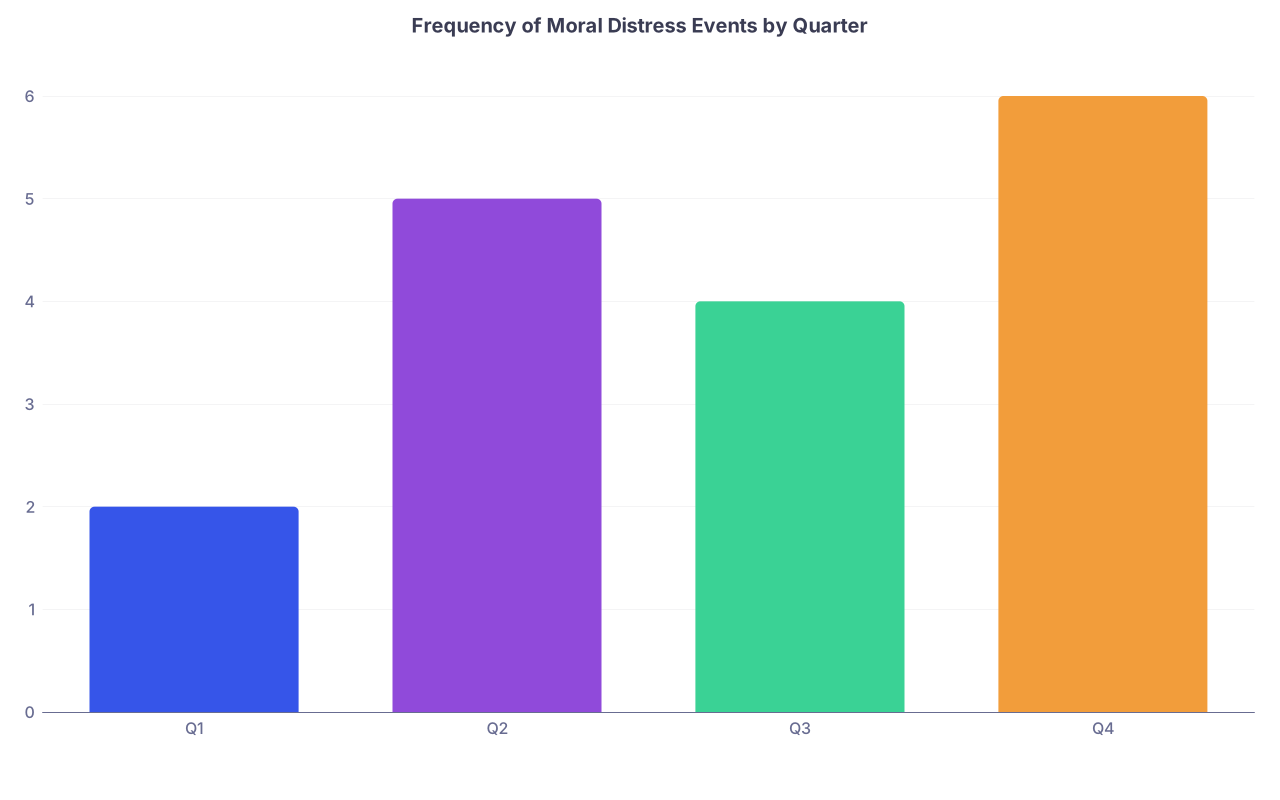
| Category | Value |
|---|---|
| Q1 | 2 |
| Q2 | 5 |
| Q3 | 4 |
| Q4 | 6 |
4.2 Map your current responses
List what you actually do when this pattern appears:
- Speak up? To whom? How often?
- Stay silent? Where and why?
- Vent to peers? Document more defensively? Request transfers? Call in ethics? Avoid certain shifts?
Then categorize these responses as:
- Protective and effective (reduce harm and distress)
- Protective but costly (help you cope but harm relationships or your own integrity)
- Maladaptive (increase harm or distress over time)
Be honest here. I have watched excellent clinicians slide into sarcasm and quiet sabotage because they never did this part of the reflection.
4.3 Identify leverage points
Ask three blunt questions:
- What is the smallest change in my own behavior that would make this pattern slightly less harmful for patients or staff?
- What is the smallest change in team norms that might help? (e.g., “we always huddle with nursing before making this call”)
- What is one institutional structure (policy, algorithm, default order set, automatic consult) that, if adjusted, would improve this?
You are not writing a manifesto. You are looking for realistic leverage.
Capture 1–3 specific ideas you could actually push for in the next year—email to ethics committee, agenda item at M&M, protocol suggestion to your division chief.
Step 5 (End of Week 2): Integrate and Name Your Year
At this point you should have three processed pieces: two incidents and one pattern. Now you stitch them together.
5.1 Identify themes across your three focal points
Read your notes and ask:
- Which values keep showing up? (truth‑telling, fairness, dignity at end of life, non‑abandonment, obedience to law, etc.)
- Which constraints keep showing up? (time pressure, fear of retaliation, hierarchy, legal risk, billing demands)
Then complete these sentences in your own words:
- “This year, my moral life at work was mostly about the tension between ___ and ___.”
- “I learned that I am the kind of clinician who will usually choose ___, even when it costs me ___.”
Do not aim for perfection; this is a snapshot.
5.2 Track changes over the year
Look back at your Q1 vs Q4 moral heat points.
- Were you more likely to speak up in Q4 than Q1?
- Were you more resigned? More strategic? More burned out?
Summarize in 3–4 sentences:
- “Compared to the start of the year, I now…
- speak up earlier / less often / more tactfully
- involve ethics more / less
- feel more supported / more isolated
- feel more aligned / misaligned with institutional values”
That contrast is your growth trajectory—positive or negative. Either way, it is data.
Step 6 (Final 2–3 Days of the Year): Convert Reflection Into Next‑Year Practice
At this point you should ruthlessly translate reflection into behavior. Vague “I’ll be more ethical” promises are useless.
6.1 Draft three concrete “moral practice” goals
Use this structure for each goal:
- Situation: “When I am in [setting] and [pattern/event] is occurring…”
- Action: “…I will [specific behavior].”
- Support: “…and I will support this by [resource/ally/structure].”
Examples:
- “When I am on night float and an ICU futility case emerges, I will request a morning multidisciplinary family meeting before new invasive procedures, and I will email the attending and ethics to flag concerns.”
- “When reproductive care conflicts with new state law arise, I will clarify the legal limits directly with risk management and then be explicit with patients about what I can and cannot do.”
- “When I feel morally distressed after a shift, I will write a 10‑minute debrief and, once a month, bring one case to our ethics or Schwartz Rounds instead of just venting in the workroom.”
Limit yourself to three. Anything more will evaporate under real‑world pressure.
6.2 Choose one skills‑training target
From your incidents and pattern, decide: what skill would make a difference?
- Advanced goals‑of‑care conversations
- Conflict with hierarchy / “speaking up” training
- Legal/ethical knowledge (capacity assessment, informed refusal, reproductive law, end‑of‑life statutes)
- Institutional navigation (how to actually use your ethics committee, ombuds, risk management)
Write a mini‑plan:
- By Month 2: identify and sign up for one course, CME, workshop, or book.
- By Month 4: apply it to at least one real case and debrief with a colleague.
- By Month 9: re‑assess if this skill is still your limiting factor.
Step 7 (Early Next Year): Establish a Monthly Micro‑Reflection Routine
At this point you should prevent next year’s reflection from turning into another forensic reconstruction. Build small checkpoints.
Set a repeating monthly event (30 minutes) titled “Moral Check‑In – [Your Name].”
Template for each month:
- List 1–2 moral events that stood out.
- Categorize them quickly (distress, uncertainty, residue, injury).
- Ask: “Did I apply any of my three moral practice goals this month?”
- Note one small thing you are proud of and one thing you want to do slightly better next time.
You will thank yourself in December when you sit down and have 12 brief check‑ins ready to review instead of relying on memory warped by fatigue.

Legal and Policy Component: Where Law Meets Your Distress
Because you are working in “Medical Ethics Law,” do not ignore the legal spine beneath your moral distress.
When you review each incident and pattern, add 5–10 minutes to ask:
- What legal standards or regulations shaped this?
- Capacity, informed consent/refusal, EMTALA, state abortion law, DNR/DNI rules, duty to report, documentation requirements.
- Did I actually know the legal boundary at the time, or was I operating on rumor and fear?
- Did I conflate “institutional policy” with “the law”? They are not the same.
Then, for the upcoming year, set one legal‑knowledge micro‑goal:
- “By June, I will attend at least one hospital legal/ethics in‑service or review a written summary of the law in [area causing me distress].”
Knowing where the law truly constrains you and where it does not is a massive relief. I have watched entire teams back down from ethically permissible actions because “legal will not like it,” when no one had actually spoken to legal.
How to Store and Protect Your Reflection
Last, do not be naive about privacy and discoverability.
- Keep identifiable patient details out (no names, MRNs, unique features).
- Store your notes on a personal device, not hospital systems.
- Label clearly as “Personal Professional Reflection – Privileged and Confidential” if you are in a jurisdiction where this may help. It is not magic protection, but it signals intent.
You are doing serious work here. Treat it like serious work.
Three Things To Remember
- Build the map first. Year‑end moral reflection starts with a timeline, not with feelings.
- Go narrow and deep. Two incidents and one pattern, analyzed systematically, will change your practice more than vague annual angst.
- Convert reflection into practice. End each year with 2–3 specific behavioral commitments and one skills‑training target, then protect a brief monthly check‑in to stay honest.