
The most dangerous thing about night float is not fatigue. It is ethical drift when you are tired, alone, and “just trying to keep the list alive.”
You will be making real decisions with less supervision, less context, and more pressure. Protocols you vaguely remember from orientation will suddenly matter a lot. So you need a timeline-driven plan to get your ethical house in order before your name goes on the pager.
Below is a chronological guide: what to review and practice in the month, week, and final days before you start night float, and how to run your nights so you do not end up in the gray zone—or worse, in an incident review.
One Month Before Night Float: Build Your Ethical Foundation
At this point you should stop thinking “night float is just cross-cover” and start treating it as your first semi-independent practice.
1. Clarify Your Legal and Institutional Ground Rules
In the first 4 weeks, you should map out the legal/ethical terrain you are actually standing on.
Focus on five domains:
- Capacity and consent
- Advanced directives and code status
- Emergency exception to consent
- Confidentiality/HIPAA boundaries
- Documentation and incident reporting
Schedule 2–3 short reading blocks (30–45 minutes each) per week.
| Area | What To Look Up |
|---|---|
| Capacity & Consent | Hospital policy, state law summary |
| Code Status | DNR/DNI forms, comfort-care policies |
| Emergencies | “Implied consent” policy |
| Confidentiality | HIPAA quick guide, social media policy |
| Reporting | Incident reporting (safety event) steps |
Print or save PDFs to a “Night Float” folder. You will not be hunting SharePoint at 03:00. Or you should not be.
2. Revisit Core Ethics Principles—Applied, Not Theoretical
You do not need a philosophy seminar. You need fast pattern recognition.
Spend one evening on each:
Autonomy
- How you assess capacity (understanding, appreciation, reasoning, expression of choice).
- When you override expressed wishes (suicidality, grave risk to others, lack of capacity).
Beneficence / Nonmaleficence
- Common night scenarios: chest pain workup, transfusion thresholds, restraints, pulling tubes.
- Asking: “Is this intervention helping or just making the chart look active?”
Justice
- Escalating care when ICU beds are tight.
- Triaging consults at night when you cannot do everything now.
Write down 3–4 “night examples” for each principle from your own experience or from senior residents’ stories. If you cannot see the principle in the scenario, you will not see it at 2 am.
3. Ask Seniors About “Ethics Traps” on Your Service
This is the fastest way to learn: targeted, specific questions.
Ask PGY-2/3s:
- “What are the top 3 situations at night where you were not sure what was ethically right?”
- “Which patient types tend to trigger ethics/legal issues here?” (capacity, elopement, restraints, end-of-life)
- “What did you wish you had documented differently?”
Capture their answers in a simple list. You are building your own “night ethics pattern library.”
Two Weeks Before Night Float: Service-Specific Protocols
At this point you should stop reading abstract ethics texts and dig hard into your actual hospital’s rules.
1. End-of-Life and Code Status Protocols
Nights are where unclear code statuses come back to haunt people.
In this 2-week window, you should:
Read the hospital’s code status policy line by line.
Find out:- Who can sign a DNR/DNI? Which surrogates are recognized in your state.
- Required documentation (specific forms, progress note language).
- Policy for “presumed full code” when nothing is documented.
Understand comfort-focused orders.
- How your hospital defines “comfort care only” or similar order sets.
- What you are allowed to withhold or withdraw under that status.
- Opioid and benzo protocols at end-of-life (dose ranges, titration rules).
Learn the escalation hierarchy for end-of-life conflicts at night.
- On-call attending? House supervisor? Palliative or ethics on-call?
Know who you can wake up when a family is screaming “Do everything” for a patient with a signed, clear DNR.
- On-call attending? House supervisor? Palliative or ethics on-call?
2. Capacity, AMA, and Elopement
Nights are when people want to leave. Or say they do.
In this period, you need to:
Review the hospital’s “Leaving AMA” form and process.
- Who must sign.
- Exactly what you must document: discussion of risks, alternatives, patient’s understanding.
- When you can (and should) call security.
Study capacity assessment policy or guideline.
If your hospital has a template or smart phrase, read it now.
Core elements you must write in the chart:- What decision the patient is making.
- Evidence of understanding of condition and consequences.
- Ability to reason and communicate a consistent choice.
Clarify restraints/seclusion rules.
- Who can order restraints.
- Time limits, reassessment requirements.
- Documentation expectations: behavior, alternatives tried, criteria for removal.
These are not optional. These are the sections risk management reads first after an incident.
One Week Before: Build Your Night-Mode Playbook
At this point you should stop passively reading and start rehearsing. You are building scripts and decision trees you can run when tired.
1. Create Quick-Access Tools
Spend one longer study block (60–90 minutes) assembling:
One-page reference for:
- Capacity assessment bullets
- AMA documentation bullets
- Restraint indications and doc phrases
- Goals-of-care conversation structure
Note templates or smartphrases in your EMR that cover:
- Capacity assessment
- AMA discharge
- Code status discussion
- End-of-life symptom management changes
Do the EMR work now. At 03:20 you are not crafting a perfect paragraph; you are dropping in and editing a prebuilt structure.
2. Run Through Five “High-Risk Night Cases”
Pick or invent cases. Example set:
- Agitated patient with alcohol withdrawal refusing labs but not obviously lacking capacity.
- Advanced cancer patient, rapidly deteriorating, no clear code status, family unreachable.
- Psych history patient demanding discharge, borderline capacity, possible risk to others.
- Elderly patient with sepsis, DNR/DNI but no clarity on BiPAP or pressors.
- Patient refusing blood transfusion for religious reasons with Hb 5.5, hemodynamically borderline.
For each case, write down:
- The ethical principles in conflict.
- The minimum people you would involve (attending, nursing supervisor, security, ethics, social work).
- The bare-minimum documentation sentences you would include.
You are training your reflex: “Pause → identify principle → check protocol → act → document.”
72–24 Hours Before Your First Night: Tighten the Screws
By now, you should not be reading whole policies. You should be sharpening.
1. Rehearse Phrases You Will Actually Say
Ethics at night is 50% content, 50% communication under stress.
Practice, out loud, short scripts like:
- “I hear that you want to leave. My job is to make sure you understand the risks and that you can make this decision safely.”
- “Right now, your mother is very, very sick. We are at a point where we need to decide whether the focus is prolonging life at all costs, or making her comfortable.”
- “I am concerned that you do not have the ability right now to understand the consequences of leaving. That means I cannot safely discharge you at this moment.”
Yes, it feels awkward. Much better than trying to invent calm, clear language while a patient is swearing at you and security is standing in the doorway.
2. Clarify On-Call Hierarchy and Backup
Know exactly:
- Which attending covers nights and how to reach them.
- Whether there is an ethics consult line at night (many are on-call).
- How to reach:
- Risk management or house supervisor
- Psychiatry on-call
- Social work (some systems have 24/7 coverage, some do not)
Write this as a mini-tree on a sticky note or note app: “Ethics escalation contacts – nights.”
3. Identify Your Own Weak Spots
Be honest. If you have:
- A tendency to “just do it and document later”
- Discomfort with conflict or saying “no” to unreasonable demands
- Anxiety about calling attendings at night
Write down one countermeasure for each. For example:
- “If I find myself thinking ‘I will document this later,’ I must stop and write 2–3 lines now.”
- “If a family conversation is turning heated, I will step out, call the attending or supervisor, and re-enter with backup.”
You are not perfect. Plan around that.
During Night Float: Daily and Hourly Ethical Habits
Once you start, the game changes. Lectures and policies are behind you. Now it is pattern, timing, and discipline.

| Step | Description |
|---|---|
| Step 1 | Start Shift |
| Step 2 | Sign Out |
| Step 3 | Identify High Risk Patients |
| Step 4 | Preemptive Chart Review |
| Step 5 | Overnight Calls |
| Step 6 | Standard Care |
| Step 7 | Pause and Protocol |
| Step 8 | Call Senior or Attending |
| Step 9 | Document Clearly |
| Step 10 | Morning Sign Out |
| Step 11 | Self Review and Adjust |
| Step 12 | Ethical Red Flag? |
Start of Each Shift: 15-Minute Ethics Scan
At sign-out, you should explicitly ask:
- “Who is likely to crash, decompensate, or have goals-of-care issues tonight?”
- “Any families upset or confused about plans?”
- “Anyone trying to leave earlier today?”
Then, before you see other new issues:
Flag:
- Patients with unclear code status
- Patients with known agitation, psych history, or prior elopement attempts
- Complex end-of-life cases or borderline-capacity patients
Skim their charts for:
- Last goals-of-care note
- Any capacity assessments
- Power of attorney/surrogate listed
You are not doing full consults. You are just not walking in blind when something happens.
In-the-Moment: Your “Ethics Timeout”
When something messy hits (agitated AMA, conflict over code, refusal of critical treatment), force a mental timeout:
- Name the problem in your head: “This is a capacity question” or “This is an end-of-life conflict.”
- Check your one-page reference if you are even slightly uncertain.
- Decide if this is above your pay grade.
- If yes, call senior/attending. Not 20 minutes later. Now.
- Document while the details are fresh.
3–5 sentences, not a novel.
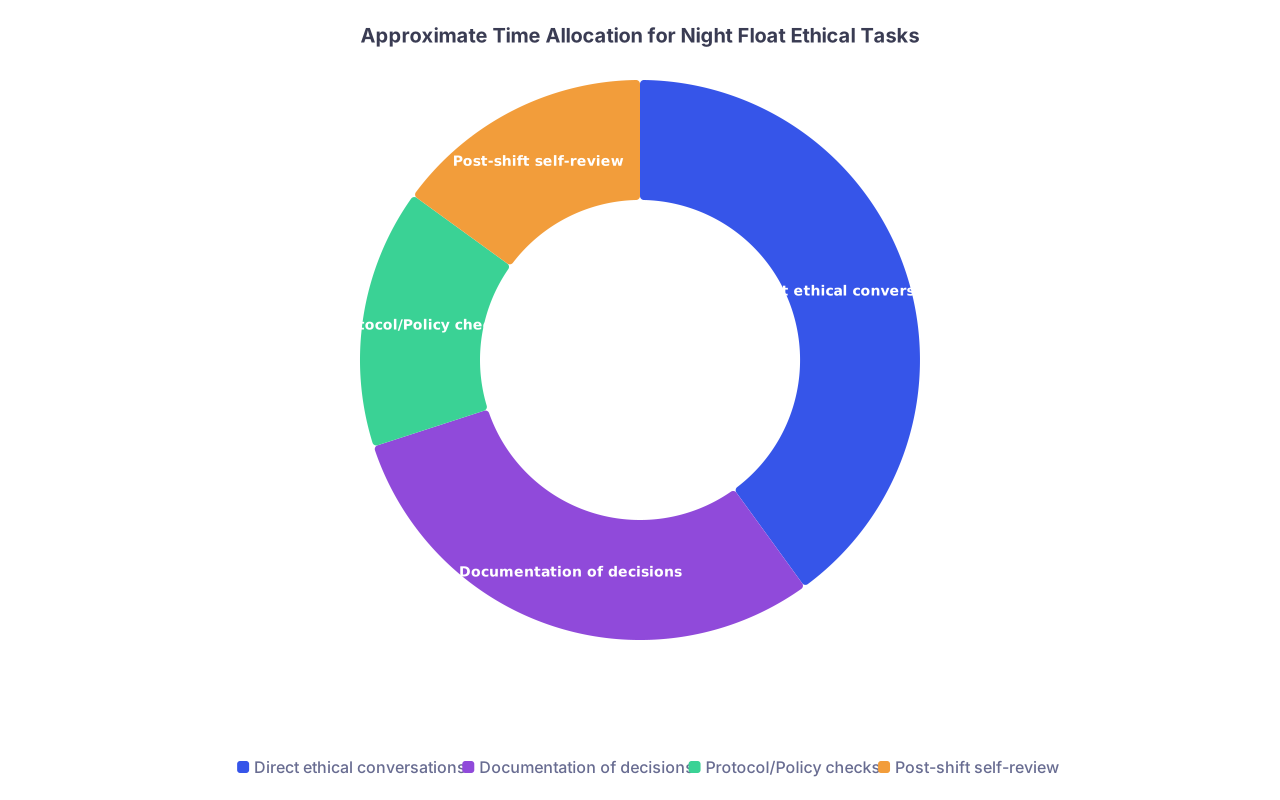
| Category | Value |
|---|---|
| Direct ethical conversations | 40 |
| Documentation of decisions | 30 |
| Protocol/Policy checks | 15 |
| Post-shift self-review | 15 |
That 10–15% of shift time spent on documentation and self-review is what protects you when things go badly.
Documentation: The 5 Elements You Should Hit
For high-risk events (AMA, restraints, code status, refusal of critical care), your note should include:
- Context – why you were called, what was happening.
- Assessment – medical and, when relevant, capacity and risk.
- Discussion – what you told the patient/family; risks and alternatives.
- Decision – what the patient/family decided, and your rationale for action.
- Consultation – which senior/attending or services you involved, even if by phone.
If a plaintiff’s attorney or risk manager reads your note 18 months later, they should understand:
You recognized the issue. You applied protocol. You did not act alone in a vacuum.
Weekly During Night Float: Course Corrections
If you are on for multiple weeks, you should not repeat the same ethical mistake on night 10 that you made on night 1.
Once per week (ideally post-call), take 20 minutes to:
- List 2–3 cases that felt ethically messy.
- Ask yourself:
- Where did I hesitate too long?
- Where did I avoid calling someone out of fear of “bothering” them?
- Where was my documentation weak or late?
Then, pick one behavior to change for the upcoming week. Not ten. One. Example:
- “This week, any AMA scenario gets documented before the end of shift, not ‘later.’”
- “This week, I will practice naming capacity vs convenience to myself every time someone wants to leave.”
That is how you actually improve, not just survive.
After You Finish Night Float: Debrief and Cement Lessons
Once the block is over, you should not immediately forget everything and move on.
Within 3–5 days:
Grab coffee with a trusted senior or attending.
- Walk through 1–2 of the hardest cases.
- Ask what they would have done differently.
- Get feedback on your thresholds for calling, documenting, and using restraints or security.
Update your personal playbook.
- Add 2–3 “lessons learned” to your night float file.
- Save de-identified skeletons of good notes you wrote as future templates.
Decide on one ethics topic to study deeper.
Maybe it is capacity, or end-of-life, or confidentiality and law enforcement. Pick one and read more than the minimum.
This is personal development, not just damage control. You are building the ethical spine of your future practice.
The Bottom Line
Night float will stress-test your ethics more than your differential diagnosis. The residents who do well are not smarter. They are the ones who did the groundwork:
- A month out, they knew the rules.
- Two weeks out, they knew the service-specific traps.
- A week out, they built scripts and templates.
- On nights, they used a deliberate routine instead of improvising every crisis.
Do not wait for your first 02:30 “patient wants to leave AMA, family is furious, nurse is overwhelmed” page to realize you needed a plan.
Action step: Before you do anything else, open your hospital intranet and locate three documents—code status policy, AMA policy, and restraints policy. Save them to a “Night Float” folder and skim the first and last page of each today.