
The worst residents to work with are the ones who never update how they talk about death.
The Annual Cycle: One Year of Keeping Your ACP Skills Sharp
You’re not going to “master” advance care planning (ACP) in one ethics lecture and a single goals‑of‑care note. ACP skills decay. Laws change. Your own comfort level shifts as you see more bad deaths and more good ones.
So treat ACP like a procedure. It needs:
- A yearly refresh
- Periodic drills
- Real‑time debriefs
Here’s a concrete, time‑structured plan you can repeat every academic year.
July–August: Baseline Reset and Legal Reality Check
At this point in the year you’re onboarding, adjusting to a new level of responsibility, and meeting new attendings. Perfect time for a reset.
Week 1–2: Quick Legal and Policy Update
Spend 60–90 minutes getting current. Not optional.
Confirm state law basics
Look up your hospital or GME’s “Advance Directives” or “Goals of Care” policy and your state legal guidance. Focus on:- Who can be a surrogate and in what order of priority
- Requirements for a valid advance directive
- State‑specific POLST/MOLST forms (if applicable)
- Capacity vs competence (your role vs the court’s)
- DNR/DNI vs “comfort measures only” vs “limited interventions”
Clarify your documentation responsibilities
Find and read:- The template for goals‑of‑care notes
- Code status documentation rules
- Where ACP documents live in the EHR (media tab? ACP tab? Scanned?)
You’re aiming for this standard: by the end of August, you should be able to find any patient’s signed ACP documents in under 60 seconds.
| Concept | Your Task Each Year |
|---|---|
| Surrogate hierarchy | Re‑confirm state‑specific order and exceptions |
| Advance directive rules | Review validity requirements and scope |
| POLST/MOLST | Check latest state form and indications |
| Code status definitions | Confirm local wording and order set options |
| Capacity assessment | Revisit institutional policy and tools |
Week 3–4: Self‑Assessment and Skill Targeting
Now you figure out where you actually suck.
Do a 10‑minute self‑audit: Rate yourself 1–5 (1 = awful, 5 = strong) on:
- Explaining code status in plain language
- Eliciting values (not just procedures)
- Handling conflict between family members
- Recognizing and documenting lack of capacity
- Knowing when to call ethics / palliative care
Anywhere you’re ≤3 becomes a deliberate focus for the year.
At this point you should:
- Know your state’s basic ACP laws cold
- Know exactly where to click in the EHR to find ACP docs
- Have 2–3 specific skills you’re targeting this year
September–October: Build Technique, Not Just Vocabulary
Now you move from “I know the terms” to “I can run the conversation without freezing.”
September: Structured Learning Sprints
Pick two 30–45 minute blocks this month. Treat them like procedures labs.
Sprint 1 – Conversation structure Review or create a simple framework you’ll actually use. For example:
- Opening: “I talk with all my patients about what matters to them if they get very sick…”
- Check understanding of illness
- Explore values: function, independence, suffering, family roles, longevity
- Make a recommendation tied to those values
- Summarize and confirm
Write your version out. Literally. Three to five bullet points on a personal “ACP cheat sheet” you can keep in your pocket or Notes app.
Sprint 2 – Language upgrades Replace bad phrases with better ones. For instance:
- Instead of “Do you want us to do everything?” →
“If your heart were to stop, would you want us to use chest compressions and life support machines, knowing they may not help you get back to the kind of life you’d want?” - Instead of “You’re a DNR, right?” →
“I want to revisit what we would do if your heart stopped or you stopped breathing, so our plan matches what matters most to you.”
Draft 5–10 go‑to sentences. You’ll use them daily.
- Instead of “Do you want us to do everything?” →
October: Practice on Real Encounters (With a System)
Now you attach practice to real work.
For the month of October, set a simple rule:
- Rule: On every admitting shift, pick one appropriate patient and do a 5–10 minute values‑focused ACP conversation (not just “what’s your code status?”).
After each:
- Jot 3 bullets:
- What worked
- What felt awkward
- What you want to say differently next time
This reflection should take under 2 minutes. If it’s longer, you won’t do it.
At this point you should:
- Have a repeatable script structure you can adapt
- Be using at least a few improved phrases daily
- Be doing intentional ACP practice with at least 1–2 patients per call or clinic session
November–December: Integrate Ethics and Handle the Hard Cases
By late fall, you’ve seen some mess: estranged families, unrealistic expectations, maybe outright legal threats. Time to sharpen the ethics side.
November: Tough Scenario Rehearsal
One evening or weekend this month, do a focused 45–60 minute session. Pull 3–4 cases from your recent rotations where ACP went sideways. For each, answer:
- What was the actual ethical tension?
(Autonomy vs best interest? Surrogate disagreement? Futility vs family demand?) - Where did you feel stuck?
- What would you try differently next time?
Then, rehearse out loud. Yes, out loud. Residents who only “think about” these lines never get smooth.
Practice things like:
- “Medically, this treatment will not help your father get back to any quality of life he would recognize. Continuing it would not be in line with what you told me matters to him.”
- “You’re asking for us to do something that we believe will cause him more suffering without benefit. Ethically and medically, that’s not something we can offer.”
December: Know When and How to Escalate
December is for accepting you’re not the ethics hero of the hospital. You need backup.
Clarify:
- How to page or refer to:
- Palliative care
- Ethics consultation
- Risk management (when legal threats appear)
- What triggers you personally will use to call them:
- Surrogates in open conflict
- Demands for clearly non‑beneficial care
- Suspected undue influence or abuse
- Confusion about who is the legal decision maker
Write yourself a one‑line rule:
- “If I have more than 2 family meetings about the same conflict with no movement, I loop in ethics/palliative.”
- Or whatever threshold makes sense at your institution.
At this point you should:
- Have practiced language for ethically messy conversations
- Know exactly how to activate ethics/palliative consultation without hesitation
- Have at least one senior/attending you trust to debrief hard ACP cases with
January–February: Documentation, Capacity, and Legal Precision
New year, same patient charts full of vague, useless notes. Fix that.
January: Documentation Boot Camp (1–2 Weeks)
For two weeks:
- Every day, pick one ACP or goals‑of‑care note and critique it.
Yours or someone else’s.
Ask:
- Does it clearly state:
- Who was present?
- What the patient’s understanding is?
- What their values are (in their own words if possible)?
- What specific decisions were made (or deferred)?
- The plan for revisiting?
Rewrite at least two of your own notes to a higher standard. You’re training your future self (and your colleagues) to understand what actually happened.
Aim for notes that read like this (stripped example):
“Pt states, ‘If I can’t recognize my family or do anything for myself, I don’t want to be kept alive on machines.’ We discussed that CPR and intubation are unlikely to return him to independent function if he has another major event. He prefers comfort‑focused care and would not want CPR or intubation. Code status updated to DNR/DNI, daughter Jane Doe listed as primary surrogate.”
Not:
“Discussed goals of care. Code status DNR/DNI.”
February: Capacity Assessment Refresh
ACP is meaningless if you misjudge capacity.
This month:
- Re‑read your institution’s policy on capacity
- Review a simple checklist or tool (e.g., understanding, appreciation, reasoning, ability to communicate a choice)
- Identify how your team documents capacity in ACP notes
Build yourself a 4‑question mental checklist:
- Can they state the problem in their own words?
- Can they recognize the likely outcomes of options?
- Can they compare options based on their values?
- Can they communicate a consistent choice?
If any of those fail, your ACP conversation shifts:
- Focus more on surrogate decision making
- Document your capacity concern explicitly
- Consider psych consult if there’s diagnostic uncertainty or reversible factors
At this point you should:
- Be writing ACP notes that future teams can actually use
- Be more deliberate and explicit in how you assess and document capacity
- Be more comfortable saying, “I do not think this patient has decision‑making capacity for this choice today, because…”
March–April: Teach, Lead, and Systematize
If you’re mid‑ or senior‑level, this is where you stop being the learner only and start enforcing better habits across your team.
March: Micro‑Teaching on Rounds
Pick one ACP micro‑topic per week to teach interns/med students for 3–5 minutes on rounds or at a break:
- Week 1: How to open a goals‑of‑care conversation without freaking everyone out
- Week 2: How to explain DNR/DNI without using jargon
- Week 3: How to document values, not just decisions
- Week 4: Basics of your state’s surrogate decision‑maker hierarchy
Use an actual patient on the list as an example. “For Mr X, here’s how I’d start that conversation…”
Why this matters: teaching forces you to clarify your own thinking and language. And frankly, it raises the floor for everyone.
April: Lead at Least One Family Meeting Properly
By this point in the year, you should deliberately volunteer to lead at least one structured family meeting focusing on ACP/goals of care, with an attending present.
Before the meeting:
- Draft a 3‑line agenda:
- “Review where things stand medically”
- “Understand what matters most to the patient”
- “Make a plan that fits those priorities”
During:
- Introduce everyone
- State the agenda out loud
- Use your practiced language and framework
- Summarize clearly at the end and assign who will document
After:
- Ask your attending for specific feedback:
- Clarity?
- Empathy?
- Time management?
- Ethical framing?
At this point you should:
- Be comfortable giving quick ACP teaching points to juniors
- Have run at least one formal family ACP meeting with supervision
- Be getting more intentional, targeted feedback on your communication style
May–June: Reflection, Metrics, and Next‑Year Upgrades
You’re closing out the year. This is where you stop and take stock rather than just rolling into the next PGY level exactly the same.
May: Personal ACP Audit
Set aside 30–45 minutes. Pull 5–10 charts from earlier in the year and 5–10 recent charts where you were involved in ACP or code‑status decisions.
Compare:
- Is your language clearer?
- Are values more explicitly documented?
- Are surrogates clearly identified?
- Did you more often call ethics/palliative when needed?
- Are there fewer vague “discussed GOC” notes and more concrete summaries?
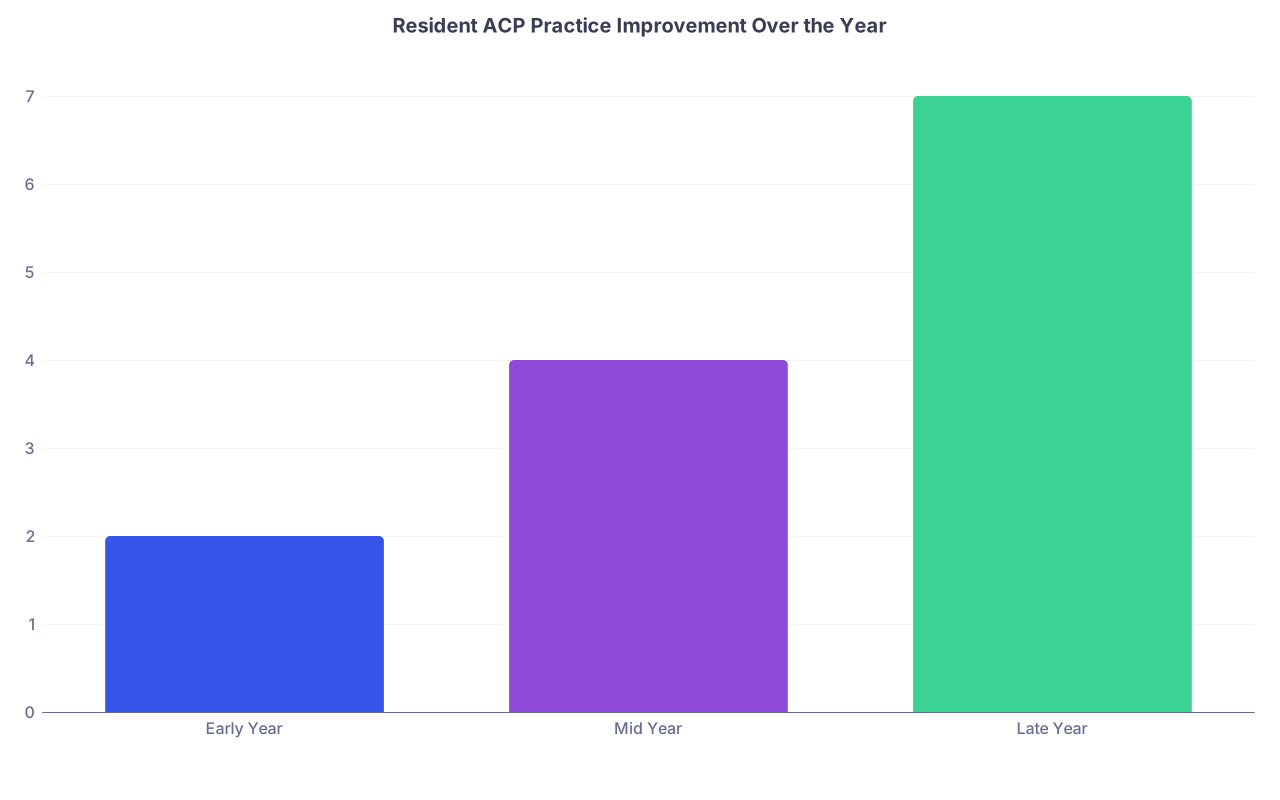
| Category | Value |
|---|---|
| Early Year | 2 |
| Mid Year | 4 |
| Late Year | 7 |
(Example: number of clearly documented value‑based ACP notes in 3 sampled periods.)
Extract 3 lessons:
- One communication habit you want to keep
- One documentation habit you want to keep
- One pattern you still dislike in your own charts or behavior
Write them down. Literally. This becomes your PGY‑to‑PGY handoff… to yourself.
June: Set Next‑Year Targets and Shore Up Gaps
By June you know what rotation is coming first next year (ICU, wards, clinic, etc.). Customize your ACP plan to that context.
Examples:
- Going into ICU:
- Target higher‑stakes family conferences, non‑beneficial treatment conversations, and explaining prognosis with uncertainty.
- Going into outpatient primary care:
- Focus on earlier ACP, chronic illness trajectories, advanced directives and POLST completion.
Take 20 minutes to define 2–3 concrete goals for next year:
- “Lead 3 ICU‑level family meetings with attending feedback”
- “Consistently screen for ACP on all new ≥65 year‑old clinic patients”
- “Present 1 brief teaching session on state ACP law for interns”
Capture them in a simple text file or note labeled:
“ACP Goals – PGY X”
At this point you should:
- Have a realistic picture of how your ACP skills changed this year
- Have 2–3 defined, written goals for next year tied to your rotations
- Feel less dread and more structure around these conversations
Daily and Weekly Micro‑Checks (All Year)
Sprinkled across the year, you keep skills from decaying with small habits.
Weekly: 10‑Minute ACP Review
Once a week, at a predictable time (end of call week, Friday afternoon, etc.):
Ask yourself:
- Did I avoid an ACP conversation I should’ve had?
- Did I have one that went especially well or badly?
- Did I document at least one patient’s values in their own words?
Pick one case and do a 3‑line mental or written debrief:
- What triggered the conversation?
- What I said that worked or didn’t
- One sentence I’ll use differently next time
Daily (or Almost Daily): Micro‑Behavior
On most inpatient days, aim for:
- 1 patient where you go beyond the yes/no code status checkbox
- 1 note where you add at least one direct quote about values
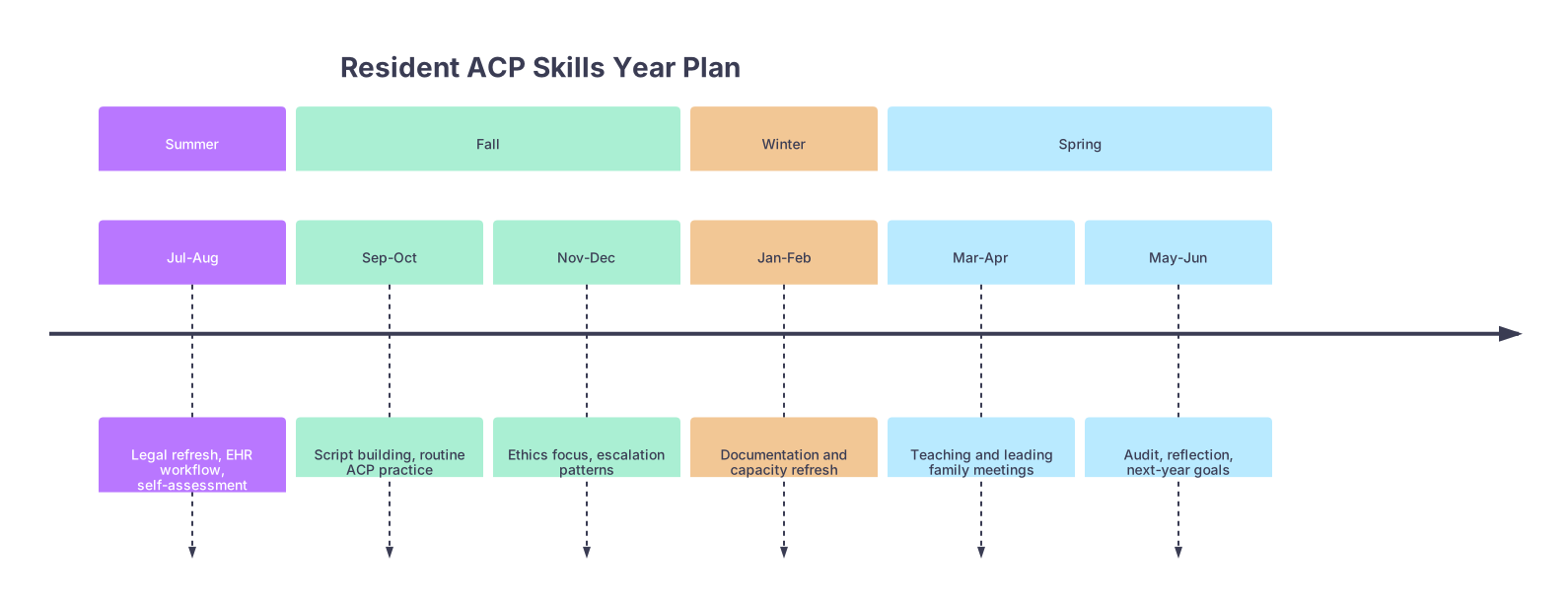
| Period | Event |
|---|---|
| Summer - Jul-Aug | Legal refresh, EHR workflow, self-assessment |
| Fall - Sep-Oct | Script building, routine ACP practice |
| Fall - Nov-Dec | Ethics focus, escalation patterns |
| Winter - Jan-Feb | Documentation and capacity refresh |
| Spring - Mar-Apr | Teaching and leading family meetings |
| Spring - May-Jun | Audit, reflection, next-year goals |
Over time, that becomes muscle memory.
Core Takeaways
- Treat advance care planning like a procedure: it needs yearly refresh, deliberate practice, and post‑case debriefs, not just “one good lecture.”
- Anchor your growth to the calendar: summer for legal and system basics, fall for scripts and reps, winter for documentation and capacity, spring for teaching and leadership.
- Measure your progress in specifics: clearer notes, faster access to ACP documents, more value‑based conversations, and better use of ethics and palliative resources when cases get hard.