

The moment your name hits Risk Management, you stop being “Doctor” and start being “Exposure.”
Let me be blunt: what you imagine happens when you’re “reported to Risk Management” is not what actually happens behind those doors. Colleagues picture some neutral, wise committee calmly reviewing facts and teaching you how to “do better next time.” That’s not the engine that’s running in the background.
Risk management exists to protect the institution first, insurers second, and only then—if there’s room left—the patient and the clinician. Not because they’re evil. Because that’s literally their job, their metrics, their mandate.
You need to understand that system if you want to survive it and keep your career intact.
What “Reported to Risk Management” Actually Means
When someone “reports you to Risk Management,” they’ve just changed the frame from clinical/educational to legal/financial.
Up to that point, it’s about:
- Did you make a mistake?
- How do we fix it?
- What do we teach you?
Once RM is involved, it’s also about:
- How much could this cost the hospital?
- What documents exist that could be discoverable?
- How do we limit downstream liability, reputational damage, and regulatory headaches?
I’ve watched this play out in real time:
- A PGY-2 in EM misses an early necrotizing fasciitis. Patient crashes 12 hours later on the floor. The initial conversation is morbidity and mortality, sepsis, “recognition of red flags.”
- The moment the family says, “We want to talk to a lawyer,” the tone shifts. The next day, Risk sends an email: “Please preserve all notes and communication related to this encounter. Do not modify any documentation. Direct any external inquiries to Legal.”
That’s the pivot point you never see written in policy manuals.
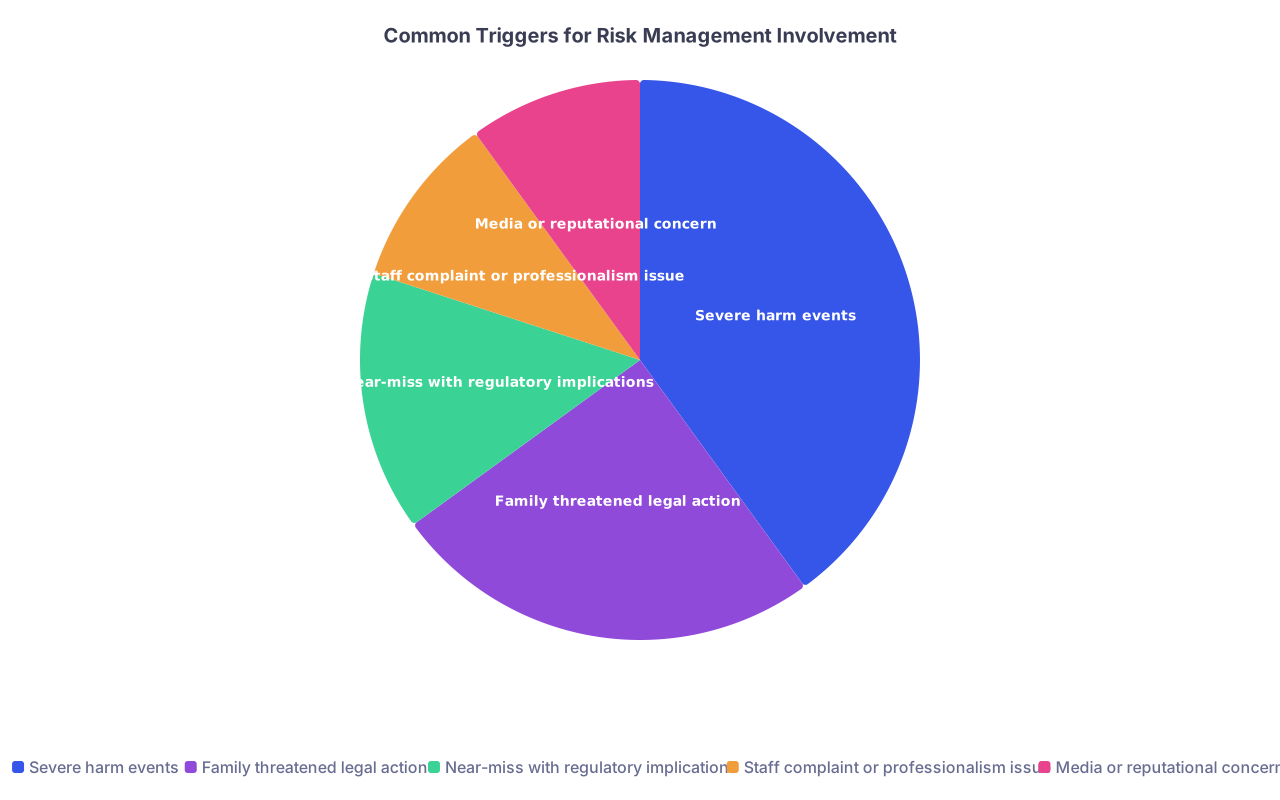
| Category | Value |
|---|---|
| Severe harm events | 40 |
| Family threatened legal action | 25 |
| Near-miss with regulatory implications | 15 |
| Staff complaint or professionalism issue | 10 |
| Media or reputational concern | 10 |
Being “reported” usually comes from one of four channels:
- A serious adverse event (death, permanent harm, wrong-site, med error).
- A family complaint that sounds even vaguely legal (“wrongful,” “negligent,” “lawyer,” “sue”).
- Another clinician or nurse files an incident or professionalism report naming you.
- Something catches admin’s eye—media risk, regulatory exposure, or multiple prior events with your name attached.
Your intent doesn’t control the downstream process. The optics and potential liability do.
Who Risk Management Really Works For
Let me strip away the slogans.
Risk Management answers to:
- The hospital C-suite.
- The malpractice carrier.
- Sometimes the system’s legal department.
They do not answer to GME. They do not answer to you. They are not your advocate. They are not your therapist. And they’re not the ethics committee, even though people mix them up in conversation.
Here’s the operating hierarchy during a serious event:
| Stakeholder | Primary Priority |
|---|---|
| Hospital C-suite | Financial and reputational |
| Risk Management | Limit liability exposure |
| Legal Department | Defensibility in court |
| GME/Program | Training, discipline |
| Clinician | Patient care, career |
| Patient/family | Outcome, truth, accountability |
I’ve sat in those rooms. The questions Risk Management actually asks in the first 24–48 hours:
- “Is this a reportable event to the state or The Joint Commission?”
- “Do we need an internal root cause analysis?”
- “What’s in the chart right now and does it help or hurt us?”
- “Who spoke to the family and what exactly was said?”
- “Has anyone apologized in a way that could be construed as admission of negligence under our state’s laws?”
Notice what’s missing? “How’s the resident coping?” That’s not on their primary checklist. If it happens, it’s because someone else pushes for it.
Step-by-Step: What Actually Happens After You’re Reported
Let’s walk through the real sequence. Not the sanitized version you get in orientation.
1. The Initial Flag
Something happens. The pager message. The code. The angry family at the nurses’ station saying, “We’re calling a lawyer.”
An incident report is filed in the hospital’s safety system. It might or might not mention you by name, but Risk can see which clinicians were involved.
If it hits certain keywords—death, wrong-site, delay in diagnosis, allegation of rudeness plus “lawyer”—the system auto-flags it. That’s how you land on their radar even before your attendings know the full story.
2. Quiet Chart Scrub
Before anyone calls you, risk or legal are already in the chart.
They look for:
- Timing: orders, notes, consults, pages.
- Internal consistency: does the story make sense across nursing, resident, attending notes?
- “Bad facts”: delays, ignored vitals, family complaints, disagreement documented in the record.
You won’t know they’ve been there. But your documentation from that point forward is being viewed like a potential exhibit, not just a clinical tool.
This is why every program director quietly tells residents, “Do not ever alter a note after an adverse outcome without talking to someone first.” Not because they want to micromanage your phrasing. Because edits and late entries are discoverable and look terrible if done sloppily.
3. The “We Just Want to Understand What Happened” Meeting
You’ll get an email or a call:
“Hi Dr. X, this is [Name] from Risk Management. We’d like to briefly review an event you were involved in so we can understand what happened and improve our processes.”
That line—“improve our processes”—is doing a lot of work.
Let me be direct:
That meeting is not primarily for your development. It’s for fact-finding and liability assessment.
Who’s typically in the room:
- A risk manager (often a nurse or JD or both).
- Sometimes in-house counsel or someone “from Legal.”
- Maybe your division chief or medical director.
- Very occasionally, your PD or APD.
They’re watching:
- Do you sound credible?
- Are you consistent with the chart?
- Do you spontaneously admit “fault” or “mistake” in legal language?
- Do you throw anyone else under the bus in a way that complicates institutional defense?
You should answer honestly, clinically, and factually. This isn’t the time for self-flagellation or for speculating about “system failures” if you don’t understand the legal implications of those words.
Documentation: The Part No One Teaches You Properly
Here’s the behind-the-scenes truth: your note is half medical, half legal artifact. Attendings know it. Risk knows it. Residents pretend it isn’t true because it’s uncomfortable.
After a bad outcome, there’s a temptation to:
- Add a “clarifying” late entry that magically covers every gap.
- Retroactively “remember” warnings you gave the patient that you never documented.
- Delete or significantly rewrite a note.
Do that wrong and you go from “honest clinician with a complication” to “credibility problem” in about five seconds.
If there’s a legitimate need for a late entry—say, to document a phone call or a detail you forgot—the safer pattern is:
“Late entry: On [date/time], I spoke with the patient’s daughter by phone and discussed…”
That’s different from rewriting history.
I’ve seen risk managers sit in a defense strategy meeting with printouts showing that a resident opened a note three days later and changed wording from “mild abdominal pain” to “severe acute abdomen advised immediate CT, patient refused.” That resident became a liability witness, not a defense asset.
How Risk Management Talks About You When You’re Not in the Room
Here’s the part residents never get to hear.
When a case looks like it might go legal, there’s an internal stratification:
- “Good witness, helps us.”
- “Neutral witness.”
- “Problematic witness, could be thrown under the bus if pressed.”
What pushes you into that third bucket?
- Inconsistent charting.
- Multiple prior complaints involving you.
- Emotional, rambling, or defensive communication with the family.
- Obvious boundary or professionalism issues.
I’ve heard versions of this in closed-door meetings:
“Dr. R is a PGY-3, sharp, chart is clean, comes across as thoughtful. We’ll put them in front of a jury if we have to.”
Versus:
“Dr. S has three prior complaints, one about rudeness, one about ‘not listening.’ Charting is thin. If we can blame this on them and keep the attending and hospital clean, that might actually be good for us.”
They won’t use the word “blame,” but that’s the underlying dynamic. Institutions are far more willing to sacrifice a trainee or a marginal locums doc than a high-revenue attending or the hospital itself.
Do not assume you and the hospital are perfectly aligned in every scenario. Often you are. Sometimes you really are not.
Interaction With Your Program: The Other Half of the Story
While Risk is doing its analysis, your program and GME are doing theirs.
Your PD is asking:
- Is this a competence issue?
- Is this a professionalism pattern?
- Do I need to document remediation to protect our program if this resident gets reported later?
Programs live in two worlds: educational and regulatory. If Risk flags your case as concerning, they may quietly nudge your PD: “We want to be sure this resident is getting additional supervision.”
Translation: “If this blows up again, we want paperwork that shows we ‘managed the risk.’”
That can mean:
- Extra evaluation forms.
- “Focused Professional Practice Evaluation” (FPPE) labels.
- Remediation plans explicitly mentioning the event.
You might be given the “this is just to help you grow” speech. Sometimes that’s true. Sometimes it’s also about building a defensive paper trail for the institution.

| Step | Description |
|---|---|
| Step 1 | Adverse event |
| Step 2 | Incident report filed |
| Step 3 | Risk reviews chart |
| Step 4 | Risk and Legal strategy |
| Step 5 | Local follow up only |
| Step 6 | Notify leadership |
| Step 7 | PD and GME looped in |
| Step 8 | Resident meeting |
| Step 9 | Remediation or extra supervision |
| Step 10 | Documented coaching |
| Step 11 | Legal concern? |
| Step 12 | Competence concern? |
What You Should and Should Not Do Once Risk Is Involved
No drama, just tactics. Here’s the reality-based approach.
You should:
- Loop in your attending immediately if they’re not already aware.
- Tell your PD or APD there’s a Risk Management matter involving you. Short, factual.
- Stick to facts in every written and verbal statement. No speculating, no reinventing.
- Ask directly (and calmly) in any Risk meeting: “Is there anything you recommend I change about my future documentation or communication in cases like this?” It signals teachability, not guilt.
You should not:
- Vent in the chart. Ever. Sarcasm, frustration, blame of other services—massive own goals in court.
- Email detailed case analysis using hospital email that looks like self-criticism without legal privilege. Plaintiff attorneys love those.
- Talk about the case in detail with random co-residents in public areas. Hallway gossip gets repeated—sometimes in depositions.
If the situation is serious—death, permanent harm, clear error—it’s not overkill to talk to your own malpractice carrier or physician support line. Many residents do not realize: you often have personal coverage or can access defense counsel through the institution’s policy. There are conversations that are privileged with personal counsel that are not privileged with Risk.
Ethics vs. Risk: The Collision You Will Feel
Here’s the real tension: your ethical duty and the institution’s risk strategy do not always line up neatly.
Ethically, good physicians:
- Acknowledge mistakes.
- Apologize sincerely.
- Are transparent about what happened, within their knowledge.
Risk Management, depending on your state’s “apology laws” and legal climate, may strongly discourage certain types of statements:
- “I was negligent.”
- “This is my fault.”
- “We definitely caused this outcome.”
They’re not trying to make you a liar. They’re trying to avoid you handing the plaintiff a golden ticket.
There are ways to be honest and humane without sinking the defense. For example:
- “I’m very sorry for the outcome and what your family is going through.”
- “Here’s what we know so far, and here are the steps we’re taking to review what happened.”
- “I wish the outcome had been different. I care about what happened to your father.”
That’s very different from: “I misread the CT and that directly caused his death.” That second sentence, in many jurisdictions, will show up in bold on the first page of a complaint.

When there’s a true error, the best approach is coordinated: involve your attending, sometimes an institutional disclosure specialist, and yes, Risk. Not to water down the truth, but to give the family honesty in a way that doesn’t recklessly blow up everyone’s ability to defend themselves if they later claim facts that aren’t accurate.
The Emotional Aftermath No One Prepares You For
You’ll hear a lot about “second victim syndrome” in wellness lectures. Here’s what it looks like unfiltered when Risk gets involved:
- You become paranoid about every chart.
- You have flashbacks whenever a similar chief complaint shows up.
- You dread checking your email or getting a call from an unknown internal number.
- You start practicing defensively in unhealthy ways—unnecessary tests, consults just to “share the risk.”
Some places are decent about this. They’ll quietly connect you with a peer support program, faculty mentor, or counseling. Others…will act like you’re a contaminated object and avoid you for a while.
You have to protect your own long game here:
- Get someone outside the direct chain of command to debrief with—faculty you trust, a mentor at another institution, a therapist.
- Separate “I made an error” from “I am a bad physician.” Hospitals are full of good physicians who made exactly one error that changed everything.
- Notice if you’re swinging to extreme defensive medicine. Patients get harmed by that too.
How Often This Actually Ends Careers
You want the honest statistics, not the horror stories.
Most single events that go to Risk:
- Never become lawsuits.
- Never hit the National Practitioner Data Bank (NPDB).
- Become “that bad night I still think about” but not “the reason I can’t get a job.”
Patterns are what kill careers. Repeated events, repeated complaints, no insight, bad behavior when under scrutiny.
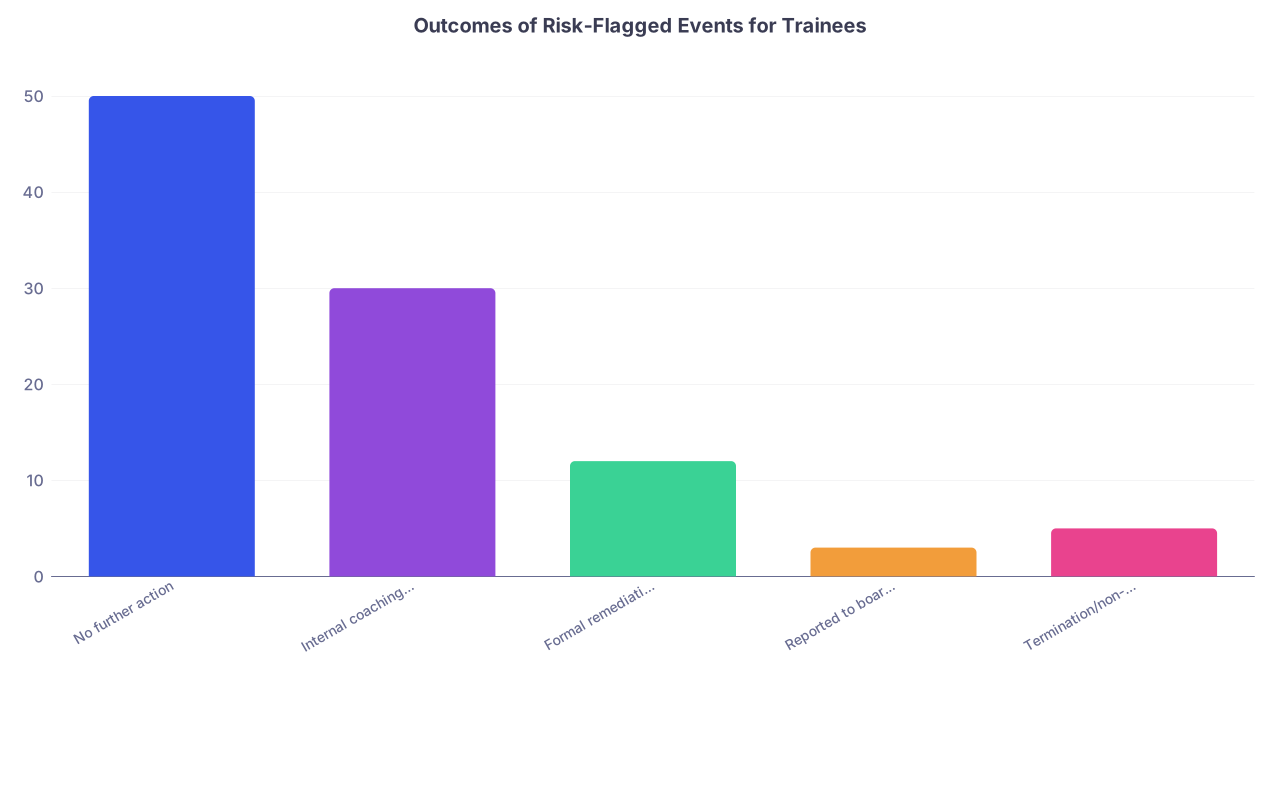
| Category | Value |
|---|---|
| No further action | 50 |
| Internal coaching only | 30 |
| Formal remediation | 12 |
| Reported to board/NPDB | 3 |
| Termination/non-renewal | 5 |
What program directors actually worry about isn’t “one resident had a bad night.” It’s:
- “This is the third time we’ve had a serious concern with them.”
- “They reacted defensively and blamed everyone else.”
- “They didn’t change their practice at all.”
If you show insight, accept coaching, and stabilize your behavior, most PDs will go to bat for you even if Risk was involved once. They’ve all been in some version of your shoes.
How to Protect Your Future Self Without Becoming Paranoid
If you want a simple framework to act on when the words “Risk Management” enter your world, make it this:
Pause and document cleanly.
Finish your note with facts, not feelings. No backdating. No fairy tales.Loop in your people.
Attending. PD or APD. Maybe chief. Do not surprise them later.Treat every conversation as if it might appear in a transcript someday.
Not with fear, just with discipline.Learn from the event on two tracks.
- Clinical: what would I do differently medically?
- Structural: how will I document, communicate, and escalate differently?
Refuse to become either victim or martyr.
You’re neither the helpless pawn of Risk Management nor the lone hero who must confess to everything in melodramatic fashion. You’re a professional learning to operate in a system that has legal and ethical layers.

FAQ: What Really Happens When You’re Reported to Risk Management
1. Does being reported to Risk Management automatically mean I’ll be sued or reported to the board?
No. Most Risk Management referrals never become lawsuits or board actions. They’re triage and damage control operations. A small percentage of events escalate to formal claims. Even fewer lead to board reports or NPDB entries. The presence of Risk means “there is perceived exposure,” not “your career is over.”
2. Should I get my own lawyer if Risk wants to talk to me?
If the event involves death, permanent harm, or obvious error, at least know your options. In many hospitals, your interests and the institution’s line up well enough that shared defense is fine. But if you feel you’re being positioned as the lone problem, or there are hints you’ll be “separated” over this, talking confidentially with counsel—often accessible through your malpractice carrier—makes sense. Do that before you start sending self-incriminating emails.
3. Can I be punished for being honest about a mistake?
You can be held accountable for errors; that’s different from being punished for honesty. Institutions actually defend honest, credible clinicians better than evasive ones. The problem isn’t admitting a complication. It’s admitting negligence in sloppy language, speculating wildly, or changing your story. The smart move is: be truthful, precise, and coordinated with your attending and, if indicated, legal.
4. Will this follow me to future jobs and credentialing?
A single Risk Management review rarely shows up explicitly in credentialing unless it led to formal action: suspension, termination, board report, or NPDB entry. However, if the event triggered formal remediation, FPPE, or non-renewal, those often require disclosure on privileging and licensure applications. That’s when phrasing matters—your PD’s letter and your own explanation can frame this as “a serious event I learned from” rather than “ongoing safety concern.”
5. What’s the one thing you’d tell a resident the day they find out Risk is involved?
Do not panic and do not isolate. Tell your attending, tell your PD, and then approach it like a professional: get clear on the facts, document cleanly, show up prepared and calm to any meeting, and quietly start working on how this will change your practice for the better. If you handle it well, this becomes a painful but finite chapter, not the headline of your career.
With this lens, Risk Management stops being a mysterious black box and starts being exactly what it is: a powerful institutional machine you have to understand to avoid getting crushed by it. Learn how it works now, and you’ll be far better prepared for the next hard case that lands in your lap. The day you sit in front of a credentialing committee or a fellowship director and they ask, “Tell me about a time you faced a serious adverse event,” you’ll have an answer that shows not just survival—but growth. The interview trail and promotion committees come later. But how you handle this moment sets the foundation for all of that.


